


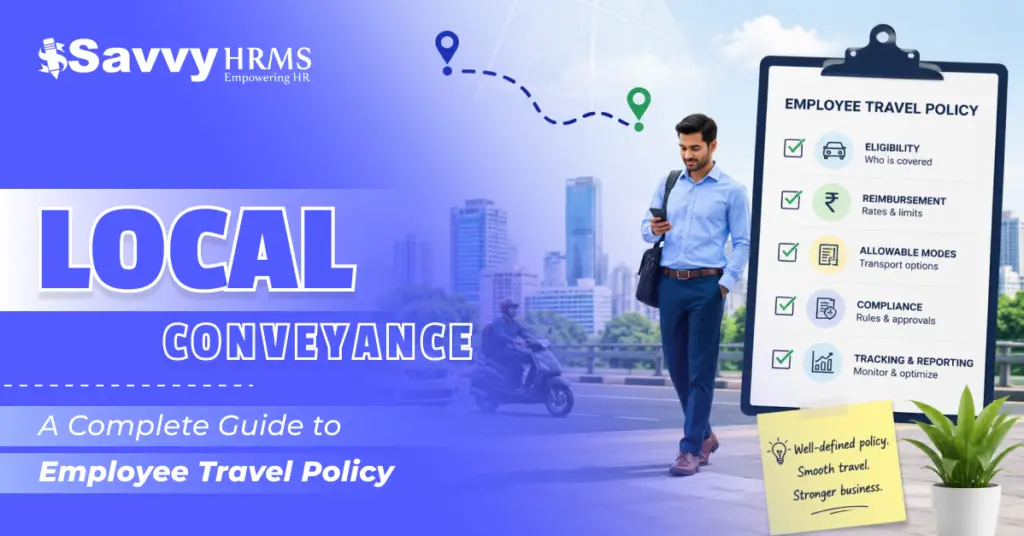

Have you ever found yourself stepping out of your office premises to meet a client and then wondered whether you will be eligible to get the costs incurred from traveling back and forth compensated? This situation occurs more frequently than one might think. In most cases, an employee’s daily operations involve short trips that require some financial costs.
In such instances, local conveyance comes into play. A clear and structured policy helps ensure that employees are not required to bear the cost of local travel for official purposes. The policy also makes it easier for managers to authorize the requests and for HR to handle the reimbursements.
The absence of a proper policy could create room for chaos. What kinds of travel qualify? Which do not qualify? Are there limits to the compensation amount? Who authorizes such requests?
These are some of the questions that arise when there are no specific policies to address them. With a detailed local conveyance policy, however, there is clarity in all matters relating to employee transport expenses.
This guide offers insights into everything one needs to know regarding the definition of local conveyance, its benefits, and how to develop an effective policy.
What is Local Conveyance?
Local Conveyance is the expense supported by an employee for local or short-distance travel related to their job within the city or local area. Local Conveyance is different from long-distance travel (which involves flights and stays in a business hotel), as local conveyance only involves short-distance or local travel required for work purposes.
Local Conveyance Travel usually includes:
- Meeting clients within the city
- Going out of the office premises for meetings
- Official duties travel
- Office branches travel
In the case of Local Conveyance, the mode of travel can range widely based on organization’s policy and employees’ personal preferences. The common modes of travel involved in local conveyance include:
- Auto rickshaw/Taxi
- Cab (Uber/Ola)
- Local bus/trains/Metro services
- Personal vehicle (Fuel compensation in case of personal vehicle)
From a Policy standpoint, the concept of Local Conveyance Policy involves compensation of employees for the expenses involved in travel for job purposes, thereby relieving the employee of such personal expenses.
Local Conveyance Policy involves the following details:
- Travel eligible for local conveyance
- Modes of transport acceptable for local conveyance
- Any maximum limit, if any
- Relevant documents required for proof (invoiced receipt/bill)
- Process approval workflow, including the employee and the manager
Without a proper approach, these small expenses can quickly become difficult to track, approve, and manage.
When is Local Conveyance Applicable?
It is necessary to understand whether a particular mode of transport can be considered a local conveyance or not for employees and the HR team alike. Every out-of-office travel does not necessarily amount to local conveyance and should have some connection with business activities.
The following are some instances where reimbursement can be claimed for local conveyance:
1. Client Meetings
Local conveyance can include travel costs involved while traveling locally to visit any client, partner, or vendor. This includes meetings that usually receive prior approval from the manager.
2. Inter-Office Travel
Employees belonging to organizations with various branches in one city travel between branches quite frequently. Their expenses can be reimbursed under the local travel policy of the company.
3. Field Work
For salespeople and service engineers, travel to different places within a local area is a frequent occurrence due to the nature of their job. Such travel can be considered as local conveyance.
4. Official Trips
Official trips, such as those made to government offices or banks, can also be reimbursed as local conveyance.
5. Training or Workshops
When employees attend training sessions or workshops within the city, conveyance reimbursement may apply depending on company policy.
When It May Not Apply?
An effective policy statement also identifies exemptions. For example,
- Regular commute between home and workplace (unless specified)
- A combination of personal and business travel
- Unauthorized or undocumented travel
Here comes the importance of a manager’s job: approving valid claims while adhering to company policies.
Why Local Conveyance is an Important Part for HR?
Although local conveyance may appear insignificant at first sight, it is an important part of the workflow that should be considered by HR and finance specialists.
1. Ensures Fair Reimbursement
HR and finance experts must ensure that their employees are reimbursed fairly. Without any guidelines, employees’ reimbursements might become irregular.
2. Improves Employee Experience
Employees will feel more comfortable when they have clear information about how to claim travel costs, required documents, and the reimbursement timeframe. This will also make them more willing to submit their reimbursement claims.
3. Controls Costs
Even the smallest expenses related to local business travel might add up over time. HR teams leverage the framework of a local conveyance policy to control:
- The maximum amount of reimbursement
- Accepted travel modes
- Excessive spending
4. Reduces Manual Work
Without a well-defined framework, HR specialists will face several challenges when processing conveyance claims manually. These include managing:
- Paper-based receipts
- Approvals via email
- Manually calculated reimbursements
5. Maintains Compliance and Audit Readiness
Any organization should ensure that its financial transactions are documented and compliant. Local conveyance policies assist with:
- Keeping accurate records
- Approval workflows
- Audit trails
Growing organizations need to pay particular attention to these elements.
6. Strengthens Manager Accountability
Managers are essential in the process of claim approval. With an effective policy, managers will be able to:
- Confirm the necessity of travel
- Approve only legitimate claims
- Deny invalid claims
This will result in a balance of interests between employees and the organization.
What Is a Sample Policy and How Does It Work?
The sample conveyance policy is used as a guideline for the organization in determining its local travel reimbursement policies. It provides guidelines on how local travel reimbursement can be done from approval to qualification.
In general, what does a sample policy look like?
1. Objective of the Policy
The document usually starts with the purpose of its formulation:
To set forward policies regarding local conveyance reimbursement for employees traveling on official business.
2. Scope and Qualification
The scope explains when the policy applies. For example:
All employees traveling on business purposes within the city are qualified for local conveyance reimbursement.
3. Approved Travel Mode
It outlines the modes of transport that employees can use for local travel, such as:
- Public transport
- App-based cab service
- Personal vehicle (fuel limit specified)
Many organizations will provide cost-efficient transport options.
4. Reimbursement Guidelines
It gives instructions on what constitutes local conveyance reimbursement, including:
- Daily or trip limits
- Reimbursement rates (e.g., per km)
- Criteria for bills submission
For example:
Employees must submit valid receipts for reimbursement claims exceeding a certain amount.
5. Process of Claims Submission
There is an organized procedure for submitting a local conveyance claim. Usually:
- The employee submits the claims form
- Attach receipts and documents
- Fill in all relevant information (e.g., purpose, date, destination)
Clear guidelines help employees avoid errors and delays.
6. Approval Workflow
Once submitted, the manager will:
- Examine the claim
- Establish its business purpose
- Approve or disapprove according to company policy
This step ensures accountability and prevents misuse.
7. Time Frame for Reimbursement
Employees should have an idea when they will get paid. Policies should state:
- Timeline for processing reimbursement
- Frequency for making payments
For example:
Reimbursed claims will be paid back within 7 – 10 working days.
8. Exceptions and Special Cases
Policies should allow flexibility for:
- Urgent travel
- High-cost situations
- Special approvals
This makes sure the policy remains practical while still maintaining control.
9. Documentation and Records Keeping
Record-keeping is important in audits. Policies should ensure:
- Proper preservation of documents
- Claim filing in the computer
- Access to the HR and Finance departments
How does it work in Practice?
Here’s a simple flow:
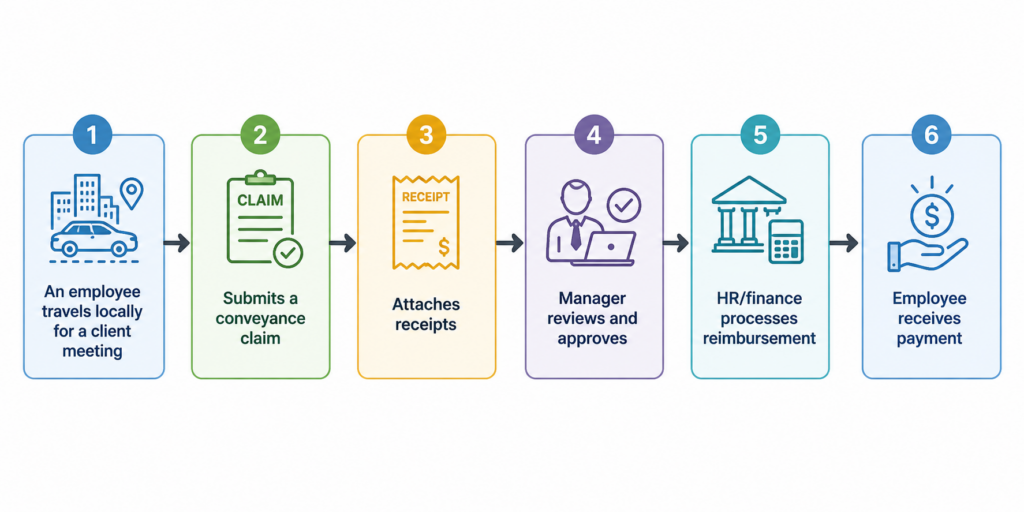
When this process is backed by a clear local conveyance policy, everything becomes smoother, faster, and more transparent.
Conclusion
There is no need for things to be complex with local conveyance management. Through proper policy, organizations can design an effective approach that will not only benefit their employees but also the HR department as well.
However, as organizations grow bigger in size and scope, manual approaches to dealing with issues such as employee travel, approval, and reimbursements can become difficult.
This is when effective HRMS can come into play.
Through Savvy HRMS, organizations can effectively manage all the processes related to local conveyance from claim filing and manager approval to automatic reimbursement monitoring.
Ready to simplify your local conveyance policy and reimbursement process?
Explore Savvy HRMS today and take the next step toward smarter HR management.
Book a Demo Today