

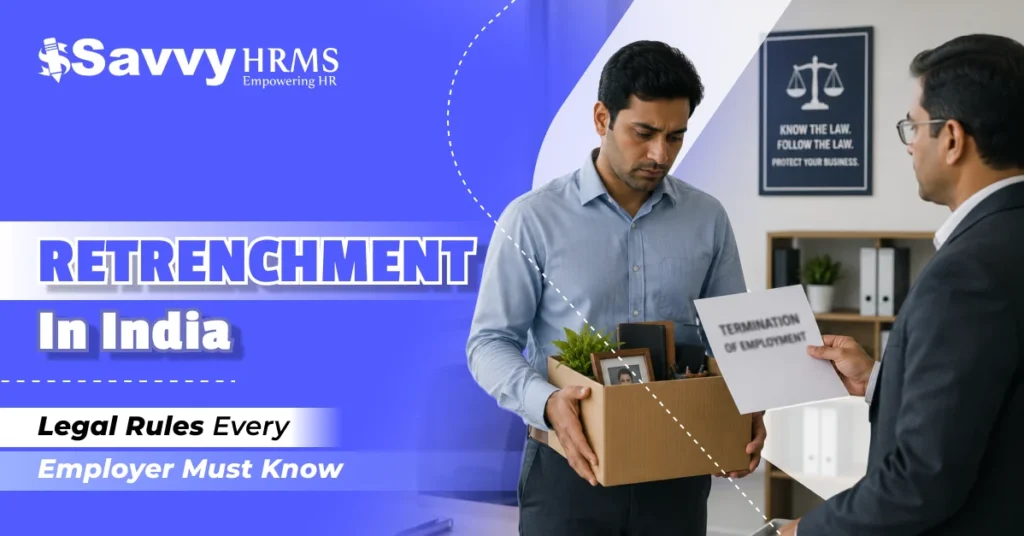
Retrenchment in India: Legal Rules Every Employer Must Know


-
AuthorRuchika Rajput
-
 Last Updated
June 29, 2026
Last Updated
June 29, 2026
-
 Reading Time
11 Mins
Reading Time
11 Mins
Employee rebuilding is one of the most sensitive challenges any organization can face. Whether due to economic slowdown, automation, combiner, or business rebuilding, companies sometimes need to reduce workforce strength. In India, this process is legally known as retrenchment.
Understanding retrenchment in labour law is important for employers, HR professionals, and employees alike. Improper retrenchment can result in legal issues, financial penalties, and reputational damage. At the same time, employees must know their rights, benefits, and compensation rights during retrenchment.
In this blog, we will explain the retrenchment meaning, legal provisions, employee rights, and the proper retrenchment process in India.
What is Retrenchment?
The retrenchment definition under Indian labour law refers to the termination of an employee by an employer for some specific reasons other than disciplinary action.
In simple terms, retrenchment of employees meaning is reducing staff because the organization no longer requires certain positions or services. This may happen due to financial losses, rebuilding, technological changes, or business closure.
According to the Industrial Disputes Act, 1947, retrenchment under the Industrial Disputes Act excludes:
- Voluntary retirement
- Retirement on reaching pension age
- Termination due to misconduct
- Contract expiry
- Continued ill health
So, if a company removes employees because it needs to cut costs or reorganize operations, it is considered retrenchment in labour law.
Retrenchment Meaning in Labour Law
The retrenchment meaning in labour law focuses on protecting employees from flexible job loss. Indian labour laws require employers to follow due process, provide notice, and pay compensation before retrenching employees.
This is why understanding what retrenchment in labour law is is extremely important for organizations.
Types of Retrenchment
There are various forms of retrenchment depending on the reason behind workforce reduction.
1. Economic Retrenchment
Economic retrenchment occurs when companies reduce employees due to financial losses, reduced profits, market slowdown, or declining customer demand.
Example:
A manufacturing company retrenches 50 factory workers after facing continuous losses and declining product sales for several months.
2. Technological Retrenchment
Technological retrenchment occurs when automation, artificial intelligence, or digital tools replace manual work and reduce workforce requirements significantly.
Example:
A company implements AI-powered payroll software and reduces the number of manual payroll processing staff because fewer employees are needed.
3. Strategic Retrenchment
Strategic retrenchment is a planned workforce reduction during mergers, rebuilding, takeovers, or business transformations to improve operational efficiency.
Example:
After merging with another company, a business removes duplicate managerial positions to reduce operational costs and improve efficiency.
4. Operational Retrenchment
Operational retrenchment happens when companies close departments, branches, projects, or unprofitable branches to manage expenses and improve productivity.
Example:
A retail company shuts down underperforming stores in different cities and retrenches employees working in those locations.
5. Partial Retrenchment
Partial retrenchment affects only specific employees, teams, or departments instead of reducing the entire workforce within an organization.
Example:
An IT company retrenches employees from its support department while keeping technical and development teams completely unaffected.
What is considered to be a fair procedure for retrenchment?
A fair retrenchment process is one that follows legal compliance, transparency, and ethical treatment of employees.
Employers should:
1. Provide Written Notice
Employers must provide employees with written notice before retrenchment, informing them about termination timelines, reasons, and important employment-related details clearly and professionally.
2. Clearly Explain the Reason for Retrenchment
Organizations should transparently explain the company’s reasons behind retrenchment, helping employees understand the situation while reducing confusion, uncertainty, and potential workplace dissatisfaction.
3. Follow “Last In, First Out” (LIFO) Principles Where Applicable
Employers should generally follow the Last In, First Out principle, retrenching recently hired employees first unless valid business reasons justify exceptions.
4. Pay Statutory Compensation
Companies must provide statutory retrenchment compensation as required under labour laws, ensuring employees receive fair financial support during their employment transformation period.
5. Maintain Proper Documentation
Proper documentation of notices, compensation records, employee communication, and retrenchment procedures helps employers maintain legal compliance and avoid future issues effectively.
6. Communicate Respectfully with Employees
Respectful communication during retrenchment helps preserve employee dignity, maintain workplace morale, and protect the organization’s professional reputation and employer brand successfully.
Under Indian law, retrenchment without following due procedure can be declared illegal.
A fair process also includes giving employees time to prepare for the transition and offering support wherever possible.
How does retrenchment differ from termination?
Many people confuse retrenchment with termination, but both are different.
| Basis | Retrenchment | Termination |
| Reason | Business-related | Employee-related or contractual |
| Cause | Cost-cutting, restructuring | Misconduct, poor performance |
| Compensation | Mandatory | Depends on circumstances |
| Legal Protection | Strong labour law protection | Varies |
| Employee Fault | No | Usually yes |
Similarly, people often compare layoff vs retrenchment.
Retrenchment vs Layoff
The debate around retrenchment vs layoff is common in labour law.
Here’s the difference:
| Layoff | Retrenchment |
| Temporary inability to provide work | Permanent workforce reduction |
| Employees may return | Employment ends |
| Caused by temporary issues | Caused by rebuilding |
| Short-term | Long-term |
Understanding retrenchment and layoff differences helps employers choose the right legal process.
What are the rights of employees during retrenchment?
Employees have various statutory rights during retrenchment.
1. Notice Period
Employees are legally permitted to receive one month’s written notice or salary instead of notice before retrenchment, ensuring sufficient time for adjustment and preparation.
2. Retrenchment Compensation
Employees completing at least one year of continuous service are eligible for retrenchment compensation under labour laws, providing financial assistance after employment termination.
Many people are often confused about the actual meaning and purpose of retrenchment compensation.
The retrenchment compensation refers to the financial payment made to employees whose services are terminated due to retrenchment.
What is Retrenchment Compensation?
If you are wondering what retrenchment compensation is, it is compensation equal to:
- 15 days’ average pay for every completed year of continuous service
This amount must be paid before retrenchment becomes effective.
What are the Benefits of Retrenchment?
Apart from compensation, employees may also receive:
1. Gratuity
Eligible employees receive gratuity payments based on their years of service, helping provide financial security and support after retrenchment or employment separation.
2. Leave Encashment
Employees are qualified to receive payment for unused earned leave collected during employment, ensuring pending leave balances are financially compensated properly.
3. Bonus Dues
Any pending statutory or performance-related bonus amounts must be cleared by employers during final settlement after the retrenchment of employees from the organization.
4. Provident Fund Settlement
Employees can withdraw or transfer their Provident Fund balance after retrenchment, providing important financial support during unemployment or career transition periods.
5. Insurance Benefits
Certain organizations continue insurance coverage temporarily after retrenchment, helping employees manage medical expenses and maintain financial protection during uncertain situations.
How to Handle Retrenchment Effectively?
Handling retrenchment poorly can damage employee morale and employer reputation. Organizations should focus on empathy, transparency, and compliance.
1. Plan Carefully
Employers should carefully evaluate business needs before implementing retrenchment, ensuring workforce reduction is genuinely necessary and strategically justified.
2. Communicate Transparently
Transparent communication helps employees understand retrenchment reasons clearly, reducing confusion, workplace rumors, anxiety, and misunderstandings during difficult organizational changes.
3. Follow Legal Procedures
Employers must comply with retrenchment laws carefully, as legal violations may result in issues, penalties, compensation claims, or litigation proceedings.
4. Provide Emotional Support
Retrenchment can emotionally affect employees, making counseling, career guidance, and outplacement support important during the workforce transition process.
5. Protect Employer Branding
Respectful retrenchment practices help organizations maintain positive employer branding, employee trust, and professional reputation among current and future job seekers.
Alternatives to Retrenchment
Before choosing retrenchment, employers should explore alternative solutions.
1. Reduced Working Hours
Companies may temporarily reduce employee working hours to control operational costs while avoiding permanent workforce reduction or retrenchment situations.
2. Salary Adjustments
Temporary salary adjustments help organizations manage financial challenges effectively while reducing layoffs and maintaining overall workforce stability during crises.
3. Redeployment
Employers can transfer employees to different departments or roles instead of retrenching staff during organizational restructuring or operational changes.
4. Voluntary Retirement Scheme (VRS)
Organizations may introduce voluntary retirement schemes, encouraging employees to resign willingly in exchange for attractive financial compensation packages.
5. Hiring Freeze
Implementing a hiring process helps companies reduce expenses gradually by stopping new recruitment instead of terminating existing employees immediately.
Retrenchment under Indian Labour Law
In India, retrenchment is mainly governed by the Industrial Disputes Act, 1947.
The law defines:
- Conditions for retrenchment
- Employee rights
- Compensation requirements
- Employer obligations
Key Conditions for Legal Retrenchment
For a valid retrenchment under the Industrial Dispute Act, employers must:
- Provide one month’s notice
- Pay retrenchment compensation
- Notify government authorities where required
Companies with 100 or more employees may require prior government permission before retrenchment.
This legal framework ensures fairness and protects employees from flexible dismissal.
Retrenchment Act: Key Legal Provisions
Some provisions under the Industrial Disputes Act regulate retrenchment.
1. Section 2(oo)
Section 2(oo) of the Industrial Disputes Act provides the legal definition of retrenchment and explains the circumstances excluded from retrenchment provisions.
2. Section 25F
Section 25F defines mandatory retrenchment conditions, including notice period requirements, compensation payment, and government notification before terminating eligible employees legally.
3. Section 25G
Section 25G introduces the “Last In, First Out” principle, requiring employers to retrench recently hired employees before senior employees.
4. Section 25H
Section 25H gives retrenched employees preference in re-employment opportunities whenever the organization starts hiring employees again for similar positions.
These provisions form the backbone of retrenchment in labour law in India.
Examples of Retrenchment in India
Understanding real-world examples makes the concept easier for you.
Example 1: Manufacturing Industry
An automobile company automates assembly lines and retrenches 200 workers whose jobs become unneeded.
Example 2: IT Sector
A software company shuts down a non-performing business unit and retrenches employees from that department.
Example 3: Retail Industry
A retail chain closes underperforming stores and reduces workforce strength.
Example 4: Startup Restructuring
A startup facing funding issues reduces operational staff as part of a cost-saving retrenchment strategy.
In all these situations, employers must comply with retrenchment laws and compensation rules.
How Retrenchment Affects Employees and Employers?
Retrenchment has significant consequences for both sides.
Impact on Employees
1. Financial Stress
Job loss during retrenchment creates financial pressure, affecting employees’ income stability, savings, family responsibilities, and future financial planning significantly.
2. Emotional Challenges
Employees facing retrenchment may experience stress, anxiety, fear, and reduced self-confidence, impacting both mental health and overall workplace morale.
3. Career Disruption
Retrenchment can interrupt career growth, as finding suitable employment opportunities often becomes difficult during economic slowdowns or competitive job markets.
Impact on Employers
1. Reduced Morale
Retrenchment can lower employee morale, as remaining workers may feel insecure, stressed, and uncertain about their future job stability.
2. Reputational Risk
Poorly managed retrenchment practices can damage employer’s reputation, affecting employee trust, public image, and future talent acquisition opportunities significantly.
3. Legal Risk
Failure to comply with retrenchment laws may result in labour disputes, legal penalties, compensation claims, and lengthy litigation proceedings.
4. Operational Changes
Workforce reduction often increases employee workload, requiring organizations to carefully manage productivity, efficiency, and operational continuity after retrenchment processes.
Retrenchment Process in India
The retrenchment process in India involves various legal and procedural steps.
Step 1: Identify Business Need
The employer must identify why retrenchment is important.
Step 2: Select Employees Fairly
Employers generally follow the “Last In, First Out” principle unless valid reasons exist otherwise.
Step 3: Provide Notice
Eligible employees must receive:
- One month’s notice
OR - Salary instead of notice
Step 4: Calculate Compensation
The employer must complete the retrenchment compensation calculation.
Retrenchment Compensation Calculation
The standard formula is:
Retrenchment Compensation = 15 days average pay × completed years of service \ text {Retrenchment Compensation} = 15 \ text { days average pay} \ times \ text {completed years of service} Retrenchment Compensation = 15 days average pay×completed years of service
Example of Retrenchment Calculation:
Suppose:
- Monthly salary = ₹30,000
- Service duration = 5 years
Average daily wage:
₹30,000 ÷ 26 = ₹1,153.85
15 days’ wages:
₹1,153.85 × 15 = ₹17,307.75
For 5 years:
₹17,307.75 × 5 = ₹86,538.75
So, the employee receives approximately ₹86,539 as retrenchment compensation.
Step 5: Notify Authorities
Where applicable, employers must notify labour authorities.
Step 6: Settlement of Dues
Final settlement includes:
- Compensation
- Gratuity
- Leave encashment
- Bonus dues
Step 7: Documentation
Maintain proper records to avoid future issues.
A structured retrenchment process protects both employers and employees.
Conclusion
Retrenchment is a sensitive yet important aspect of workforce management that every organization must handle carefully and legally. Understanding the retrenchment meaning, employee rights, compensation rules, and legal procedures helps businesses avoid issues while ensuring fair treatment of employees.
A well-planned retrenchment process not only protects organizations from legal risks but also helps maintain employee trust, workplace morale, and employer reputation. By following proper labour law compliance and transparent communication practices, companies can manage workforce transitions more responsibly and professionally.
This is where modern HR solutions like Savvy HRMS can make a major difference. From employee record management and payroll processing to compliance tracking and workforce planning, Savvy HRMS helps businesses simplify HR operations and handle complex processes efficiently. With automated HR workflows and centralized employee management, organizations can ensure smoother compliance with labour regulations and better workforce decision-making.
Simplify your workforce management and stay legally compliant with Savvy HRMS. Manage your HR processes smarter and faster.
Book a Demo Today