

What does ECR Filing means? A Complete Guide For Modern Businesses


-
AuthorRuchika Rajput
-
 Last Updated
June 29, 2026
Last Updated
June 29, 2026
-
 Reading Time
13 Mins
Reading Time
13 Mins
Have you ever had to deal with the stress of completing PF filings on time, worrying about miscalculations and fines? HR and payroll professionals have found it challenging, confusing, and complicated to maintain manual compliance with EPF.
Electronic Challan cum Return (ECR) can help change all that. ECR filing means the process introduced by EPFO that simplifies EPF filings, challan creation, and monthly return submission through a centralised, online method of EPF compliance and statutory compliance.
Here’s the Short Version
- Electronic Challan cum Return (ECR) is an online EPFO filing system for EPF compliance.
- It merges the process of PF challan creation and monthly returns into one.
- ECR makes it easy to administer contributions for EPF, EPS, and EDLI.
- The employer can digitally upload salary and contribution data for employees.
- ECR decreases human error and improves payroll management.
- It facilitates better compliance with the EPF Act 1952.
- HR and payroll managers can keep track of UAN-based employee contributions.
- ECR facilitates easier TRRN generation and electronic payments.
- Modern HRMS software can automate ECR filing and payroll compliance.
What does ECR Filing Means?
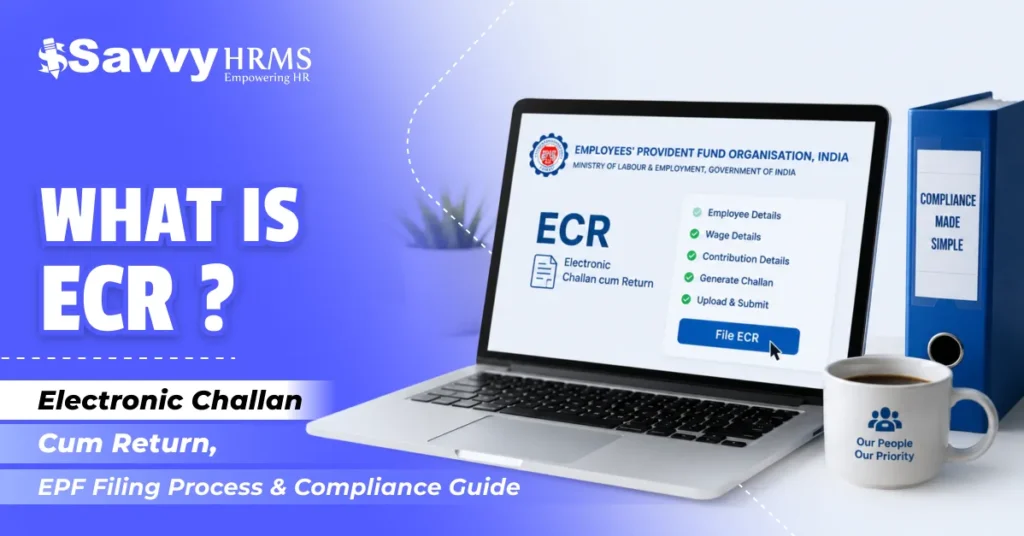
ECR, i.e., Electronic Challan cum Return, is an electronic system for filing of provident fund contributions, introduced by the EPFO. Using this system, companies can upload the details of their employees’ contributions and create challans in one place.
Previously, companies needed to undertake different tasks such as creating challans, filing the monthly returns, and filing their provident funds. This process used to be difficult for many industries as it required them to manage many things at once, sometimes resulting in delays and inaccuracies. However, now, using ECR, EPFO has developed a centralised system for this purpose.
In the ECR system, employers are supposed to upload the salary and contribution details of their employees using a specific format of files. Once they submit their files, ECR generates a temporary return reference number (TRRN). The TRRN serves the purpose of payment verification and tracking.
Nowadays, the ECR system is mandatory for all those industries that are complying with the EPF scheme. Under the scheme, certain schemes must be followed, which include:
- Employees’ Provident Fund (EPF)
- Employee Pension Scheme (EPS)
- Employees’ Deposit Linked Insurance (EDLI)
What is the difference between a Challan and a Return?
It is commonly misunderstood by many that a challan is similar to a return since both of them are a part of the statutory compliance process. However, there is a difference between the two regarding the EPF filing process.
A challan is basically a payment document, which shows the amount to be paid by the employer towards EPF, EPS, and EDLI contributions for a certain period.
The return, on the other hand, is a more elaborate process. It is a reporting mechanism for submitting information related to employee contributions, UAN, wages, pensions, etc., to EPFO.
In simple terms:
- Challan refers to informing EPFO about the amount payable.
- Return refers to informing EPFO about the payees and the calculation of their contributions.
The Electronic Challan cum Return system combines both these functions into a single online process. This integration minimizes duplication, reduces compliance errors, and enhances payroll management efficiency.
Key Components of ECR
The Electronic Challan cum Return system consists of various important elements that help organizations complete EPF compliance accurately.
1. UAN-Based Employee Data
The contributions made by each employee are linked to their UAN number. This enables the EPFO to maintain detailed information of employees while making contribution records completely transparent.
2. Wage and Contribution Details
The file ECR contains the salary amounts of employees, the EPF wage, the EPS wage, and the contribution amounts of both the employers and the employees.
3. TRRN Generation
Once an employer successfully uploads an ECR file, the EPFO generates the Temporary Return Reference Number (TRRN), which can be used to keep track of the payment and the challan.
4. Challan Generation
The ECR system automatically generates a challan based on the information entered about employee contributions.
5. Online Payment Integration
This portal allows employers to make payments using the integrated online banking service.
6. Error Validation System
ECR validates the details of the employees, including their UAN numbers and the amount of contributions, to prevent mistakes in filling the returns.
7. Monthly Return Filing
ECR facilitates monthly return filing for companies that are registered under the EPF Act 1952.
What Are the Benefits of Using ECR for Businesses?
Electronic Challan cum Return offers several advantages for organizations managing employee payroll and provident fund compliance.
1. Quicker Process of Compliance
Under the ECR system, both the challan preparation process and the monthly return submission process have been combined into one simplified process, which enables businesses to comply with the EPF rules effectively while saving time and effort.
2. Reduced Manual Errors
The ECR framework automatically checks employee data as well as their contribution details, thereby ensuring there are no errors in making UAN-related entries, calculating the payroll, or completing EPF filings.
3. Enhanced Payroll Management
ECR works smoothly with the payroll management and HRMS systems, making it easier for HR departments to manage employee contributions and deductions.
4. Higher Transparency Levels
Employees can easily monitor their EPF contribution amounts by accessing UAN-related information.
5. Simpler Record Keeping
The digital filing system for ECR reduces the amount of paperwork involved, ensuring ease in keeping track of compliance documents.
6. Lower Risk of Penalties
The timely and precise submission of ECRs ensures that businesses remain compliant and reduce the risk of fines, penalties, and legal issues as specified in the EPF Act 1952.
7. Simplified Audit Processes
An organized record-keeping system through digital filing facilitates smoother audits by ensuring that businesses provide relevant information effortlessly during the audit process.
8. Improved Scalability
As businesses continue to grow, ECR enables efficient management of compliance obligations without compromising the burden of paperwork on the HR department.
How ECR Simplifies EPF, EPS, and EDLI Payments?
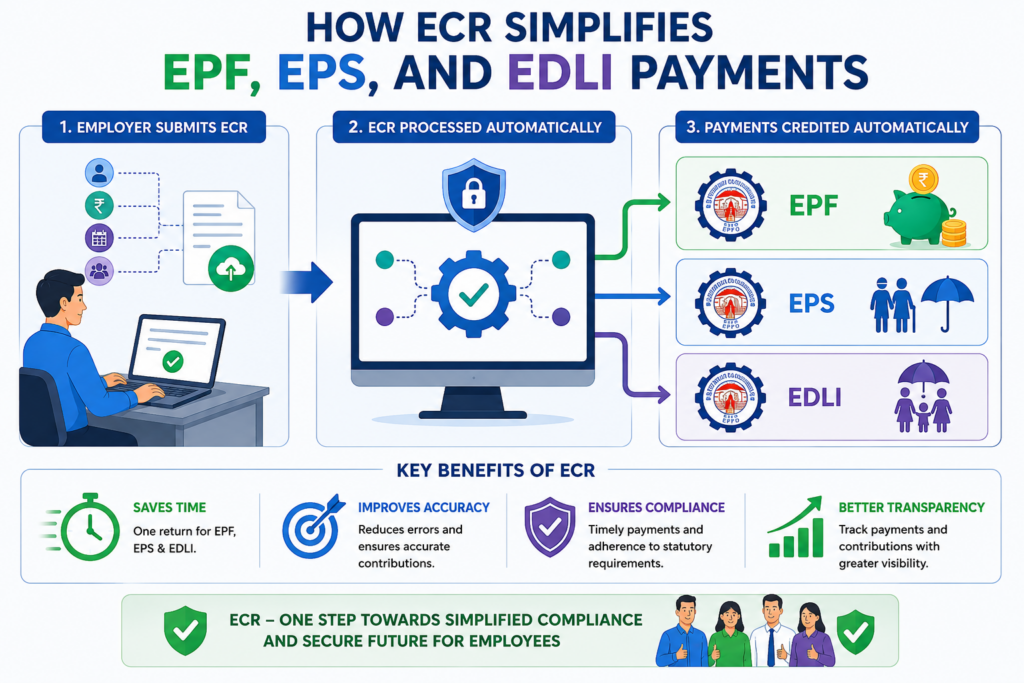
A major strength associated with ECR is that it makes management of contributions across several statutory schemes simple.
Before the adoption of ECR, there were different procedures involved when managing:
- Employees’ Provident Fund (EPF)
- Employee Pension Scheme (EPS)
- Employees’ Deposit Linked Insurance (EDLI)
This resulted in increased administrative complications and high possibilities of non-compliance issues.
Under the ECR scheme, employers have the capability to upload their contribution information using a single file. The platform will separate amounts for EPF, EPS, and EDLI using the wage details uploaded.
Some of the benefits that arise from using the ECR system include:
- Quick processing of contributions
- Accurate deduction of statutory amounts
- Challan generation
- Payment reconciliation
- Compliance checking
The portal will also verify whether the employee contribution details are accurate before submission. This reduces the workload and compliance issues for HR and Payroll departments.
Importance of ECR in HR and Payroll
For modern HR departments, compliance management is no longer just about filing returns. It is about maintaining accuracy, transparency, and efficiency while handling employee data.
Electronic Challan cum Return plays an important role in improving HR and payroll functions.
1. Supports Accurate Payroll Processing
The ECR process assists companies in calculating and paying their employees’ provident fund contributions without difficulty each month, thus making payroll management smooth.
2. Simplifies Statutory Compliance
Compliance with EPF and other payroll compliance regulations is made easy as a result of using a centralized online portal for managing these requirements.
3. Enhances Employee Trust
Employee confidence increases as a result of timely deductions of contributions as well as deposits into their provident funds, all thanks to ECR.
4. Enhances Employee Trust
A manual ECR filing takes up too much time of HR personnel, whereas a digital ECR filing automates the repetitive processes, thus saving valuable time.
5. Improves Reporting and Documentation
A good amount of time saved can be allocated to creating reports and documenting compliance activities by utilizing the digital ECR filing process.
6. Reduces Compliance Risks
ECR ensures timely and accurate ECR payments to the EPFO, which helps companies avoid unnecessary fines or penalties in relation to ECR compliance.
7. Integrates with HRMS Platforms
With the right HRMS software, businesses can simplify their ECR filing process and eliminate the use of spreadsheets completely.
What is the process of ECR Filing?
The Electronic Challan cum Return filing process involves various steps that employers must follow carefully.
Step 1: Prepare Employee Contribution, Data
This step involves preparing employees’ salary details and provident fund contribution details for the particular month by the employer. The accuracy of such information will help avoid mistakes, non-compliance, and delays associated with the ECR procedure.
The required details generally include:
- UAN
- Name of employee
- EPF wages
- EPS wages
- Employee contribution
- Employer contribution
Step 2: Generate the ECR File
In preparation for the ECR file, after collecting all employee contributions details, employers convert the data to the ECR file format provided by the EPFO. This task is often automated using Payroll or HRMS systems in many organizations.
Benefits of automated ECR generation:
- Faster processing
- Reduced paperwork
- Increased accuracy
- Improved compliance
Step 3: Log in to the EPFO Portal
Logging into the EPFO website with the establishment credentials is the next step that follows. Employers can easily log in to upload ECR files, generate challans, and perform other tasks associated with payment of provident funds.
The portal helps employers:
- Upload ECR files
- Generate challans
- Get TRRN
- Make online payments
Step 4: Upload the ECR File
Once the ECR files are uploaded after their preparation and conversion, the employers submit the information to the EPFO portal for verification purposes.
The upload process verifies:
- Employee’s details
- UAN records
- Wage information
- File formats
Step 5: Verify Errors
Upon uploading the files, the EPFO system checks for any errors, such as wrong UANs, duplications, or contribution mistakes, that need to be corrected before submitting the files.
Common ECR errors include:
- Invalid UANs
- Duplications
- Wrong contribution figures
- Wage discrepancies
Step 6: Generate TRRN
If the file uploaded does not have any errors, then the EPFO system creates a Temporary Return Reference Number (TRRN). This helps monitor the payments and filing process.
TRRN is used for:
- To track payments
- To check for filing statuses
- For reference during the audit
- For documentation purposes
Step 7: Generate Challan
Once the file uploads successfully, EPFO automatically generates the electronic challan with EPF, EPS, and EDLI contributions to be paid by the company.
The challan includes:
- EPF contribution
- EPS contribution
- EDLI contribution
- Employer payment details
Step 8: Complete Online Payment
After generating the electronic challan, the next step is to do the payment online using the facility provided on the website by the EPFO portal. Doing the online payment will help the organization to avoid any penalty.
Online payment advantages include:
- Fast transaction
- Secure payment method
- Easier to track
- Reduces paperwork
Step 9: Confirmation and Record Maintenance
After doing the payment online, the employer needs to download the challan forms and payment acknowledgements for proper record keeping and auditing purposes.
Important records to maintain:
- Challan copies
- Payment receipts
- TRRN number
- Monthly return records
For more info, visit: https://www.epfindia.gov.in/
Common Challenges in ECR Filing
Although ECR simplifies compliance, organizations may still face various filing challenges.
1. Invalid or Incorrect UAN
Inaccurate, invalid or incorrect UAN details might become the reason for the rejection of the ECR file by the authority.
2. Mismatch in Data
Any mismatch in information on the employer’s side against EPFO contribution information will create a validation issue, causing late submissions.
3. Formatting Errors
Poor formatting of the ECR file by an employer might obstruct its successful upload on the portal, causing late submissions and errors.
4. Contribution Calculation Errors
Calculation mistakes may impact contributions to the provident fund, such as EPF, EPS, and EDLI, resulting in compliance issues.
5. Delayed Filing
Late ECR filing may result in penalties or interest on payments, along with compliance challenges under the EPF Act 1952.
6. Manual Data Handling
Organizations which have a strong dependence on manual methods of handling payroll are prone to making mistakes and having inconsistencies.
7. Lack of Payroll Integration
With the absence of integrated payroll systems, it is hard for organizations to generate accurate ECR files.
8. Technical Portal Issues
Employers may sometimes face technical problems while uploading the ECR file due to any issues on the EPFO’s portal.
Difference Between ECR and Traditional PF Filing
| Aspect | ECR Filing | Traditional PF Filing |
| Filing Method | Fully online | Mostly manual or semi-manual |
| Challan Generation | Automatic | Separate process |
| Return Submission | Integrated with the challan | Filed separately |
| Data Validation | Automated system checks | Limited manual verification |
| UAN Integration | Direct UAN-based filing | Minimal digital integration |
| Processing Speed | Faster | Time-consuming |
| Error Handling | Real-time validation | Errors found later |
| Record Maintenance | Digital documentation | Paper-heavy process |
| Payroll Integration | Easily integrates with HRMS | Difficult integration |
| Compliance Tracking | Centralized tracking | Fragmented tracking |
| Risk of Penalties | Lower due to automation | Higher due to manual errors |
| Scalability | Suitable for growing businesses | Harder to manage at scale |
How HR Technology Simplifies ECR Compliance?
Managing ECR manually may still become difficult for growing organizations with larger workforces. This is where HR technology and modern HRMS platforms become valuable.
An advanced HRMS system helps automate payroll compliance and reduces the workload on HR and finance teams.
1. Automated Payroll Calculations
EPF, EPS, and EDLI deductions are automatically calculated by the HRMS software using the correct salary structure of the employees.
2. Error-Free ECR Generation
It is easier to prepare the EPFO-compliant ECR file without making mistakes using the HRMS software for your company.
3. UAN Management
The HRMS software allows you to manage the UAN numbers for all your employees effectively while complying with the provident funds.
4. Integrated Payroll Management
All payroll operations and filings become easier through the automation of payroll management through an HRMS system.
5. Real-Time Compliance Monitoring
You will be able to monitor the process of filling up ECR files through the HRMS system.
6. Reduced Administrative Burden
Using the HRMS software will enable you to automate repetitive tasks and save time and labour.
7. Better Reporting and Documentation
Automated systems can make compliance reporting and maintaining proper documentation easy and efficient.
8. Improved Employee Experience
Employees will get accurate deductions in their provident funds and have access to payroll details through the system.
Solutions like Savvy HRMS help businesses simplify statutory compliance, automate payroll management, and ensure accurate ECR filing without unnecessary complexity.
Conclusion
EPF compliance done manually might be too much to handle for the HR and Payroll departments of growing companies. However, Electronic Challan cum Return makes the process easy by merging the entire process of creating challans, filing monthly returns, and completing payments all through an automated electronic process.
With the help of modern HRMS software such as Savvy HRMS, one can easily simplify the whole process of payroll compliance, minimise the risk of incorrect filings, comply better with regulations, and efficiently manage the process of filing ECRs.
Ready to make your life simpler with efficient ECR filings?
Contact us at Savvy HRMS now.
Book a Demo Today