

Minimum Wages in Gujarat 2026: Latest Rates, Categories & Updates


-
AuthorRuchika Rajput
-
 Last Updated
May 11, 2026
Last Updated
May 11, 2026
-
 Reading Time
8 Mins
Reading Time
8 Mins
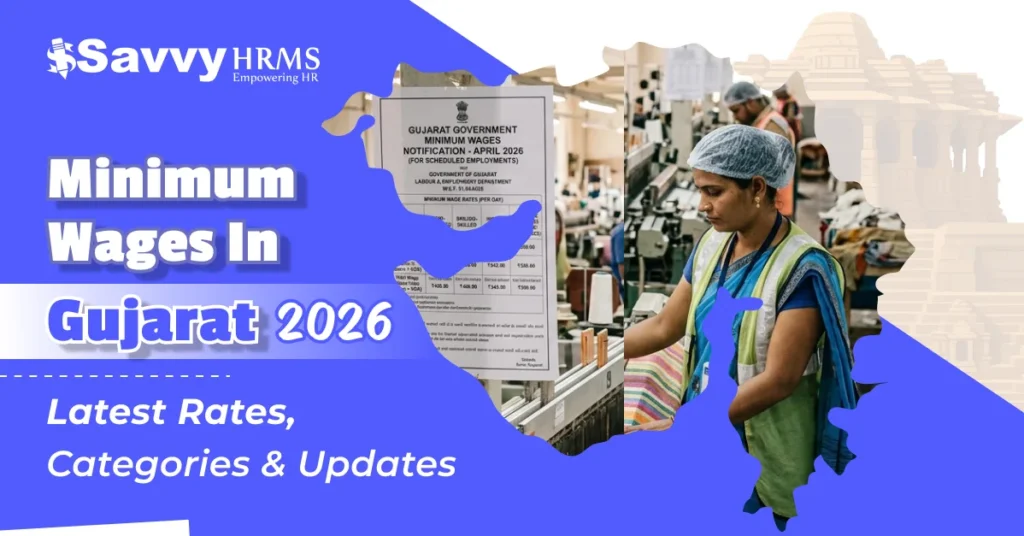
Minimum Wages are very important in ensuring that workers are paid fairly and get the financial support that they deserve. The Labour Department in Gujarat frequently revises the minimum wage rates considering inflation, cost of living, and other factors. Such revisions have direct implications for businesses, HR departments, and individuals involved across all industries.
As businesses continue implementing the Labour Codes and the recent changes introduced through the Variable Dearness Allowance (VDA), it becomes even more essential to know about the latest changes in wage structures. Businesses need to comply with the revised wage structure in order to avoid any legal issues.
In this blog post, we will cover the minimum wages in Gujarat 2026 and provide details about their categories, rates, zones, and more.
What are the minimum wages in Gujarat?
Minimum Wages in Gujarat can be defined as the statutory rate of minimum payment for the work done. They are set as per the provisions of the Minimum Wages Act and are regularly updated by the Government of Gujarat.
Wage structure in Gujarat consists of the following components:
- Basic Wage
- Variable Dearness Allowance (VDA), or we can say Special Allowance
The variable allowance component gets revised every six months (April & October) depending upon inflation rates and cost of living indexes.
In Gujarat, there is an organised system wherein wages are determined depending on skill (unskilled, semi-skilled, skilled), zones (Zone I & Zone II), and schedules of employment.
What are the Latest Minimum Wages in Gujarat 2026?
Minimum wages in Gujarat 2026 (April to September 2026) are determined by calculating the VDA with the existing basic wage rate.
Important Features of Gujarat Minimum Wages 2026 include:
- Effective from 1 April 2026
- VDA revised to ₹60.50/day
- For 46 scheduled employments
- Wage amount is based on 26 days’ pay per month
Two Zones can be categorised as:
- Zone I (Urban Areas)
- Zone II (Other Areas)
| Skill Level | Zone I Daily (₹) | Zone I Monthly (₹) | Zone II Daily (₹) | Zone II Monthly (₹) |
| Unskilled | 512.50 | 13,325 | 501.50 | 13,039 |
| Semi-skilled | 522.50 | 13,585 | 512.50 | 13,325 |
| Skilled | 534.50 | 13,897 | 522.50 | 13,585 |
Source: https://col.gujarat.gov.in/
Explanation:
1. Zone-wise Differences
Zone I consists of areas that are highly urbanised, and the cost of living is relatively high there. Therefore, the wages in Zone I are somewhat higher than in Zone II, which consists of rural areas.
2. Skill-based Classification
- Unskilled workers do work that requires no particular skill
- Semiskilled workers have some training or experience
- Skilled workers have skills or technical knowledge
As expected, wages increase with the skill level.
3. Effect of VDA
The increase in wages in 2026 will be entirely due to the VDA increase from ₹45.50 to ₹60.50 per day, giving a net monthly increase of ₹390.
What Minimum Wage Rates Apply to Sweeping and Cleaning Work?
Sweeping and cleaning operations usually qualify for classified employment like building upkeep, housekeeping, and city services, which come within the scope of standard pay scales.
In the year 2026, workers involved in sweeping and cleaning operations would usually be considered unskilled workers, except if any special machinery or skills are needed.
Applicable rates include:
- Zone I (Urban): ₹512.50 per day
- Zone II (Others): ₹501.50 per day
Important Points to consider:
- If the cleaning includes machines or any technical job, workers will be considered semi-skilled.
- Contract workers should also be paid according to the minimum wage requirements.
What is the Impact of Labour Codes on Minimum Wages in Gujarat?
1. Universal Minimum Wage Law
Now, the minimum wage law is applicable to all workers, and it does not have any exceptions as it used to be with specific scheduled employments before.
2. National Floor Wage Law
A national floor wage concept is included, where the central government has declared that the state governments should not fix their wages lower than the national standard. The wages fixed by Gujarat are far greater than the national benchmark.
3. Wage Formula
New wage definition includes:
- Basic wages
- Dearness allowance
- Retention allowance
It has implications for PF, gratuity, and bonus.
4. Overtime Regulations
Overtime payments should be double the usual after working:
- For 8 hours per day
- Or 48 hours per week
5. Inspector cum Facilitator Concept
In place of the old system of inspectors only, there is the inspector-cum-facilitator concept.
6. Increased Penalty for Violations
In violation of the new wage code, there is a provision for a fine and even imprisonment.
What are the Compliance Requirements for Employers?
Ensuring compliance with minimum wages in Gujarat in 2026 is important for avoiding penalties.
Key Compliance Checklist Include:
1. Correct Wage Payment
- Pay the minimum wage as notified
- Classification of the workforce based on their skills and zone
2. Timely Payment
- Paying wages within a month before the 7th day of the following month
- Settlement of wages within two days
3. Record Maintenance
Employers should maintain:
- Attendance register
- Register for payment of wages
- Record for payment of overtime
- Record for deductions
4. Contractor’s Responsibility
Contractual workers should get wages not less than the minimum wage.
What Are the Practical Payroll Implications of Minimum Wages in Gujarat 2026?
The 2026 wage revision has direct implications for payroll management.
1. Higher Salary Expenses
As a result of increased VDA, there has been an increment in the wage structure, which has caused increased salary expenses. In companies that have a huge employee strength, even a little increment in the salaries per employee can cause huge increments in the payroll expense.
2. Revamping Statutory Payments
There will be changes in the statutory payments, like EPF and ESI contributions, based on the changed wage structure and needs to be recalculated to make sure that it is done correctly.
3. Calculation of Overtime Payment
As a result of increased wages, there will be an increase in overtime payment by doubling the regular payment.
4. Updating the Payroll System
There needs to be an update of the payroll system in order to accommodate changes in the structure.
5. Compliance with Audit Readiness
The companies need to maintain payroll records in order to avoid penalties; the companies must always be audit-ready.
Conclusion
Minimum Wages in Gujarat 2026 show the steps that have been taken by the state to achieve a balance between workers’ interests and the realities of the economy. The current hike in wages owing to the revised VDA is moderate, providing adequate financial protection to workers while ensuring that employers are financially sustainable.
Manual handling of payroll activities can result in mistakes, legal non-compliance, and even penalties for organizations. This is where HR and payroll solutions such as Savvy HRMS become extremely important. The system helps companies maintain compliance effortlessly through the automation of wage computations.
Make payroll easy and simplify your HR activities using Savvy HRMS, which makes sure that you are always compliant.
Book a Demo TodayFAQ
1. What is the minimum wages in Gujarat for 2026?
For the year 2026, the minimum wage for Gujarat is dependent upon categories such as unskilled, semi-skilled, skilled, and highly skilled, along with the industry types which come under scheduled employment. The wages may be reviewed at regular intervals by the Gujarat Labour, Skill Development and Employment Department and include Basic + VDA (Variable Dearness Allowance).
2. What is the latest news on minimum wages in Gujarat for 2026?
New updates would always include changes in the VDA in relation to the Consumer Price Index. The final is released twice in a year, that is, in April and October. In case there are any drastic changes in the structure and categorisation of the wage system, the state government will inform accordingly.
3. What is the latest minimum wages notification in Gujarat?
The most recent notice has been published by the Gujarat Labour Department, which contains details of revised rates of wages for various types of workers. Such notices often include new rates of VDA and are legally binding on employers in scheduled employment in Gujarat.
4. Where can I download the latest minimum wages notification PDF for Gujarat?
You can download the official notice PDF from the website of the Labour, Skill Development and Employment Department, Gujarat. This can be found in parts such as “Notifications,” “Labour Laws,” or “Minimum Wages.”
5. What are the minimum wages set by the Gujarat Labour Department?
Minimum wages in Gujarat are determined by the following criteria:
– Skill (Unskilled, Semi-Skilled, Skilled, Highly Skilled)
– Industry (e.g., Construction, Textile, Engineering, Shops & Establishments)
– Area (where relevant)
Components of wages:
– Basic Wage
– Variable Dearness Allowance (VDA)
6. What is the current unskilled labour rate in Gujarat?
Unskilled labour cost in Gujarat is based on the last VDA amendment and the nature of work. The approximate unskilled labour rate in Gujarat is from ₹300 to ₹450 per day; however, it could vary according to the last VDA amendment notice.