


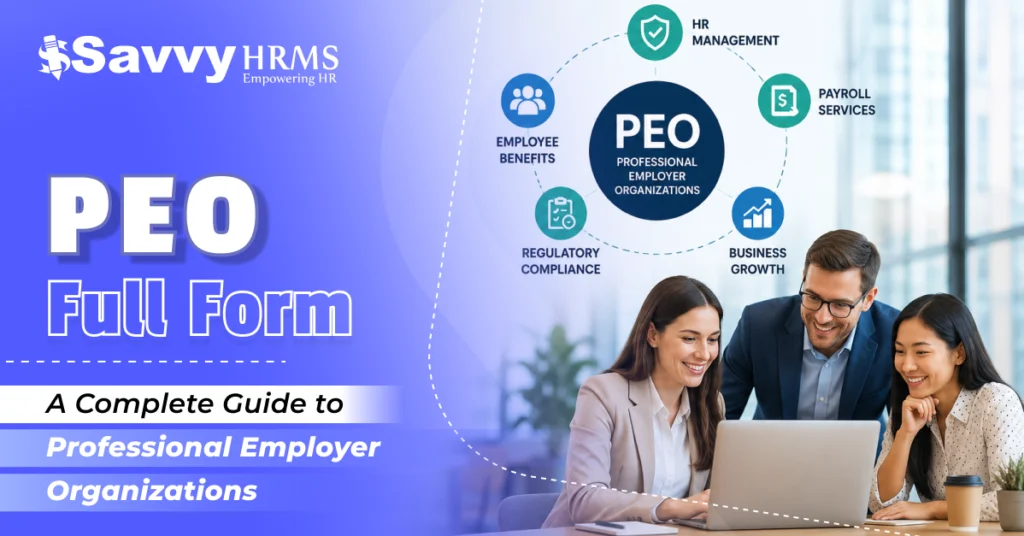

Managing employees is not just about hiring and paying salaries anymore. Businesses today also have to handle payroll administration, employee benefits, HR management, tax filing, labor law compliance, onboarding, and much more. For small and growing companies, these responsibilities can become confusing and time-consuming.
This is where a PEO becomes useful. The PEO full form is Professional Employer Organization. A PEO helps businesses manage important HR and payroll functions through a co-employment model. Instead of building a large in-house HR department, companies can partner with a PEO to simplify operations, improve compliance, and save time.
In this blog, we will explain everything about PEOs in simple language, including how they work, their benefits, limitations, comparisons with payroll companies and staffing agencies, and how to choose the right PEO for your business.
What Is the PEO Full Form and What Does It Mean?
The PEO full form is Professional Employer Organization.
A PEO is a company that provides HR outsourcing services to businesses. It helps employers manage tasks like:
- Payroll administration
- Employee benefits
- Tax filing
- HR management
- Compliance support
- Recruitment Management
- Employee onboarding
PEOs work using a co-employment model. In this arrangement:
- The business controls daily operations and employee work.
- The PEO handles administrative HR responsibilities.
This partnership allows businesses to focus more on growth while reducing HR workload and compliance risks.
Many startups, SMEs, and growing companies use PEO services to manage their workforce efficiently without building a large HR team internally.
How Does a PEO Work?
A PEO works through a co-employment agreement between the business and the PEO provider.
Under this setup:
- The business remains responsible for managing employees, assigning work, and making business decisions.
- The PEO becomes responsible for HR-related administrative tasks.
Here’s a simple step-by-step explanation of how a PEO works:
1. Business Partners with a PEO
The company signs a co-employment agreement with the PEO provider to outsource HR functions like payroll administration, compliance management, employee benefits, and HR support services.
2. Employees Are Added to the PEO System
After onboarding, employee information is added to the PEO system for managing payroll records, attendance, tax documentation, benefits administration, and employee-related HR processes.
3. HR and Payroll Processes Are Managed
The PEO handles salary processing, payroll administration, tax filing, compliance monitoring, employee benefits management, and HR documentation to simplify workforce operations for businesses.
4. Business Focuses on Core Operations
While the PEO manages HR responsibilities, businesses can focus on growth, customer service, sales, employee productivity, and long-term business development strategies efficiently.
What Services Do PEOs Provide?
PEOs offer a wide range of HR outsourcing services that help businesses simplify workforce management.
1. Payroll Administration
Payroll administration is one of the biggest services offered by PEOs.
This includes:
- Salary processing
- Payslip generation
- Attendance integration
- Overtime calculations
- Bonus and deductions management
- Direct deposits
A PEO ensures employees are paid accurately and on time.
2. Benefits Administration
Managing employee benefits can be complicated for growing companies.
PEOs help manage:
- Health insurance
- Retirement plans
- Leave policies
- Employee wellness programs
- Insurance coverage
Because PEOs manage many employees across multiple companies, they can often negotiate better employee benefits at lower costs.
3. Tax Filing and Compliance
Compliance mistakes can lead to penalties and legal issues.
PEOs help businesses with:
- Payroll tax filing
- Labor law compliance
- Statutory compliance
- Employee documentation
- Tax reporting
This reduces the risk of non-compliance and helps businesses stay updated with changing regulations.
4. HR Management
PEOs also support overall HR management, including:
- Employee onboarding
- HR policy creation
- Performance management support
- Recruitment assistance
- Employee record management
- Training support
This makes HR operations more organized and efficient.
PEO vs Your Internal Team: Who Manages What?
A PEO does not completely replace your internal team. Instead, responsibilities are shared between the company and the PEO.
Here’s a simple comparison:
| Task | Internal Team | PEO |
| Daily employee supervision | ✔ | ✘ |
| Business strategy | ✔ | ✘ |
| Hiring decisions | ✔ | Partial Support |
| Payroll administration | Partial | ✔ |
| Employee benefits management | Partial | ✔ |
| Tax filing | ✘ | ✔ |
| HR compliance | Partial | ✔ |
| Employee onboarding | Partial | ✔ |
| Workplace culture | ✔ | ✘ |
| HR documentation | Partial | ✔ |
In simple terms:
- The business controls employees and operations.
- The PEO handles administrative and HR-related responsibilities.
Where Can You Use a PEO?
PEOs can be used across many industries and business sizes.
They are commonly used by:
- Startups
- Small businesses
- Growing companies
- IT companies
- Healthcare organizations
- Manufacturing Industries
- Retail businesses
- Remote-first companies
Businesses usually choose a PEO when:
- They lack a dedicated HR team
- Payroll and compliance become difficult
- They want to improve employee benefits
- They are expanding quickly
- They want to reduce the administrative workload
A PEO can also help companies entering new markets where labor laws and compliance requirements are unfamiliar.
What Are the Benefits of Using a PEO?
Using a PEO provides several advantages for businesses.
1. Saves Time
A PEO manages payroll administration, compliance tasks, employee records, and HR processes, allowing businesses to save valuable time and focus on growth and operations.
2. Better Compliance Support
PEOs help businesses follow labor laws, payroll tax regulations, and statutory requirements properly, reducing compliance mistakes, penalties, and unnecessary legal or financial risks.
3. Improved Employee Benefits
PEOs provide access to better employee benefits plans, including insurance and wellness programs, helping companies improve employee satisfaction, retention, and overall workplace experience.
4. Reduced HR Workload
By outsourcing HR administration to a PEO, businesses reduce manual work related to payroll, documentation, compliance management, onboarding, and employee support activities efficiently.
5. Professional HR Expertise
PEOs offer experienced HR professionals who understand payroll administration, labor laws, employee management, compliance requirements, and modern HR practices for growing businesses effectively.
6. Scalable Workforce Management
As companies expand, a PEO helps manage increasing HR responsibilities, employee records, payroll operations, and compliance requirements without creating additional administrative pressure on businesses.
What Are the Limitations of a PEO?
Although PEOs offer many benefits, there are also some limitations businesses should consider.
1. Less Direct Control Over HR Processes
Since some HR responsibilities are managed by the PEO, businesses may experience reduced control over payroll administration, policies, employee communication, and HR operations.
2. Service Costs
PEO services may become costly for small businesses, especially when pricing depends on employee count, additional HR services, or long-term service agreements signed.
3. Not Fully Customized
Some PEO providers follow standard HR policies and workflows that may not perfectly align with a company’s work culture, management style, or operational needs.
4. Dependency on External Provider
Businesses depending heavily on a PEO may face difficulties if service quality declines, communication slows, or payroll administration and compliance processes experience disruptions.
5. Communication Challenges
Delayed responses or poor coordination from the PEO provider can slow down issue resolution, affecting employee experience, payroll queries, and HR-related decision-making processes.
Difference Between a PEO and a Payroll Service Provider
Many people confuse PEOs with payroll companies, but they are different.
Here’s a comparison:
| Basis | PEO | Payroll Service Provider |
| Definition | Provides complete HR outsourcing services. | Handles payroll processing services. |
| Main Focus | HR, payroll, compliance, and benefits management. | Salary processing and payroll tasks. |
| Co-Employment | Works under a co-employment model. | No co-employment involved. |
| HR Support | Offers full HR support. | Limited HR support. |
| Payroll Administration | Manages complete payroll administration. | Handles payroll processing only. |
| Employee Benefits | Manages employee benefits programs. | Usually does not manage benefits. |
| Compliance Support | Provides labor law and compliance support. | Limited payroll compliance support. |
| Tax Filing | Handles payroll tax filing. | Handles payroll tax processing. |
| Recruitment Support | May assist with hiring and onboarding. | Recruitment support is not included. |
| Business Control | HR responsibilities are shared. | Employer keeps full HR control. |
| Cost | Higher due to broader services. | Lower compared to PEO services. |
| Best For | Businesses need full HR outsourcing. | Businesses needing payroll management only. |
Is a PEO Similar to a Staffing Agency?
No, a PEO is not the same as a staffing agency, although both are related to workforce management. Their roles and services are completely different.
A staffing agency mainly helps companies hire temporary, permanent, or contract employees. Its primary focus is recruitment and providing manpower based on business requirements. Once employees are hired, the staffing agency’s role is usually limited.
On the other hand, a PEO focuses on HR outsourcing and employee management. A PEO works with a company through a co-employment model and helps manage payroll administration, employee benefits, tax filing, compliance, onboarding, and other HR functions for existing employees.
In simple words:
- A staffing agency helps businesses find employees.
- A PEO helps businesses manage employees efficiently.
Companies often use staffing agencies for recruitment needs, while PEOs are used for long-term HR management and compliance support.
What Is the Difference Between PPO and PEO?
People often confuse PPO and PEO because the terms sound similar, but they are completely different.
| Feature | PEO | PPO |
| Full Form | Professional Employer Organization | Preferred Provider Organization |
| Industry | HR and payroll | Health insurance |
| Main Purpose | HR outsourcing and payroll management | Healthcare network management |
| Focus Area | Employees and HR operations | Medical services |
| Includes payroll administration | ✔ | ✘ |
| Includes a health insurance network | ✘ | ✔ |
| Used By | Businesses | Insurance providers and employees |
In simple words:
- A PEO helps businesses manage HR and payroll.
- A PPO is a type of health insurance plan.
How to Choose a PEO?
Choosing the right PEO is important for long-term HR success.
Key Factors to Evaluate:
1. Industry Experience
Choose a PEO with experience in your industry because they better understand workforce challenges, compliance requirements, payroll administration, and HR practices specific to your business.
2. Services Offered
Before selecting a PEO, review whether they provide payroll administration, compliance management, employee benefits, recruitment support, onboarding, and complete HR management services effectively.
3. Technology and HR Software
A modern PEO should provide easy-to-use HR and payroll software that simplifies attendance tracking, employee management, payroll processing, reporting, and overall workforce operations efficiently.
4. Compliance Expertise
The PEO should understand labor laws, tax regulations, payroll compliance, and statutory requirements to help businesses avoid penalties, legal issues, and compliance-related operational risks.
5. Customer Support
Reliable customer support is important because quick assistance helps resolve payroll errors, employee concerns, compliance questions, and HR-related issues without affecting business operations significantly.
6. Pricing Structure
Always understand the PEO’s pricing structure, including service fees, hidden charges, contract terms, and additional costs, before choosing a long-term HR outsourcing partner.
Questions to Ask Before Choosing a PEO
Before finalizing a provider, ask:
- What HR services are included?
- How do you manage payroll administration?
- What compliance support do you provide?
- Do you offer employee self-service tools?
- How is employee data protected?
- What industries do you specialize in?
- How quickly do you resolve payroll issues?
- Can your services scale with business growth?
Asking the right questions helps businesses avoid future problems.
Conclusion
The PEO full form is Professional Employer Organization, and it plays an important role in modern HR outsourcing. From payroll administration and compliance to employee benefits and HR management, a PEO helps businesses simplify workforce operations and reduce administrative burden through a co-employment model.
However, every business has different needs. Before choosing a PEO, companies should carefully evaluate services, pricing, technology, compliance expertise, and long-term business goals. Businesses looking for smarter HR and payroll management solutions can also explore advanced HR software platforms like Savvy HRMS for efficient employee management, payroll automation, attendance tracking, and compliance support.
So, are you looking to simplify HR and payroll management for your business?
Connect with Savvy HRMS today and simplify your workforce operations with smart HR technology.
Book a Free Demo Today