



Let’s be honest, the Minimum Wages in Jharkhand is a subject many people find easy until they really dive into it.
Maybe you think there’s only one minimum wage for the entire Jharkhand state. Not quite!
The minimum wage you earn in Jharkhand actually varies not only based on the job but also on the location and level of skill of the employee. Two employees doing the exact same job can get different wages depending on where they live, Ranchi or rural Jharkhand.
This is because of Jharkhand’s unique system that takes Area A, B, and C, occupation, and skills into consideration. The idea behind it may seem logical, but the actual implementation might not be easy to understand.
But let’s imagine you always had the following questions regarding Jharkhand’s minimum wages:
- Why does my wage differ from the one I earn at another workplace?
- What’s the difference between Area A, B, and C?
- How much do I have the right to earn?
Here comes your solution.
We have created this article to explain the peculiarities of Jharkhand’s minimum wage in a clear way. So if you are an employee, HR manager, or employer, keep reading!
So, What’s the Latest Update on Minimum Wages in Jharkhand?
The latest official notification concerning the minimum wage in Jharkhand was made on 3 November 2025, which was implemented on 1 October 2025. Such rates remained valid even till 2026 (until April 2026, according to official information).
An official notification that would have updated such minimum wages after April 2026 could not be identified at all through any official websites as part of this study, indicating these are the latest figures.
Jharkhand Doesn’t Use District-Wise Wages (Here’s Why)
The assumption most people often hold about minimum wages in Jharkhand is that they are determined per district. In most cases, most Indian states determine wages in this manner. Therefore, it should not be surprising to think that different districts, like Ranchi, Dhanbad, or Bokaro, have individual minimum wage rates.
But in Jharkhand, things are done differently.
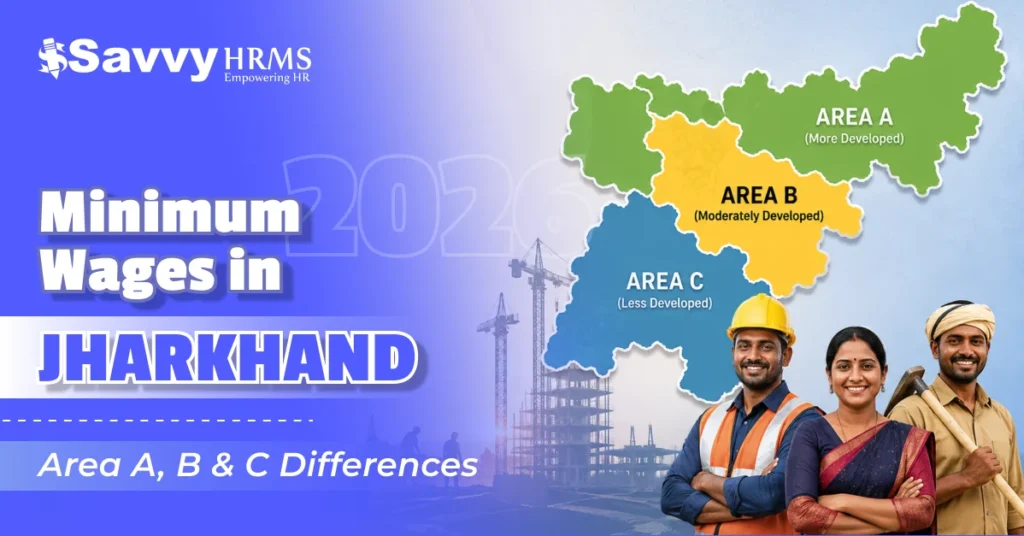
As opposed to determining wages per district, the state categorizes regions into broad areas referred to as Areas A, B, and C.
So why doesn’t Jharkhand use district-wise wages?
1. Urban vs Rural Matters More Than District Boundaries
There could be areas of high development in an urban sector of the district, as well as rural sectors within the same district. Thereby, fixing the wages according to the district would be wrong.
Consider the following situation:
- An employee of the municipal corporation in the area within the district might experience high expenditure
- But another employee in a rural area of the same district would not have such issues
Thus, by dividing the district into Area A, B, and C, the government would be able to ensure the wages are proportional to living expenses.
2. Simplifies Compliance for Employers
Suppose one is running a business in multiple districts; under such a scenario, determining wages for each district can cause problems.
Using the A/B/C classification system:
- The employer does not find out about the district wages, but simply focuses on identifying the area
- It will eliminate unnecessary complications for employers
This is particularly useful for businesses functioning in multiple locations within the state of Jharkhand.
3. Flexible Across Industries
The existing wage structure in Jharkhand is based upon:
- 90 scheduled employments
- Two broad classifications (क and ख)
- Four levels of skills
With the addition of the district-wise wage rates, it will further increase the complexities of the structure.
The area-wise classification achieves the ideal mix, making it both systematic and simple.
4. Reflects Real Economic Differences
Area A consists of large urban areas such as Ranchi and Jamshedpur, wherein:
- Rentals are higher
- Travel expenses are higher
- The cost of living is higher
Area C consists of rural districts with:
- Lower costs of living
- Diverse economies
Therefore, instead of considering the geographical boundaries of the districts, the wage structure recognises economic realities in Jharkhand.
Let’s Talk Numbers: What Are the Latest Wage Rates?
Here’s a simplified form from the latest verified schedule (Oct 2025).
Category “क’” (Higher-paying sectors)
| Skill Level | Area | Basic Wage Per Day (₹) | Monthly VDA (₹) | Total Monthly Pay (₹) |
| Unskilled | A | 468 | 882 | 13,050 |
| Semi-Skilled | A | 491 | 926 | 13,692 |
| Skilled | A | 647 | 1220 | 18,084 |
| Highly Skilled | A | 800 | 1406 | 20,802 |
| Unskilled | B | 446 | 841 | 12,437 |
| Semi-Skilled | B | 468 | 882 | 13,050 |
| Skilled | B | 617 | 1163 | 17,205 |
| Highly Skilled | B | 712 | 1342 | 19,854 |
| Unskilled | C | 425 | 801 | 11,851 |
| Semi-Skilled | C | 446 | 841 | 12,437 |
| Skilled | C | 588 | 1108 | 16,396 |
| Highly Skilled | C | 678 | 1278 | 18,906 |
Category “ख” (Traditional sectors)
| Skill Level | Area | Basic Wage Per Day (₹) | Monthly VDA (₹) | Total Monthly Pay (₹) |
| Unskilled | A | 446 | 841 | 12,437 |
| Semi-Skilled | A | 468 | 882 | 13,050 |
| Skilled | A | 616 | 1161 | 17,177 |
| Highly Skilled | A | 711 | 1340 | 19,826 |
| Unskilled | B | 425 | 801 | 11,851 |
| Semi-Skilled | B | 446 | 841 | 12,437 |
| Skilled | B | 588 | 1108 | 16,396 |
| Highly Skilled | B | 678 | 1278 | 18,906 |
| Unskilled | C | 405 | 763 | 11,293 |
| Semi-Skilled | C | 425 | 801 | 11,851 |
| Skilled | C | 560 | 1056 | 15,616 |
| Highly Skilled | C | 646 | 1218 | 18,014 |
Source: https://shramadhan.jharkhand.gov.in/
What Are the Latest Wage Changes for 2026?
Looking for the updated wage figures for 2026? Here’s what you need to know about the current situation:
There have been no notifications on minimum wages in Jharkhand so far.
This means that the last effective revision will be in October 2025, followed by 2026 as well.
But How Much Did They Change Recently?
There was an update to the wages, which took effect on:
- 3rd November 2025 (effective from 1st October 2025)
- This was due to VDA (Variable Dearness Allowance), which means changes in wages according to inflation.
Did the Update Lead to a Big Raise?
Not exactly.
Comparing the new updates to April 2025, it can be concluded that the increase was minimal:
- Daily wage rates increased by about ₹1-₹2 per day
- The update was minimal due to the slight increase in inflation at the time
So, What Should You Expect in 2026?
Since nothing has changed recently:
- Employers have to use the October 2025 rates
- Employees will see no changes in minimum wages (so far)
- Wage calculations for early 2026 remain the same
Why Do Employers Have to Follow Minimum Wage Rules?
Unlike any suggestion, minimum wages in Jharkhand are mandatory laws that every employer needs to abide by.
In Jharkhand, minimum wages are established through the Minimum Wages Act, 1948, which empowers the government to establish minimum wages applicable for various jobs.
1. Mandatory Compliance With the Law
Employers have no choice but to comply with the minimum wage when notified.
- Ensure payment of minimum wages
- The employers are free to pay more, but they can never pay less
Regardless of:
- The size of their organization
- The agreement of the employee on a reduced wage
- The temporary nature of the employment
2. Employers Need to Comply With the Claim for Arrears
Employees have a legal right to file claims regarding underpayment.
This can include:
- Filing for arrears with the labour authority
- Recovering underpaid money
- Compensation
Under the law, compensation to the extent of 10 times the arrears can also be claimed from employers, creating a heavy financial burden for them.
3. Keeping Necessary Records by Employers
Payment of wages is not all. They are also required to keep some necessary records.
These include the following:
- Payroll sheets
- Attendance records
- Over-time records
In case of their failure to do so, employers might have to face some penalty during inspection.
4. Inspections Are Serious in Jharkhand
Jharkhand follows the process of:
- Labour inspections
- Keeping records and returns digitally
- Labour compliance monitoring through its labour portal
Therefore, it is not only a formality. An employer can always be checked.
5. It Guarantees Minimum Wages
The main objective behind the enactment of the minimum wage law is:
To avoid exploitation and guarantee a minimum wage
In the absence of such laws,
- Employees may be paid low wages
- Wage criteria may fluctuate from employer to employer
- No minimum wage standard
Therefore, with the help of this legislation, minimum wages are guaranteed to workers.
Are Contract Workers Covered Under Minimum Wage Rules?
Certainly, yes. The law protecting minimum wages is applicable to contract workers in Jharkhand.
There is a common misconception that if the workers are engaged by contractors, there would be a different set of rules governing their wages. But irrespective of whether the worker belongs to the payroll of the organization or is hired by a contractor, it is important that he gets at least the basic wages according to the classification on the basis of his location, job position, and proficiency.
Though payment of wages is the obligation of the contractor, the principal employer too should ensure the timely and proper payment of wages to avoid any underpayment.
Furthermore, even if the agreement made between two parties involves low wages, it will not be considered valid as per law; thus, a worker will not lose any legal entitlements simply because there was an agreement of lower pay rates.
In addition, underpayment of wages invites the liability of recovery of those wages. Most often, it has been observed that contractors and employers both become liable for such an act.
Thus, it can be concluded that there is no question of exemption from minimum wage protection for contract workers.
What are the Practical Tips for Employers?
If you are running a business in Jharkhand, here’s what you need to do:
1. Classify Properly
This is where most mistakes occur:
- Classification (क or ख)
- Level of Skill
- Territory (A, B, C)
2. Ensure the Wage Calculation Format is Proper
- If employed daily, then daily wages
- If employed monthly, then the monthly total wages
Formula: multiply or divide by 26 days of work in a month
3. Maintain Wages Record
You need to maintain:
- Wages Register
- Attendance register
- Overtime record
4. Pay Within Set Time Frame
Proper way to pay monthly wages as per wage code guidelines:
Within 7 days of next month
Important Limitation You Should Know
One important consideration:
There is no evidence of an official April 2026 wage increase.
Therefore:
- The October 2025 wage increases remain the most recent confirmed
- However, employers should verify before processing payroll
Final Thoughts
Minimum wages in Jharkhand might appear complicated at first glance, but ultimately, it points to knowing the geography, category, and skills of the workers.
This is where Savvy HRMS can help you save time by simplifying your payroll processes, adhering to the most recent guidelines for minimum wages, and preventing any mistakes due to manual input.
Make your payroll process smooth, Book a free demo with Savvy HRMS today!
Book a Demo Today