



Think about an expanding business that is experiencing high turnover rates, low morale among employees, and poor performance. Although management focuses on recruiting talented individuals, they fail to focus on employee development, which leads to low productivity levels and loss of competitiveness in the market environment.
Are you wondering how you can avoid such situations? You can start by gaining a clear understanding of HRM and HRD and the role each plays in achieving organizational success. Here are some insights into what HRM and HRD require, their important functions, and their differences.
What is HRM?
Human Resource Management (HRM) is a management tool that involves managing the human resources in an organization strategically. The aspects of HRM include recruitment, industrial relations, rewards, and compliance, which are important for efficient business functioning.
Human Resource Management (HRM) is important in ensuring that organizational objectives and activities are aligned. This is done by employing the right employees and retaining them.
What are the Key Functions of HRM?
1. Recruiting and Selecting
HRM will have the responsibility of recruiting, assessing, and employing an appropriate candidate. It will ensure that suitable employees are selected, taking into account the company culture and skill level.
2. Employee On-Boarding
It will take charge of the onboarding process by familiarizing new hires with company policies and culture. This way, employees will adjust fast and contribute to the business.
3. Remuneration and Benefits
HRM will come up with salary packages and incentives that will be attractive to employees while at the same time being competitive in the market.
4. Performance Management
Performance appraisal and management systems will enable HRM to measure how well employees perform and ensure that productivity is attained.
5. Employee Relationships
The main objective of HRM in an organization is to ensure positive relations between all employees and the organization.
6. Compliance with Labor Laws
The HRM department will ensure that the organization meets the set labor laws, regulations, and standards in the labor market.
What is HRD?
The Human Resource Development (HRD) is the process that revolves around skill building and knowledge upgrading among employees in order to help them perform at their best.
HRD is all about the future, where efforts are made to equip employees with skills that will serve them in meeting any new requirements coming into the organization due to change.
What are the Key Functions of HRD?
1. Training and Development
HRD develops training programs to develop the abilities of the workforce, provide them with greater knowledge, and make sure that they are capable of meeting the demands of their respective jobs.
2. Career Development
HRD assists the employees to help them plan their career development paths in order to increase their engagement and retention within the company.
3. Performance Improvement
HRD assesses the existing deficiencies in employee skills and offers development programs to improve their performance and productivity levels.
4. Organizational Development
HRD concentrates on organizational development through developing effective strategies for organizational change and improvement of its performance and structure.
5. Leadership Development
HRD is responsible for developing the workforce and preparing employees to become good managers and leaders of tomorrow.
6. Employee Engagement
HRD develops employee engagement programs designed to increase employee motivation, satisfaction, and dedication.
7. Learning and Development Culture
HRD promotes the development of a learning and development culture by helping employees enhance their competencies and stay up-to-date with new technologies and trends in the market.
Key Differences Between HRM and HRD
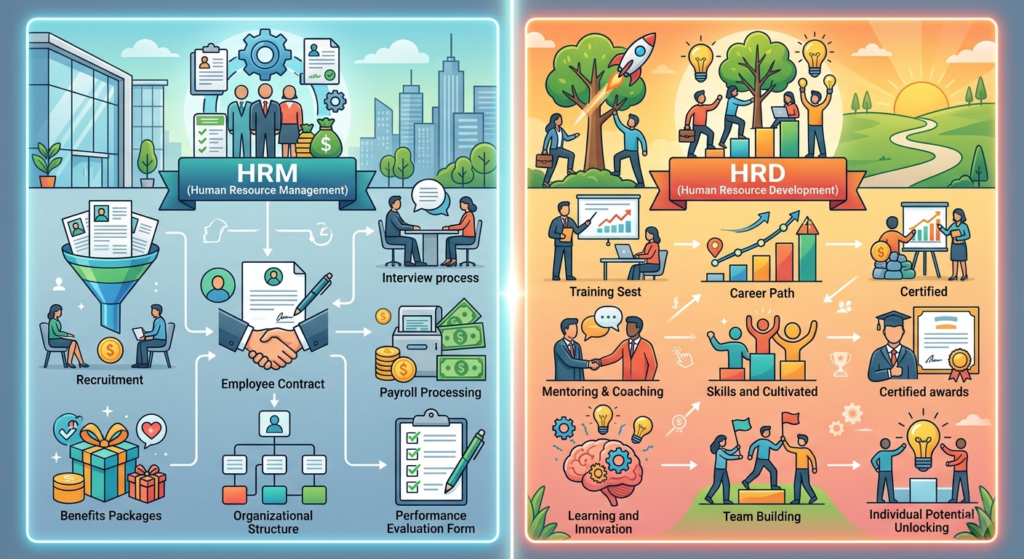
| Basis | HRM (Human Resource Management) | HRD (Human Resource Development) |
| Focus | Managing employees and ensuring smooth day-to-day workforce operations | Developing employees and improving their skills for future growth |
| Nature | Administrative and operational, focused on routine HR activities and processes | Strategic and developmental, focused on long-term employee growth and learning |
| Objective | Efficient workforce management and alignment with organizational policies and goals | Skill and capability enhancement for long-term organizational success |
| Approach | Reactive approach to solve workforce issues as they arise | Proactive approach to prepare employees for future challenges |
| Time Frame | Short-term focus on immediate workforce needs and operational efficiency | Long-term focus on continuous learning and employee development |
| Scope | Broad scope including recruitment, payroll, compliance, and employee management | Specific scope focusing on training, development, and employee growth initiatives |
| Goal | Organizational stability, efficiency, and smooth business operations | Organizational growth, innovation, and continuous improvement |
| Function | Handles hiring, compensation, policies, and employee relations management | Focuses on training, career development, and performance improvement programs |
| Orientation | Process-oriented with an emphasis on rules, systems, and structure | People-oriented with emphasis on learning, growth, and engagement |
| Dependency | Includes HRD as a part of the overall human resource strategy | Functions as a subset within the HRM framework and structure |
| Outcome | Ensures workforce efficiency, discipline, and compliance with policies | Builds a skilled, motivated, and future-ready workforce |
How Do HRM and HRD Work Together?
HRM and HRD work together and help to manage the development of the workforce in the organization. While HRM ensures that appropriate candidates are recruited, HRD focuses on ensuring that they possess good skills and perform well.
How does this process actually occur?
- HRM recruits the best talent for the organization
- HRD designs training programs for the development of its skills
- HRM measures its performance constantly
- HRD uses these findings to design development programs
For example, the HRM department ensures the recruitment of the best talent and employees, and the HRD department ensures their training. In this way, organizations can be assured that they will have talented employees who are always improving their skill set.
Also, the performance of employees is evaluated by the HRM, and based on such information, the HRD develops programs for them to further their performance and skill set.
In this way, the two concepts combine perfectly to manage the workforce in organizations.
Why HRM and HRD Are Important for Modern Organizations’ Success?
In the modern business world, companies need to concentrate not only on the management of the labor force but also on its development. HRM and HRD are important concepts that can ensure the effectiveness of operations, as well as constant improvements and innovations.
1. Increased Efficiency of Workers
HRM is responsible for assigning roles properly, and HRD makes sure that employees develop their skills and become more productive.
2. Lower Rate of Turnover
When management and development are effectively combined, it helps to retain employees since they will be satisfied with their jobs.
3. Flexibility
While HRD teaches employees how to be flexible, HRM facilitates the implementation of changes and innovations in order to adjust to changing circumstances.
4. Corporate Culture
Workplace policy is maintained by HRM, and HRD encourages learning and cooperation.
5. Competitive Advantage
When organizations manage to use HRM and HRD successfully, they create conditions necessary for innovation and development.
Which Option Does Your Business Require the Most?
It is difficult to distinguish between HRM and HRD. It all boils down to the current state of your business.
So, what do you need?
Effective management or Skilled workers?
If you concentrate on recruitment, maintenance of policies, and routine activities within your organization, then HRM will play its main role. It will introduce more order and structure into the working process.
Need better hiring?
Want smoother operations?
Looking for compliance?
Need workforce control?
In case you consider developing your company and training the staff, you will have to pay much attention to HRD. It implies employee development and preparation for future challenges.
Or for a long-term strategy?
For future success?
You Need…..
Skilled employees?
Future leaders?
Focus on innovation?
Improve performance?
In reality, the best approach is not selecting one over the other but finding the right option between HRM and HRD based on your organizational goals.
Conclusion
Understanding the difference between HRM and HRD is important when it comes to making better decisions regarding the development of your business through your employees. The HRM is needed for efficiency, while the HRD is required for the continuous improvement of your employees to adapt and be productive all the time.
But how will you do this successfully?
- Achieve a balance between management and development
- Prioritize investment in your employees’ growth
- Make long-term goals the priority
- Create a future-fit workforce
The most effective companies do not just pick one of these concepts but use both of them. And with the help of great HR Software like Savvy HRMS, you can maximize the efficiency of these practices in your company.
Ready to grow your HR career?
Maximizing efficiency and development of your employees will ensure that you have an improved workforce. Optimize your employees today by booking a demo!
Book a Demo Today