



Are traditional HR processes keeping up with the fast-moving workforce needs of hospitality and retail businesses? From rotating shifts and changing rosters to multi-location attendance, overtime, leave, and payroll, HR teams need a smarter way to manage employees without depending on scattered spreadsheets.
HRMS software for hospitality and retail businesses brings these processes together in one platform. It can help businesses manage employee records, attendance, leave, payroll, shifts, rosters, mobile access, and workforce data while giving HR teams better visibility across stores, hotels, restaurants, and outlets.
With several HRMS platforms available in India, choosing the right one can be challenging. This guide compares 8 leading HRMS software based on hospitality and retail requirements, including workforce flexibility, shift management, multi-location operations, payroll, support, pricing, and overall industry fit.
Our Evaluation Methodology
Choosing the best HRMS software for hospitality and retail is not simply about counting features. A platform may have dozens of HR modules but still be difficult to use for a hotel chain, restaurant group, retail network, or business with employees working across different locations.
For this comparison, we evaluated the shortlisted HRMS platforms against the following factors:
- Shift and roster management: How effectively the software handles changing shifts, rotations, weekly offs, and workforce scheduling.
- Attendance management: Availability of mobile, biometric, GPS, geo-fencing, selfie, or other attendance options.
- Payroll and compliance: Ability to connect attendance and leave with payroll and support Indian statutory requirements.
- Frontline workforce management: Suitability for employees working in stores, hotels, restaurants, outlets, and field locations.
- Multi-location capability: Support for multiple branches, entities, locations, policies, and workforce groups.
- Employee self-service: Mobile and web access for attendance, leave, payslips, approvals, and employee requests.
- HR breadth: Availability of recruitment, onboarding, performance, expenses, helpdesk, assets, learning, and other HR modules.
- Pricing and transparency: Whether pricing is publicly available, customizable, or quotation-based.
- Support and implementation: Availability of onboarding, customer support, account management, or enterprise implementation services.
- Overall industry fit: How well the platform matches the operational realities of hospitality and retail businesses in India.
The ratings in this article are editorial comparisons based on the stated criteria, not third-party review scores. Features and pricing can change, so businesses should confirm the final commercial proposal and module availability before purchasing.
What Is the Best HRMS Software for Hospitality & Retail Businesses in India in 2026?
Savvy HRMS is a strong overall choice for hospitality and retail businesses that need integrated HR, attendance, shift, roster, payroll, compliance, mobile, and workforce management capabilities.
Its published plans include multiple shift creation, roster combinations, location-based holiday calendars, mobile attendance, geo-fencing, geo-tagging, payroll, statutory compliance, employee self-service, and several additional HR modules.
However, “best” depends on business size and priorities. A smaller retailer may prioritize affordable pricing, while a large hospitality group may prioritize enterprise HCM, analytics, integrations, or multi-country capabilities.
For example, Kredily offers a free HRMS and payroll plan for unlimited employees, while Keka emphasizes shift management, attendance, payroll, and workforce automation. Darwinbox and ZingHR are more strongly positioned toward larger enterprise environments.
Why Do Hospitality & Retail Businesses Need Specialized HRMS Software?
Hospitality and retail businesses have workforce requirements that are different from a conventional 9-to-5 office environment.
Employees may work morning, evening, night, weekend, split, rotating, or seasonal shifts. A retail business may have employees distributed across dozens or hundreds of stores, while a hospitality group may manage employees across hotels, restaurants, kitchens, housekeeping teams, front desks, and support functions.
This creates several operational challenges:
- Managing changing employee schedules
- Tracking attendance across locations
- Handling overtime and shift allowances
- Managing weekly offs and holidays
- Processing leave without affecting staffing
- Tracking frontline employees
- Managing payroll for multiple locations
- Maintaining statutory compliance
- Giving employees mobile access
- Reducing dependency on spreadsheets and manual approvals
A suitable HRMS software for hospitality and retail brings these processes into a connected system. Instead of HR teams collecting attendance, leave, overtime, and payroll information from different sources, the information can flow through a centralized HR platform.
This is particularly important when a business grows from one location to multiple stores, properties, branches, or outlets.
What HRMS Features Are Most Important for Hospitality & Retail Workforce Management?
The most important features depend on how the organization operates, but several capabilities are particularly valuable for hospitality and retail.
1. Shift and Roster Management
The software should support multiple shifts, shift rotations, weekly offs, roster planning, and schedule changes, helping businesses manage workforce requirements efficiently across different teams and locations.
2. Mobile Attendance
Mobile attendance allows employees to mark attendance remotely, making it useful for field teams, distributed workforces, and managers who need flexible attendance tracking.
3. Geo-Fencing and Geo-Tagging
Geo-fencing and geo-tagging help validate employee attendance based on predefined locations, improving attendance accuracy, reducing misuse, and providing better visibility across distributed teams.
4. Payroll Integration
Payroll integration ensures attendance, overtime, leave, deductions, and other payroll inputs flow automatically into payroll, reducing repetitive data entry, manual errors, and processing time.
5. Multi-Location Management
Multi-location management helps businesses oversee employees across stores, hotels, restaurants, branches, or offices while maintaining centralized visibility and location-specific policies and workflows.
6. Employee Self-Service
Employee self-service enables employees to view shifts, mark attendance, apply for leave, access payslips, and submit requests without depending on HR for routine tasks.
7. Compliance Management
Compliance management helps Indian businesses handle statutory payroll requirements such as PF, ESI, Professional Tax, and TDS while supporting accurate calculations, records, and regulatory processes.
8. Workforce Analytics
Workforce analytics provides insights into attendance, overtime, headcount, leave, workforce costs, and operational trends, helping managers make informed decisions and improve workforce planning.
9. Integration Capability
Integration capability allows businesses to connect HRMS with biometric devices, accounting platforms, ERP systems, banking systems, and other applications, creating a more connected workforce management environment.
What Are the 8 Best HRMS Software for Hospitality & Retail Businesses in India in 2026?
The following platforms are worth considering when comparing HRMS software for hospitality and retail in India.
1. Savvy HRMS
Overview
Savvy HRMS is a comprehensive HR and payroll platform designed to simplify employee management, attendance, leave, payroll, compliance, and workforce operations. Its attendance module supports multiple shifts, roster combinations, location-based holidays, mobile attendance, geo-fencing, and geo-tagging for distributed teams.
For hospitality and retail businesses, Savvy HRMS is particularly useful when teams work across branches, stores, hotels, or changing schedules. Its broader modules also connect recruitment, performance, travel and expenses, helpdesk, assets, learning, and other HR processes in one platform.
Key Features
- Create multiple shifts and combine them into configurable employee rosters.
- Track attendance through mobile workflows, geo-fencing, and geo-tagging capabilities effectively.
- Connect attendance inputs with payroll processing and salary reconciliation workflows.
- Manage location-based holiday calendars for distributed teams and business units.
- Give employees mobile access to attendance, leave, payslips, and requests.
- Configure role-based permissions and data access across HR workflows securely.
- Manage statutory payroll requirements including PF, ESI, TDS, LWF, and PT.
- Support travel, expense, reimbursement, assets, helpdesk, and performance workflows together.
- Use employee and manager dashboards for approvals, visibility, and daily actions.
Best For
Best for hospitality groups, retail chains, and multi-location businesses needing HR, attendance, payroll, compliance, mobile access, and workforce management from one configurable platform with scalable modules and India-focused HR processes.
Editorial Rating: ⭐⭐⭐⭐⭐ 5/5
2. Kredily
Overview
Kredily is an India-focused HRMS and payroll platform combining employee records, attendance, leave, payroll, compliance, mobile self-service, and AI capabilities. Its free plan and published pricing make it accessible for smaller hospitality and retail teams.
Key Features
- Run payroll, attendance, leave, and statutory calculations in one connected platform.
- Provide employees with mobile self-service for payslips, leave, and attendance requests.
- Use selfie and GPS attendance on eligible paid plans for distributed teams.
- Manage salary payouts, challans, tax forms, and payroll analytics centrally.
- Support AI-assisted workflows, employee records, onboarding, and workforce insights together.
Best For
Best for smaller hospitality and retail businesses looking for an affordable India-focused HRMS, payroll, attendance, compliance, mobile self-service, and transparent pricing with a free entry option and setup for lean HR teams.
Editorial Rating: ⭐⭐⭐⭐ 4/5
3. Darwinbox
Overview
Darwinbox is an AI-native HCM platform aimed at larger and growing enterprises, covering core HR, payroll, workforce processes, employee experience, and analytics. Its India payroll offering supports automated inputs, statutory reporting, approvals, and employee self-service.
Key Features
- Automate India payroll inputs, approvals, reconciliation, and anomaly detection processes.
- Integrate leave, attendance, PF, TDS, and payroll data automatically across workflows.
- Provide employee self-service, payslips, approvals, and payroll query assistance easily.
- Support workforce processes, analytics, and configurable enterprise HR workflows efficiently.
- Offer multi-country capabilities for organizations operating across different global markets.
Best For
Best for larger hospitality groups and retail enterprises needing enterprise HCM, AI-enabled workflows, India payroll, analytics, employee experience, and scalable multi-country capabilities with sophisticated process automation for complex workforce environments.
Editorial Rating: ⭐⭐⭐⭐ 4/5
4. Keka
Overview
Keka is an end-to-end HRMS and payroll platform with strong time, attendance, shift, payroll, and performance capabilities. Its workforce tools support mobile attendance, geo-fencing, location punching, shift rotations, overtime, and payroll integration for distributed teams.
Key Features
- Manage flexible shifts, rotations, weekly offs, and overtime automatically across teams.
- Capture attendance through mobile, GPS, geo-fencing, selfie, and biometric devices.
- Sync attendance and leave data directly with payroll calculations every month.
- Support field teams through continuous location punching and mobile workflows.
- Connect payroll, expenses, compliance, employee self-service, and performance management together.
Best For
Best for growing hospitality and retail organizations prioritizing advanced attendance, shift management, mobile workforce tracking, payroll integration, employee experience, and configurable HR automation across locations and teams with workforce policies.
Editorial Rating: ⭐⭐⭐⭐ 4/5
5. greytHR
Overview
greytHR is a mature HR and payroll platform for Indian businesses, covering core HR, payroll, leave, attendance, employee self-service, workflows, analytics, and compliance. Its Growth plan adds advanced attendance, shift management, overtime, and geo-fencing capabilities.
Key Features
- Manage payroll, leave, employee records, onboarding, and self-service centrally with ease.
- Support advanced attendance, shift management, overtime, permissions, and geo-fencing capabilities.
- Provide mobile employee access for requests, information, and payroll documents.
- Offer analytics, workflows, statutory reports, and configurable HR processes for teams.
- Add GPS tracking, timesheets, expenses, recruitment, and performance modules together.
Best For
Best for Indian businesses wanting established payroll and HR operations with transparent plans, strong compliance capabilities, attendance, shifts, employee self-service, and optional workforce add-ons for expanding teams with reliable payroll administration.
Editorial Rating: ⭐⭐⭐ 3/5
6. factoHR
Overview
factoHR provides HR, attendance, leave, payroll, employee self-service, multi-entity management, expenses, performance, and workforce tools. Its attendance capabilities include biometric integration, multiple policies, shift planning, roster planning, mobile access, and location-oriented features for distributed teams.
Key Features
- Plan shifts and rosters alongside attendance and leave policies centrally.
- Integrate biometric devices with online attendance and multiple timezone configurations.
- Automate payroll processing, payslips, statutory compliance, and salary workflows efficiently.
- Support mobile employee self-service, multiple entities, and centralized dashboards for managers.
- Add geo-fencing, expenses, performance, recruitment, face recognition, and timesheets capabilities.
Best For
Best for growing businesses needing integrated HR, payroll, attendance, roster planning, multi-entity management, mobile self-service, geo-fencing, and flexible workforce management features across locations and employee groups for operationally diverse teams.
Editorial Rating: ⭐⭐⭐ 3/5
7. Qandle
Overview
Qandle is a configurable HRMS covering employee lifecycle management, attendance, payroll, leave, performance, expenses, recruitment, and employee helpdesk. Its platform supports GPS and biometric attendance, shift scheduling, payroll synchronization, and add-ons for field force tracking.
Key Features
- Capture attendance using GPS, biometrics, and location-aware mobile workflows accurately.
- Schedule rotating shifts and synchronize attendance and leave automatically across teams.
- Connect payroll with attendance, reimbursements, taxes, and statutory reporting processes.
- Support field force tracking through dedicated add-on capabilities for distributed teams.
- Manage employee lifecycle, performance, expenses, recruitment, and helpdesk workflows centrally.
Best For
Best for organizations wanting HRMS capabilities with attendance, payroll, shift planning, field-force tracking, employee lifecycle management, and flexible add-on options for distributed teams across diverse business locations with operational workflows.
Editorial Rating: ⭐⭐⭐⭐ 4/5
8. ZingHR
Overview
ZingHR is an enterprise HCM platform with workforce management, payroll, compliance, recruitment, performance, and analytics. Its workforce solution includes geo-fenced attendance, shift rostering, employee self-service, and payroll integration, while its India offering targets retail-QSR operations.
Key Features
- Manage shift rostering, attendance, leave, and workforce scheduling centrally across locations.
- Use geo-fenced punch-in and punch-out for distributed workforce teams accurately.
- Connect time, attendance, and leave data directly with payroll processing.
- Support enterprise payroll, statutory compliance, analytics, and employee self-service features.
- Provide workforce management capabilities designed for retail-QSR and large operations.
Best For
Best for large retail, QSR, hospitality, and distributed enterprises needing enterprise workforce management, shift rostering, geo-attendance, payroll, compliance, analytics, and mobile-first HR operations at scale across multiple sites and entities.
Editorial Rating: ⭐⭐⭐ 3/5
HRMS Comparison Table for Hospitality & Retail Businesses
| HRMS Software | Rating | Best For | Strength | Limitations | Industry Fit | Support Model | Pricing |
| Savvy HRMS | ⭐⭐⭐⭐⭐ | Hospitality groups, retail chains, multi-location businesses | Strong HR, shift, roster, attendance, payroll and compliance coverage | Advanced enterprise requirements may need plan selection/customization | Excellent | Demo, implementation assistance, premium support on enterprise plan | Customizable according to the organization’s need |
| Kredily | ⭐⭐⭐⭐ | Smaller businesses and cost-conscious teams | Free HRMS, payroll, attendance and compliance | Advanced workforce features are plan-dependent | Very Good | Online support, training, dedicated support on Enterprise | Free; paid from ₹1,249/month |
| Darwinbox | ⭐⭐⭐⭐ | Large enterprises | Enterprise HCM, AI, payroll, analytics and workflows | Enterprise implementation can require more planning | Excellent | Enterprise implementation and customer support | Custom |
| Keka | ⭐⭐⭐⭐ | Growing multi-location organizations | Strong shift, attendance, payroll and mobile capabilities | Advanced modules can increase total cost | Excellent | Guided onboarding and customer support | From ₹9,999/month |
| greytHR | ⭐⭐⭐ | Indian SMBs and growing companies | Payroll, compliance, attendance and transparent plans | Some advanced capabilities are add-ons | Very Good | Onboarding support, helpdesk and support plans | From ₹2,495/month |
| factoHR | ⭐⭐⭐ | Growing and multi-entity businesses | Roster, attendance, payroll, geo-fencing and HR breadth | Several advanced capabilities are plan/add-on dependent | Very Good | Implementation, training and support | From ₹4,999/month |
| Qandle | ⭐⭐⭐⭐ | Configurable and distributed teams | Shift planning, field-force tracking and HR flexibility | Add-on pricing can affect total cost | Very Good | Email, phone and dedicated account manager options | Custom |
| ZingHR | ⭐⭐⭐ | Large retail, QSR and enterprise operations | Workforce management, rostering and enterprise HCM | May be more than smaller businesses need | Excellent | Enterprise support and demo-led engagement | Custom |
Pricing shown is based on publicly available vendor information reviewed for this comparison and may change. Custom-priced products require a vendor quotation. Ratings are editorial assessments for this specific hospitality and retail use case.
How Can HRMS Software Help Reduce Workforce Management Challenges in Hospitality & Retail?
HRMS software can reduce workforce management challenges by replacing disconnected spreadsheets, attendance registers, manual approvals, and repetitive payroll data entry with connected digital workflows.
For example, consider a retail chain with 50 stores. Each store may have its own employees, shift schedules, attendance records, leave requests, and managers. Without centralized HR software, HR may have to collect and consolidate information from every location.
With an HRMS, the process can become more structured:
Employee → Shift/Roster → Attendance → Leave & Overtime → Payroll → Approval → Payslip → Reporting
This connected approach can help reduce:
- Manual attendance consolidation
- Payroll input errors
- Delayed leave approvals
- Shift scheduling confusion
- Duplicate employee records
- Unnecessary HR queries
- Difficulties tracking distributed employees
- Delayed workforce reporting
- Repetitive compliance work
For hospitality businesses, the same approach can be applied across hotels, restaurants, housekeeping, front-office, kitchen, security, and support teams.
For retail businesses, it can be applied across stores, warehouses, regional offices, sales teams, and other locations.
The important point is that HRMS does not simply digitize HR records. The right platform connects people, time, attendance, payroll, location, approvals, and workforce data.
What Are the Benefits of Using HRMS Software for Hospitality & Retail Businesses?
1. Better Shift Management
HR teams can organize multiple shifts, rotations, weekly offs, and changing schedules more efficiently, reducing spreadsheet dependency and making workforce planning easier across different teams and locations.
2. More Accurate Attendance
- Mobile attendance tracking
- Biometric attendance
- GPS-based tracking
- Selfie attendance
- Geo-fencing
- Real-time attendance visibility
3. Faster Payroll Processing
When attendance, leave, overtime, and employee information are connected, payroll teams spend less time reconciling records manually, helping improve payroll accuracy and speed.
4. Easier Multi-Location Management
- Centralized employee visibility
- Location-specific policies
- Branch-wise attendance tracking
- Standardized HR workflows
- Easier management of distributed teams
5. Improved Employee Self-Service
Employees can access attendance records, leave balances, payslips, schedules, and HR requests through web or mobile applications, reducing their dependence on HR teams.
6. Better Workforce Visibility
- Headcount insights
- Attendance trends
- Overtime monitoring
- Leave analysis
- Workforce cost visibility
- Real-time dashboards and reports
7. Reduced Administrative Work
Automating repetitive HR activities reduces manual effort and allows HR teams to focus more on recruitment, employee engagement, retention, workforce planning, and other strategic priorities.
8. Improved Compliance Management
- PF and ESI calculations
- Professional Tax support
- TDS processing
- Statutory reports
- Compliance workflows
9. Easier Workforce Expansion
A scalable HRMS makes it easier to add new stores, properties, branches, departments, and employee groups, helping organizations manage workforce growth without significantly increasing administrative complexity.
How Much Does HRMS Software Cost for Hospitality & Retail Businesses in India?
So, how much should you actually expect to pay for HRMS software? There is no fixed price because the cost usually depends on the size and requirements of your business.
For hospitality and retail businesses, pricing may depend on:
- Number of employees and locations
- Modules and features required
- Attendance and biometric integrations
- Payroll and compliance requirements
- Mobile app and geo-location features
- Customization and implementation needs
- Customer support and maintenance
Many HRMS providers offer monthly or annual subscription plans, while additional charges may apply for implementation, integrations, or advanced features. Instead of looking only at the lowest price, businesses should compare the features, scalability, support, and overall value the software provides.
How Should You Choose the Right HRMS for a Hospitality or Retail Business?
Start by identifying how your workforce actually operates.
If most employees work fixed office hours, basic HRMS functionality may be sufficient. But if employees work rotating shifts, multiple locations, weekend schedules, night shifts, or field-based roles, workforce management capabilities become much more important.
Before choosing a platform, ask these questions:
1. Does it support your shift structure?
Check whether the software supports multiple shifts, rotations, weekly offs, overtime, and roster changes.
2. Can employees use it from mobile devices?
This is important for store employees, hotel staff, field employees, and managers who are not always sitting at a desk.
3. Can attendance connect with payroll?
The less manual data transfer required between attendance and payroll, the easier the monthly payroll cycle becomes.
4. Can it manage multiple locations?
Check whether you can create location-wise policies, holidays, attendance rules, departments, and reporting structures.
5. Does it support your workforce size?
A solution suitable for 50 employees may not be suitable for 5,000 employees. Evaluate scalability before implementation.
6. Is the pricing transparent?
Compare the actual cost, including employee charges, add-ons, setup, integrations, and support.
7. What support is included?
Ask about implementation, training, migration, response times, account management, and ongoing support.
8. Can it integrate with existing systems?
For larger businesses, check integrations with biometric devices, accounting systems, ERP platforms, banking systems, and other applications.
9. Does it support Indian compliance?
Confirm support for the statutory requirements relevant to your organization and locations.
Most importantly, do not select an HRMS based only on a feature checklist. Ask vendors to demonstrate your actual use case, for example, creating a roster for a hotel department, marking attendance for a retail employee, processing overtime, and generating payroll from that data.
That will give you a much clearer picture of whether the platform fits your business.
What Are the Most Common Questions About HRMS for Hospitality & Retail Businesses?
Choosing an HRMS for a hospitality or retail business naturally comes with a few questions. After all, managing shifts, frontline employees, multiple locations, attendance, and payroll is different from managing a traditional office workforce.
Here are some common questions businesses usually consider:
- Can HRMS handle multiple shifts and changing rosters? Yes, the right HRMS should support shift planning, rotations, weekly offs, and schedule changes.
- Can employees mark attendance from their mobile phones? Many platforms offer mobile attendance with features such as GPS, geo-fencing, or selfie-based verification.
- Can it manage employees across multiple locations? Yes, businesses can use centralized HR management while maintaining location-specific policies and workflows.
- Does HRMS integrate with payroll? A connected system can transfer attendance, leave, overtime, and other inputs directly into payroll.
- Can employees manage HR tasks themselves? Employee self-service features can allow employees to view schedules, apply for leave, check payslips, and submit requests.
- Is HRMS useful for growing businesses? Absolutely. A scalable platform can make it easier to manage increasing employee numbers, branches, stores, hotels, and operational teams.
The key is to choose an HRMS that fits your actual workforce structure rather than simply selecting software based on the number of features it offers.
Conclusion
The right HRMS can make a significant difference for hospitality and retail businesses because these industries manage employees in environments where fixed office-hour processes often do not work. Shifts, rosters, multiple locations, frontline employees, attendance, overtime, leave, and payroll all need to work together.
Among the platforms compared, Savvy HRMS stands out as a strong overall choice for hospitality and retail businesses looking for a broad HRMS platform with shift, roster, attendance, payroll, compliance, mobile, and workforce management capabilities. Other platforms such as Kredily, Darwinbox, Keka, greytHR, factoHR, Qandle, and ZingHR can be strong alternatives depending on company size, workforce complexity, budget, and enterprise requirements.

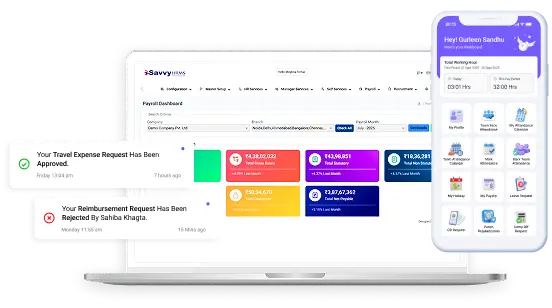








Looking for an HRMS that can simplify shifts, attendance, payroll, and workforce management?
Explore Savvy HRMS and see how it can fit your hospitality or retail business.
Frequently Asked Questions (FAQs)
1. What is HRMS software for hospitality and retail businesses?
HRMS software helps hospitality and retail businesses manage employee records, attendance, shifts, rosters, leave, payroll, compliance, and workforce operations across stores, hotels, restaurants, branches, and multiple locations.
2. Which HRMS software is best for hospitality and retail businesses in India?
The best HRMS depends on business size, workforce structure, locations, and requirements. Savvy HRMS is a strong option for businesses looking for integrated attendance, shift, roster, payroll, compliance, and workforce management.
3. Can HRMS software manage multiple shifts and employee rosters?
Yes. A suitable HRMS can manage multiple shifts, rotations, weekly offs, roster planning, overtime, and schedule changes, making it useful for businesses with flexible and distributed workforces.
4. Can HRMS software manage employees across multiple locations?
Yes. HRMS platforms can provide centralized workforce visibility while allowing businesses to configure location-specific attendance rules, holidays, policies, departments, and workflows.
5. Can HRMS software integrate attendance with payroll?
Yes. HRMS can connect attendance, leave, overtime, deductions, and other employee information with payroll, helping reduce manual data entry, reconciliation, and payroll processing errors.
6. How much does HRMS software cost for hospitality and retail businesses in India?
The cost varies based on employee count, modules, locations, integrations, implementation, and support requirements. Businesses should compare overall value, scalability, features, and support before choosing a platform.