

Payroll Software Price in India: 2026 Buyer’s Guide


-
AuthorRaghvendra Bhardwaj
-
 Last Updated
August 24, 2026
Last Updated
August 24, 2026
-
 Reading Time
16 Mins
Reading Time
16 Mins
How much should you actually budget for payroll software in India in 2026? With dozens of HRMS and payroll platforms offering different pricing structures, choosing the right solution can feel confusing. The lowest monthly price is not always the most cost-effective option for your business.
Payroll software pricing in India can depend on employee count, modules, payroll complexity, implementation, integrations, and support. In this guide, we’ll break down payroll software costs, pricing models, company-size-wise estimates, leading providers, hidden charges, ROI, and the key factors to consider before buying.
How Much Does Payroll Software Cost for Indian Businesses in 2026?
There is no single payroll software price in India because providers use different pricing models. In 2026, businesses can find solutions starting from ₹0 for limited free plans and moving to ₹2,000-₹7,000+ per month for entry-level paid plans, while enterprise platforms generally provide customised quotations.
For example, Savvy HRMS currently lists its Core plan at ₹4,500/month, starting from ₹90 per employee, while its Edge plan starts at ₹6,000/month or ₹120 per employee. Its pricing varies according to employee strength and selected modules.
Other providers use different structures. Some list a free plan for up to 20 employees, while their Core plan is ₹4,999/month for up to 50 employees, plus ₹69/month for each additional employee. Its Premium and Ultimate plans start at ₹5,999 and ₹6,999 per month, respectively.
So, instead of asking only, “What is the cheapest payroll software?”, a better question is:
“What will my total payroll software cost be after employee count, required modules, implementation, integrations, taxes, and support are considered?”
That distinction can make a significant difference when comparing payroll software in India.
A simple payroll software cost example
Suppose a company has 100 employees and chooses a payroll solution priced at approximately ₹80 per employee per month.
Its basic software cost would be:
100 employees × ₹80 = ₹8,000/month
That means:
₹8,000 × 12 = ₹96,000/year
However, the actual annual investment may be higher if the provider charges separately for implementation, additional HR modules, integrations, premium support, or other services.
For comparison, some providers’ published FY 2026 calculator shows an example of 100 employees on its Essential plan at ₹4,745/month before taxes, based on ₹2,495 for the first 50 employees and ₹45 per additional employee.
This is why comparing only the headline monthly price can sometimes be misleading.
What Are the Different Payroll Software Pricing Options in India?
Payroll software providers in India generally use one or more of the following pricing models. Understanding these models makes it easier to compare quotations from different vendors.
1. Per-employee pricing
Under this model, you pay according to the number of employees managed through the system.
For example, if a provider charges ₹50 per employee per month and you have 200 employees:
200 × ₹50 = ₹10,000/month
This model can be attractive for growing businesses because costs generally increase alongside workforce size.
2. Flat monthly pricing
Some payroll software providers charge a fixed monthly subscription for a defined employee limit.
For example:
- Up to 50 employees: ₹4,000/month
- Up to 100 employees: ₹7,000/month
- Up to 250 employees: ₹12,000/month
This approach makes monthly budgeting relatively straightforward.
3. Base fee + per-employee pricing
This is another common model. You pay a fixed base amount covering a certain number of employees and then an additional amount for employees beyond that limit.
For example, a provider currently publishes plans that combine a standard monthly price with an additional per-employee-per-month charge above the included employee threshold.
4. Module-based pricing
Some HRMS platforms allow businesses to select specific modules rather than purchasing everything.
For example, a company might initially need:
Later, it may add:
- Recruitment
- Performance management
- Expense management
- Travel management
- Asset management
This can be useful when you want to control your initial HR software investment.
Savvy HRMS follows a modular approach, with its pricing varying according to employee count and selected modules.
5. Custom enterprise pricing
Large organizations often require more complex payroll structures, multiple entities, advanced integrations, custom workflows, dedicated support, or implementation services.
In such cases, vendors may not publish a fixed price and instead provide a customised quotation.
This is common with enterprise-focused payroll and HCM platforms.
Which pricing model is best?
There is no universally best model.
A small company may prefer a flat monthly subscription because it is predictable. A rapidly growing business may prefer scalable per-employee pricing. A larger organization may benefit from negotiating a customised enterprise package.
The right choice depends on your employee count, payroll complexity, required modules, and expected growth.
What Factors Affect Payroll Software Pricing in India?
Why can two payroll software providers quote completely different prices for apparently similar solutions?
The answer usually comes down to what is included in the package.
1. Employee strength
Employee count is one of the biggest pricing factors. A 30-employee company and a 3,000-employee organization will usually have very different requirements and software costs.
2. Payroll complexity
Payroll becomes more complicated when businesses manage:
- Multiple salary structures
- Variable pay
- Incentives
- Overtime
- Loans and advances
- Reimbursements
- Full & final settlements
- Multiple locations
- Multiple legal entities
- Complex deductions
A simple salary-processing requirement may cost less than an enterprise payroll environment with several layers of configuration.
3. HR modules
Payroll rarely works in isolation. Businesses often connect payroll with attendance, leave, employee information, recruitment, performance, expenses, and other HR processes.
Adding more modules can increase the overall HRMS cost.
4. Statutory compliance
Indian payroll requires attention to areas such as Provident Fund (PF), Employees’ State Insurance (ESI), Professional Tax (PT), Labour Welfare Fund (LWF), Tax Deducted at Source (TDS), Form 16, and other applicable statutory requirements.
A payroll platform that automates calculations, reports, challans, and compliance workflows can offer greater value than a basic salary calculator.
Savvy HRMS, for example, includes payroll and statutory compliance capabilities covering areas such as PF, ESIC, UAN, TDS, LWF, and PT within its payroll functionality.
5. Integrations
If your payroll needs to connect with accounting software, biometric devices, banking systems, ERP platforms, APIs, or other business applications, integration requirements can affect pricing.
6. Implementation and onboarding
A simple cloud payroll implementation may require limited configuration. A large company with historical payroll data, multiple entities, customised workflows, and integrations may need more implementation support.
7. Support and service level
Pricing can also vary depending on whether you receive standard support, dedicated account management, priority support, training, or managed payroll services.
How Much Does Payroll Software Cost Based on Company Size?
Company size provides a useful starting point when estimating payroll software costs, although actual quotations vary by vendor.
| Company Size | Typical Employee Count | Approx. Monthly Budget* | Suitable Pricing Approach |
| Micro business | 1-20 | ₹0-₹3,000 | Free or basic plan |
| Small business | 21-50 | ₹2,500-₹6,000 | Flat or base + employee |
| Growing business | 51-100 | ₹4,000-₹10,000 | Per-employee or modular |
| Medium business | 101-500 | ₹8,000-₹30,000+ | Scalable subscription |
| Large business | 501-1,000+ | ₹20,000-₹75,000+ | Custom enterprise pricing |
| Enterprise | 1,000+ | Custom quote | Enterprise/custom package |
These are indicative budgeting ranges, not fixed market prices. Actual payroll software pricing depends on the vendor, modules, employee count, implementation, integrations, and contract terms.
The important point is that company size should not be the only factor in your decision. A 100-employee company with complex payroll requirements may need a more advanced platform than a 300-employee organization with straightforward salary processing.
What Features Are Usually Included in Payroll Software Pricing Plans?
When comparing payroll software prices in India, always look beyond the number displayed on the pricing page.
A good payroll solution may include several capabilities within the subscription.
1. Payroll Processing
A good payroll system automates salary calculations using attendance, leave, overtime, deductions, incentives, reimbursements, and other salary components, reducing manual work and calculation errors.
2. Salary Structure Management
Payroll software should allow businesses to create and manage different salary structures based on:
- Departments
- Employee grades
- Job roles
- Locations
- Employment categories
3. Statutory Compliance
Payroll software should help businesses manage important Indian payroll compliance requirements, including:
- Provident Fund (PF)
- Employees’ State Insurance (ESI)
- Professional Tax (PT)
- Labour Welfare Fund (LWF)
- Tax Deducted at Source (TDS)
- Form 16
- Statutory reports
4. Payslip Generation
Employees can access digital payslips directly through the system, making salary information easier to view while reducing repetitive requests handled by HR teams.
5. Employee Self-Service
An Employee Self-Service (ESS) portal can help employees independently:
- View and download payslips
- Check attendance
- Apply for leave
- Submit HR requests
- Access important documents
- View tax-related information
6. Attendance and Leave Integration
Integrating attendance and leave with payroll allows approved employee data to flow automatically into salary processing, helping HR teams save time and reduce manual data entry.
7. Full & Final Settlement
For employees leaving an organization, payroll software can simplify full and final settlement by managing:
- Pending salary
- Leave encashment
- Deductions
- Loans or advances
- Notice-period adjustments
- Other settlement components
8. Reports and Analytics
Payroll reports give HR and finance teams a clearer view of salary expenses, deductions, statutory information, payroll trends, and other workforce-related data.
Savvy HRMS, for example, includes payroll capabilities such as salary structures, salary processing, loans and advances, variable salary, statutory compliance, payroll integrations, and analytical views.
Are There Any Hidden Costs in Payroll Software Pricing?
The advertised subscription price is not always the final amount you will spend.
Before signing a payroll software contract, ask the vendor about these possible additional costs:
1. Implementation fees
Some providers may charge separately for onboarding, configuration, data migration, or complex implementation.
For example, some providers state that a nominal setup fee applies to cover its onboarding process, including payroll configuration and employee data migration.
2. Additional modules
Your initial plan may not include every HR feature you eventually need. Recruitment, performance management, expense management, advanced analytics, or other modules may be priced separately.
3. Integration costs
Custom API integrations, accounting integrations, biometric integrations, or other third-party connections may involve additional charges.
4. Premium support
Some vendors offer different support tiers. Dedicated support or priority service may cost more than standard support.
5. Additional employee charges
A plan might include 50 employees but charge separately for every employee above that threshold.
6. Taxes
Always check whether the quoted amount is before or after GST.
For example, some providers explicitly state that their published prices exclude applicable taxes, with GST applied to the final invoice.
7. Data migration
If you are moving from spreadsheets or another HRMS, ask whether historical employee and payroll data migration is included.
8. Customization
Custom workflows, reports, salary rules, dashboards, or integrations may increase the total cost.
Tip: Before buying payroll software, ask the vendor for a complete Total Cost of Ownership (TCO) estimate for at least 12 months.
How Does Payroll Software Pricing Compare Across Top Providers in India?
Pricing comparison becomes more useful when you look at both cost and what the platform includes.
Here is a simplified comparison of 5 popular payroll and HRMS platforms in India. Public pricing availability varies, so where a vendor does not publish a comparable price, you should request a customised quote.
| Payroll Software | Public Pricing Information | Payroll/HR Capabilities | Best Suited For |
| Savvy HRMS | Core from ₹4,500/month; starts from ₹90/employee (Customizable pricing also available) | Payroll, statutory compliance, attendance, leave, ESS and broader HRMS | Small, growing, mid-sized, and large businesses |
| Darwinbox | Custom pricing | India payroll, HRMS and enterprise workforce management | Mid-sized and large organizations |
| Keka | Custom pricing | Payroll, statutory compliance, attendance, expenses, tax and HR | Growing and mid-sized businesses |
| greytHR | From ₹2,495/month for Essential; first 50 employees included | Payroll, compliance, leave, attendance, ESS and HR | Small and growing businesses |
| factoHR | Free up to 20 employees; Core ₹4,999/month up to 50 employees | Payroll, HR, attendance, leave, ESS and multiple entities | Small and growing businesses |
Important: Pricing changes frequently. Treat publicly listed prices as a starting point and confirm the latest quotation, GST, implementation charges, employee limits, modules, and contract terms directly with each vendor before purchasing.
What Is the Average Payroll Software Cost Per Employee in India?
Per-employee pricing can make payroll software easier to compare, but the calculation is not always as simple as multiplying the employee count by a single number.
Suppose a provider charges ₹75 per employee per month.
For 100 employees:
100 × ₹75 = ₹7,500/month
For one year:
₹7,500 × 12 = ₹90,000/year
For 500 employees:
500 × ₹75 = ₹37,500/month
Annual cost:
₹37,500 × 12 = ₹4,50,000/year
But there is an important catch.
Some providers use a base fee + PEPM model. Others include a fixed number of employees in the base price. Some charge only for selected users for certain modules.
For example, some providers differentiates between PEPM (per employee per month) and PUPM (per user per month) for different services and modules.
Therefore, when a vendor tells you the software costs “₹X per employee,” ask:
- Is there a minimum monthly charge?
- Is the price based on total headcount?
- Are inactive employees billed?
- Are contractors included?
- Are all modules included?
- Is GST included?
- Are implementation charges separate?
- Is support included?
That will give you a much more realistic payroll software cost estimate.
How Can You Calculate the ROI of Payroll Software?
Payroll software ROI should not be measured only by the subscription price.
You should consider the time saved, errors avoided, compliance risks reduced, and productivity gained.
A simple formula is:
Payroll Software ROI = (Annual Benefits − Annual Software Cost) ÷ Annual Software Cost × 100
Suppose your business spends:
- ₹1,20,000 per year on payroll software
- ₹2,00,000 worth of HR/finance employee time saved
- ₹80,000 in estimated avoided payroll-error and correction costs
- ₹50,000 in other operational savings
Total annual benefit:
₹3,30,000
ROI:
(₹3,30,000 − ₹1,20,000) ÷ ₹1,20,000 × 100
= 175%
The exact numbers will vary, but the calculation shows why payroll software should be evaluated as an investment, not simply an expense.
For your own business, calculate:
- Current payroll processing hours
- HR and finance employee cost
- Average payroll errors per year
- Cost of correcting those errors
- Time spent answering employee payroll queries
- Compliance-related administrative effort
- Cost of manual reporting
- Software subscription cost
Then compare your current process with the expected automated process.
What Should You Look for Before Buying Payroll Software?
Price is important, but it should never be the only deciding factor.
Before purchasing payroll management software in India, evaluate these areas.
1. Payroll automation
Check whether the platform can automate salary calculations, deductions, overtime, variable pay, reimbursements, loans, and other payroll components.
2. Indian statutory compliance
Make sure the software supports the statutory requirements relevant to your organization, including PF, ESI, PT, LWF, TDS, and applicable payroll reports.
3. Scalability
A 50-employee business may become a 200-employee business sooner than expected. Choose software that can scale without forcing you to replace the platform.
4. Attendance and leave integration
Payroll becomes much easier when approved attendance and leave information automatically flows into salary processing.
5. Employee self-service
An ESS portal or mobile app can reduce repetitive payroll questions by giving employees direct access to payslips, tax documents, leave information, and requests.
6. Security and access controls
Payroll contains highly sensitive employee and salary information. Check user permissions, role-based access, authentication, data security, backups, and audit capabilities.
7. Reporting
Look for payroll registers, statutory reports, salary reports, reconciliation reports, analytics, and downloadable reports.
8. Integrations
If you already use accounting software, biometric systems, ERP tools, banking platforms, or other applications, verify integration capabilities.
9. Customer support
Ask about onboarding, training, response times, support channels, escalation processes, and dedicated account management.
10. Transparent pricing
Finally, ask for the complete annual cost, not just the monthly subscription price.
A good quotation should clearly mention employee limits, modules, implementation, integrations, support, taxes, renewal terms, and additional charges.
How to Choose the Right Payroll Software for Your Organization?
Choosing payroll software becomes much easier when you work backward from your actual business requirements.
Start with your employee count.
Then list the payroll problems you want to solve.
For example, are you struggling with:
- Manual salary calculations?
- Attendance-to-payroll errors?
- PF and ESI calculations?
- TDS management?
- Payslip distribution?
- Employee payroll queries?
- Full & final settlements?
- Multiple salary structures?
- Multiple company or location management?
- Payroll reporting?
Once you know the problems, identify the features required to solve them.
1. Small businesses
If you have fewer than 50 employees, prioritize affordability, payroll automation, statutory compliance, payslips, ESS, and ease of use.
2. Growing businesses
For 50-500 employees, look for scalability, attendance and leave integration, configurable salary structures, employee self-service, reporting, integrations, and stronger access controls.
3. Large businesses
For 500+ employees, consider multiple entities, advanced workflows, integrations, API capabilities, security, audit controls, implementation support, and enterprise-level service.
A simple 5-step buying process
Step 1: Calculate your current payroll cost
Include HR time, finance time, manual work, errors, reporting, and compliance administration.
Step 2: Define your must-have features
Separate essential features from nice-to-have features.
Step 3: Shortlist 3-5 payroll software providers
Compare vendors on features, pricing, scalability, support, and user experience.
Step 4: Request a customised quotation
Ask each vendor for the total annual cost based on your actual employee count.
Step 5: Take a demo before buying
A demo can reveal whether the software actually fits your payroll workflow.
For businesses looking for a scalable Indian HRMS with integrated payroll, Savvy HRMS is worth considering. Its platform combines payroll and statutory compliance with HR, attendance, leave, employee self-service, and other workforce-management capabilities.
Conclusion
Payroll software pricing in India in 2026 can range from free plans for very small teams to customised enterprise pricing for large organizations. The right choice depends on employee count, payroll complexity, required modules, compliance needs, integrations, support, and total cost, not simply the lowest advertised price.
If you want a scalable HR and payroll platform with transparent starting plans, Savvy HRMS offers payroll, statutory compliance, attendance, leave, ESS, and additional HR capabilities in a modular HRMS environment. Its published pricing starts from ₹4,500/month for the Core plan, with pricing designed to scale according to business requirements.

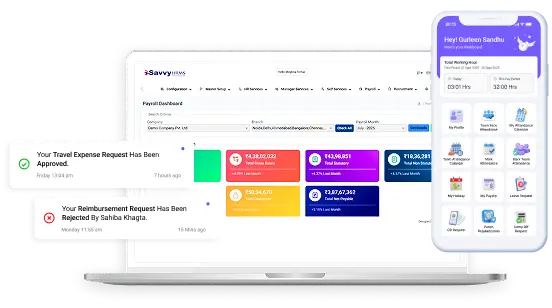









Ready to simplify payroll and reduce manual HR work?
Explore Savvy HRMS today and book a free demo to find the right plan for your organization.
Frequently Asked Questions (FAQs)
1. How much does payroll software cost in India in 2026?
Payroll software in India can range from free plans to ₹5,000+ per month for standard solutions, while enterprise platforms may use customized pricing based on employee count, modules, and requirements.
2. What is the average payroll software cost per employee in India?
The cost can vary significantly by provider and pricing model. Some payroll software may charge around ₹50-₹150 per employee per month, while others use fixed plans or a combination of base fees and per-employee charges.
3. What factors affect payroll software pricing?
Payroll software pricing depends on employee count, payroll complexity, HR modules, statutory compliance features, integrations, implementation, customization, support, and contract terms. Businesses should compare the total annual cost rather than only the advertised monthly price.
4. Is payroll software worth the cost for small businesses?
Yes. Payroll software can help small businesses reduce manual calculations, save HR time, simplify statutory compliance, automate payslips, and minimize payroll errors. The right solution can provide value even with a relatively small workforce.
5. What should I check before buying payroll software in India?
Check pricing, payroll features, statutory compliance, employee limits, integrations, security, scalability, customer support, implementation costs, and hidden charges. Request a complete quotation and product demo before making your final decision.