Full and Final Settlement in India: Rules, Process & Calculation



-
AuthorS.K. Gupta
-
 Last Updated
November 13, 2026
-
 Reading Time
22 Mins
TL;DR
- Full and final settlement is the process of calculating and paying an employee’s outstanding dues when their employment ends with the employers.
- According to Section 17(2) of the Code on Wages, 2019, the wages are payable on resignation, dismissal, removal, retrenchment or closure must generally be paid within two working days of the relevant exit event.
- Gratuity has a separate payment timeline which comes under Section 56 of the Code on Social Security, 2020, it must generally be paid within 30 days from the date it becomes payable.
- FnF may include unpaid salary, earned leave encashment, eligible gratuity, pending bonus or incentives, reimbursements and notice pay.
- Deductions may include notice-period recovery, outstanding loans, applicable taxes and permitted recovery for loss or damage. They must have a valid basis and comply with applicable law.
- The 50% wage rule under the new labour codes can impact the wage calculation for some of the statutory benefits.
- Employers should provide an itemised settlement statement and maintain records of calculations, approvals and payments.
When an employee resigns, retires or is terminated, the employer must calculate and clear all outstanding payments and recoveries before closing the employment relationship. This whole process is known as full and final settlement (FnF).
A full and final settlement may include unpaid salary, unused earned leave, gratuity, pending incentives, bonuses, reimbursements and other eligible dues. It may also account for lawful deductions such as notice-period recovery, outstanding loans, applicable taxes and unreturned company assets.
In 2026, companies should keep a close eye on the labour law amendments that were effective in India on 21 November 2025. As per Section 17(2) of the Code on Wages, 2019, wages payable to an employee on resignation, retrenchment, or removal of service, or when they are retrenched or have become unemployed due to an establishment’s closure, must be paid within two working days. This date should not be mistaken with the time-limit of any other element of the FnF settlement.
This guide explains everything about the full and final settlement in India in 2026, including applicable laws, payment timelines, components, calculation methods, taxation, employee exit scenarios and the responsibilities of employers.
What Is Full and Final Settlement (FnF)?
Full and final settlement, commonly called FnF or F&F settlement. It is the process of calculating and clearing all outstanding financial dues between an employer and an employee when the employment relationship ends.
It ensures that the employee receives the payments they have earned and that any legitimate outstanding amounts payable by the employee are accounted for.
FnF settlement generally applies when an employee leaves an organization because of:
- Resignation: The employee voluntarily decides to leave the organization.
- Termination: The employer ends the employment relationship in accordance with applicable law and employment terms.
- Retirement: The employee completes their service and retires.
- Retrenchment: The employer terminates the services of an employee for reasons recognized under relevant industrial relations legislation.
- Completion of a fixed-term contract: The agreed employment period comes to an end.
- Death during service: Outstanding dues are settled with the employee’s nominee or legal heirs, as applicable.
For example, suppose an employee resigns on 15 November 2026 after working for six years. The employer must calculate the salary payable for the days worked in November, eligible unused leave, gratuity if applicable, pending reimbursements and other dues. Any lawful deductions must also be considered before arriving at the net settlement amount.
In simple terms, FnF settlement closes the financial relationship between an employer and an employee. It is different from simply processing the employee’s last month’s salary because it can include several statutory and contractual payments.
What Are the New FnF Rules For 2026 in India?
In India, full and final settlement is controlled by various tax and labour provisions. The defined rules depend on the type of payment, the employee’s exit reason, the employment arrangement and the state where the employee works.
The four Labour Codes came into effect on 21 November 2025 as they brought several existing central labour laws together and introduced changes to wages, social security and employee separation.
As employers should refer to the Ministry of Labour and Employment’s official FAQs, rules and guidelines to understand these changes and update their HR policies accordingly.
Let’s understand what are the key provisions which core HR teams and employees should understand.
1. Wages must be paid within two working days
According to section 17(2) of the Code on Wages, 2019, wages payable to the employee shall be paid within 2 working days of the day following the time when the wages are due if the employee:
- Is removed or dismissed from service.
- Is retrenched.
- Resigns from service.
- Becomes unemployed because the establishment closes.
This provision makes timely payment of wages an important part of the employee exit process.
But the legal language says it’s wages payable. It shouldn’t be consider that every FnF component (including gratuity and PF withdrawal) is a matter of course to be processed and paid within two working days. There are separate laws and procedures for those which will discuss later.
2. The definition of wages has changed
The Code on Wages, 2019 introduces a common definition of wages for the purposes covered by the Code.
It includes basic pay, dearness allowance and retaining allowance, if any. Certain payments are excluded from the definition. However, if the excluded components exceed 50% of the total remuneration, the excess amount is added back to wages, subject to the statutory definition.
This is commonly referred to as the 50% wage rule.
For example, suppose an employee earns ₹60,000 per month, including ₹36,000 in allowances. If the excluded allowances exceed 50% of the total remuneration then the excess amount is added back to wages when calculating wages under the Code.
The Ministry’s FAQs also explain which salary components should be included or excluded. Performance-based incentives, ESOPs and reimbursements are treated separately under these guidelines.
3. Gratuity provisions have changed for fixed-term employees
Section 53 of the Code on Social Security, 2020 mentions that employees appointed on a fixed term by an employer shall be given gratuity if they have completed one year of service with the employer.
This is different from the ordinary five-year requirement for continuous service with the employer which does not apply to other employees. However, certain exceptions such as death or disablement, may apply.
It is also clarified in the Ministry’s FAQs issued in March 2026 that the reservation of this provision for fixed-term employment applies to employees who are engaged directly by the employer as the same does not apply to contract labour engaged by a contractor.
4. Deductions from wages are regulated
Employers cannot make arbitrary deductions from an employee’s wages during FnF settlement.
The Code on Wages, 2019, in section 18, recognizes the following types of deductions from wages which are deductions for absence, deductions for fine lawfully imposed, deductions for damage or loss to an employee caused by neglect or default, and particular recoveries.
The Code also limits the amount of total deductions that can be made from wages. As a general rule the total amount of deductions for a wage period cannot be more than 50% of wages. An employer should verify the legal basis, applicable limit and supporting documents before making a recovery.
How Many Days Does it Take for a FnF Settlement in India?
The full and final settlement time limit depends on the component being paid. There is no single deadline that applies identically to salary, gratuity, PF and every other payment.
The following table summarizes the main Full and Final Settlement Timeline.
| FnF component | Applicable timeline or process |
| Wages payable on resignation, dismissal, removal, retrenchment or closure | Generally within two working days under Section 17(2) of the Code on Wages, 2019 |
| Gratuity | Generally within 30 days from the date it becomes payable under Section 56 of the Code on Social Security, 2020 |
| EPF transfer or withdrawal | Governed by the applicable EPFO claim and transfer process |
| Retrenchment compensation | Governed by the Industrial Relations Code and applicable provisions for retrenchment |
| Notice pay | Depends on the applicable employment terms and circumstances of separation |
| Other contractual dues and reimbursements | Depends on the relevant contract, policy and applicable law |
Is the two-working-day rule applicable to every FnF component?
No. This is an important distinction for both employers and employees.
The two-working-day deadline under Section 17(2) applies to wages payable on the specified types of employment separation. It does not automatically replace the separate statutory process for gratuity or the EPFO process for PF transfer and withdrawal.
For example, if an employee resigns on 10 November:
- Wages payable for the days worked must generally be paid within two working days.
- Eligible gratuity must be processed within its separate statutory timeline.
- PF transfer or withdrawal must be initiated through the applicable EPFO process.
- Other contractual dues must be settled according to their governing terms and applicable law.
Employers should not use the separate processing timelines for gratuity or PF as a reason to delay wages that are already due.
What Are the Components of Full and Final Settlement?
A full and final settlement statement generally includes two categories which are payments due to the employee and deductions or recoveries that may lawfully be made.
The exact components depend on the employee’s salary structure, tenure, leave balance, employment agreement, company policies and applicable statutory provisions.
A. Amounts payable to the employee
These are the payments an employer may need to include in the Full and Final Settlement calculation.
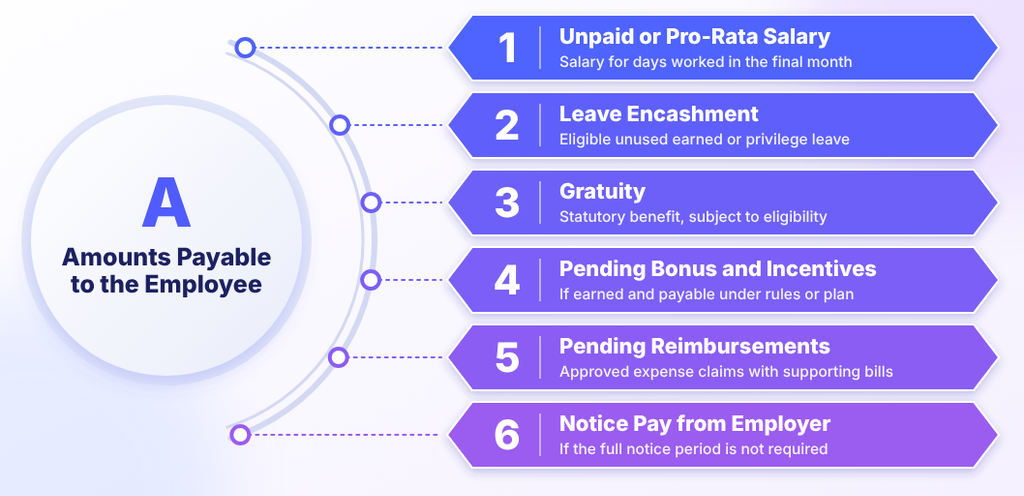
1. Unpaid or pro-rata salary
The employer must calculate salary for the days the employee worked during the final month but has not yet been paid for.
2. Leave encashment
Employees may receive payment for eligible unused earned or privilege leave accumulated during their employment.
The encashable days and calculations vary in accordance with the relevant state’s legislation, employment conditions, and leave policy of the company. Casual leave and sick leave should not be ignored, but the lex cantus which applies to them should be taken into account.
3. Gratuity
Gratuity is a statutory benefit paid to a worker in case of terming his employment on account of resignation, retirement, termination or layoff.
Under the Code on Social Security, 2020, the general eligibility requirement is five years of continuous service. This requirement does not apply in certain cases, including death, disablement and expiration of fixed-term employment. Fixed-term employees directly engaged by the employer can qualify after one year of service under the contract.
4. Pending bonus and incentives
If an employee has earned a bonus, incentive or performance-linked payment that remains unpaid, the employer should check whether it is payable under the applicable statutory provisions, incentive plan or employment terms.
For example, an employee who has completed the performance period and met the conditions for an incentive may have a pending payment that needs to be considered during settlement.
5. Pending reimbursements
Employees may have submitted business-related expense claims that have not yet been processed.
These may include:
- Travel and accommodation expenses.
- Client meeting expenses.
- Fuel and local conveyance claims.
- Telephone or internet expenses.
- Other approved business expenses.
The employer should verify the claims against the organization’s reimbursement policy and supporting bills.
6. Notice pay from the employer
If an company releases an employee without requiring them to serve the full notice period, notice pay may be payable depending on the employment agreement and the circumstances of separation.
The amount should be calculated according to the applicable contractual terms.
B. Deductions from the employee’s settlement
The employer may also need to account for outstanding amounts that the employee owes. However, a deduction should not be made merely because the organization wants to reduce its FnF liability.
Common deductions include:
1. Notice-period recovery
If an employee does not serve the required notice period, the employer may seek recovery for the unserved period where the employment agreement or applicable policy permits it.
2. Outstanding loans and salary advances
Any unpaid balance of a company loan or salary advance may be considered for recovery, subject to the relevant agreement and applicable deduction rules.
3. Tax deductions
Tax may be deducted from taxable components of the settlement according to the income-tax provisions applicable to the payment and tax year.
4. Professional tax
Professional tax may apply depending on the state and the employee’s applicable salary and employment circumstances. You can use a free professional tax tool to calculate the the tax.
5. Recovery for company assets
If an employee fails to return company property, such as a laptop, phone, access card or other equipment, the employer may examine whether recovery is permitted under the applicable law, employment terms and documented asset policy.
The employer should establish the actual loss and the employee’s responsibility rather than automatically deducting the asset’s original purchase price.
Important: The Code on Wages only permits certain items to be deducted from wages, and only up to a certain limit. Remember to distinguish deductions from wages from other contractual deductions, and seek legal advice in areas where the treatment is uncertain.
How to Calculate Full and Final Settlement in India?
To calculate full and final settlement in India, an employer must add all eligible payments due to the employee and subtract valid deductions.
The basic formula is:
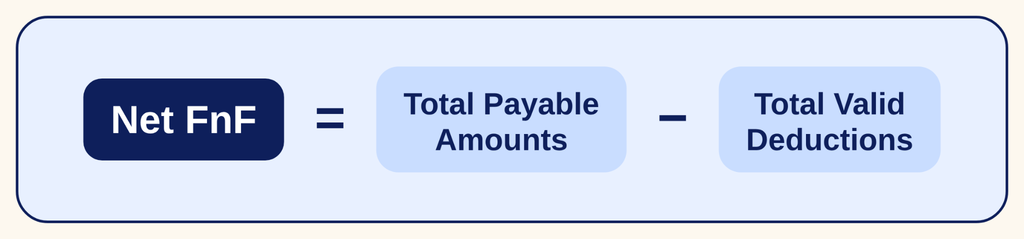
The calculation generally involves the following steps:
- Calculate unpaid salary up to the last working day.
- Calculate eligible unused leave encashment.
- Determine gratuity eligibility and calculate the amount, if applicable.
- Add pending bonus, incentives and approved reimbursements.
- Calculate notice-period recovery or other permissible deductions.
- Calculate applicable tax and statutory deductions.
- Arrive at the final net amount payable.
What is the formula for calculating unpaid salary?
A commonly used illustrative formula is:
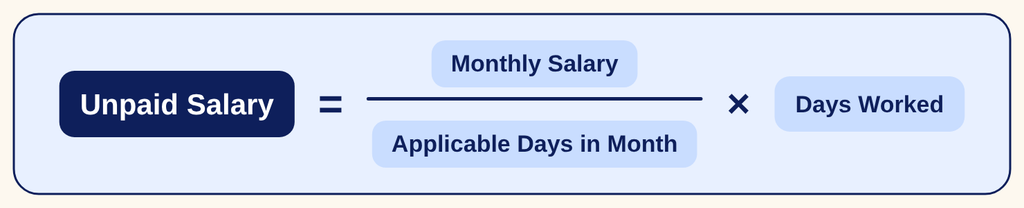
For example, suppose an employee earns ₹60,000 per month and works for 15 days in a month. If the organization uses 30 days as the divisor:
60,0003015=₹30,000
The applicable divisor and salary basis should be determined by the relevant law, employment terms and payroll policy. The employers should not assume that every organization must use the same divisor.
What is the formula for calculating leave encashment?
The general calculation method for leave encashment is:

For example, if the applicable daily rate is ₹2,000 and the employee has 12 eligible unused earned leave days:
2,00012=₹24,000
The salary components used to determine the daily rate and the number of encashable days depend on the applicable state law and company policy.
What is the formula for calculating gratuity?
For employees covered by the standard monthly-rated gratuity formula, the commonly used calculation is:

For example, suppose an employee has:
- Last drawn eligible wages: ₹40,000 per month
- Completed years of service: 6
- Applicable gratuity rate: 15 days’ wages for each eligible year
The calculation would be:
40,00015626=₹1,38,462
This is an illustrative calculation. The wage components, service period, rounding of service and applicable statutory maximum must be checked under the Code on Social Security and relevant rules. The calculation for fixed-term employees, piece-rated employees and other special categories may differ.
Example: How is the final FnF amount calculated?
Let’s consider an employee with the following details to understand all important factor which we have discussed above:
- Monthly salary: ₹60,000
- Last working day: 15 November 2026
- Salary days payable: 15 days
- Eligible unused earned leave: 10 days
- Applicable daily salary rate for leave encashment: ₹2,000
- Pending approved reimbursement: ₹5,000
- Notice-period recovery: ₹10,000
- Outstanding loan: ₹5,000
- Illustrative tax deduction: ₹2,000
| Component | Calculation | Amount (₹) |
| Unpaid salary | ₹60,000 ÷ 30 × 15 | 30,000 |
| Leave encashment | ₹2,000 × 10 | 20,000 |
| Pending reimbursement | Approved claim | 5,000 |
| Total payable | 55,000 | |
| Notice-period recovery | As per applicable terms | (10,000) |
| Outstanding loan | As per loan agreement | (5,000) |
| Illustrative tax deduction | Based on tax calculation | (2,000) |
| Net FnF payable | 38,000 |
Note: This example is for illustration only. It excludes gratuity because eligibility and the employee’s eligible wage details have not been provided. Actual salary, leave, tax and recovery calculations may differ.
What Is the Full and Final Settlement Process?
A structured FnF process helps HR, payroll, finance and other departments to coordinate employee exits and avoid delays.
Let’s see a step-by-step Full and Final Settlement Process organizations can follow.
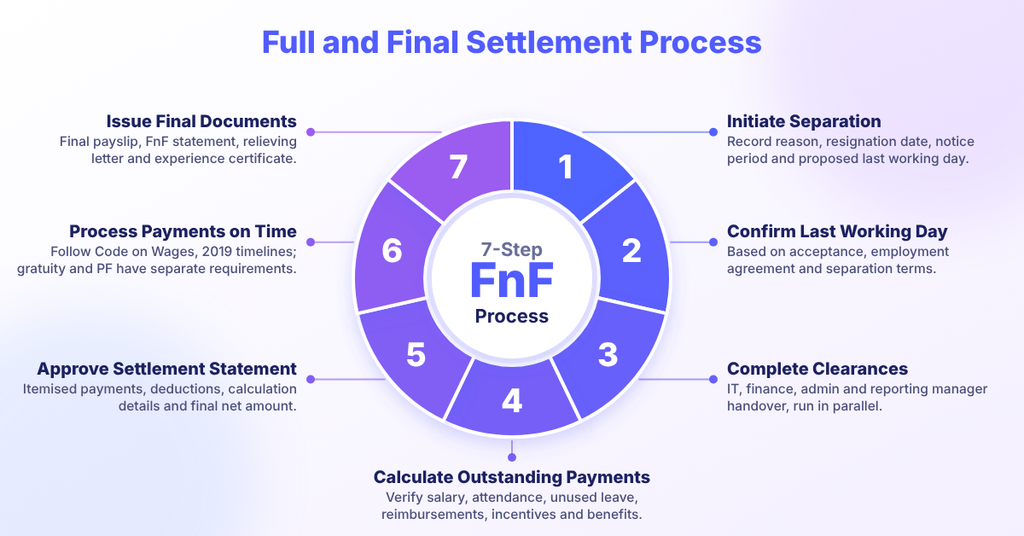
Step 1: Receive the resignation or initiate separation
The process begins when an employee resigns or the employer initiates termination then the HR should record the reason for separation, resignation date, notice period and proposed last working day.
Step 2: Confirm the last working day
Next, the HR should confirm the employee’s last working day based on the resignation acceptance, employment agreement and applicable separation terms. This date helps calculate salary, leave balance and other eligible payments.
Step 3: Complete departmental clearances
HR should coordinate clearances with relevant departments. These may include IT for company devices and access, finance for loans and advances, administration for company property, and the reporting manager for handover. Clearances should run in parallel wherever possible to save time.
Step 4: Calculate outstanding payments
Next, Payroll team should verify salary, attendance, unused leave, approved reimbursements, incentives and applicable statutory benefits. Any proposed deductions should also be checked against supporting records and applicable rules.
Step 5: Review and approve the settlement statement
Prepare an itemized statement showing payments, deductions, calculation details and the final net amount. Clearly mention payments, such as gratuity or PF, that follow separate processes. HR, finance and payroll should review the statement before approval.
Step 6: Process payments within applicable timelines
Wages payable on exit must follow the timeline under Section 17(2) of the Code on Wages, 2019 as Gratuity and PF-related claims have separate requirements.
Step 7: Issue final documents
At last, HR should provide relevant documents, such as the final payslip, FnF statement, relieving letter and experience certificate, and complete required employee records and exit formalities.
Which Documents Are Required for Full and Final Settlement?
Both employers and employees should maintain the documents needed to verify payments, deductions and employee separation details.
The following table shows the common documents used during the FnF process.
| Document | Purpose |
| Resignation or termination letter | Records the reason and date of separation |
| Resignation acceptance or separation confirmation | Confirms the agreed last working day and applicable terms |
| Appointment letter or employment agreement | Helps verify notice period, salary terms and contractual conditions |
| Last salary slips | Provides salary and deduction details |
| Attendance records | Helps calculate salary payable for the final month |
| Leave balance statement | Confirms unused eligible leave |
| Loan or salary advance records | Supports outstanding loan or advance recovery |
| Asset handover or return form | Records the return of company property |
| Reimbursement claims and bills | Supports pending business expense payments |
| FnF settlement statement | Provides an itemized breakdown of payments and deductions |
| Final payslip | Records the final payroll calculation |
| Relieving and experience letters | Documents the employee’s separation and employment history |
Depending on the employee’s circumstances, additional documents may be required for gratuity, PF transfer or withdrawal, nominee claims and tax reporting.
Employees should retain copies of the final settlement statement, payslips and relevant exit documents for future reference.
How Is Full and Final Settlement Taxed in India?
Not every component of full and final settlement receives the same tax treatment. Some payments are fully taxable, while others may qualify for exemptions subject to eligibility conditions and prescribed limits.
For payments made from 1 April 2026, the Income-tax Act, 2025 and rules applicable may be used. The Income Tax Department confirms that the new Act has been effective from 1 April 2026 and the previous Act is applicable for the Tax Years and proceedings concerning period before 1 April 2026.
The general treatment of common FnF components is as follows:
| FnF component | General tax treatment |
| Unpaid salary | Generally taxable as salary |
| Bonus and incentives | Generally taxable as salary |
| Notice pay received | Generally taxable, subject to the applicable provisions |
| Leave encashment | Tax treatment depends on whether it is received during service, on retirement or in another qualifying situation |
| Gratuity | May qualify for full or partial exemption subject to eligibility and statutory limits |
| Retrenchment compensation | May qualify for exemption subject to applicable conditions and limits |
| EPF withdrawal | Tax treatment depends on the employee’s service period and applicable conditions |
| Reimbursements | Depends on the nature of the expense, supporting documents and applicable tax provisions |
Is leave encashment taxable?
Leave encashment received during employment is generally taxable. Leave encashment received at retirement or termination may receive different treatment depending on the employee’s category and applicable tax provisions.
For example, eligible government employees may receive more favourable tax treatment than non-government employees. For non-government employees, exemptions are subject to prescribed conditions and limits.
Is gratuity taxable?
Gratuity may be fully or partially exempt from income tax depending on the employee’s eligibility, employer category and applicable statutory limits.
Employers should calculate the taxable portion, if any, using the relevant provisions rather than assuming that the entire gratuity amount is taxable or fully exempt.
Is notice pay taxable?
Notice pay received by an employee is generally treated as taxable salary income. If an employer recovers notice pay from an employee, the tax and payroll treatment should be determined based on the nature of the payment and applicable rules.
Note: Tax provisions and section references changed with the Income-tax Act, 2025. Employers should verify the applicable tax year, exemption conditions and current limits before calculating TDS on an FnF payment.
If you want then you can calculate TDS for your employees by our free tool.
What Deductions Are Allowed in Full and Final Settlement?
Employers may need to recover outstanding amounts from an employee during FnF settlement. However, the recovery must have a valid legal or contractual basis and comply with applicable wage deduction provisions.
Common deductions include:
| Deduction | When it may apply | What the employer should verify |
| Notice-period recovery | Employee does not serve the required notice period | Employment agreement and applicable terms |
| Outstanding loan | Employee has an unpaid company loan | Loan agreement and outstanding balance |
| Salary advance | Employee has an unpaid salary advance | Advance records and recovery terms |
| Asset loss or damage | Company property is lost or damaged due to the employee’s neglect or default | Evidence of loss, responsibility and lawful recovery basis |
| Professional tax | Tax is applicable in the relevant state | State-specific rules and applicable salary |
| TDS | A settlement component is taxable | Applicable income-tax provisions and tax calculation |
Employers should also consider the following:
- Deductions from wages must fall within the categories permitted by law.
- The total deductions from wages are generally subject to the 50% limit under the Code on Wages.
- Asset recovery should be based on a substantiated loss rather than an automatic penalty.
- Notice-period recovery should be assessed against the employment terms and applicable law.
- The FnF statement should show each deduction separately, along with its basis.
What Should Employees Check Before Accepting Their FnF Settlement?
Employees should review their settlement statement carefully to confirm that all payments and deductions have been calculated correctly.
Here is a checklist employees can follow before acknowledging their FnF settlement.
- Check whether salary has been calculated up to the correct last working day.
- Verify eligible unused earned leave and its encashment amount.
- Check gratuity eligibility and calculation, if applicable.
- Confirm whether pending bonus, incentives and reimbursements have been included.
- Review any notice-period recovery against the employment agreement.
- Verify outstanding loan or salary advance balances.
- Check applicable TDS and professional tax deductions.
- Confirm that asset-related recoveries are supported by a valid basis.
- Request an itemized FnF statement showing all payments and deductions.
- Keep copies of the final payslip, settlement statement and exit documents.
- Check the status of PF transfer or withdrawal separately.
Employees must document in writing any disagreement, prior to accepting an erroneous calculation as final. Verifying receipt of a settlement statement is not the same as agreeing with an unsubstantiated deduction.
Conclusion
Overall, Full and final settlement is an important part of employee separation. It helps organizations clear outstanding payments, document recoveries and complete the financial responsibilities associated with an employee’s exit.
In 2026, HR teams must pay particular attention to the two-working-day wage payment requirement under the Code on Wages, the separate gratuity provisions under the Code on Social Security and the updated wage definition. They should also review state-specific requirements, employment agreements and tax treatment before finalizing a settlement.
A structured exit process, accurate payroll records, clear departmental responsibilities and properly documented calculations can help organizations reduce settlement disputes and complete employee exits more efficiently.



Want to Make Your Full and Final Settlement Process More Efficient?
Frequently Asked Questions
1. What is the full and final settlement rule in India in 2026?
Full and final settlement is the process of clearing outstanding employee dues when employment ends. Under Section 17(2) of the Code on Wages, 2019, wages payable on resignation, dismissal, removal, retrenchment or closure must generally be paid within two working days.
2. Is full and final settlement mandatory after resignation?
Employers must pay employees the wages and other eligible dues owed to them when employment ends. This includes outstanding salary and other payments payable under applicable law, employment terms and company policy. The employee’s resignation does not remove their right to receive earned dues.
3. Can an employer hold an employee’s FnF settlement because of incomplete handover?
An employer may follow its handover and clearance procedures, but it should not use an incomplete handover as a blanket reason to withhold wages that are legally due. Any proposed recovery for a genuine loss or outstanding obligation must have a valid basis and comply with applicable law.
4. Is gratuity included in full and final settlement?
Yes. Gratuity is generally included in the employee’s exit-related dues when the employee is eligible. It is governed by the Code on Social Security, 2020 and has a separate payment timeline. Fixed-term employees directly engaged by an employer may qualify after one year of service under the contract.
5. Are employees on probation eligible for full and final settlement?
Yes. Employees leaving during probation are entitled to wages and other dues they have earned. However, gratuity, leave encashment and notice-period payments depend on statutory eligibility, applicable state law, employment terms and company policy.
6. Can an employer deduct notice-period recovery from FnF?
An employer may seek notice-period recovery where the employment agreement or applicable terms provide for it and the recovery is legally enforceable. The amount should be calculated according to the relevant terms. Employers must also comply with applicable restrictions on deductions from wages.
7. Is the two-day FnF rule applicable to private companies?
Section 17(2) of the Code on Wages, 2019 sets out the two-working-day payment requirement for wages in specified separation situations. Employers should assess its application based on the statutory definition of employee, the relevant provisions and any applicable government notification. It should not be assumed that all FnF components have the same deadline.
8. What is the 50% wage rule under the new Labour Codes?
The 50% wage rule is part of the definition of wages under the Code on Wages, 2019. If the excluded components of remuneration exceed 50% of total remuneration, the excess is added back to wages for the purposes of the Code. This can affect the wage base used for certain statutory calculations.
9. Are fixed-term employees eligible for gratuity after one year?
Yes. Under Section 53 of the Code on Social Security, 2020, fixed-term employees directly engaged by an employer can qualify for gratuity after completing one year of service under the contract. This provision is distinct from the general five-year continuous-service requirement applicable to other employees.
10. What documents should an employee receive after FnF settlement?
Employees should request an itemized FnF statement and final payslip. Depending on the organization and separation circumstances, they may also receive a relieving letter, experience certificate, tax documents and relevant PF-related information or claim support.