15 Essential Employee Handbook Policies Every Indian Company Should Have


-
AuthorAvkash Maurya
-
 Last Updated
November 11, 2026
-
 Reading Time
22 Mins
TL;DR
An employee handbook should explain the rules, benefits, responsibilities and procedures that guide employees throughout their time with an organization. Here are 15 important policies Indian companies should consider:
- Employment terms and conditions: Explain working arrangements, probation, confirmation, notice periods and employment expectations.
- Employee code of conduct: Set standards for professional behaviour, workplace ethics and conflicts of interest.
- Attendance and working hours: Define office timings, attendance recording, punctuality, shifts and overtime procedures.
- Leave and holidays: Explain leave types, eligibility, application procedures, approvals and holiday schedules.
- Compensation and payroll: Clarify salary components, payroll cycles, deductions, payslips and statutory contributions.
- Employee benefits and reimbursements: Document insurance, allowances, expense claims and other benefits.
- POSH and anti-harassment: Explain how employees can report sexual harassment and how complaints are handled.
- Equal opportunity and non-discrimination: Establish fair and respectful treatment at work.
- Workplace health and safety: Define safety responsibilities, emergency procedures and incident reporting.
- Remote and hybrid work: Set expectations for employees working outside the office.
- IT, data security and acceptable use: Explain how employees should use company devices, systems and information.
- Performance management and appraisal: Describe performance reviews, feedback, goal-setting and improvement plans.
- Disciplinary action and grievance redressal: Explain how misconduct and workplace complaints are addressed.
- Training and professional development: Outline learning opportunities, training expectations and development support.
- Resignation, termination and exit: Explain notice periods, handover, asset returns, final settlement and exit formalities.
An employee handbook helps employees understand how a company operates, what the organization expects from them and where they can find guidance on workplace matters. It brings important workplace rules, procedures, employee benefits and responsibilities together in one accessible document.
For Indian companies, an employee handbook should cover more than basic office rules. It should explain employment terms, attendance, leave, salary, workplace conduct, prevention of harassment, data security, performance management and exit procedures. It should also reflect the labour and employment laws applicable to the organization.
In this guide, we cover 15 essential employee handbook policies, explain what each should include and share practical examples to help HR teams create a clear and useful handbook.
What Is an Employee Handbook?
An employee handbook is a document that brings together an organization’s workplace policies, employment guidelines, employee benefits, rules and procedures. It helps employees to understand their rights and responsibilities while giving Core HR teams a consistent reference for communicating workplace expectations.
An employee handbook typically covers:
- Company introduction, values and workplace culture.
- Employment terms and conditions.
- Working hours, attendance and leave.
- Salary, benefits and reimbursements.
- Workplace conduct and disciplinary procedures.
- Health, safety and employee well-being.
- Data security and confidentiality.
- Performance management and employee development.
- Resignation and exit procedures.
For example, when an employee wants to understand the casual leave application process, they should be able to refer to the handbook and find the eligibility criteria, application steps and approval process.
An employee handbook is not simply a collection of legal documents. It translates company policies into practical information employees can understand and follow.
What Is the Difference Between an HR Policy and an Employee Handbook?
An HR policy explains a specific workplace rule or procedure, while an employee handbook brings multiple policies together into one employee-facing document.
Although the terms are sometimes used interchangeably, they serve different purposes.
| Basis | HR Policy | Employee Handbook |
| Meaning | A formal rule or guideline covering a specific HR area | A consolidated document containing important workplace policies and guidelines |
| Scope | Usually focuses on one subject, such as leave or attendance | Covers multiple aspects of the employee lifecycle |
| Purpose | Defines how a particular workplace matter should be handled | Helps employees understand company rules, benefits and expectations |
| Audience | HR teams, managers and employees, depending on the policy | Primarily employees and managers |
| Detail | May include detailed procedures, eligibility rules and approval authority | Summarizes key rules and directs employees to detailed policies where needed |
| Example | Leave policy, POSH policy or travel reimbursement policy | A handbook containing leave, conduct, payroll, safety and exit guidelines |
For example, a company’s leave policy may explain different leave categories, eligibility, carry-forward rules and approval workflows in detail. The employee handbook can summarize the main leave rules and direct employees to the complete leave policy for further information.
In short, HR policies define individual rules, whereas an employee handbook makes those rules easier for employees to understand and access.
What Is the Importance of an Employee Handbook?
An employee handbook gives employees a common understanding of workplace expectations and helps HR teams to communicate policies consistently. Without a central reference, employees may receive different answers about leave, attendance, benefits or workplace procedures.
Let’s understand below how an employee handbook is important in the workplace as explained below:
1. Sets Clear Workplace Expectations
An employee handbook explains expected behaviour, working hours, attendance requirements, communication standards and workplace responsibilities.
It helps employees to understand what the organization expects from them from the beginning of their employment.
2. Promotes Consistent HR Practices
When policies are documented, HR teams and managers have a common reference for handling routine employee matters.
This can reduce confusion and help prevent inconsistent decisions across departments or locations.
3. Improves Employee Onboarding
New employees often have questions about company rules, leave, salary, benefits and reporting procedures.
A handbook gives them access to this information without depending entirely on verbal explanations.
4. Supports Workplace Compliance
A handbook can help to communicate important statutory requirements and company procedures related to wages, social security, workplace safety, maternity benefits and prevention of sexual harassment.
However, simply mentioning a law in the handbook does not establish compliance. Employers must separately meet the legal obligations applicable to their establishment.
5. Reduces Repeated HR Queries
Employees can refer to the handbook for common questions about attendance, leave applications, reimbursement procedures and workplace conduct.
This can reduce repetitive administrative queries and allow Core HR teams to focus on other responsibilities.
15 Essential Employee Handbook Policies Every Indian Company Should Have
An employee handbook should cover the policies employees need throughout their employment, from joining the organization to their final working day. The exact policies and their legal requirements may vary depending on the company’s industry, size, location and applicable employment laws.
The following 15 policies provide a practical starting point.
1. Employment Terms and Conditions Policy
The employment terms and conditions policy explains the basic rules governing the relationship between an employer and an employee. It helps employees to understand the conditions of their employment before and after joining.
This policy should include:
- Employment type, such as permanent, fixed-term, temporary or contractual.
- Job title, department and reporting manager.
- Date of joining and work location.
- Probation period and confirmation process.
- Working arrangements and transfer provisions.
- Notice period and separation conditions.
- Confidentiality and other relevant employment obligations.
Example: An organization may specify that new employees will undergo a probation period of three months. Their performance and suitability will be reviewed before confirmation, as subject to the terms of their appointment letter and applicable law.
HR teams should make sure the handbook is consistent with appointment letters, employment agreements and applicable laws. If any employment terms change, the related documents should also be updated.
2. Employee Code of Conduct Policy
An employee code of conduct defines the professional and ethical behaviour expected from employees. It helps to create a respectful workplace and gives employees clear guidance on acceptable and unacceptable conduct.
This policy should cover:
- Professional behaviour and workplace communication.
- Respect for colleagues, managers, customers and vendors.
- Conflicts of interest and disclosure requirements.
- Gifts, hospitality and business ethics.
- Prevention of bullying, harassment and discrimination.
- Misuse of company resources.
- Confidentiality and responsible handling of information.
- Consequences of policy violations.
Example: If an employee has a personal or financial connection with a vendor, they should inform the organization if it could affect a purchasing decision. The organization can then review the situation and decide whether the employee should take part in the decision.
Use simple language and practical examples to explain expected behaviour. Avoid unclear rules that may confuse employees about what is acceptable.
3. Attendance and Working Hours Policy
The attendance and working hours policy explains when employees are expected to work and how their attendance is recorded. It is particularly important for organizations with multiple offices, shift-based teams, manufacturing units or field employees.
This policy should include:
- Daily and weekly working hours.
- Office timings and shift schedules.
- Attendance marking procedures.
- Late arrival and early departure rules.
- Break timings.
- Overtime eligibility and approval procedures.
- Weekly offs and holidays.
- Attendance correction and regularization process.
- Rules for missed punches and unauthorized absence.
Example: If an employee forgets to mark their attendance, they can submit a correction request through the designated system. The reporting manager can then review and approve or reject the request according to company rules.
The policy should clearly explain how employees can mark their attendance and correct genuine mistakes. The policy should also mention how overtime is approved and recorded as per applicable laws.
Organizations can use Attendance Management Software to track their attendance, manage shifts, record late marks, correct missed punches and handle approval requests.
4. Leave and Holidays Policy
The leave and holidays policy explains the types of leave employees can take, eligibility conditions and the process for requesting time off. It helps employees to plan their absence and allows managers to maintain workforce availability.
This policy should cover:
- Casual leave
- Sick leave
- Earned or annual leave
- Privilege leave, where applicable
- Maternity and other statutory leave
- Public and company holidays
- Leave eligibility and accrual
- Leave application and approval procedures
- Carry-forward and encashment rules, where applicable
- Leave during notice periods
- Unauthorized absence and leave without pay
Example: An employee who needs a day of casual leave can request approval from their reporting manager in advance, except in emergencies. The manager reviews the request based on the employee’s leave balance and company rules.
Leave rules are not the same across India as the number of leave days and eligibility may depend on applicable labour laws, state rules, the type of establishment and employee category.
5. Compensation and Payroll Policy
The compensation and payroll policy explains how employees are paid and what salary-related deductions or benefits may apply which helps employees to understand their salary structure and the payroll process.
This policy should include:
- Salary structure and pay components.
- Payroll processing cycle and salary payment date.
- Attendance and leave inputs affecting salary.
- Applicable statutory deductions and contributions.
- Tax deduction and declaration procedures.
- Payslip access.
- Salary revisions and increments.
- Loan and salary advance procedures, if offered.
- Reimbursement adjustments.
- Process for reporting salary discrepancies.
Example: If an employee notices an incorrect deduction in their payslip, they can raise a payroll query with HR or the payroll team. The team reviews the attendance, leave and salary records before correcting any verified error.
The policy should explain salary components in a way employees can understand. It should also clarify that statutory deductions and contributions are calculated according to the laws and rules applicable to the employee and establishment.
A company can use Payroll Software to manage salary structures, deductions, reimbursements, payslips and payroll records more systematically.
6. Employee Benefits and Reimbursement Policy
The employee benefits and reimbursement policy explains the additional benefits employees may receive apart from their regular salary. It also describes which business-related expenses the organization will reimburse.
This policy should include:
- Health and medical insurance, where provided.
- Travel and conveyance allowances.
- Internet and telephone allowances, where applicable.
- Meal or food benefits.
- Learning and development support.
- Business travel expenses.
- Expense submission deadlines.
- Required bills and supporting documents.
- Approval authorities and reimbursement timelines.
Example: An employee travelling to another city for an official meeting may submit travel tickets, hotel invoices and eligible local transport expenses through the company’s reimbursement process. The manager verifies the expenses before forwarding them for approval.
The handbook should distinguish between statutory benefits, contractual entitlements and benefits offered voluntarily by the employer. It should also explain the conditions under which a benefit may be changed or withdrawn, subject to applicable law and contractual commitments.
7. POSH and Anti-Harassment Policy
The POSH and anti-harassment policy explains the organization’s approach to preventing and addressing sexual harassment at the workplace. It should make employees aware of prohibited conduct, reporting channels and the complaint-handling process.
This policy should include:
- A clear explanation of sexual harassment.
- Examples of prohibited behaviour.
- The organization’s commitment to a safe workplace.
- Details of the Internal Committee, where required.
- Complaint submission procedures.
- Confidentiality requirements.
- Inquiry procedures and applicable timelines.
- Protection against retaliation.
- Awareness and training initiatives.
Example: If an employee experiences unwelcome behaviour at work, they should know how to approach the Internal Committee or the designated reporting channel. The complaint should be handled through the procedure prescribed under applicable law.
Under India’s Sexual Harassment of Women at Workplace (Prevention, Prohibition and Redressal) Act, 2013, employers have specific responsibilities, including constituting an Internal Committee at workplaces where the statutory conditions apply.
A handbook should not replace the organization’s detailed POSH policy or the statutory complaint procedure. It should clearly explain how employees can access the complete policy and raise a concern.
8. Equal Opportunity and Non-Discrimination Policy
An equal opportunity policy explains the organization’s commitment to fair treatment and a workplace free from unlawful discrimination. It helps employees to understand the standards expected in recruitment, workplace interactions, performance reviews and career development.
This policy should include:
- Fair recruitment and selection practices.
- Equal access to training and development.
- Fair performance evaluation.
- Respectful workplace behaviour.
- Prohibition of unlawful discrimination and harassment.
- Reasonable accommodation, where applicable.
- A process for reporting discrimination concerns.
Example: During recruitment, candidates should be evaluated against role-related qualifications, experience and skills rather than irrelevant personal characteristics.
The policy should use language that reflects applicable legal protections and the organization’s commitment to fair employment practices. HR teams should also review recruitment, promotion and appraisal processes to identify inconsistent treatment.
9. Workplace Health and Safety Policy
The workplace health and safety policy explains how the organization protects employees from workplace hazards and responds to safety incidents. It is especially important for manufacturing units, warehouses, construction sites, laboratories and other workplaces with physical risks.
This policy should include:
- Workplace safety responsibilities.
- Use of personal protective equipment, where required.
- Fire safety and evacuation procedures.
- First-aid arrangements.
- Reporting of accidents and near misses.
- Emergency contact details.
- Workplace cleanliness and hygiene.
- Safety training and awareness.
- Procedures for handling equipment and hazardous materials, where relevant.
Example: If an employee notices a damaged electrical cable or unsafe machine, they should report it to the designated safety representative instead of attempting an unauthorized repair.
Employers should tailor this policy to the nature of their operations and applicable occupational safety requirements. A generic office safety statement may not be sufficient for a factory or industrial workplace.
10. Remote and Hybrid Work Policy
The remote and hybrid work policy explains the conditions under which employees can work from home or another approved location. It helps organizations to maintain accountability, communication and information security when employees are not physically present in the office.
This policy should include:
- Eligibility for remote or hybrid work.
- Approval and scheduling procedures.
- Expected working hours and availability.
- Attendance and work reporting.
- Communication and meeting expectations.
- Use of company devices and systems.
- Confidentiality and data security.
- Internet and equipment support, if provided.
- Conditions for returning to the office.
Example: An employee working in a hybrid arrangement may need to come to the office on fixed days and remain available during agreed working hours when working remotely.
The policy should clearly state that remote work depends on the employee’s role, business needs, employment terms and applicable laws. It should also clarify that remote work is not an automatic entitlement unless the organization has specifically approved it.
11. IT, Data Security and Acceptable Use Policy
The IT and data security policy explains how employees should use company devices, software, networks and information. It helps to protect confidential business information and personal data handled during employment.
This policy should include:
- Acceptable use of laptops, phones and other devices.
- Password and access management.
- Email and internet usage.
- Software installation and licensing.
- Handling of confidential business information.
- Employee and customer data protection.
- Rules for sharing or transferring files.
- Reporting lost devices and security incidents.
- Use of personal devices for work.
- Return of company devices and access removal during exit.
Example: An employee should not share customer records or internal salary information through a personal email account or an unauthorized file-sharing platform.
Indian organizations should review this policy in light of applicable data protection requirements, including the Digital Personal Data Protection Act, 2023 and the notified Digital Personal Data Protection Rules, 2025. The Rules have phased commencement provisions, so organizations should check the relevant enforcement timeline rather than assume every provision applies from the same date.
The policy should explain employees’ responsibilities in simple terms and direct them to the organization’s detailed information security and privacy procedures.
12. Performance Management and Appraisal Policy
The performance management policy explains how the organization sets employee goals, reviews performance and provides feedback. It helps employees to understand how their work is evaluated and what they can do to improve.
This policy should include:
- Performance review frequency.
- Goal-setting and key performance indicators.
- Role-specific evaluation criteria.
- Self-assessment procedures.
- Manager feedback and review discussions.
- Performance ratings, where used.
- Promotion and increment considerations.
- Performance improvement procedures.
- Documentation and review timelines.
Example: An employee who consistently misses agreed project deadlines may receive structured feedback, clear improvement expectations and a review timeline. If necessary, the organization may initiate a formal Performance Improvement Plan based on its documented procedure.
The policy should explain how performance decisions are made and how employees can discuss or clarify their evaluation. Avoid relying only on annual reviews; regular feedback can help employees to understand expectations throughout the year.
13. Disciplinary Action and Grievance Redressal Policy
The disciplinary action and grievance redressal policy explains how the organization handles misconduct, policy violations and employee complaints. It helps employees to understand the process for raising concerns and the steps the company may take when rules are breached.
This policy should include:
- Examples of misconduct and policy violations.
- Channels for raising workplace grievances.
- Reporting and escalation procedures.
- Investigation and documentation process.
- Opportunity for employees to respond.
- Possible disciplinary measures.
- Confidentiality and protection against retaliation.
- Appeal or review procedures, where applicable.
Example: If an employee believes that a manager has treated them unfairly, they should be able to raise the concern through HR or the designated grievance channel. The organization should review the complaint objectively and follow its documented process.
Disciplinary action should be proportionate, consistent and aligned with applicable employment laws, standing orders and contractual requirements. The handbook should not suggest that an employer can dismiss an employee without following the required procedure.
14. Training and Professional Development Policy
The training and professional development policy explains how employees can build their skills and access learning opportunities. It also helps organizations to communicate expectations around mandatory training and role-specific development.
This policy should include:
- Induction and onboarding training.
- Role-specific technical training.
- Compliance and workplace safety training.
- Leadership and management development.
- Learning platforms and available resources.
- Training nomination and approval procedures.
- Training attendance and completion requirements.
- Certification or reimbursement conditions, where applicable.
Example: A newly appointed team leader may be nominated for a management development programme covering team communication, performance feedback and conflict resolution.
The policy should explain how employees can request training and how managers identify skill gaps. It should also distinguish mandatory training from optional professional development programmes.
15. Resignation, Termination and Exit Policy
The resignation, termination and exit policy explains the procedures employees and the organization must follow when employment ends. It helps to ensure a structured transition and clarifies responsibilities before the employee’s last working day.
This policy should include:
- Resignation submission procedure.
- Notice period and applicable conditions.
- Notice period waiver or buyout, where permitted.
- Handover of work and responsibilities.
- Return of company assets.
- Withdrawal of system and building access.
- Exit interview procedure.
- Full and final settlement process.
- Issuance of relevant employment documents.
- Termination procedures, subject to applicable law.
Example: An employee who resigns should receive information about their notice period, handover responsibilities, pending leave or salary adjustments, company asset returns and the expected exit formalities.
The policy should explain the full and final settlement process without promising a fixed timeline that may conflict with applicable legal requirements. HR teams should also ensure that termination procedures follow the employee’s contract and relevant statutory protections.
Which Indian Labour Laws Should an Employee Handbook Consider?
An employee handbook should reflect the employment laws and rules applicable to the organization. However, not every law applies to every establishment in the same way. Applicability can depend on factors such as the nature of the business, number and category of employees, establishment type and state.
The following legal framework is a useful starting point for HR teams reviewing handbook content.
| Law or framework | What HR teams should review |
| Code on Wages, 2019 | Applicable provisions relating to wages, minimum wages, payment of wages, bonus and deductions |
| Code on Social Security, 2020 | Applicable social security provisions, including provident fund, employee state insurance, gratuity and maternity-related benefits |
| Industrial Relations Code, 2020 | Relevant provisions concerning industrial relations, standing orders, disciplinary matters and termination-related procedures |
| Occupational Safety, Health and Working Conditions Code, 2020 | Applicable workplace health, safety, welfare and working-condition requirements |
| POSH Act, 2013 | Prevention of sexual harassment, Internal Committee requirements and complaint redressal procedures |
| Digital Personal Data Protection Act, 2023 and Rules, 2025 | Applicable requirements concerning the processing and protection of digital personal data |
| Other applicable state and sector-specific laws | Local requirements relating to shops and establishments, holidays, leave, working hours and other employment conditions, as applicable |
India’s four Labour Codes were brought into effect on 21 November 2025. The Ministry of Labour and Employment publishes the Codes, Central Rules and related implementation notifications. So, employers should check the latest Central and relevant State or Union Territory notifications before updating their policies.
The Digital Personal Data Protection Rules, 2025 were notified with different commencement dates for certain provisions. HR teams should review the official enforcement timeline when updating employee data and privacy procedures.
| Important: This table is a general reference, not a complete legal compliance checklist. Companies should obtain professional legal advice to confirm which provisions, rules and notifications apply to their establishments. |
How to Create an Employee Handbook for Your Company
Creating an employee handbook involves more than putting existing HR documents together.
You need to identify the policies your organization requires, check applicable laws and explain workplace rules clearly. Follow these eight steps to create a useful handbook:
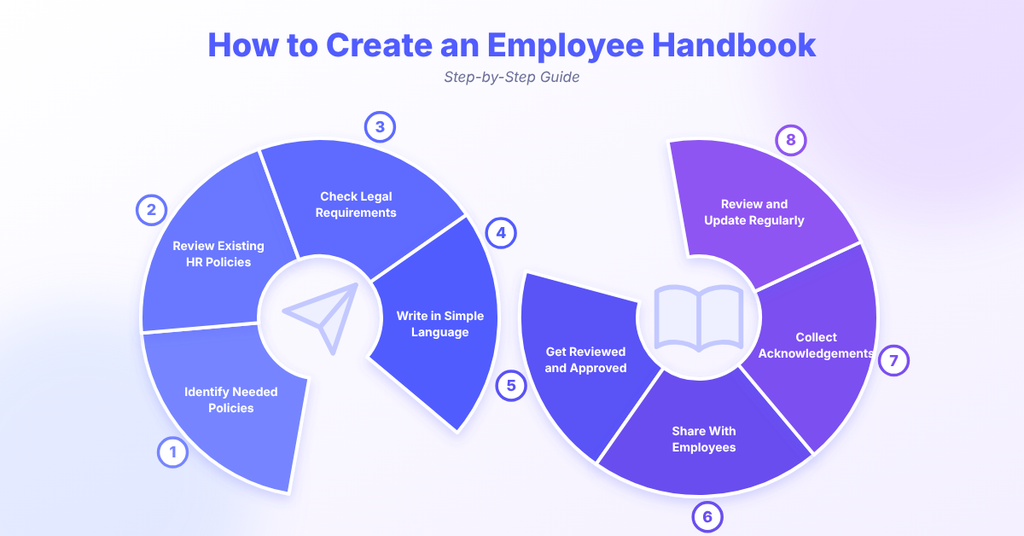
Step 1: Identify the Policies Your Organization Needs
List the policies relevant to your workforce, business operations and locations. A manufacturing company with shift-based employees may need different guidelines from an office-based business.
Step 2: Review Existing HR Policies and Procedures
Gather your appointment terms, leave rules, attendance procedures, payroll guidelines and other HR documents. Check for outdated information, missing details or conflicting rules.
Step 3: Check Applicable Legal Requirements
Next, review relevant employment laws, state-specific rules and statutory requirements. Always take help from legal guidance where necessary to confirm which provisions apply to your establishment.
Step 4: Write Policies in Simple Language
Use clear instructions to explain employee responsibilities, approval processes and reporting channels. Also, try to avoid vague statements that could create confusion.
Step 5: Get the Handbook Reviewed and Approved
Ask HR, management and relevant department heads to review the handbook. Ensure it aligns with employment agreements and detailed HR policies.
Step 6: Share It With Employees
Provide access during onboarding and make the latest version available through a central location, such as an employee portal or HRMS.
Step 7: Collect Employee Acknowledgements
Ask employees to confirm that they have received and reviewed the handbook. Maintain acknowledgement records without treating them as a waiver of statutory rights.
Step 8: Review and Update It Regularly
Update the handbook when laws, benefits or company procedures change. Maintain version numbers and effective dates so employees can identify the latest copy.
Conclusion
Overall, an employee handbook gives employees a clear reference for understanding workplace rules, benefits, responsibilities and HR procedures. For Indian companies, it should cover the complete employee lifecycle, from employment terms and attendance to performance management and exit formalities.
The most useful handbook is not necessarily the longest one. It is the one that reflects the organization’s actual practices, explains policies in simple language, considers applicable legal requirements and remains updated as the business changes.
By documenting the right employee handbook policies and making them easy to access, HR teams can promote consistency, improve communication and create a more transparent workplace.



Want to Make Employee Management Easier for Your HR Team?
Frequently Asked Questions
1. What policies should be included in an employee handbook?
An employee handbook should generally include employment terms, code of conduct, attendance, leave, payroll, benefits, POSH, equal opportunity, workplace safety, remote work, IT security, performance management, grievance redressal, training and exit procedures. The exact policies depend on the organization’s size, industry, workforce and applicable laws.
2. Is an employee handbook mandatory for companies in India?
There is no single universal requirement that every Indian company must maintain one consolidated document called an employee handbook. However, employers may have statutory obligations to maintain, communicate or display specific policies, notices, records and procedures depending on the applicable laws and establishment.
3. What is the difference between an employee handbook and an HR policy manual?
An employee handbook is generally an employee-facing document that summarizes workplace rules, benefits and expectations. An HR policy manual is usually a more detailed internal reference for HR teams and managers, covering policy rules, procedures, responsibilities and approval requirements.
4. Can a company use an employee handbook template?
Yes. An employee handbook template can help HR teams organize policy sections and prepare an initial draft. However, companies should customize it according to their employment terms, workforce, industry, locations and applicable laws. A generic template should not be treated as a legally reviewed document.
5. How often should an employee handbook be updated?
Companies should review their employee handbook periodically and whenever there are significant changes in applicable laws, company policies, employee benefits or workplace procedures. HR teams should maintain version numbers, effective dates and revision records so employees can identify the latest version.
6. Should employees sign an employee handbook?
Companies can ask employees to sign or electronically acknowledge that they have received and had an opportunity to review the handbook. This helps maintain an acknowledgement record. However, an acknowledgement does not remove statutory rights or automatically make every handbook provision enforceable.