Diwali Bonus: How to Calculate and Manage Employee Bonuses Using Payroll Software


-
AuthorRuchika Rajput
-
 Last Updated
November 05, 2026
-
 Reading Time
12 Mins
TL;DR
- Diwali bonus is an additional payment that many companies offer employees to appreciate their contributions during the festive season.
- The bonus amount and eligibility depend on the company’s policy and applicable statutory bonus rules.
- Companies may calculate Diwali bonuses as a fixed amount, a percentage of salary or a specified number of days’ salary.
- Eligible Central Government employees may receive a 30-day ad-hoc bonus, subject to the ₹7,000 monthly calculation ceiling announced for 2025-26.
- Diwali bonus is generally taxable as salary income, and employers must consider applicable TDS.
- HR teams need to check employee eligibility, calculate bonus amounts, avoid payment errors and maintain accurate records.
- Payroll software makes bonus management easier by helping Core HR teams handle calculations, process payments and maintain employee payroll records.
Diwali is one of the big occasions when many organizations reward employees with festive bonuses. It is a way to recognize their contributions and share the benefits of business growth.
However, calculating and distributing Diwali bonuses can become challenging for HR and payroll teams, particularly when they manage employees with different salary structures, joining dates and eligibility conditions.
A clear bonus policy and an efficient payroll system can make this process easier. In this guide, we will explain Diwali bonus rules, calculation methods and how payroll software helps simplify employee bonus management.
What Is a Diwali Bonus?
A Diwali bonus is an additional payment that employers provide to employees during the Diwali festival. It is generally offered as a festive benefit to appreciate employee contributions and improve workplace morale.
In India, Diwali bonus payments can broadly be classified into two categories:
- Statutory bonus: A payment that employers must provide to eligible employees in covered establishments under applicable labour laws.
- Customary or festival bonus: An additional payment provided by employers based on established practice, employment terms or company policy.
These two are not necessarily the same, so employers should understand their statutory obligations before deciding how to structure festive bonus payments.
What Are the Diwali Bonus Rules in India?
Diwali bonus rules depend on whether the payment is a statutory bonus or a festive benefit offered by the employer.
Under the Code on Wages, 2019, eligible employees working in covered establishments are entitled to statutory bonuses as per the applicable rules.
Here are some important points:
- Establishment coverage: The bonus rules apply to establishments covered under the Code.
- Employee eligibility: Employees must meet the prescribed salary and working-day requirements.
- Minimum bonus: Eligible employees will get a minimum bonus of 8.33% of the applicable calculation base.
- Maximum bonus: The statutory bonus can go up to 20% of the applicable calculation base.
- Working days: Employees generally need to work for at least 30 days in an accounting year to qualify.
It’s important to understand that a festive bonus and statutory bonus are not always the same, as employers should check the applicable rules before deciding how to calculate and pay employee bonuses.
How to Calculate Diwali Bonus for Employees?
Diwali bonus calculation depends on the company’s bonus policy. Employers may use fixed-amount, percentage-based or salary-based methods for discretionary festive bonuses.
Let’s understand how to calculate a Diwali bonus for your employees, as explained below:
1. Fixed-Amount Bonus
A fixed-amount bonus is one of the easiest ways to reward employees during Diwali. Under this method, the company decides a specific amount, and every eligible employee receives the same payment, regardless of their salary.
Example:
Suppose a company wants to give ₹5,000 to each eligible employee as a Diwali bonus. If 50 employees qualify then the total bonus budget will be ₹2,50,000.
| Particulars | Amount |
| Fixed bonus amount | ₹5,000 |
| Eligible employees | 50 |
| Total bonus expense | ₹2,50,000 |
This method works well when a company wants to offer the same festive benefit to its employees without considering differences in salary levels.
2. Percentage-Based Bonus
Some companies calculate Diwali bonuses based on a percentage of an employee’s basic salary or another salary component defined in their bonus policy.
In this method, employees with higher eligible salaries may receive a higher bonus, while those with lower salaries receive a smaller amount.
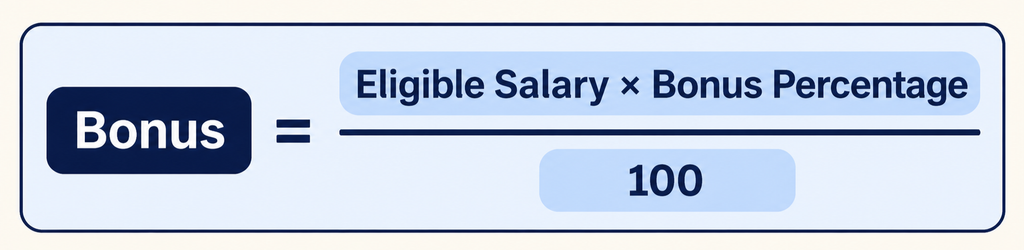
Diwali bonus calculation formula:
Example:
Suppose an employee receives a monthly basic salary of ₹25,000 and the company offers a 10% festive bonus.
Bonus = (₹25,000 × 10) ÷ 100
Diwali bonus = ₹2,500
This approach helps companies to link the bonus amount to an employee’s salary while following a consistent percentage-based policy.
3. Salary-Based Bonus
Another method is to calculate the Diwali bonus based on a fixed number of days or months salary. For example, a company may decide to offer 15 days’ basic salary as a festive bonus.
The amount an employee receives will depend on their monthly salary and the number of days covered under the company’s policy.
Example:
If a company offers 15 days basic salary as a Diwali bonus to an employee earning ₹30,000 per month:
The basic formula is:

Bonus = (Monthly Basic Salary ÷ 30) × Bonus Days
Bonus = (₹30,000 ÷ 30) × 15
Diwali bonus = ₹15,000
Note: These are illustrative company-policy calculations. They should not be confused with the statutory bonus calculation method.
How Much Diwali Bonus Do Central Government Employees Get?
Central Government employees may receive a Non-Productivity Linked Bonus (ad-hoc bonus) during the festive season. The amount and eligibility depend on the government’s annual announcement. This bonus is different from the statutory bonus paid under labour laws.
For the 2025-26 accounting year, the Department of Expenditure announced a bonus equal to 30 days’ emoluments for eligible employees on 15 October 2026.
This bonus covers:
- Group C Central Government employees.
- Non-gazetted Group B employees who are not covered under a Productivity Linked Bonus (PLB) scheme.
- Eligible employees of the Central Armed Police Forces and Armed Forces.
- Certain Union Territory employees who follow Central Government pay rules and are not covered by another bonus scheme.
The government has set a monthly calculation limit of ₹7,000. So, if an employee’s average monthly emoluments are higher than ₹7,000, the bonus is calculated using ₹7,000 instead. If the amount is lower, the actual emoluments are considered.
What Are the Eligibility Conditions?
To receive the 2025-26 ad-hoc bonus, regular employees must generally meet these conditions:
- Service on 31 March 2026: The employee must have been in service on this date.
- Minimum service: The employee must have completed at least six months of continuous service during the 2025-26 accounting year.
- Proportionate payment: Employees with six months or more but less than one year of eligible service receive a proportionate bonus.
- PLB coverage: Employees already covered by a Productivity Linked Bonus Scheme are not covered by this particular ad-hoc bonus order.
The order also includes specific provisions for certain cases, such as employees who retired on superannuation or medical invalidation, or died before 31 March 2026, after completing at least six months of regular service.
How Much Diwali Bonus for Central Government Employees?
The bonus is calculated using the employee’s average monthly emoluments, subject to the ₹7,000 monthly ceiling.
Calculation formula:

Example:
Suppose an eligible employee has average monthly emoluments of ₹10,000 and qualifies for the full 30-day bonus.
Since ₹10,000 is higher than the ₹7,000 ceiling, the calculation will use ₹7,000.
| Particulars | Amount |
| Average monthly emoluments | ₹10,000 |
| Monthly calculation ceiling | ₹7,000 |
| Amount considered for calculation | ₹7,000 |
| Bonus days | 30 |
| Calculation | (₹7,000 × 30) ÷ 30.4 |
| Bonus payable | ₹6,908 |
Therefore, the employee will receive approximately ₹6,908 as the 30-day ad hoc bonus.
If an employee’s average monthly emoluments are below ₹7,000, the lower actual amount is used instead.
Employees who qualify for a shorter service period receive a proportionate amount, and all payments are rounded to the nearest rupee.
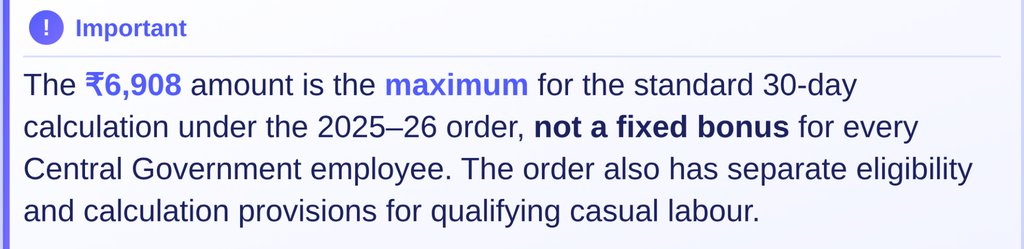
This government ad hoc bonus is different from the statutory bonus applicable to eligible employees in covered establishments under labour laws. Private-sector employers should not use this government calculation as their standard Diwali bonus formula.
What Challenges Do HR Teams Face While Managing Diwali Bonuses?
Managing Diwali bonuses for a large workforce involves more than calculating bonus amounts. HR and payroll teams must also check employee details, follow company policies and maintain accurate payment records.
Below are some common challenges businesses face:
1. Verifying Employee Eligibility
HR teams need to check employee joining dates, service periods and other eligibility conditions before processing bonuses because missing or incorrect employee information can lead to payment errors.
2. Managing Different Bonus Calculation Methods
Not every company follows the same bonus policy. Some offer a fixed amount, while others calculate bonuses based on salary or a percentage as managing these different methods can become difficult, especially when there are many employees.
3. Avoiding Manual Calculation Errors
Calculating bonuses manually through spreadsheets takes time and increases the chances of mistakes. Even a small error in salary details or bonus percentages can affect the final payment amount.
4. Handling Payroll Adjustments
HR teams also need to check how the bonus will affect an employee’s final salary. This includes accounting for applicable deductions and taxes before processing the payment.
5. Maintaining Payment Records
Businesses need to maintain employee-wise bonus details, payment statements and approval records. Keeping these records updated helps HR teams track payments and refer to them when needed.
A structured bonus management process can help businesses reduce these challenges and ensure timely, accurate payments.
How Does Payroll Software Simplify Diwali Bonus Management?
Payroll software helps HR teams manage employee details, calculate bonuses and record payments in one place. It reduces the need to handle bonus-related tasks manually and makes the process easier to manage.
Here’s how different payroll software features help with bonus management:
| Payroll Software Feature | How It Helps |
| Employee database | Keeps employee details, salary information and joining dates in one place. |
| Salary structure management | Helps HR check the salary components used for bonus calculations. |
| Earning components | Allows HR to add bonus payments to the payroll. |
| Payroll calculations | Reduces manual work when calculating employee bonuses. |
| Deduction management | Helps account for applicable deductions and taxes. |
| Payslip generation | Shows bonus details along with other salary information. |
| Payroll reports | Helps HR track bonus payments and maintain records. |
For example:
For a company with 500 employees, calculating bonuses manually can take a lot of time, but Payroll software makes it easier to calculate bonuses, process payments and keep employee records updated in one place.
What Are the Best Practices for Managing Diwali Bonus Payments?
A little planning can make Diwali bonus processing easier for HR and payroll teams. Here are some simple practices businesses can follow:
- Plan the budget early: Decide how much the company can spend on employee bonuses.
- Set clear eligibility rules: Let employees know who will receive the bonus and how the amount will be calculated.
- Check employee details: Review salary, attendance and joining-date records before calculating bonuses.
- Double-check calculations: Verify bonus amounts to avoid payment errors.
- Keep payment records: Save bonus details, payslips and approval records for future reference.
- Inform employees in advance: Share the bonus payment date so employees know when to expect it.
Following these practices can help HR teams process Diwali bonuses smoothly and avoid last-minute confusion.
How Can Savvy HRMS Help Simplify Payroll Management?
Managing Diwali bonuses becomes easier when businesses have an organized payroll system to handle employee salary information, earnings and payment records.
Savvy HRMS Payroll Software helps businesses to simplify payroll activities through features such as:
- Smart Payroll: Manage employee salary structures, earnings and deductions.
- Employee Management: Maintain centralized employee information for payroll processing.
- Statutory Compliance: Manage applicable PF, ESI, professional tax and TDS calculations.
- Payslip Generation: Generate payslips with relevant salary and payment details.
- Payroll Reports: Access payroll information for reviewing and maintaining records.
With Savvy HRMS, businesses can simplify regular payroll activities and manage bonus-related payments more systematically.
Conclusion
Diwali bonus management involves more than deciding how much to pay employees. HR teams also need to verify eligibility, calculate the correct amounts, process payments and maintain accurate payroll records.
While a clear bonus policy helps establish consistency, payroll software makes it easier to manage these activities, especially for businesses with large workforces.
By using an organized payroll system like Savvy HRMS, businesses can simplify payroll operations, manage employee payment information and make bonus processing more systematic.
Frequently Asked Questions
1. Is Diwali bonus mandatory for employees in India?
Diwali bonus is not automatically mandatory for every employee. However, employers must fulfil applicable statutory bonus obligations for eligible employees in covered establishments. Customary or contractual festival bonus obligations may also apply.
2. Is the Diwali bonus included in salary?
Yes. A cash Diwali bonus is generally treated as part of an employee’s salary for income tax purposes. It is added to the employee’s taxable income and taxed according to the applicable income tax rules. The employer may also deduct TDS as required.
3. How is Diwali bonus calculated?
Diwali bonus can be calculated using a fixed amount, a percentage of salary or a specified number of days’ salary, depending on company policy. Statutory bonus follows the applicable legal calculation method.
4. Is Diwali bonus part of CTC?
It depends on the company’s salary structure and employment policy. If the company includes the bonus as a component of the employee’s annual compensation, it may form part of the CTC. However, a separate Diwali bonus paid at the employer’s discretion is generally not included in CTC unless the employment terms specify otherwise.
5. What is the minimum statutory bonus in India?
Under the Code on Wages, the minimum annual statutory bonus is 8.33% of the applicable wages earned or ₹100, whichever is higher, subject to eligibility and other statutory conditions.
6. How much Diwali bonus do central government employees receive?
For 2025-26, eligible Central Government employees covered by the October 2026 ad-hoc bonus order are entitled to 30 days’ emoluments, subject to a monthly calculation ceiling of ₹7,000. The maximum payment for 30 days is approximately ₹6,908.
7. Is Diwali Bonus Taxable in India?
Yes. A cash Diwali bonus received from an employer is generally taxable as salary income. It is included in the employee’s taxable income and taxed according to the applicable income tax rules.
The bonus is generally taxable in the year it is received, unless it has already been taxed on a due basis. Employers should account for it while calculating applicable TDS.