


How to Calculate TDS in India: Formula, Examples and Online Calculator


-
AuthorS.K. Gupta
-
 Last Updated
November 25, 2026
-
 Reading Time
14 Mins
Summary
- TDS is deducted at the applicable rate from specified payments before the recipient receives the remaining amount.
- TDS calculation depends on the nature of payment, applicable rate, threshold limit and PAN availability.
- To calculate TDS, multiply the amount subject to deduction by the applicable TDS rate, subject to relevant tax provisions.
- TDS on salary is calculated based on the employee’s estimated annual tax liability and adjusted across salary payments.
- You can use an online TDS calculator to estimate deductions for different payment categories.
- The Savvy HRMS TDS Calculator helps calculate payment-based TDS by using the recipient type, PAN availability, nature of payment and payment amount.
Tax Deducted at Source (TDS) is deducted from certain payments before the remaining amount is paid to the recipient. Whether you receive a salary, professional fees, rent or interest income, understanding how TDS works can help you track your tax deductions and plan your finances better.
But how do you calculate TDS, and how do you know whether the correct amount has been deducted? The calculation depends on the nature of payment, applicable TDS rate, threshold limit and other relevant conditions.
In this guide, we explain how to calculate TDS in India, including the TDS calculation formula, salary-based calculations and monthly deductions. You will also learn how to calculate TDS online using a free TDS calculator.
What Is TDS and How Does It Work in India?
Tax Deducted at Source (TDS) is a way of collecting income tax at the time a payment is made. Under this system, the person or organization making certain payments deducts tax at the prescribed rate before paying the remaining amount to the recipient. The deducted amount is then deposited with the Central Government and adjusted against the recipient’s tax liability.
The main purpose of TDS is to ensure that tax is collected regularly throughout the year instead of waiting until the end of the tax year.
Why Is TDS Deducted?
TDS helps the government collect taxes regularly and makes tax collection easier to track. It also helps taxpayers spread their tax payments throughout the year rather than paying the entire amount at once.
Some key reasons why TDS is deducted include:
- Regular tax collection: It helps the government to collect taxes throughout the year.
- Easier tax management: It allows taxpayers to pay tax in smaller amounts instead of facing a large tax payment at year-end.
- Better tax compliance: It creates a record of tax deducted and deposited against the recipient’s PAN.
- Payment transparency: It helps to track specified payments made by individuals and businesses.
Who Is Responsible for Deducting TDS?
The responsibility for deducting TDS generally lies with the person or organization making a payment covered under the applicable tax provisions. This person is called the deductor, while the person receiving the payment is known as the deductee.
For example, an employer deducts TDS from an employee’s salary, while a bank may deduct TDS from eligible interest payments. The deductor must deposit the deducted amount with the government and complete the applicable TDS reporting requirements.
For example:
| Payment | Responsible deductor |
| Salary | Employer |
| Bank interest | Bank or financial institution |
| Rent covered under TDS provisions | Applicable tenant or payer |
| Professional fees | Applicable business or payer |
| Commission | Applicable payer |
The responsibility to deduct TDS depends on the nature of payment, applicable monetary threshold and other conditions prescribed under income tax law.
What Is the Difference Between TDS and Income Tax?
TDS and income tax are related, but they are not the same. Income tax is the tax payable on a person’s taxable income, whereas TDS is one method through which the government collects that tax in advance.
| Basis | TDS | Income Tax |
| Meaning | Tax deducted before making specified payments | Tax charged on taxable income |
| Collection | At the time of specified payment or credit, depending on the provision | Determined based on total taxable income |
| Responsible person | Deductor, such as an employer or payer | Taxpayer is responsible for their final tax liability |
| Calculation | Depends on the applicable TDS provision | Depends on taxable income and applicable tax rates |
| Adjustment | Credited against the recipient’s tax liability | Final liability determined through tax computation |
If the TDS deducted during the year is higher than your actual tax liability, you may claim a refund when filing your income tax return. If it is lower, you may need to pay the remaining tax.
How to Calculate TDS in India?
To calculate TDS in India, you first need to identify the type of payment, check the applicable TDS rate and threshold, and determine the amount on which tax must be deducted. The calculation method differs for salary and other specified payments.
The basic calculation process involves these steps:
- Identify the nature of payment.
- Check the applicable TDS provision and rate.
- Verify the monetary threshold and eligibility conditions.
- Determine the amount on which TDS is applicable.
- Calculate the TDS amount.
- Deduct and deposit the tax within the prescribed timelines.
What Is the TDS Calculation Formula?
The TDS calculation formula depends on the type of payment being made.
For payments other than salary:

For example, suppose a business pays ₹50,000 as professional fees and the applicable TDS rate is 10%.
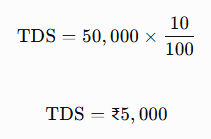
The business deducts ₹5,000 as TDS and pays the remaining ₹45,000 to the recipient, assuming no other adjustments apply.
For salary payments:
Salary TDS is calculated using the employee’s estimated annual tax liability.

For instance, if an employee’s estimated annual tax liability is ₹60,000 and no TDS has been deducted yet, then the employer may deduct approximately ₹5,000 per month over 12 equal salary payments.
This is a simplified illustration. However, actual monthly deductions may change depending on the employee’s joining date, salary revisions, tax declarations, previous deductions and remaining salary payments.
Note: The formula for non-salary payments is only a starting point. The applicable statutory threshold, payment category, recipient status, PAN requirements and other conditions must be checked before calculating the final deduction.
How to Calculate TDS on Salary in India?
TDS on salary is calculated based on an employee’s estimated annual taxable income and the income tax rates applicable under the selected tax regime. The employer estimates the employee’s annual tax liability and deducts it from salary payments during the tax year.
For Tax Year 2026–27, salary TDS is governed by Section 392 of the Income-tax Act, 2025. The employer must calculate the average tax rate using the applicable tax slabs and the employee’s estimated salary income.
Here is how to calculate TDS on salary step by step.
Step 1: Calculate Your Annual Salary
Start by calculating your total expected salary for the entire tax year. Include the salary components and taxable allowances applicable to you.
These may include:
- Basic salary
- House Rent Allowance (HRA)
- Dearness Allowance (DA)
- Special allowance
- Performance bonuses
- Other taxable allowances and perquisites
For example, if your monthly gross salary is ₹1,25,000, then your estimated annual gross salary will be:
₹1,25,00012=₹15,00,000
Your annual gross salary is ₹15 lakh.
However, this is not necessarily your final taxable income as you must account for applicable exemptions, deductions and other adjustments.
Step 2: Identify Applicable Exemptions and Deductions
The next step is to identify the exemptions and deductions you can claim under your selected tax regime.
The old and new tax regimes have different rules.
Under the new tax regime:
- A standard deduction of ₹75,000 is available to eligible salaried taxpayers.
- Most common exemptions and deductions available under the old regime are not allowed.
- Certain specified deductions and exemptions continue to be available, subject to conditions.
Under the old tax regime:
Eligible taxpayers may claim deductions and exemptions such as:
- Section 80C deductions for eligible investments and expenses.
- Section 80D deductions for eligible health insurance premiums.
- HRA exemption, subject to applicable conditions.
- Eligible LTA exemption.
- Standard deduction of ₹50,000.
The availability of deductions depends on the applicable provisions and eligibility requirements.
Step 3: Calculate Your Annual Taxable Income
After identifying applicable exemptions and deductions, subtract them from your annual salary to determine your taxable salary income.
The basic formula is:

For example, assume an employee earns ₹15 lakh annually and opts for the new tax regime.
| Particulars | Amount |
| Annual gross salary | ₹15,00,000 |
| Standard deduction | ₹75,000 |
| Taxable salary income | ₹14,25,000 |
Therefore, the employee’s taxable salary income is ₹14.25 lakh, assuming no additional taxable income or adjustments.
Step 4: Apply the Applicable Income Tax Slabs
Once you calculate your taxable income, then apply the income tax slabs under your selected tax regime.
For example, under the new tax regime, different portions of taxable income are taxed at different rates. You do not pay the highest applicable rate on your entire income.
We will cover the applicable tax slabs for Tax Year 2026–27 in the next section.
Step 5: Calculate the Total Tax Liability
After applying the income tax slabs, calculate the tax payable on your taxable income.
You should also account for:
- Applicable tax rebate, if eligible.
- Surcharge, if applicable.
- Health and Education Cess at 4% on income tax and surcharge.
The rebate can reduce the tax payable for eligible resident individuals. Its availability depends on the applicable tax regime, taxable income and statutory conditions.
Step 6: Calculate the Annual and Monthly TDS
After calculating the final estimated tax liability, the employer determines how much TDS must be deducted from the employee’s salary.
For a full year with 12 equal salary payments and no previous deductions:
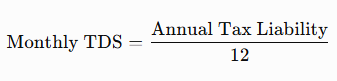
If TDS has already been deducted, the employer adjusts the remaining liability against the remaining salary payments.
This helps to distribute the employee’s annual tax liability across the tax year.
What Are the Income Tax Slabs Applicable for TDS Calculation in India?
Income tax slabs determine how much tax an individual must pay based on their taxable income. The applicable rates depend on the selected tax regime, age-related eligibility under the old regime and the relevant tax year.
For Tax Year 2026–27, the new tax regime remains the default regime, while eligible taxpayers can choose the old tax regime subject to applicable conditions.
New Tax Regime Slabs for Tax Year 2026–27
| Annual taxable income | Tax rate |
| Up to ₹4 lakh | Nil |
| ₹4 lakh – ₹8 lakh | 5% |
| ₹8 lakh – ₹12 lakh | 10% |
| ₹12 lakh – ₹16 lakh | 15% |
| ₹16 lakh – ₹20 lakh | 20% |
| ₹20 lakh – ₹24 lakh | 25% |
| Above ₹24 lakh | 30% |
Old Tax Regime Slabs for Tax Year 2026–27
For individuals below 60 years of age, the general old tax regime slabs are:
| Annual taxable income | Tax rate |
| Up to ₹2.5 lakh | Nil |
| ₹2.5 lakh – ₹5 lakh | 5% |
| ₹5 lakh – ₹10 lakh | 20% |
| Above ₹10 lakh | 30% |
The basic exemption limit is different for resident senior citizens and super senior citizens under the old regime.
What Is the Standard Deduction and Tax Rebate?
Two important factors to consider while calculating salary TDS are the standard deduction and tax rebate.
- Standard deduction: This is a fixed deduction available to eligible salaried taxpayers. For Tax Year 2026–27, the standard deduction is ₹75,000 under the new regime and ₹50,000 under the old regime.
- Tax rebate: Eligible resident individuals can claim a rebate that reduces their income tax liability. Under the new regime, the rebate can be up to ₹60,000 where taxable income does not exceed ₹12 lakh, subject to applicable conditions and marginal relief.
- For salaried individuals under the new regime, the ₹75,000 standard deduction means that eligible individuals with salary income up to ₹12.75 lakh may have zero tax liability, assuming no special-rate income or other factors affecting the calculation.
Important: Tax slabs and rebates are not the same as TDS rates for every payment. Salary TDS follows the applicable income tax calculation, whereas other specified payments have their own TDS provisions and rates.
How to Calculate TDS Using a Savvy HRMS TDS Calculator?
Calculating TDS manually can take time, especially when you need to check the applicable rate and threshold for different types of payments. An online TDS calculator makes this process easier by estimating the deduction based on the payment details you enter.
If you want to calculate TDS online, you can use the free Savvy HRMS TDS Calculator. It helps you to calculate TDS for different payment categories and displays the estimated deduction along with the applicable rate, threshold and relevant rule.
How to Use the Savvy HRMS TDS Calculator?
Follow these steps to calculate TDS using the Savvy HRMS online calculator:
- Select the recipient type: Choose whether the payment is being made to an individual or a company.
- Select PAN availability: Specify whether the recipient has provided their PAN.
- Choose the nature of payment: Select the relevant payment category from the dropdown list, such as professional fees, rent, interest or contractor payments.
- Enter the payment amount: Add the total amount on which TDS needs to be calculated.
- Calculate TDS: Click the Calculate TDS button to view the result.
The calculator displays the total TDS, applicable rate, threshold, and relevant rule based on the details entered.
Example: Calculate TDS on Professional Fees Using the Savvy HRMS Calculator
Suppose a company pays ₹1,00,000 to an individual consultant for professional services. The consultant has provided a valid PAN.
To calculate the TDS, enter the following details in the Savvy HRMS calculator:
| Calculator field | Details entered |
| Recipient | Individual |
| PAN Available | Yes |
| Nature of Payment | 194J – Fees for professional service/royalty |
| Amount of Payment | ₹1,00,000 |
After entering these details, click Calculate TDS. The calculator displays the following result:
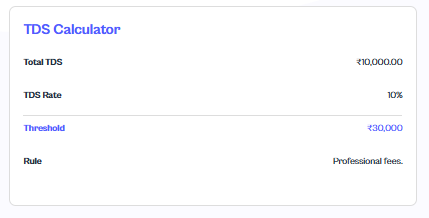
The TDS amount is ₹10,000, calculated at 10% of the ₹1,00,000 payment. After deducting TDS, the consultant receives ₹90,000.
This example shows how you can use the calculator to estimate TDS without working through the calculation manually.
What Information Do You Need to Calculate TDS Online?
Before using an online TDS calculator, keep the following details ready:
- Recipient type: Whether the payment is being made to an individual or a company.
- PAN availability: Whether the recipient has provided their PAN.
- Nature of payment: The category under which the payment falls, such as professional fees, rent or interest.
- Payment amount: The total amount on which TDS needs to be calculated.
Make sure you select the correct nature of payment because the applicable TDS rate and threshold vary depending on the type of transaction.
Note: The Savvy HRMS TDS Calculator currently provides payment-based TDS calculations using the available recipient, PAN, payment category and amount fields. If you want to estimate TDS on salary, use a salary-specific calculator that considers annual income, tax regime, standard deduction and eligible exemptions.
Conclusion
Overall, calculating TDS requires you to understand the nature of payment, applicable tax rates, thresholds and relevant statutory provisions. For salary payments, you must also consider annual taxable income, tax regime, eligible deductions and previous TDS deductions to estimate the correct monthly amount.
While manual calculations help you understand how TDS works, an online calculator can simplify payment-based TDS estimates.










Want to Make TDS Calculations Easier for Your Business?
Frequently Asked Questions About TDS Calculation
1. How can I calculate TDS?
You can calculate TDS by identifying the nature of payment, checking the applicable TDS rate and threshold, and applying the rate to the eligible payment amount. For salary, calculate annual taxable income and tax liability first, then estimate the monthly deduction.
2. How to calculate TDS on salary?
To calculate TDS on salary, estimate annual gross salary, subtract eligible deductions and exemptions, calculate tax using the applicable income tax slabs, and add cess and surcharge where applicable. Divide the remaining annual tax liability across the remaining salary payments.
3. How do I calculate TDS for one month?
To calculate monthly TDS, subtract the TDS already deducted from the estimated annual tax liability and divide the balance by the remaining salary payments. If no TDS has been deducted and the amount is spread equally across 12 months, divide the annual tax by 12.
4. Is TDS calculated on gross salary or taxable salary?
Salary TDS is calculated using estimated taxable salary income rather than simply applying a fixed percentage to gross salary. Eligible deductions, exemptions, standard deduction and other taxable income adjustments are considered while estimating the annual tax liability.
5. Is TDS 1% or 2%?
TDS is not fixed at 1% or 2%. The applicable rate depends on the nature of payment, recipient category, PAN availability and relevant income tax provisions. Salary TDS is calculated using the applicable income tax slab rates.
6. Can I calculate TDS online for free?
Yes. You can calculate applicable TDS online using free calculators. Savvy HRMS provides a free TDS Calculator that lets you enter recipient details, PAN availability, payment category and payment amount to estimate TDS.
7. Is Form 16 required for TDS calculation?
No. Form 16 is not required to calculate salary TDS. However, it serves as a certificate issued by the employer showing salary paid, tax deductions and other relevant tax details for the financial year.