LWD in Job: Meaning, Full Form, Calculation and Rules



-
AuthorSatyam Chauhan
-
 Last Updated
November 19, 2026
-
 Reading Time
11 Mins
TL;DR
- LWD stands for Last Working Day, which refers to an employee’s final official employment date with an organization.
- It is generally determined based on the resignation date, applicable notice period and company policies.
- LWD is different from the resignation date and relieving date.
- It helps HR to calculate payable salary, process full and final settlement and complete employee exit formalities.
- HR should communicate and document the confirmed LWD to avoid confusion between employees, payroll and other departments.
When an employee resigns, one of the first questions that comes to mind is, “When will be my last day at work?” This is where LWD, or Last Working Day, becomes important. It tells employees when their working relationship with the organization is expected to end. However, calculating this date is not always straightforward. The notice period, resignation date, early release and company policies can all affect the final date.
For HR teams, LWD is equally important because it helps coordinate payroll, full and final settlement, employee records and exit formalities. Knowing how LWD works can help employees plan their next steps and help HR teams manage resignations without confusion.
In this guide, we will cover the LWD meaning, its full form, how to calculate it and what employees should know before their last working day.
What Does LWD Mean in a Job?
LWD in Job stands for Last Working Day. It is the last day an employee works at a company, usually after completing their notice period. HR uses this date to take care of things like salary, attendance records and exit formalities.
Simply put, LWD is the final working day before an employee officially leaves the organization.
What Is the Full Form of LWD in HR?
The LWD full form in a job is Last Working Day. In HR, this term is commonly used when an employee resigns and starts serving their notice period.
For example, when an employee submits their resignation, HR checks their notice period and confirms their last working day. This helps both the employee and the company plan the remaining work and complete the exit process smoothly.
Why Is LWD in Job Important?
LWD is an important date for both employees and HR teams because several activities depend on when an employee officially leaves the organization. It helps different departments to plan the exit process and keep employee records up to date.
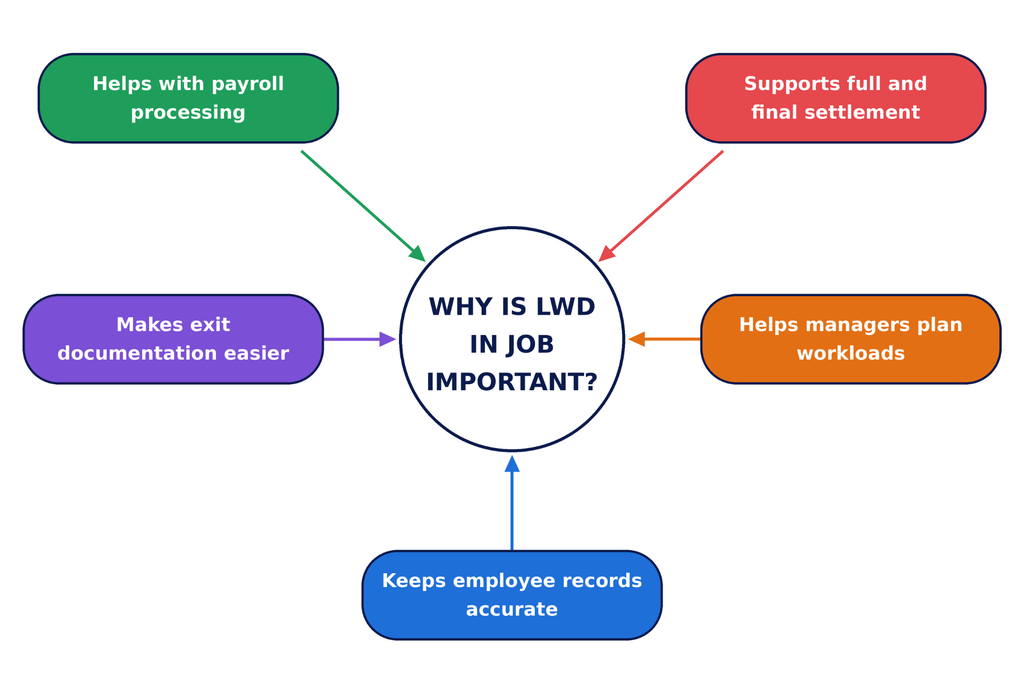
Let’s see why LW is important as defined below:
1. Helps with payroll processing
HR and payroll teams use the LWD to calculate the employee’s salary for the eligible working period and process the final payment.
2. Supports full and final settlement
The date helps to determine applicable salary dues, deductions, leave encashment and other payments during the full and final settlement process.
3. Makes exit documentation easier
HR uses the confirmed LWD while preparing documents such as relieving letters, experience letters and other employment records.
4. Helps managers plan workloads
Knowing when an employee will leave gives managers time to redistribute responsibilities, arrange handovers or plan for a replacement.
5. Keeps employee records accurate
Recording the correct LWD helps the organization to maintain updated employment details for future reference and verification.
How Is the Last Working Day Calculated?
The last working day is generally calculated using the employee’s resignation date and the notice period mentioned in their employment agreement. However, the final date can change depending on notice-period counting rules, early release, approved buyouts or an agreed extension.
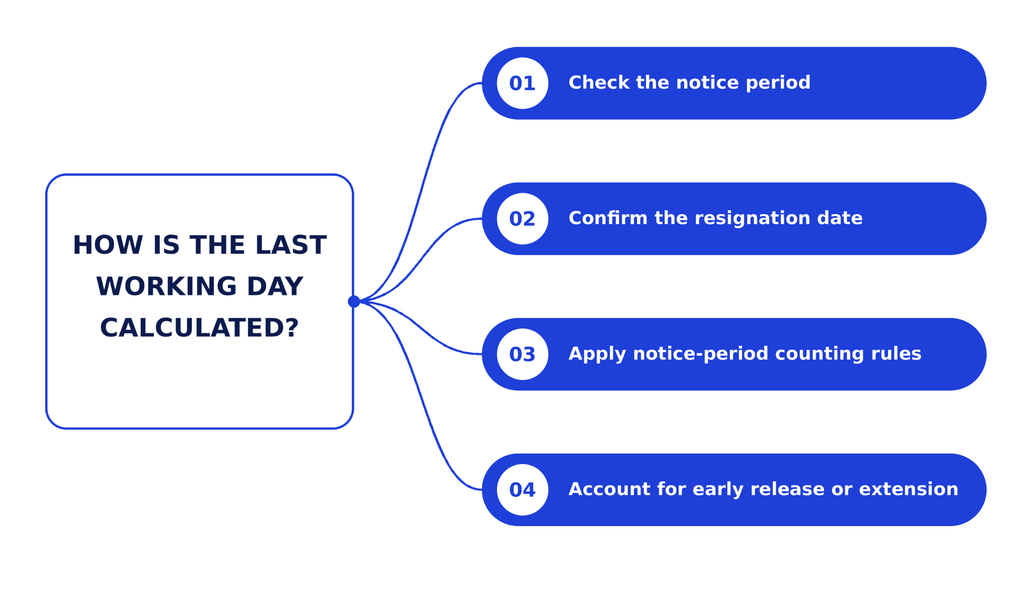
Let’s see how HR generally determines LWD.
1. Check the Notice Period
Start by checking the notice-period clause in the employee’s appointment letter or employment agreement. It specifies how much notice the employee must provide before leaving the organization.
For example, an employee may have a notice period of:
- 15 days
- 30 days
- 60 days
- 90 days
The applicable duration depends on the employee’s employment terms and company policy.
2. Confirm the Resignation Date
Next, HR confirms the date on which the employee submitted their resignation and whether it has been acknowledged or accepted according to the company’s process.
This is important because some organizations calculate the notice period from the date of resignation submission, while others may follow a different contractual or policy-based approach.
3. Apply the Notice-Period Counting Rules
Once the resignation date and notice period are confirmed then HR calculates the tentative LWD.
The calculation may depend on whether the resignation date is included in the notice-period count, how the agreement treats calendar days and whether any special conditions apply.
4. Account for Early Release or Notice-Period Extension
Sometimes, an employee may not need to serve the entire notice period. The employer may approve an early release or notice-period buyout. In other cases, both parties may agree to extend the notice period.
If either situation changes the original LWD, HR should confirm the revised date in writing.
Last Working Day Calculation Example
Let’s understand this with a simple example.
Suppose an employee submits their resignation on 1 June 2026 and has a 30-day notice period. If the notice period starts on 2 June, the calculation would look like this:
| Particulars | Details |
| Resignation date | 1 June 2026 |
| Notice period | 30 days |
| Notice-period start date | 2 June 2026 |
| Tentative LWD | 1 July 2026 |
In this example, 1 June is not counted as part of the notice period. The 30-day period runs from 2 June to 1 July which makes 1 July the tentative LWD.
However, the date may differ if the employment agreement follows another counting method. So, HR should check the applicable terms before confirming the employee’s final working day.
How to Confirm Your LWD in a Job?
You can confirm your Last Working Day (LWD) by checking your resignation acceptance email, employment agreement or official communication from HR. If the date is unclear then contact your HR team and ask them to confirm it in writing.
Here are a few simple ways to check your LWD:
1. Check Your Resignation Acceptance Email
Start by checking the email you received after submitting your resignation. HR may have mentioned your tentative or confirmed LWD in the reply. If the date is not included then you can ask for an update.
2. Review Your Employment Agreement
Check your appointment letter or employment agreement to see what notice period applies to you. This will help you understand how your LWD is calculated.
3. Ask Your HR Team
If you are unsure about the date then reach out to HR. They can confirm your LWD and explain whether any changes have been made due to early release, notice-period adjustments or other agreed terms.
4. Check Your HRMS Portal
Some organizations provide resignation and exit details through an employee self-service portal. You may be able to check your resignation status, notice period and confirmed LWD there.
5. Keep the LWD Confirmation Email
Once HR confirms your last working day, save the email for future reference. You may need it while planning your handover, checking your final salary or following up on your relieving documents.
| Remember: A tentative LWD may change if the notice period or exit terms are revised. Always rely on the latest confirmation from HR to avoid confusion about your final working date. |
LWD vs Resignation Date vs Relieving Date: What’s the Difference?
LWD, resignation date and relieving date are related to employee separation, but they refer to different stages of the exit process. The resignation date is when an employee submits their resignation, LWD is their final official employment date, and the relieving date is generally the date confirmed in the relieving documentation.
Here is a comparison:
| Basis | Resignation Date | Last Working Day (LWD) | Relieving Date |
| Meaning | Date an employee submits resignation | Final official working/employment date | Date mentioned in the relieving confirmation |
| Purpose | Initiates the exit process | Establishes the end of employment | Confirms the employee’s release |
| Notice period | Usually starts the notice-period process | Reflects the applicable notice-period outcome | Generally corresponds to the confirmed exit date |
| HR activity | Records resignation | Completes exit-related processing | Issues relieving documentation |
For example, an employee may submit their resignation on 1 June, complete the applicable notice period and have an LWD of 1 July. The relieving letter may subsequently be issued confirming their release from the organization.
The exact terminology and dates may vary depending on company policy and employment documentation.
How Does LWD Affect Salary and Full and Final Settlement?
An employee’s Last Working Day (LWD) helps HR and payroll teams determine the salary and other dues payable when they leave the organization. It acts as the reference date for calculating final payments, checking leave balances and reviewing any pending recoveries.
Here are some common components that depend on the LWD:
| Component | How LWD Affects It |
| Final salary | Helps to calculate salary payable up to the employee’s last working day. |
| Leave encashment | Helps HR to check unused eligible leave and calculate its encashment as per company policy. |
| Notice-period recovery | Helps to determine whether any recovery applies if the employee leaves before completing the required notice period. |
| Gratuity | Helps to establish the employee’s service period and check eligibility under applicable law. |
| Other dues | Helps HR to review pending reimbursements, incentives and other payments, wherever applicable. |
| Deductions | Helps account for outstanding advances, asset-related recoveries or other permitted deductions. |
The final settlement amount may also include eligible leave encashment, pending payments and applicable deductions. The exact amount depends on the employee’s employment terms, company policy and applicable statutory requirements.
How to Write an LWD Confirmation Email to an Employee?
An LWD confirmation email formally informs an employee about their approved last working day. It should clearly mention the confirmed date, resignation acknowledgement and any important exit-related instructions so that the employee understands what needs to be completed before leaving.
A good LWD confirmation email should include:
- Employee’s name and designation.
- Acknowledgement of the resignation.
- Confirmed last working day.
- Any relevant notice-period or early-release confirmation.
- Instructions regarding pending exit formalities.
- HR contact details for further assistance.
Sample Employee LWD Confirmation Email
Subject: Confirmation of Your Last Working Day
Dear [Employee Name],
This email is to confirm that your resignation has been acknowledged and your last working day with [Company Name] will be [Date], as per the applicable notice-period terms and our discussion.
Please ensure that you complete the necessary exit formalities before your last working day. You can contact the HR team if you need any clarification regarding the process or required documentation.
Our team will coordinate with you regarding the remaining formalities and full and final settlement process.
We appreciate your contributions to the organization and wish you the best in your future endeavours.
Regards,
[HR Name]
[Company Name]
Conclusion
Overall, Understanding LWD in a job helps employees and HR teams to manage the resignation and exit process more clearly. From calculating the notice period to completing employee handovers, processing final salary and issuing exit documentation, the confirmed last working day acts as an important reference throughout employee separation.
For HR teams, maintaining accurate employee exit records and coordinating with payroll, IT and reporting managers can make the process more organized. An integrated HRMS can further help centralize employee information and connect employee management with payroll activities.






Looking to Simplify Employee Exit and Payroll Management?
Frequently Asked Questions About LWD
1. What Is the Full Form of LWD?
LWD stands for Last Working Day. It refers to the final official working or employment date of an employee with an organization, as determined by the applicable employment terms and exit process.
2. Is LWD the Same as the Resignation Date?
No, LWD and resignation date are different. The resignation date is when an employee submits their resignation, whereas LWD is the final official employment date after considering the applicable notice period and any approved changes.
3. Is the Last Working Day Included in the Notice Period?
The last working day is generally the final date of the notice-period process. However, whether the resignation date or LWD is included in the day count depends on the employment agreement and applicable notice-period calculation rules.
4. Can HR Change an Employee’s Last Working Day?
Yes, an employee’s LWD may change if an early release, notice-period extension or another change is agreed upon or permitted under the applicable employment terms. HR should communicate and document the revised date.
5. Is Salary Paid for the Last Working Day?
Salary is generally payable for eligible employment days, including the last working day, subject to applicable employment terms and attendance records. The final amount is calculated as part of the employee’s salary settlement.
6. Is LWD the Same as the Relieving Date?
Not necessarily. LWD refers to the employee’s final official employment date, while the relieving date is the date confirmed in the relieving documentation. Both dates often correspond, but the terminology and documentation process may differ between organizations.
7. What Happens If an Employee Leaves Before Their LWD?
If an employee leaves before the confirmed LWD without an approved early release, it may be treated as a failure to complete the required notice period. The consequences depend on the employment agreement, company policy and applicable law.
8. Does LWD Affect Full and Final Settlement?
Yes, LWD is an important reference point for full and final settlement. It helps HR and payroll determine payable salary, eligible leave encashment, applicable deductions and other outstanding dues.