15 Best Recruitment Strategies to Attract Top Talent in 2026



-
AuthorRaghvendra Bhardwaj
-
 Last Updated
November 11, 2026
-
 Reading Time
20 Mins
TL;DR
The right recruitment strategy helps businesses attract qualified candidates, improve hiring efficiency and make better hiring decisions. Here is a quick overview of the best recruitment strategies in 2026:
- Build a strong employer brand to attract potential employees.
- Encourage employee referrals to reach suitable candidates through professional networks.
- Focus on skills-based hiring rather than relying only on degrees or previous job titles.
- Use AI-powered recruitment tools to support resume screening, candidate matching and interview scheduling.
- Improve candidate experience through clear communication and a simple hiring process.
- Build talent pools to maintain relationships with potential candidates for future vacancies.
- Promote internal mobility by considering existing employees for new roles and promotions.
- Use targeted job portals, social media and professional networks to reach relevant candidates.
- Follow structured interviews and consistent assessment methods to make fair hiring decisions.
- Use recruitment software to organize candidate information, track applications and monitor hiring activities.
Businesses should combine different recruitment strategies based on their hiring goals, workforce requirements and available resources.
Finding and hiring the right employees is becoming increasingly challenging for businesses. Changing skill requirements, competition for qualified candidates and evolving employee expectations mean that traditional hiring methods may not always deliver the desired results.
To attract suitable candidates, businesses need effective recruitment strategies that go beyond posting vacancies on job portals. Approaches such as employer branding, employee referrals, skills-based hiring and AI-powered recruitment can help HR teams reach relevant talent and make better hiring decisions.
Technology is also changing how recruiters find and evaluate candidates. According to LinkedIn’s 2026 research, 66% of recruiters say finding qualified talent has become more difficult, while 93% plan to increase their use of AI in 2026.
In this blog, we explore 15 best recruitment strategies to help businesses attract top talent, improve hiring outcomes and build a stronger workforce in 2026.
What Are Recruitment Strategies?
Recruitment strategies are planned methods that businesses use to identify, attract, evaluate and hire suitable candidates for vacant positions. They help HR teams to reach the right talent through appropriate channels while considering hiring requirements, timelines and budgets.
A recruitment strategy provides direction to the hiring process. Instead of relying on the same recruitment method for every vacancy, businesses can select suitable approaches based on the role, required skills, available talent and organizational goals.
For example, a company hiring entry-level graduates may focus on campus recruitment and internship programmes. However, when hiring an experienced leader, it may use professional networks, targeted outreach and executive search.
Why Are Recruitment Strategies Important?
A well-planned recruitment strategy helps businesses to attract the right people, manage hiring activities efficiently and make better hiring decisions. Here are six key benefits:
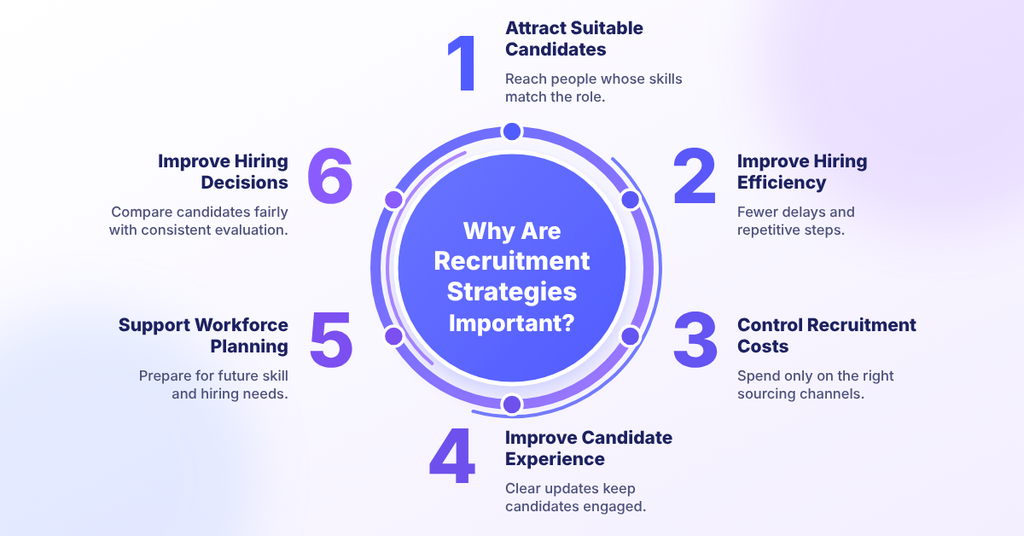
1. Attract Suitable Candidates
A clear recruitment strategy helps businesses to reach candidates whose skills, qualifications and experience match the job requirements. This improves the chances of finding the right person for each role.
2. Improve Hiring Efficiency
A structured approach reduces unnecessary steps, repetitive tasks and delays. It also helps HR teams manage vacancies and move candidates through the hiring process smoothly.
3. Control Recruitment Costs
Choosing the right sourcing channels helps businesses avoid spending money on platforms that generate irrelevant applications which makes recruitment spending more effective.
4. Improve Candidate Experience
Clear communication, timely updates and a simple application process help candidates stay informed and engaged throughout recruitment.
5. Support Workforce Planning
Recruitment strategies help businesses to identify future skill requirements, prepare for hiring needs and build relationships with potential candidates.
6. Improve Hiring Decisions
Consistent evaluation methods allow recruiters to compare candidates fairly and select people based on role-specific requirements.
15 Best Recruitment Strategies in 2026
The best recruitment strategies help businesses to find the right candidates, make better hiring decisions and improve the overall recruitment process. However, not every strategy works for every role.
Businesses should choose their approach based on the skills they need, the type of candidates they want to hire and their hiring goals.
Here are 15 effective recruitment strategies that HR teams can use to attract and hire the right talent.
1. Build a Strong Employer Brand
Employer branding is how people see a company as a place to work. It reflects the company’s culture, values, work environment, employee benefits and career opportunities.
Before applying for a job, candidates often visit a company’s website, read employee reviews and check its social media pages. A positive image can help build trust and encourage more suitable candidates to apply.
How to implement this strategy:
- Share your company’s mission, values and workplace culture.
- Publish employee stories and experiences.
- Highlight career growth, training and learning opportunities.
- Keep your careers page updated with current job openings.
- Encourage employees to share their experiences of working with the company.
For example, a manufacturing company can highlight its employee training programmes, workplace safety measures and career growth opportunities while a technology company can showcase its learning culture, team projects and flexible work options.
2. Implement an Employee Referral Programme
An employee referral programme encourages existing employees to recommend people from their professional networks for open positions.
Employees may know professionals with the right skills, experience or industry knowledge. Their recommendations can help Core HR teams connect with candidates who may not be actively searching for jobs on recruitment portals.
How to implement this strategy:
- Share current job openings and referral guidelines with employees.
- Make it easy for employees to submit referrals.
- Offer suitable rewards for successful referrals, where appropriate.
- Keep employees updated about the progress of their referrals.
- Track referrals, interview conversions and successful hires.
However, employee referrals should not be the only way to hire. Every referred candidate should go through the same selection process as other applicants because businesses should also use different sourcing channels to reach a wider range of candidates.
3. Adopt Skills-Based Hiring
Skills-based hiring focuses on what a candidate can actually do rather than looking only at their degree, previous job title or years of experience.
It allows businesses to consider candidates who have gained relevant skills through work experience, certifications, projects, internships or independent learning.
For example, while hiring a digital marketing executive, a company can assess the candidate’s knowledge of SEO, campaign management, analytics and content planning through practical assignments.
How to implement this strategy:
- Identify the technical and behavioural skills required for each role.
- Separate essential skills from preferred qualifications.
- Use practical tests, work samples or job-related assignments.
- Ask candidates how they have used their skills in previous projects or roles.
- Evaluate everyone using clear and consistent criteria.
Skills-based hiring can also help businesses reach a wider talent pool. According to LinkedIn’s 2025 Future of Recruiting report, companies that used skills-based searches most extensively were 12% more likely to make a quality hire. This shows the value of looking beyond traditional qualifications when evaluating candidates.
4. Leverage AI-Powered Recruitment Tools
AI-powered recruitment tools help HR teams manage repetitive hiring tasks and find suitable candidates more efficiently. They can support resume screening, candidate matching, communication and recruitment reporting.
For example, AI tools can scan resumes to identify candidates with skills and experience that match a job description, and recruiters can then review these profiles and decide who should move to the next stage.
How to implement this strategy:
- Use AI tools to organize and screen candidate applications.
- Match candidate profiles with the skills required for a role.
- Automate routine communication and interview scheduling.
- Use recruitment reports to identify delays in the hiring process.
- Let recruiters review AI recommendations and make the final decisions.
AI should support recruiters, not replace their judgement as HR teams should check whether these tools produce inaccurate or unfair results. They should also pay attention to candidate privacy, data security and applicable employment requirements.
5. Improve the Candidate Experience
Candidate experience is how applicants feel about a company throughout the hiring process, from applying for a job to receiving the final decision.
Long application forms, delayed responses and unclear interview instructions can discourage good candidates from continuing. Therefore, businesses should make the recruitment process simple, clear and professional.
How to implement this strategy:
- Keep application forms short and ask only for necessary details.
- Clearly explain job responsibilities and hiring stages.
- Acknowledge applications and provide timely updates.
- Share interview schedules and instructions in advance.
- Inform candidates about the final decision, even if they are not selected.
For example, if a candidate completes two interview rounds but is not selected, HR should communicate the decision instead of leaving them waiting. When possible, a brief explanation can also help create a positive candidate experience.
6. Optimize Job Descriptions and Job Postings
A job description is often one of the first things candidates see when they come across a vacancy. If it is confusing or missing important details, suitable candidates may decide not to apply.
A clear job posting should explain the role, its main responsibilities, the skills required and what candidates can expect from the company.
How to implement this strategy:
- Use a clear job title that candidates commonly search for.
- Explain the main responsibilities of the role.
- Separate required qualifications from preferred ones.
- Mention the job location, work arrangement and relevant benefits.
- Avoid unnecessary jargon and unrealistic experience requirements.
- Use simple and inclusive language.
For example, instead of writing “Must be a rockstar with excellent multitasking abilities”, explain the actual work, such as managing multiple client accounts, preparing reports and coordinating marketing campaigns.
A clear job description helps candidates decide whether the role matches their skills and expectations.
7. Use Social Media Recruitment
Social media recruitment means using platforms such as LinkedIn, Instagram and other online communities to share job openings and connect with potential candidates.
These platforms also give businesses an opportunity to show their workplace culture, employee experiences and company activities.
How to implement this strategy:
- Share job openings on your company’s social media pages.
- Encourage employees to share vacancies with their networks.
- Post employee stories and workplace updates.
- Join relevant professional groups and online communities.
- Choose platforms based on the type of candidates you want to reach.
For example, a technology company can use LinkedIn to connect with experienced software professionals. A retail business may use social media to promote vacancies for store-level and frontline roles.
However, getting more views and likes does not always mean getting suitable candidates. HR teams should check which platforms bring relevant applications and successful hires.
8. Build Talent Pools and Candidate Communities
A talent pool is a group of potential candidates who may be suitable for current or future job openings. It can include previous applicants, candidates who were not selected, former employees and professionals identified by recruiters.
Building a talent pool helps businesses maintain contact with potential candidates instead of starting the search from the beginning every time a vacancy opens.
How to implement this strategy:
- Maintain an organized database of suitable candidates.
- Group candidate profiles by skills, experience, location and job interests.
- Share relevant job updates, newsletters or event invitations.
- Review previous applications when new vacancies arise.
- Update candidate information regularly.
For example, a company that regularly hires sales executives across different cities can maintain separate candidate lists based on location and experience. When a new position opens, recruiters can check these profiles before looking for new candidates.
Businesses should collect and use candidate information responsibly, keeping privacy, consent and data-retention requirements in mind.
9. Engage Passive Candidates Through Targeted Outreach
Passive candidates are professionals who are not actively looking for a new job but may be interested in the right opportunity. They can be useful when businesses need experienced professionals or people with specialized skills.
These candidates may not visit job portals or apply to advertised vacancies. Recruiters need to find relevant professionals and approach them through personalized communication.
How to implement this strategy:
- Identify professionals with the skills and experience required for the role.
- Use professional networks and industry communities to find potential candidates.
- Send personalized messages instead of generic job invitations.
- Explain why the opportunity may suit their experience and career goals.
- Build a relationship rather than expecting an immediate application.
For example, while hiring a senior cybersecurity professional, a recruiter can connect with experienced people in the field and discuss the company’s technology requirements, team responsibilities and career opportunities.
This approach takes time as candidates may not be ready to change jobs immediately, but staying in touch can create opportunities for future hiring.
10. Strengthen Campus Recruitment and Internship Programmes
Campus recruitment helps businesses to connect with students and recent graduates through colleges and universities. However, Internship programmes also allow companies to identify promising candidates and understand their abilities through practical work.
These methods are useful for businesses that regularly hire fresh graduates, trainees and entry-level employees.
How to implement this strategy:
- Build relationships with colleges and placement teams.
- Take part in campus placement drives and career events.
- Offer internships, apprenticeships and practical training.
- Assess candidates through tests and job-related activities.
- Allow successful interns to apply for full-time positions.
For example, an IT company can work with engineering colleges to hire software development trainees. It can offer internships based on real projects and consider high-performing interns for permanent roles.
Campus recruitment also helps businesses to build long-term relationships with educational institutions and young professionals.
11. Promote Internal Recruitment and Employee Mobility
Internal recruitment means filling open positions by considering existing employees for promotions, transfers or other roles within the company.
Before looking outside, HR teams can check whether current employees have the skills or potential to take on new responsibilities.
How to implement this strategy:
- Share internal job openings with employees.
- Maintain updated records of employee skills and experience.
- Identify employees interested in new roles or career growth.
- Provide training to help employees prepare for new responsibilities.
- Follow a clear and fair internal selection process.
For example, a customer support executive with strong product knowledge and communication skills may be suitable for a customer success role after receiving the required training.
Internal mobility helps businesses to retain existing knowledge, support employee growth and reduce their dependence on external hiring. However, companies should make internal opportunities available through a fair and transparent process.
12. Focus on Diversity, Equity and Inclusion in Hiring
Diversity, equity and inclusion in recruitment mean giving candidates from different backgrounds a fair opportunity to apply and demonstrate their skills.
Inclusive hiring helps businesses to reach a wider range of candidates and assess them using fair, job-related criteria. It does not mean lowering job requirements. Instead, it means removing unnecessary barriers from the hiring process.
How to implement this strategy:
- Use clear and inclusive language in job descriptions.
- Share vacancies through different recruitment channels.
- Ask questions related to the skills and responsibilities of the role.
- Use the same evaluation criteria for all candidates.
- Review recruitment data to identify possible barriers.
- Provide reasonable accommodations during interviews where required.
For example, a company can review whether a degree is genuinely necessary for a role or whether candidates with equivalent practical experience can also be considered.
HR teams should regularly review their recruitment process to understand where suitable candidates may be facing unnecessary difficulties.
13. Offer Competitive Compensation and Flexible Work Options
Salary and work arrangements can influence a candidate’s decision to apply for a job or accept an offer. If businesses do not clearly explain their salary, benefits and working conditions, they may lose suitable candidates to other employers.
However, candidates do not always look for the highest salary, as sometimes they also consider career growth, work-life balance, job stability, benefits and flexibility.
How to implement this strategy:
- Check salary benchmarks for the role and location.
- Set salary ranges based on skills, experience and responsibilities.
- Clearly explain employee benefits and incentives.
- Offer remote or hybrid work where the role allows it.
- Highlight learning opportunities and career growth.
- Keep salary discussions clear and consistent.
For example, a company hiring experienced software developers can attract candidates through competitive pay, flexible work arrangements, learning opportunities and clear career paths.
Work arrangements should also match the role. Remote work may suit technology or consulting positions, while manufacturing, healthcare and other on-site roles may require employees to work from a specific location.
14. Use Targeted Recruitment Channels and Niche Job Boards
Different recruitment channels attract different types of candidates. General job portals can help businesses to reach a large audience, while specialized job boards and professional communities may be more useful for finding candidates with specific skills.
Targeted recruitment means choosing channels based on the role, industry, required experience and job location.
How to implement this strategy:
- Find out where suitable candidates usually search for jobs.
- Use general job portals for common hiring requirements.
- Explore industry-specific job boards for specialized positions.
- Connect with professional associations and online communities.
- Compare the quality of applications from different channels.
- Spend more on channels that bring suitable candidates.
For example, a company hiring finance professionals can explore finance-focused job communities. A healthcare organization may use healthcare recruitment platforms and professional networks.
The goal is not simply to get more applications. It is to find channels that bring candidates who match the job requirements.
15. Use Structured Interviews and Consistent Assessment Methods
Structured interviews follow a planned set of job-related questions. Each candidate applying for the same role is assessed using similar questions and predefined criteria. This helps hiring teams compare candidates more fairly.
In unstructured interviews, different candidates may be asked different questions or judged mainly on personal impressions. This can make hiring decisions less consistent.
How to implement this strategy:
- Prepare questions based on the role’s main responsibilities.
- Decide which skills and qualities interviewers need to assess.
- Use the same rating criteria for candidates applying for the same position.
- Include practical tests when they are relevant to the role.
- Train interviewers to recognize common hiring biases.
- Record interview feedback and compare candidates against job requirements.
For example, when hiring a team leader, interviewers can ask every candidate how they have handled team conflicts, managed performance issues or completed projects under tight deadlines.
Structured interviews cannot remove every form of bias, but they help make candidate evaluation more consistent, clear, and focused on the requirements of the job.
What Are the Different Types of Recruitment Strategies?
Recruitment strategies can be divided into different types based on how businesses find and attract candidates, as each type serves a different hiring need. For example, some strategies focus on hiring existing employees, while others help businesses reach fresh graduates or experienced professionals outside the organization.
Here are seven common types of recruitment strategies and how they work.
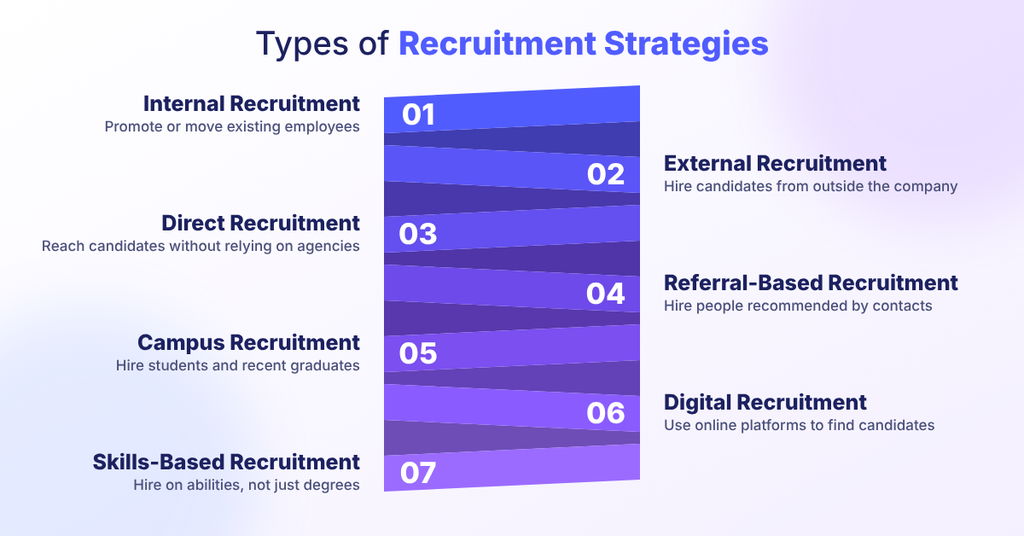
1. Internal Recruitment
Internal recruitment means filling open positions by hiring or moving existing employees to new roles within the organization. This can include promotions, transfers and internal job postings.
It gives employees opportunities to grow while helping businesses make use of their existing workforce.
2. External Recruitment
In External recruitment, recruiters hire candidates from outside the organization. Businesses use this approach when they need new skills, fresh perspectives or talent that may not be available within their existing workforce.
3. Direct Recruitment
Direct recruitment involves reaching out to potential candidates without depending entirely on third-party recruitment agencies. Businesses can connect with applicants through their own hiring channels and recruitment activities.
4. Referral-Based Recruitment
Referral-based recruitment involves hiring candidates recommended by existing employees or other professional contacts. It helps businesses reach people who may have the skills and experience required for a role.
5. Campus Recruitment
Campus recruitment focuses on hiring students and recent graduates through colleges and universities. It is useful for businesses looking to fill entry-level positions, trainee roles and internships.
6. Digital Recruitment
Digital recruitment uses online platforms and technology to advertise vacancies, connect with candidates and manage hiring activities. It helps businesses reach a wider audience and manage applications more efficiently.
7. Skills-Based Recruitment
Skills-based recruitment focuses on a candidate’s abilities and practical knowledge rather than relying only on degrees or previous job titles. It helps businesses identify candidates who can perform the tasks required for a particular role.
Businesses can use a combination of these recruitment strategies based on their hiring needs. For instance, internal recruitment may be suitable when filling a managerial position, while campus recruitment can help bring in fresh graduates for entry-level roles. Similarly, digital recruitment and employee referrals can support hiring across different departments and locations.
How Does Recruitment Management Software Help Improve Hiring Strategies?
Recruitment software helps Core HR teams manage different stages of the hiring process through a centralized system. It can support candidate information management, application tracking, interview coordination and recruitment reporting.
When hiring activities are managed manually across emails, spreadsheets and separate documents, recruiters may find it difficult to track candidate progress and coordinate with hiring managers. Recruitment Management software helps organize these activities and provides better visibility into the recruitment pipeline.
Some common ways recruitment software supports hiring strategies include:
- Centralized candidate information: Store and organize candidate profiles, resumes and application details in one place.
- Resume screening and tracking: Help recruiters to review applications and monitor candidates as they move through different hiring stages.
- Interview scheduling: Coordinate interview schedules and reduce manual communication between candidates and hiring teams.
- Recruitment workflow management: Track application status, approvals and hiring activities.
- Recruitment analytics: Generate reports on hiring timelines, recruitment sources and other performance indicators.
- Improved coordination: Help HR teams and hiring managers access relevant candidate information and share feedback.
For example, when an organization is hiring for multiple departments, recruitment software can help HR teams to monitor open positions, organize candidate records and track interview progress without relying on disconnected spreadsheets.
However, software alone cannot guarantee better hiring outcomes. Businesses should first define their recruitment requirements and processes, then select tools that support those needs. AI-enabled features should also be reviewed for accuracy, fairness and appropriate handling of candidate data.
Conclusion:
Overall, attracting and hiring the right people requires more than publishing job openings and waiting for applications. Businesses need effective recruitment strategies that help them reach suitable candidates, assess relevant skills and provide a positive hiring experience.
From employer branding and employee referrals to AI-powered recruitment and skills-based hiring, each strategy serves a different purpose. The right combination depends on the organization’s workforce requirements, hiring budget and long-term business goals.
Businesses should also review their recruitment performance regularly. By tracking hiring metrics, improving candidate communication and using suitable recruitment technology, HR teams can make more informed hiring decisions and build a stronger workforce.
1. What Are the Best Recruitment Strategies in 2026?
Some of the best recruitment strategies in 2026 include employer branding, employee referrals, skills-based hiring, AI-powered recruitment, talent pooling, targeted candidate outreach and structured interviews. Businesses should combine suitable strategies based on their hiring requirements, available resources and the skills they need.
2. What Are the Five Main Types of Recruitment Strategies?
Five common types of recruitment strategies are internal recruitment, external recruitment, referral-based recruitment, campus recruitment and digital recruitment. Each method helps businesses reach different candidate groups. Organizations can combine these approaches depending on the role, hiring volume and availability of suitable talent.
3. How Can Businesses Attract Top Talent?
Businesses can attract top talent by building a strong employer brand, offering competitive compensation, writing clear job descriptions and providing a positive candidate experience. They should also use suitable sourcing channels, communicate career opportunities and make the selection process transparent.
4. What Is the Difference Between Recruitment and Talent Acquisition?
Recruitment focuses on finding and hiring candidates for current vacancies. Talent acquisition takes a broader, long-term approach that includes workforce planning, employer branding, talent pipelines and building relationships with potential candidates for future business requirements.
5. How Can Small Businesses Improve Their Recruitment Strategies?
Small businesses can improve recruitment by using employee referrals, maintaining a clear careers page, sharing vacancies through professional networks and writing focused job descriptions. They can also build talent pools and use recruitment tools to organize applications and reduce repetitive administrative work.
6. How Does AI Improve Recruitment?
AI can support recruitment by helping HR teams screen resumes, identify relevant candidate skills, match profiles with job requirements and automate routine communication. However, recruiters should review AI-generated recommendations and retain human oversight during candidate evaluation and selection.