How to Conduct an Effective Employee Engagement Survey


-
AuthorS.K. Gupta
-
 Last Updated
November 04, 2026
-
 Reading Time
18 Mins
TL;DR
Employee engagement surveys give employees a chance to share their thoughts about their work and workplace. HR teams use this feedback to make improvements. Here are the key things to consider when conducting an effective employee engagement survey:
- Set clear objectives: Decide what you want to understand or improve through the survey.
- Choose relevant topics: Cover areas such as leadership, communication, recognition, career growth and work-life balance.
- Ask clear questions: Use simple, unbiased questions that encourage honest responses.
- Maintain confidentiality: Make employees feel comfortable sharing their opinions openly.
- Analyze the responses: Look for common feedback, patterns and areas that need attention.
- Take action: Share the findings, create an improvement plan and keep employees updated on the steps taken.
Employee engagement plays an important role in how employees feel about their work, contribute to organizational goals and connect with their workplace. However, understanding what employees think about their work experience can be difficult without regular feedback.
This is where employee engagement surveys can help. They allow organizations to collect employee feedback on important workplace factors such as management support, communication, recognition, career growth and company culture.
In this guide, we’ll explain how to conduct an effective employee engagement survey, explore important questions to ask employees, share a practical survey template and discuss how to analyze responses to improve the employee experience.
What Is an Employee Engagement Survey?
An employee engagement survey is a way for organizations to ask employees about their work, workplace and overall experience. It collects feedback on areas such as job satisfaction, management support, workplace communication, recognition, career development and company culture.
The main purpose of an employee engagement survey is to understand whether employees feel valued, supported and motivated to contribute to organizational goals. Core HR teams use these responses to identify workplace strengths, understand employee concerns and make informed decisions to improve the overall employee experience.
Employee Engagement Survey vs. Employee Feedback Survey
Although these terms are often used interchangeably but they have slightly different purposes.
An employee feedback survey collects employees’ opinions about different workplace matters, such as company policies, management, communication and work processes. In comparison, an employee engagement survey focuses specifically on employees’ connection with their work and organization, including their motivation, involvement and sense of belonging.
Both surveys help organizations understand employee experiences and identify areas where workplace improvements may be needed.
Why Are Employee Engagement Surveys Important?
Employee engagement surveys help organizations understand what employees think about their work, management and workplace environment. By collecting regular feedback, HR teams can identify concerns, understand employee expectations and make better decisions to improve the overall employee experience.
Let’s understand how employee engagement surveys help, as explained below:
1. Understand Employee Expectations
Surveys help HR teams understand what employees expect from their roles, managers and workplace. This makes it easier to identify gaps between employee expectations and actual experiences.
2. Identify Workplace Challenges
Feedback can highlight concerns such as unclear responsibilities, poor communication, limited resources or a lack of recognition as these insights help HR teams address recurring issues.
3. Improve Communication
Surveys allow employees to share their opinions with management. They can also reveal communication gaps between teams and departments.
4. Understand Recognition and Growth Needs
Feedback helps organizations understand whether employees feel valued and have enough opportunities to develop their skills.
5. Support Employee Retention
Survey responses can reveal workplace concerns that may influence employees’ decisions to stay with an organization.
6. Make Better Workplace Decisions
Employee feedback can also help managers understand where employees need additional guidance, recognition or support. By connecting these insights with a structured Performance Management System, organizations can identify development needs, improve performance discussions and support employee growth.
What Topics Should an Employee Engagement Survey Cover?
An employee engagement survey should cover the main factors that influence employees’ day-to-day work experience. The questions should be relevant to the organization’s goals and should give employees an opportunity to share honest feedback.
The following topics can help HR teams prepare a balanced survey.
| Survey Topic | What It Measures |
| Leadership and management | Trust, guidance and manager support |
| Communication | Clarity and access to information |
| Recognition | Appreciation and acknowledgment |
| Career development | Learning and growth opportunities |
| Work-life balance | Workload and personal time |
| Workplace culture | Inclusion, respect and values |
| Team collaboration | Cooperation and teamwork |
| Job satisfaction | Role clarity and work experience |
Businesses do not need to include every topic in every survey as select the areas that match the survey’s objectives and avoid asking questions that do not lead to useful insights.
How to Conduct an Effective Employee Engagement Survey?
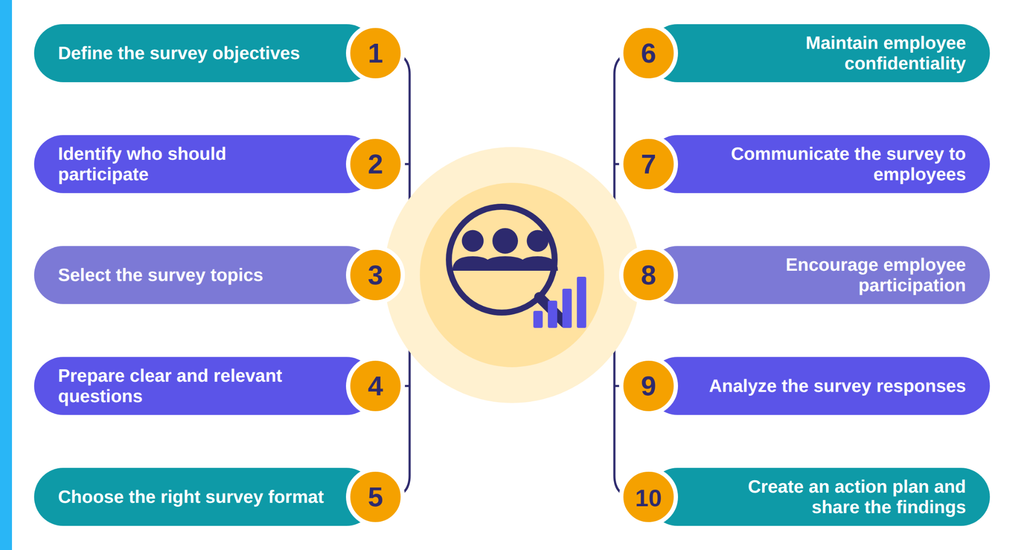
To conduct an effective employee engagement survey, HR teams should define the survey’s purpose, select relevant topics, prepare clear questions, communicate confidentiality and analyze the responses. Most importantly, they should use the findings to create an action plan.
Let’s look at the key steps for conducting an effective employee engagement survey.
Step 1: Define the Survey Objectives
Start by deciding what you want to understand through the survey because a clear objective helps HR teams to choose relevant questions and avoid collecting unnecessary information.
For example, your objectives may include:
- Understanding employee satisfaction with management support.
- Identifying communication gaps between departments.
- Evaluating recognition and career development opportunities.
- Understanding workload and work-life balance concerns.
- Identifying factors that may affect employee retention.
Keep the objectives specific, as a survey designed to understand manager effectiveness may require different questions from one focused on workplace culture.
Step 2: Identify the Employees Who Should Participate
Decide whether the survey will cover the entire organization or a specific group of employees.
For an organization-wide survey, employees from all departments, locations and job levels may be invited to participate. For a focused survey, HR teams may target a particular department, business unit or employee group.
Consider the following before finalizing the audience:
- Include employees from different departments and locations where relevant.
- Provide an accessible survey format for office, remote and frontline employees.
- Avoid excluding employees simply because they work different shifts.
- Make sure employees have enough time to complete the survey.
The goal is to collect feedback that represents the different employee experiences within the organization.
Step 3: Select the Survey Topics
Choose topics based on your objectives. Common areas include leadership, communication, recognition, career growth, workplace culture, teamwork and work-life balance.
Avoid including too many unrelated topics in one survey. A focused questionnaire is easier for employees to complete and easier for HR teams to analyze.
For example, if the organization is experiencing communication issues, include questions about access to information, manager communication and coordination between teams.
Step 4: Prepare Clear and Relevant Questions
Write questions in simple language so employees can understand what is being asked.
A good employee engagement survey question should:
- Focus on one topic at a time.
- Avoid confusing or technical language.
- Avoid leading employees towards a particular answer.
- Be relevant to employees’ actual work experiences.
- Allow employees to express their opinions honestly.
For example, instead of asking, “Do you agree that your manager communicates effectively and provides enough support?”, divide it into two questions:
- Does your manager communicate expectations clearly?
- Does your manager provide the support you need to complete your work?
This makes the responses easier to interpret and it is also useful to test the questionnaire with a small group before launching it across the organization. This can help identify confusing wording or questions that do not provide useful answers.
Step 5: Choose the Right Survey Format
Select a format that is easy for employees to access and complete.
Common survey question formats include:
- Rating scale: Employees rate their agreement or experience on a scale.
- Multiple choice: Employees select one or more predefined options.
- Yes/No: Employees provide a simple response.
- Open-ended questions: Employees write their opinions or suggestions.
A combination of rating-scale and open-ended questions often works well as rating scales help HR teams identify patterns, while written responses provide additional context.
Step 6: Maintain Employee Confidentiality
Employees are more likely to share honest feedback when they understand how their responses will be handled.
Before launching the survey, explain:
- Whether responses are anonymous or confidential.
- Who will have access to the collected information.
- How survey results will be analyzed and shared.
- Whether individual comments may be included in reports.
- How the organization will protect employee information.
Do not promise anonymity unless the survey process genuinely supports it. In small teams, even comments without names may reveal an employee’s identity through their role or situation.
Where possible, report results in groups rather than identifying individual respondents. Set minimum response thresholds for small teams and avoid sharing comments that could reveal someone’s identity.
Step 7: Communicate the Survey to Employees
Explain why the organization is conducting the survey and how the feedback will be used.
A survey announcement should mention:
- The purpose of the survey.
- Who should participate.
- The deadline for submission.
- The estimated time required.
- How confidentiality will be protected.
- When employees can expect an update about the findings.
Managers and HR teams should encourage participation without pressuring employees to provide particular answers.
Step 8: Encourage Employee Participation
A survey is useful only when employees feel comfortable participating and believe their feedback matters.
To encourage participation:
- Keep the questionnaire focused and easy to complete.
- Give employees sufficient time to respond.
- Make the survey accessible on suitable devices.
- Send polite reminders before the deadline.
- Allow employees to complete it during an appropriate work period.
- Explain how previous feedback has led to workplace improvements.
Try to avoid repeatedly sending reminders or asking managers to monitor individual responses. The focus should be on encouraging honest participation, not forcing completion.
Step 9: Analyze the Survey Responses
Once the survey closes, review the responses to identify common themes, positive feedback and areas that need attention.
Look at rating-scale results, participation levels and written comments together. For example, low scores on career development combined with comments about limited training opportunities may indicate a need to review learning and development initiatives.
Compare results across departments or locations only when there are enough responses to protect confidentiality and make the comparison meaningful.
Step 10: Create an Action Plan and Share the Findings
Once the survey results are ready, identify the areas that need improvement. Then, share the key findings with employees, decide on the next steps and assign responsibilities.
For example, if employees feel they do not receive enough feedback from managers, the organization can introduce regular one-to-one meetings or provide manager training.
Finally, keep employees updated about the actions taken which shows that their feedback matters and encourages them to participate in future surveys.
40+ Employee Engagement Survey Questions to Ask Employees
Employee engagement survey questions should help organizations to understand how employees experience their work, managers, colleagues and workplace culture. Always use a mix of rating-scale and open-ended questions to collect both measurable feedback and personal opinions.
Below are sample questions HR teams can adapt to their organization’s needs.
1. Leadership and Management
These questions help HR teams understand how employees feel about their managers and leadership support.
- Does your manager communicate work expectations clearly?
- Do you receive the support you need from your manager?
- Does your manager listen to your ideas and concerns?
- Do you trust the decisions made by senior leadership?
- Does your manager provide helpful feedback on your performance?
- Do leaders communicate the organization’s goals and priorities clearly?
2. Workplace Communication
Use these questions to understand whether employees receive timely and clear information.
- Are you satisfied with communication within your team?
- Do you receive important company updates on time?
- Are your roles and responsibilities clearly communicated?
- Do you feel comfortable sharing your opinions at work?
- Do different departments communicate and coordinate effectively?
3. Recognition and Appreciation
These questions help identify whether employees feel valued for their work and contributions.
- Do you feel recognized for your contributions?
- Does your manager appreciate your efforts and achievements?
- Are recognition and rewards distributed fairly?
- Do you receive feedback when you perform well?
- Does the organization celebrate employee achievements?
4. Career Growth and Development
Include these questions to understand employees’ learning needs and career expectations.
- Do you have opportunities to learn new skills?
- Does the organization support your professional development?
- Are career growth opportunities clearly communicated?
- Do you receive guidance to achieve your career goals?
- Do you believe you can grow professionally within the organization?
5. Work-Life Balance
These questions help organizations understand employees’ workload and ability to manage work and personal commitments.
- Can you manage your workload within your working hours?
- Do you have enough time to complete your assigned tasks?
- Does your organization support a healthy work-life balance?
- Can you take time off when needed?
- Do you feel comfortable discussing workload concerns with your manager?
Employee feedback about leave flexibility and time-off policies can help organizations understand whether employees feel supported in managing their personal and professional commitments. A Leave Management System can help HR teams organize leave requests, approvals and leave balances.
6. Workplace Culture and Inclusion
Use these questions to understand whether employees feel respected, included and connected to the workplace.
- Do you feel respected by your colleagues?
- Does the organization promote a fair and inclusive work environment?
- Do you feel comfortable being yourself at work?
- Are employees treated fairly regardless of their roles or backgrounds?
- Do you feel a sense of belonging within the organization?
7. Teamwork and Collaboration
These questions help evaluate how well employees work together and support one another.
- Do team members support each other when needed?
- Are team goals and responsibilities clearly defined?
- Do you have the resources needed to collaborate effectively?
- Are disagreements within your team handled constructively?
- Does your team work together to achieve common goals?
8. Overall Employee Engagement
These questions help organizations understand employees’ overall connection with their work and the organization.
- Do you feel motivated to perform your best at work?
- Are you proud to be associated with this organization?
- Do you understand how your work contributes to company goals?
- Would you recommend this organization as a good place to work?
- Do you see yourself continuing to work here over the next year?
9. Open-Ended Employee Feedback
Open-ended questions allow employees to share opinions and suggestions in their own words.
- What do you like most about working here?
- What is one thing the organization could improve?
- What changes would help you perform your job more effectively?
- What additional support would help you feel more engaged at work?
- Is there anything else you would like to share with the management team?
| Tip: You do not need to include all 46 questions in one survey. Select questions based on your objectives, survey length and the topics you want to understand. You can also combine rating-scale questions with a few open-ended questions to collect more meaningful feedback. |
How to Analyze Employee Engagement Survey Results?
Analyzing employee engagement survey results involves reviewing response patterns, identifying recurring concerns and understanding differences across relevant employee groups. HR teams should combine numerical scores with written feedback to understand not only what employees are experiencing but also why.
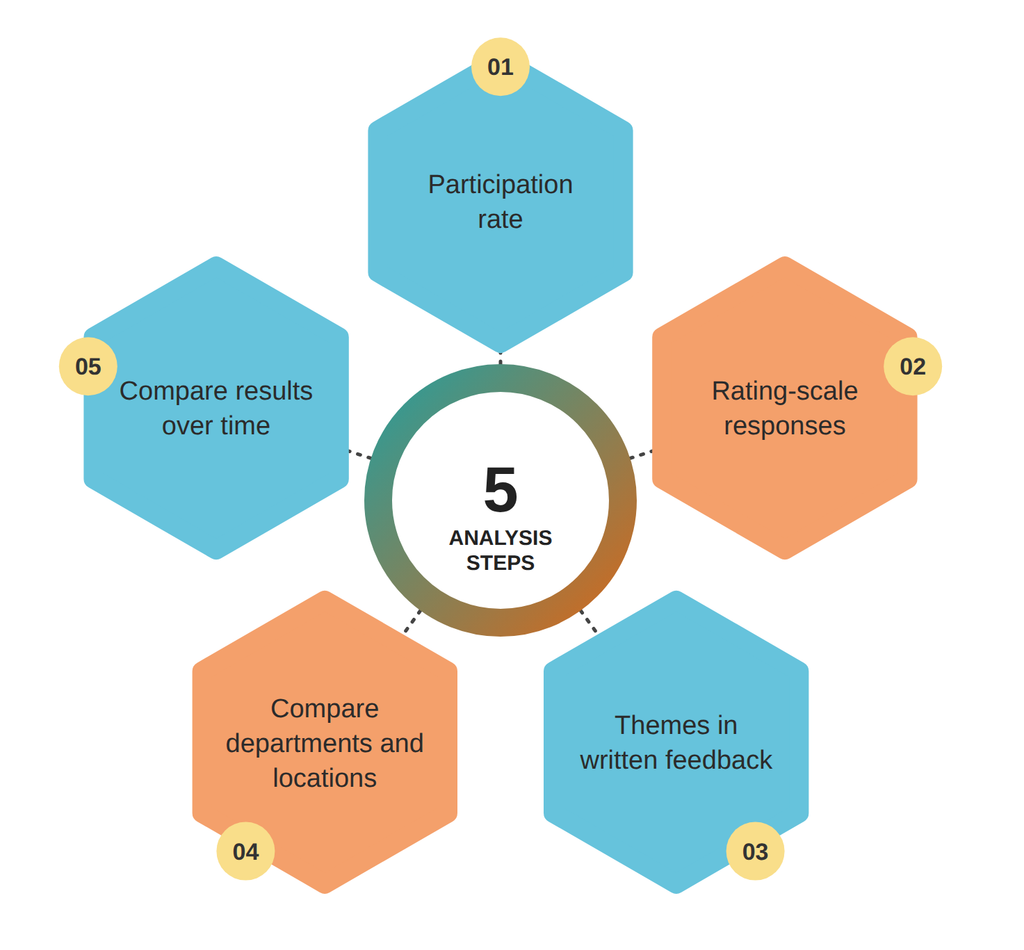
Follow these steps to review the results.
1. Check the Survey Participation Rate
Start by checking how many employees completed the survey compared with the total number of employees invited. This helps you understand the level of participation.
You can calculate the participation rate using this formula:
Participation Rate = (Completed Surveys ÷ Total Employees Invited) × 100
For example, if 160 out of 200 employees complete the survey, the participation rate is 80%.
A higher participation rate gives you feedback from more employees. However, it does not automatically mean that employees are highly engaged.
2. Review the Rating-Scale Responses
Next, calculate the average score for each survey topic to understand which areas are performing well and which need attention.
For example:
| Survey Area | Average Score (Out of 5) |
| Leadership support | 4.2 |
| Team collaboration | 4.1 |
| Workplace communication | 3.6 |
| Recognition | 3.2 |
| Career development | 2.9 |
In this example, employees have given lower scores to career development and recognition as HR teams can look into these areas to understand what changes employees expect.
Note: These scores are illustrative and not industry benchmarks.
3. Review Employee Comments
Apart from rating-scale responses, read employees’ written comments to understand their concerns in more detail.
For example, employees may mention limited training opportunities, delayed communication, a lack of manager feedback or uneven workloads.
Group similar comments together to identify common problems and understand what employees want the organization to improve.
4. Compare Results Across Departments or Locations
If enough employees have responded, compare survey results across departments, locations or teams.
For example, employees at one location may report communication problems, while another location may highlight limited training opportunities.
This helps HR teams understand whether a concern affects the entire organization or only a specific group. However, protect employee privacy when reviewing feedback from smaller teams.
5. Compare Results With Previous Surveys
Finally, compare the current survey results with previous surveys to see whether employee feedback has improved or changed.
For example, check whether scores for manager support, recognition or communication have improved after introducing new initiatives.
For a fair comparison, use the same or similar questions and response scales. This helps HR teams track progress and identify areas that still need attention.
How Often Should Organizations Conduct Employee Engagement Surveys?
Organizations should conduct employee engagement surveys often enough to understand changing employee experiences, but not so frequently that employees experience survey fatigue.
The right frequency depends on the organization’s size, workforce structure, recent changes and ability to act on feedback.
Common approaches include:
| Survey Type | Typical Frequency | Purpose |
| Annual engagement survey | Once a year | Review overall engagement and workplace experience |
| Pulse survey | Monthly or quarterly, depending on need | Check specific topics or recent changes |
| New employee survey | At selected onboarding milestones | Understand the new hire experience |
| Exit survey | When an employee leaves | Understand reasons behind the employee’s departure |
These are common planning options, not mandatory schedules as organizations should choose a frequency that allows them to review responses and take meaningful action between surveys.
What Should HR Teams Consider When Deciding Survey Frequency?
The survey schedule should depend on the organization’s needs and the type of feedback it wants to collect.
- Survey objectives: Use annual surveys for a broader understanding of employee engagement and pulse surveys for specific concerns.
- Workforce size: Consider the time and resources required to collect and analyze feedback across different teams and locations.
- Recent workplace changes: Conduct targeted surveys after major changes, such as restructuring, policy updates or leadership transitions.
- Previous survey results: If earlier feedback highlighted concerns, use follow-up surveys to understand whether the situation has improved.
Avoid sending too many surveys without taking action on previous feedback. Employees may lose interest if they are repeatedly asked for opinions but do not see meaningful changes.
Conclusion
Employee engagement surveys give organizations a structured way to understand employee experiences, identify workplace challenges and collect feedback that can support better decisions. However, their value depends on more than preparing questions and collecting responses.
HR teams should define clear objectives, ask relevant questions, protect employee confidentiality and communicate the findings. Most importantly, they should turn employee feedback into practical improvements and keep employees informed about the progress.
When organizations listen to employees and act on their feedback, engagement surveys can become a useful part of ongoing workplace improvement rather than just another HR activity.



Want to improve the way you manage your workforce?
Frequently Asked Questions About Employee Engagement Surveys
1. What Is the Main Purpose of an Employee Engagement Survey?
An employee engagement survey helps organizations understand how employees feel about their work and workplace. It gives HR teams insights into areas such as management support, communication, recognition and career growth so they can identify what needs improvement.
2. What Are the Best Questions to Ask in an Employee Engagement Survey?
Ask questions about manager support, teamwork, recognition, career opportunities and work-life balance. For example, “Do you feel valued for your work?” and “Do you get enough opportunities to learn new skills?” can help understand employees’ experiences.
3. How Many Questions Should an Employee Engagement Survey Have?
There is no fixed number of questions. It depends on what the organization wants to learn. Keep the survey short and focused, with enough questions to cover the important topics without making it tiring for employees.
4. Should Employee Engagement Surveys Be Anonymous?
Anonymous surveys can encourage employees to share honest feedback. However, anonymity depends on how the survey is designed and managed. Organizations should clearly explain how responses are collected, who can access them and how the results will be shared.
5. How Often Should HR Conduct Employee Engagement Surveys?
Many organizations conduct a detailed employee engagement survey once a year and use shorter pulse surveys during the year. However, the frequency should depend on how often the organization needs feedback and whether it has time to act on the results.
6. How Do You Measure Employee Engagement Through Surveys?
Employee engagement can be measured through questions about motivation, manager support, recognition, communication and career growth. HR teams can review employee ratings, written comments and changes in survey results over time to understand engagement levels.