

Show Cause Notice: Meaning, Format, Examples and How to Write One


-
AuthorRuchika Rajput
-
 Last Updated
November 23, 2026
-
 Reading Time
23 Mins
TL;DR
- A show cause notice is a formal communication asking an employee to explain an alleged act of misconduct, negligence or violation of workplace rules.
- Employers may issue it for misconduct, negligence of duty, unauthorized absenteeism, repeated late coming or policy violations.
- A proper show cause notice format should include employee details, incident description, relevant dates, applicable rules and a reasonable response deadline.
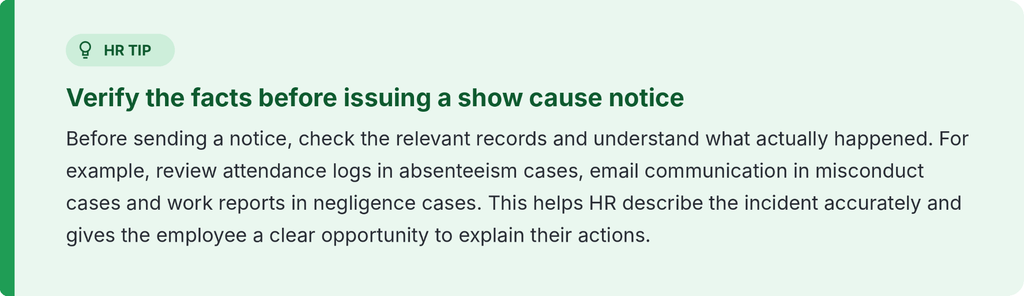
- HR should verify the facts, use neutral language and give the employee a fair opportunity to submit an explanation.
- After reviewing the response, the employer may close the matter, seek clarification or initiate further disciplinary proceedings, depending on the circumstances.
- In India, the process should follow applicable employment terms, standing orders, disciplinary procedures and legal requirements.
Workplace issues such as employee misconduct, negligence of duty, repeated late coming or unauthorized absence can create challenges for HR teams. However, employers should understand the circumstances before deciding whether disciplinary action is necessary. A show cause notice provides a formal way to ask an employee for an explanation before taking the next step.
Understanding the show cause notice meaning, when it may be issued and how to draft one can help HR to handle these matters carefully. The notice should describe the alleged incident, refer to the relevant workplace policy and provide a reasonable time for the employee to respond.
In this guide, we cover the key elements of a show cause notice, a practical show cause notice format, sample notices for common workplace situations, the steps to write one and important legal considerations in India.
What Is a Show Cause Notice?
A show cause notice is a formal letter issued by an employer asking an employee to explain their actions or conduct before the organization considers taking disciplinary action.
In simple terms, it gives employees a chance to share their side of the story before the employer decides what to do next.
For example, suppose an employee remains absent from work for four consecutive working days without informing their reporting manager or getting leave approval. In such a situation, HR may issue a show cause notice asking the employee to explain the reason for their absence and why it should not be considered a violation of the company’s attendance policy.
Receiving a show cause notice does not automatically mean that an employee is guilty or will be terminated. The employer must first review the employee’s explanation and consider the available facts before deciding on any further action.
Why Is a Show Cause Notice Important?
A show cause notice is important because it helps employers address workplace concerns through a documented and fair disciplinary process. It gives employees an opportunity to explain their actions while helping Core HR team to understand the incident before deciding on further action.
Let’s see why a show cause notice is important in an organization as shown below:
1. Gives Employees an Opportunity to Explain
It allows employees to share their side of the story, clarify misunderstandings or submit supporting documents before the employer makes a decision.
2. Maintains Proper Disciplinary Records
A show cause notice creates a written record of the incident, the allegations communicated to the employee, their response and the organization’s subsequent decision.
3. Promotes Fairness in the Process
It helps to ensure that employees are given a reasonable opportunity to respond before any adverse decision is considered. This supports a more transparent disciplinary process.
4. Clarifies Workplace Expectations
The notice identifies the conduct, responsibility or company policy that needs attention. This helps employees to understand the concern and the workplace expectations they are required to follow.
5. Encourages Consistent HR Practices
Following a documented process helps HR to handle similar workplace incidents more systematically and maintain consistency across departments.
Overall, a show cause notice is not simply a warning or punishment. It is a way to establish the facts, consider the employee’s explanation and determine the appropriate next step fairly.
When Should an Employer Issue a Show Cause Notice to an Employee?
An employer may issue a show cause notice when there is a reasonable concern that an employee has violated workplace rules, neglected assigned responsibilities or failed to follow organizational policies. However, HR should first verify the incident and review the relevant circumstances before issuing the notice.
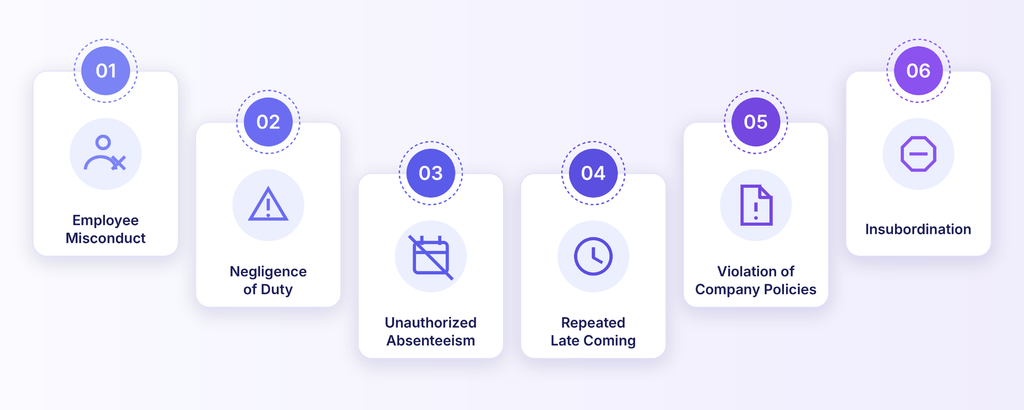
Here are some common situations in which an employer may consider issuing a show cause notice.
1. Employee Misconduct
When an employee behaves in a way that goes against the organization’s code of conduct or workplace rules, the employer may issue a show cause notice to understand the circumstances.
Some examples of employee misconduct include:
- Using abusive or inappropriate language with colleagues or managers.
- Sharing confidential company information without permission.
- Ignoring workplace safety rules.
- Misusing company property or resources.
- Engaging in behaviour that disrupts the work environment.
For example, if an employee shares confidential business information with someone outside the organization without authorization then HR may ask them to explain how the information was shared and why the incident occurred.
2. Negligence of Duty
Employees are expected to perform their assigned responsibilities with reasonable care and attention. When an employee repeatedly ignores work instructions or fails to follow important procedures, it may raise concerns about negligence of duty.
A show cause notice may be considered in situations such as:
- Repeatedly failing to complete assigned responsibilities.
- Ignoring important instructions from a reporting manager.
- Not following workplace safety procedures.
- Mishandling company equipment or materials.
- Neglecting important duties despite receiving clear instructions.
For example, an employee responsible for inspecting manufacturing equipment repeatedly skips the required checks. If this creates operational or safety concerns, the employer may seek an explanation through a show cause notice.
However, HR should understand the reason behind the failure before treating it as negligence. An occasional mistake, lack of proper training or unclear instructions should not automatically be considered misconduct.
3. Unauthorized Absenteeism
When an employee remains absent without informing the organization or obtaining the required leave approval, it may raise concerns about compliance with the company’s attendance policy.
An employer may consider issuing a show cause notice when an employee:
- Remains absent for several working days without informing their manager.
- Does not return to work after the approved leave period.
- Repeatedly takes leave without following the required approval process.
- Fails to respond to HR’s attempts to understand the reason for their absence.
For example, an employee takes two days of approved leave but does not report to work on the scheduled joining date or inform their manager about the extended absence. In such a situation, HR may ask the employee to explain the reason.
Before issuing the notice, HR should check attendance records, leave applications and previous communication with the employee. It is also important to consider genuine reasons for absence, such as medical emergencies or other unavoidable circumstances.
4. Repeated Late Coming
Employees are expected to follow the organization’s working hours and attendance policies. However, when an employee repeatedly arrives late without a reasonable explanation, it may become a disciplinary concern.
For example, an employee consistently arrives 30–45 minutes after the reporting time despite receiving reminders from their manager.
If the issue continues, HR may issue a show cause notice asking the employee to explain the repeated late arrivals and why the attendance policy has not been followed.
5. Violation of Company Policies
Every organization has policies that guide employee behaviour, workplace responsibilities and the use of company resources. When an employee allegedly violates these policies, the employer may seek an explanation through a show cause notice.
Some common examples include:
- Violating the company’s IT or data security policy.
- Using company resources for personal or unauthorized purposes.
- Ignoring workplace health and safety requirements.
- Sharing confidential information without permission.
- Failing to follow the organization’s code of conduct.
For example, if an employee uses their official company account to share restricted business information with an unauthorized person, HR may issue a notice asking them to explain the incident.
In such cases, the notice should clearly mention the policy involved and explain how the employee’s actions may have violated it.
6. Insubordination
Insubordination refers to an employee’s refusal to follow a lawful and reasonable instruction given by an authorized manager or supervisor, without a valid reason.
For example, an employee repeatedly refuses to perform an assigned responsibility despite receiving clear instructions and reminders from their reporting manager.
If the matter continues, the employer may issue a show cause notice asking the employee to explain their refusal.
However, HR should first check whether the instruction was reasonable, related to the employee’s role and communicated clearly. An employee raising a genuine concern or questioning an inappropriate instruction should not automatically be treated as insubordination.
What Are the Important Elements of a Show Cause Notice?
A proper show cause notice should include the employee’s details, the date and description of the alleged incident, relevant workplace rules, an explanation request and a reasonable response deadline. These details help the employee to understand the allegations and prepare an appropriate response.
The following elements should generally be included:
| Element | What should it contain? |
| Company details | organization’s name, address and contact information |
| Notice date | Date on which the notice is issued |
| Employee details | Employee’s name, designation, department and employee ID |
| Subject line | A clear subject explaining the reason for issuing the notice |
| Incident details | Description of the alleged incident, including relevant dates and circumstances |
| Supporting information | Relevant records, evidence or references, where appropriate |
| Policy reference | Applicable company policy, service rule or conduct provision |
| Explanation required | Clear questions or points the employee needs to address |
| Response deadline | Reasonable time limit for submitting a written explanation |
| Issuing authority | Name, designation and signature of the authorized person |
For example, instead of writing “You have repeatedly violated company attendance rules”, HR should mention the specific dates on which the employee was allegedly absent or late and identify the relevant attendance policy. This makes the notice more specific and gives the employee a fair opportunity to respond.
What Is the Format of a Show Cause Notice?
A show cause notice format is a formal letter structure that includes company and employee details, the subject, a description of the alleged incident, the relevant policy, a request for an explanation and a response deadline. HR can adapt this format to suit the circumstances and applicable company procedures.
Here is a general format HR teams can adapt according to the circumstances and applicable company procedures.
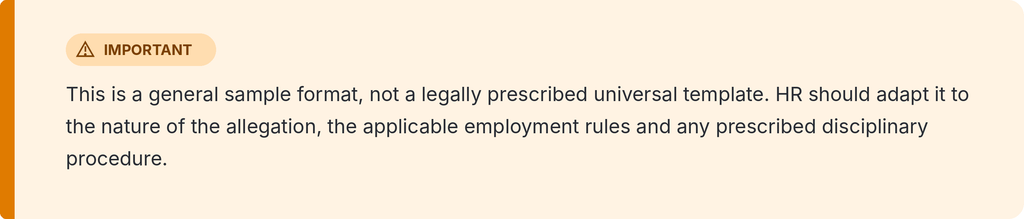
Sample Show Cause Notice Format
[Company Name]
[Company Address]
[Date]
To,
[Employee Name]
[Employee ID]
[Designation]
[Department]
Subject: Show Cause Notice Regarding [Reason for Issuing the Notice]
Dear [Employee Name],
It has been brought to our attention that on [Date/Period], you allegedly [describe the incident or conduct clearly].
According to the information available with the organization, [provide relevant details, including dates, circumstances and applicable policy or rule, wherever appropriate].
The above matter raises concerns regarding compliance with the organization’s [mention relevant company policy, employment terms or applicable conduct rules].
You are hereby requested to submit a written explanation within [reasonable response period] from the receipt of this notice, explaining why appropriate disciplinary action should not be considered in relation to the above matter.
You may also provide any relevant documents or supporting information that you believe should be considered while reviewing your explanation.
Your response will be examined before the organization decides on the appropriate next steps in accordance with applicable policies and procedures.
If you require additional time to submit your explanation, you may communicate your request to the HR department before the response deadline.
Please treat this matter as important and submit your explanation within the specified period.
Sincerely,
[Name of authorized Person]
[Designation]
[Company Name]
How to Write a Show Cause Notice to an Employee?
To write a show cause notice to an employee, HR should verify the incident, review the applicable workplace rules, describe the allegations clearly and ask for a written explanation within a reasonable period. The notice should use neutral language and avoid assuming that the employee is already guilty.
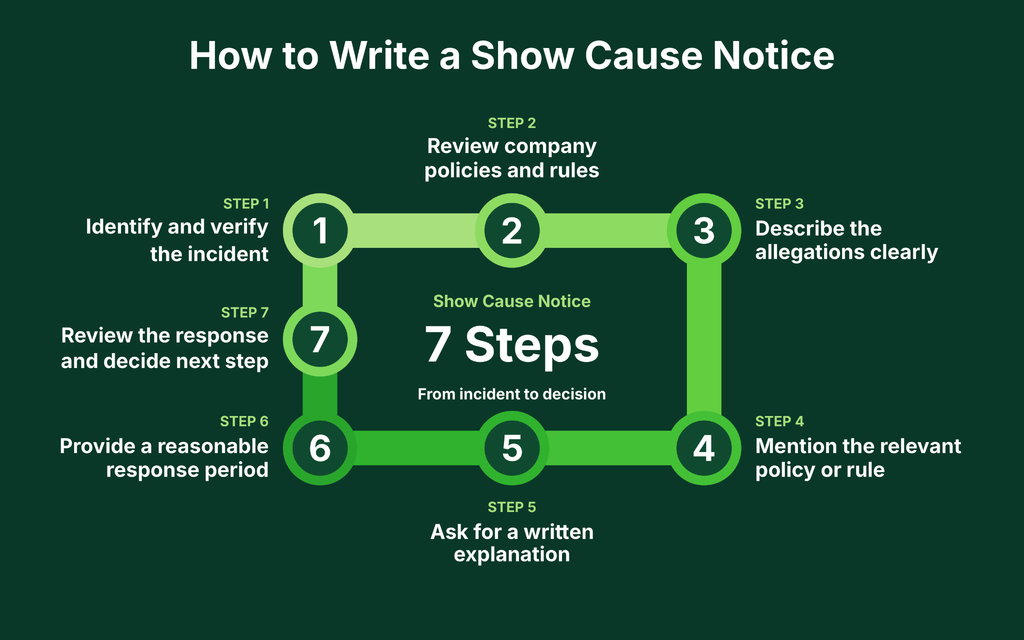
Let’s understand below how to write a well written show cause notice as shown below:
Step 1: Identify and Verify the Incident
Start by understanding what happened and why the matter requires an explanation.
Speak with the reporting manager, review relevant records and collect the available information about the incident.
For example, if an employee is suspected of unauthorized absenteeism, check:
- Attendance and punch records.
- Approved and casual leave applications.
- Communication with the reporting manager.
- Emails or messages sent to HR.
- Any explanation already provided by the employee.
Reviewing these details helps HR to establish whether there is a genuine concern that needs to be addressed formally.
Step 2: Review Company Policies and Employment Rules
Before drafting the notice, check the applicable company policies, employment terms, service rules and disciplinary procedures.
For example, if the issue relates to repeated late coming, review the organization’s attendance policy to understand the prescribed reporting time, grace period and procedure for addressing repeated violations.
Where applicable, also check the relevant standing orders and statutory requirements.
Step 3: Describe the Allegations Clearly
Explain what the employee is alleged to have done or failed to do. Include relevant dates, times, locations and other details wherever available.
Avoid vague statements such as:
“You have demonstrated irresponsible behaviour at work.”
Instead, provide specific information:
“According to the attendance records, you reported to work after the prescribed reporting time on 5, 8, 11 and 14 November 2026 without an approved exception.”
The second statement gives the employee a clearer understanding of the incidents they are being asked to explain.
Step 4: Mention the Relevant Policy or Rule
Identify the company policy, employment condition or applicable rule that may have been violated.
For example:
“Your repeated late arrival appears inconsistent with the organisation’s Attendance and Punctuality Policy.”
Mentioning the relevant rule helps the employee understand why the organization is seeking an explanation.
Step 5: Ask for a Written Explanation
Clearly state what the employee needs to explain. Ask them to provide their version of events and any supporting documents they want the organisation to consider.
Keep the language neutral and avoid statements that suggest the employee has already been found responsible.
Step 6: Provide a Reasonable Response Period
Mention the deadline for submitting the written explanation.
The response period should be reasonable, considering the seriousness and complexity of the allegations, the information the employee may need to review and the applicable rules or disciplinary procedure.
There is no single response period that applies to every private-sector employee or every type of show cause notice in India. HR should follow the relevant employment rules, standing orders and applicable legal requirements.
Step 7: Review the Response and Decide the Next Step
Once the employee submits their explanation, HR should review it objectively and consider the information and supporting documents provided.
Depending on the facts, the organization may:
- Accept the explanation and close the matter.
- Request additional information or clarification.
- Conduct a further investigation.
- Initiate a disciplinary inquiry, where required.
- Consider appropriate action in accordance with applicable rules.
The final decision should be based on the facts and the applicable procedure, not predetermined when the notice is issued.
What Are the Different Show Cause Notice Examples for Employees?
Show cause notice examples vary according to the nature of the alleged incident, such as employee misconduct, negligence of duty or unauthorized absenteeism.
Each notice should describe the specific incident, identify the relevant workplace rule and give the employee an opportunity to explain.
Below are three sample formats HR can adapt for common workplace situations.
1. Show Cause Notice to an Employee for Misconduct
Subject: Show Cause Notice Regarding Alleged Workplace Misconduct
Dear [Employee Name],
It has been brought to the management’s attention that on [Date], you allegedly engaged in inappropriate conduct at the workplace involving [briefly describe the incident and relevant circumstances].
Based on the information currently available, the incident occurred at [Location/Department] and involved [mention relevant details, where appropriate].
The reported conduct raises concerns regarding compliance with the organization’s Code of Conduct and applicable workplace discipline policies.
You are requested to submit a written explanation within [Response Period] from the receipt of this notice, describing your version of the incident and explaining why disciplinary action should not be considered.
You may also submit any supporting documents or other information that you believe are relevant to the matter.
The organization will review your explanation and the available information before deciding on the appropriate next steps under the applicable disciplinary procedure.
Sincerely,
[Authorised Person’s Name]
[Designation]
[Company Name]
2. Show Cause Notice to an Employee for Negligence of Duty
Subject: Show Cause Notice Regarding Alleged Negligence of Duty
Dear [Employee Name],
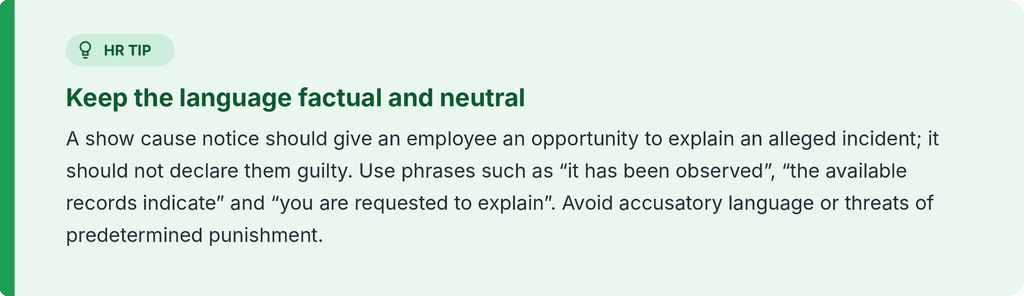
It has been observed that on [Date/Period], you allegedly failed to carry out [mention the specific assigned responsibility] in accordance with the instructions and procedures communicated to you.
As a result, [briefly describe the operational impact or concern, if established and supported by available information].
The incident raises concerns about whether your assigned responsibilities and the organisation’s relevant work procedures were followed.
You are requested to submit a written explanation within [Response Period] from the receipt of this notice, explaining the circumstances that led to the incident and why appropriate disciplinary action should not be considered.
You may include any relevant documents or supporting information along with your response.
The organization will review your explanation and the available records before deciding whether any further action is necessary, in accordance with applicable policies and procedures.
Sincerely,
[Authorised Person’s Name]
[Designation]
[Company Name]
3. Show Cause Notice to an Employee for Absenteeism
Subject: Show Cause Notice Regarding Absence from Duty Without Prior Approval
Dear [Employee Name],
According to the organization’s attendance records, you were absent from duty on [Mention Dates] without an approved leave application or prior intimation to your reporting manager.
The organization attempted to contact you through [Mention communication method and dates, if applicable] to understand the reason for your absence. However, [mention whether a response was received, if relevant].
Your absence without prior approval or intimation raises concerns regarding compliance with the organization’s attendance and leave policies.
You are requested to submit a written explanation within [Response Period] from the receipt of this notice, stating the reasons for your absence and providing any relevant supporting documents.
If any personal, medical or emergency circumstances prevented you from informing the organization in advance, please explain them in your response.
Your explanation will be reviewed before the organization decides on the appropriate next steps in accordance with applicable policies and procedures.
Sincerely,
[Authorised Person’s Name]
[Designation]
[Company Name]

What Happens After a Show Cause Notice Is Issued?
After a show cause notice is issued, the employer reviews the employee’s explanation and supporting documents before deciding on the next step. Depending on the circumstances, the matter may be closed, further clarification may be requested or formal disciplinary proceedings may be initiated.
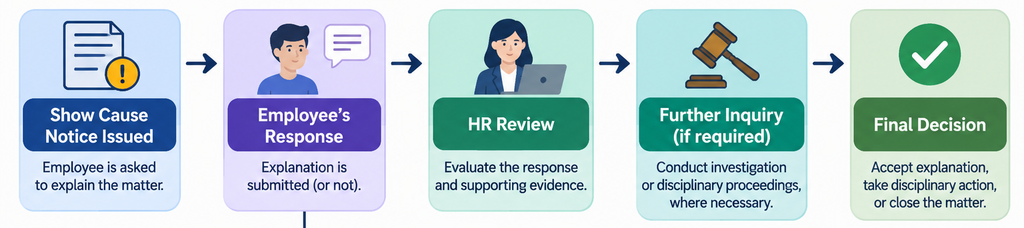
There are generally four possible situations after issuing the notice let’s explore below:
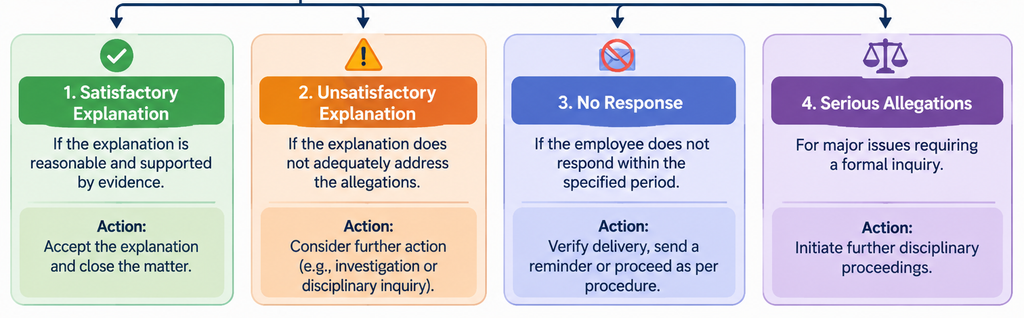
1. Employee Submits a Satisfactory Explanation
If the employee provides a reasonable explanation supported by relevant information, the employer may accept it and close the matter without further disciplinary action.
For example, an employee who was absent without prior approval may explain that they faced a medical emergency and provide supporting documents.
HR should evaluate the explanation and record the outcome appropriately.
2. Employee Submits an Unsatisfactory Explanation
If the employee’s explanation does not adequately address the allegations, the employer may consider further action.
Depending on the nature of the allegations and applicable rules, this may involve:
- Seeking additional clarification from the employee.
- Conducting a further investigation.
- Initiating a formal disciplinary inquiry, where required.
- Considering an appropriate disciplinary measure in accordance with the applicable procedure.
However, an unsatisfactory explanation does not automatically justify punishment. The employer should consider the available evidence and follow the required disciplinary process before making a decision.
3. Employee Does Not Submit a Response
If the employee does not respond within the specified period, HR should first check whether the notice was properly delivered and whether the employee had a reasonable opportunity to submit an explanation. The organization may send a reminder or provide additional time, where justified.
If the employee still does not respond, the employer may proceed in accordance with the applicable disciplinary procedure. However, failure to respond should not automatically be treated as proof that the allegations are true.
4. Further Disciplinary Proceedings Are Initiated
For serious allegations or matters requiring a formal inquiry, the orgaiization may initiate further disciplinary proceedings.
Depending on the applicable rules and procedure, this may involve:
- Appointing an inquiry officer.
- Communicating the specific charges to the employee.
- Providing access to relevant evidence, as required.
- Giving the employee an opportunity to present their defence.
- Recording the inquiry findings.
- Taking a decision based on the findings and applicable service rules.
A show cause notice and a formal charge sheet or charge memorandum may serve different purposes. A notice seeking an initial explanation should not automatically be treated as a substitute for a formal inquiry or charge-sheet procedure where one is required.
What Precautions Should HR Take While Issuing a Show Cause Notice?
A show cause notice is an important step in the workplace disciplinary process. If it is not handled properly then it can lead to disputes, procedural issues or questions about whether the employee received a fair opportunity to explain their actions.
Here are some important precautions.
- Verify the incident: Confirm the facts and review supporting information before issuing the notice. Check relevant attendance records, emails, reports or statements, depending on the nature of the matter.
- Clearly describe the allegations: Mention the relevant dates, incidents, responsibilities and policies. Avoid vague statements that do not explain what the employee is being asked to address.
- Use neutral language: Present the matter as an allegation that requires an explanation. Do not describe the employee as guilty or use threatening language.
- Provide a reasonable response period: Give the employee sufficient time to understand the allegations, review relevant information and prepare a response. Follow the applicable employment rules and disciplinary procedure.
- Maintain confidentiality: Share the notice and related information only with authorized individuals who need access to handle the matter.
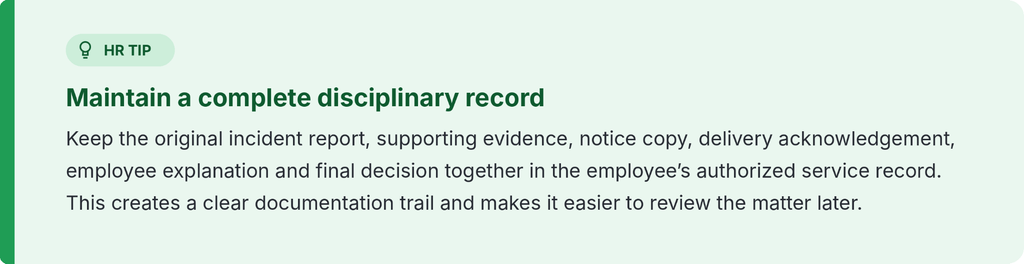
- Keep proper records: Retain a copy of the notice, proof of delivery, the employee’s response, supporting documents and records of subsequent decisions.
- Consider the employee’s explanation: Review the response objectively and consider any relevant documents or circumstances before deciding on further action.
- Follow the applicable procedure: Ensure that any further action is consistent with employment terms, service rules, applicable standing orders and relevant laws
What Are the Legal Considerations for Issuing a Show Cause Notice in India?
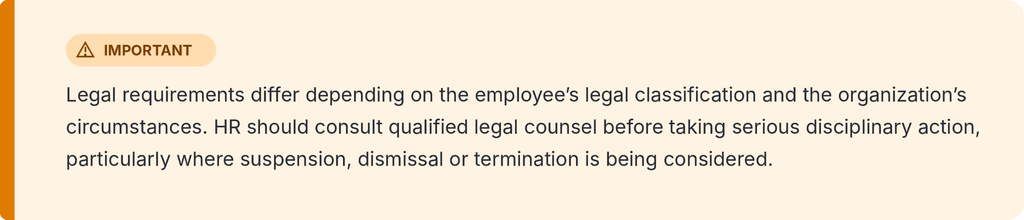
In India, the process for issuing and acting on a show cause notice depends on the nature of employment, the establishment, applicable legislation, certified or model standing orders, service rules and employment terms.
There is no single universal law prescribing one identical show cause notice format and response deadline for every employee in every organization.
HR should pay attention to the following legal and procedural considerations.
1. Principles of Natural Justice
The principles of natural justice are important in disciplinary proceedings. They generally require that an employee should have a fair opportunity to respond to allegations before an adverse decision is made.
Two important principles are:
- Audi alteram partem: Give the other party an opportunity to be heard.
- Nemo judex in causa sua: No one should be a judge in their own cause.
In practical terms, HR should communicate the allegations clearly, provide an appropriate opportunity to respond and ensure that the matter is considered fairly.
2. Industrial Employment (Standing Orders) Requirements
The Industrial Employment (Standing Orders) framework governs employment conditions and disciplinary matters for covered industrial establishments and employees.
The Industrial Relations Code, 2020, which consolidates the standing orders framework along with other industrial relations legislation which is relevant to understanding the current statutory framework.
Where applicable, HR should check the relevant standing orders, including provisions concerning misconduct, disciplinary procedures and domestic inquiries. The exact applicability and requirements depend on the establishment and employee category.
3. Applicable Employment Terms and Company Policies
An organization’s appointment letter, employment agreement, service rules, disciplinary policy and employee handbook may contain provisions relating to misconduct, attendance, negligence and disciplinary action.
HR should ensure that the notice and subsequent procedure are consistent with the applicable provisions.
4. Fair Opportunity Before Disciplinary Action
A show cause notice should not be treated as a formality before imposing a decision that has already been made.
The employee’s explanation should be considered genuinely. Where a formal domestic inquiry is required, the organization should follow the applicable procedure rather than treating the initial notice as sufficient by itself.
Conclusion
Overall, A show cause notice is an important part of employee disciplinary management. It allows employers to communicate alleged violations, seek an employee’s explanation and evaluate the matter before deciding on further action.
For HR professionals, the key is to ensure that every notice is based on verified information, clearly explains the allegations and provides a fair opportunity to respond. Maintaining proper documentation and following applicable employment rules also helps organizations to manage disciplinary matters more systematically.
With clear communication and a consistent process, HR can handle workplace concerns while maintaining fairness, transparency and accountability.










Want Better Control Over Employee Records and HR Processes?
Frequently Asked Questions
1. Is a Show Cause Notice a Punishment?
No, a show cause notice is not a punishment. It is a formal communication asking an employee to explain an alleged act of misconduct, negligence or violation of company rules. The employer reviews the employee’s response before deciding whether any disciplinary action is necessary.
2. What Is the Correct Format for a Show Cause Notice?
A show cause notice should include the company name, notice date, employee details, subject, description of the alleged incident, relevant policy or rule, request for a written explanation and response deadline. It should use clear, neutral and professional language.
3. How to Write a Show Cause Notice Sample?
To write a show cause notice, mention the specific incident, explain the concern, refer to the applicable company policy and ask the employee to submit a written explanation within a reasonable timeframe. Avoid assuming that the employee is guilty before reviewing their response.
4. What Is the Format of a Show Cause Letter?
A show cause letter generally follows a formal letter format:
Company details: Name and address of the organization.
Date and employee details: Date of issue, employee name, designation and department.
Subject: Purpose of the notice.
Incident details: Description of the alleged misconduct or violation.
Explanation request: Ask the employee to provide a written response.
Response deadline: Mention a reasonable date or timeframe.
Authorized signature: Name and designation of the issuing authority.
5. What Is the Show Cause Process?
The show cause process generally involves the following steps:
– Identify and verify the alleged incident.
– Review relevant company policies and employment rules.
– Issue a written show cause notice to the employee.
– Give the employee a reasonable opportunity to respond.
– Review the explanation and supporting evidence.
– Decide whether the matter should be closed or further disciplinary action is required.
The exact procedure may vary depending on applicable employment laws, standing orders and company policies.
6. Can a Show Cause Notice Be Sent Through Email?
Yes, a show cause notice can generally be sent through email, provided the method is permitted under the applicable service rules, company policies and legal requirements. HR should send it to the employee’s official email address, retain proof of delivery and preserve a copy of the notice and any response.