How HRMS Software Simplifies Employee Salary Disbursement



-
AuthorRuchika Rajput
-
 Last Updated
November 06, 2026
-
 Reading Time
16 Mins
TL;DR
- Salary disbursement is the process of paying employees their net salaries after payroll calculations and necessary approvals.
- Businesses may face challenges such as incorrect bank details, manual calculations, approval delays, failed transactions and difficulty managing bulk payments.
- HRMS software can connect employee records, attendance, leave management and payroll to simplify salary preparation and payment administration.
- Automating salary disbursement helps ensure timely salary payments, reduce manual errors, save administrative time and maintain better payment records.
- Common salary payment methods in India include NEFT, RTGS, IMPS and NACH, depending on banking arrangements.
- When choosing HRMS software, look for payroll automation, bank detail management, approval workflows, bulk payment support and payment reporting.
Salary disbursement is an important task for HR and finance teams. Employees expect to receive their salaries on time, while businesses need to make sure that every payment is accurate.
In India, digital wage payments are becoming more common. According to the International Labour Organization (ILO), the share of wage recipients receiving wages in cash fell from 79% in 2014 to 43% in 2021.
However, as a business grows, managing salary payments manually can become difficult. HR teams need to check attendance, adjust leave, calculate salaries, verify bank details and get payment approvals. As a result, the process can take more time and increase the chances of errors.
This is where HRMS software helps. It brings these activities together in one system, making it easier to prepare payroll, manage bulk salary payments and maintain salary records. In this blog, we explore how HRMS software simplifies employee salary disbursement.
What Is Salary Disbursement?
Salary disbursement is the process of paying employees their salaries for a specific payroll period. It includes calculating the final salary, getting the required approvals and transferring the payable amount to employees’ bank accounts.
Most companies disburse salaries every month. However, the payment schedule may vary depending on company policies and employment agreements.
The final salary amount is calculated after considering different components, such as:
- Basic Salary: The fixed part of an employee’s salary.
- Allowances: Additional amounts such as HRA and conveyance allowance.
- Variable Pay: Performance incentives, commissions and bonuses.
- Attendance and Leave: Paid days, unpaid leave, and other attendance adjustments.
- Deductions: PF, ESI, professional tax, TDS, loan repayments and other applicable deductions.
- Reimbursements: Approved expenses that the company needs to repay to employees.
After checking these details and getting the necessary approvals, the company processes the salary payment and transfers the amount to employees.
What Is the Difference Between Payroll Processing and Salary Disbursement?
Payroll processing and salary disbursement are connected activities, but they serve different purposes.
Payroll processing focuses on calculating how much an employee should receive, whereas salary disbursement focuses on transferring that amount to the employee.
| Parameter | Payroll Processing | Salary Disbursement |
| Primary purpose | Calculate employee salaries | Pay employees their net salaries |
| Main activities | Earnings, deductions, taxes and adjustments | Payment preparation, authorization and transfers |
| Key information | Attendance, salary structure and deductions | Net salary and bank account details |
| Main output | Approved payroll | Salary payment transactions |
| Responsible teams | HR and payroll | Finance and payroll |
| Final record | Payroll register | Bank transaction and payment records |
For example, if an employee’s monthly gross earnings are ₹50,000 and applicable deductions total ₹5,000, the net salary payable is ₹45,000.
Payroll processing determines the ₹45,000 payable amount while Salary disbursement ensures that this amount is transferred to the employee’s bank account.
This distinction is important when selecting software because businesses need both accurate payroll calculations and a reliable payment execution process.
What Challenges Do Businesses Face During Employee Salary Disbursement?
Managing salary payments for a small team may seem straightforward. However, as an organization expands across departments, branches and locations, the salary disbursement process becomes more demanding.
Core HR and finance teams must coordinate employee information, payroll approvals, payment instructions and bank transactions while ensuring that employees receive the correct amounts on time.
Some common challenges include:
1. Incorrect Employee Bank Account Details
Salary payments depend on accurate employee banking information because incorrect account numbers, IFSC codes, inactive accounts or outdated bank details can result in failed or delayed transactions.
When HR teams maintain employee bank information across multiple spreadsheets, verifying and updating these details can become difficult.
2. Manual Salary Calculations and Payment Errors
Manual payroll system calculations increase the chances of mistakes, particularly when businesses manage different salary structures, allowances, deductions and variable payments.
For example, if unpaid leave or an approved salary revision is not reflected correctly, the employee may receive an incorrect amount. Such errors require additional verification, corrections and sometimes separate payments.
3. Delays in Payroll Approvals
Salary disbursement usually involves coordination between HR, payroll managers, finance teams and authorized approvers.
If payroll information is incomplete or approval requests remain pending, the payment process can get delayed. This becomes particularly challenging when companies have multiple approval levels or operate across different locations.
4. Difficulty in Managing Bulk Salary Transfers
Businesses with hundreds or thousands of employees need to process multiple salary payments within a limited period.
Preparing individual bank transfers manually can consume considerable time and increase administrative work. That’s why companies need a reliable process for preparing, authorizing and monitoring bulk salary payments.
5. Difficulty in Tracking Failed Transactions
Sending salary payment instructions does not always mean that every employee has received the money.
Transactions may fail because of incorrect banking details, account restrictions, technical issues or other bank-side reasons.
Without proper payment tracking, finance teams may struggle to identify unsuccessful transfers and arrange corrections promptly.
6. Maintaining Salary Records and Payment Reports
Businesses need accurate records of salary calculations, approved payroll, payment instructions and completed transactions.
When these records are maintained separately, preparing monthly reports, verifying payments and reconciling payroll with bank statements can become time-consuming.
An organized salary disbursement process helps businesses maintain better financial visibility and simplifies record management.
How Does HRMS Software Make Employee Salary Disbursement Easier?
HRMS software simplifies employee salary disbursement by connecting employee information, attendance, leave management, payroll calculations and salary administration.
So, instead of managing these activities through separate spreadsheets and manual processes, HR teams can use an integrated system to prepare and review payroll information before initiating salary payments.
You can understand this by exploring how HRMS software makes the process easier.
1. Automates Salary Calculations Before Disbursement
HRMS software helps calculate employee salaries based on their salary structure and applicable payroll rules.
It can consider different salary components, such as:
- Basic salary and allowances.
- Incentives, bonuses and variable pay.
- Overtime and shift allowances.
- Paid and unpaid leave adjustments.
- PF, ESI, professional tax and TDS.
- Loans, advances and reimbursements.
This reduces the need for repeated manual calculations and makes payroll preparation easier.
For example, if an employee takes unpaid leave during the month, the system can adjust the payable salary based on the company’s leave and payroll policies. The payroll team can then review the calculated amount before approving the salary payment.
2. Integrates Attendance and Leave Data
Attendance and leave records play an important role in salary calculation. If these records are maintained separately, HR teams may have to collect reports and update payroll spreadsheets manually.
An integrated HRMS connects attendance and leave management with payroll. This helps HR teams:
- Check employee attendance records.
- Calculate payable working days.
- Account for approved and unpaid leave.
- Include overtime and shift-related earnings.
- Reduce differences between attendance and payroll records.
For example, if an employee takes two days of unpaid leave in a month, the system can consider those days while calculating the salary.
This saves manual effort and helps payroll teams prepare salary details more easily.
3. Centralizes Employee Bank Account Information
Correct bank details are important for successful salary transfers, and HRMS software provides a central place to store and manage employee information, including bank account details.
These details may include:
- Employee name.
- Bank account number.
- Bank name and branch.
- IFSC code.
- Bank detail verification status, where supported.
This makes it easier for authorized HR and finance teams to access the information needed to prepare salary payments. It also reduces the need to collect bank details repeatedly through emails or spreadsheets.
However, businesses should still verify bank details and follow an approval process whenever an employee updates their account information.
4. Simplifies Payroll Approval and Authorization
Before salaries are transferred, payroll information generally needs to be reviewed and approved by authorized personnel.
HRMS software can support structured payroll approval workflows, depending on the available functionality.
For example:
- The payroll team prepares the monthly payroll.
- The HR manager reviews employee earnings and deductions.
- The finance team verifies the total salary payable.
- An authorized approver approves the payment instructions.
- The payment is initiated through the company’s supported banking channel.
This creates a more organized approval process and helps businesses maintain accountability.
It also reduces the need to coordinate every approval through separate email conversations.
5. Supports Bulk Salary Transfers
Processing salary payments individually can become difficult when a company has a large workforce.
Bulk Salary Transfer Software helps businesses to prepare and manage multiple employee payments together rather than handling every transaction separately.
Depending on the HRMS and banking integration, businesses can:
- Generate bank-compatible salary payment files.
- Prepare payment instructions for multiple employees.
- Review employee-wise salary amounts.
- Submit approved payments through supported banking channels.
- Monitor transaction results where integration supports payment tracking.
For example, a business with 500 employees can prepare a consolidated salary payment file instead of manually entering 500 individual transactions. The finance team can then upload or authorize the payment through its corporate banking platform, depending on the bank’s process.
This can significantly simplify salary administration for businesses managing large or distributed workforces.
6. Generates Payslips and Payment Reports
Salary disbursement is not complete from an employee communication point of view just because the payment has been initiated.
Employees also need clear information about their earnings, deductions and net salary. HRMS software can generate employee payslips containing relevant salary details, such as:
- Basic salary and allowances.
- Variable earnings and incentives.
- Statutory and other deductions.
- Reimbursements, where applicable.
- Net salary payable.
Employee self-service functionality can also allow employees to access their payslips without repeatedly contacting HR.
In addition, payroll reports help HR and finance teams review salary expenses, employee-wise payment amounts and monthly payroll records. This improves transparency and makes salary administration easier to manage.
Which Salary Payment Methods Can Businesses Use in India?
Businesses in India can use different banking channels to transfer salaries to employees. The choice depends on the company’s bank, payment requirements, transaction limits and available banking facilities.
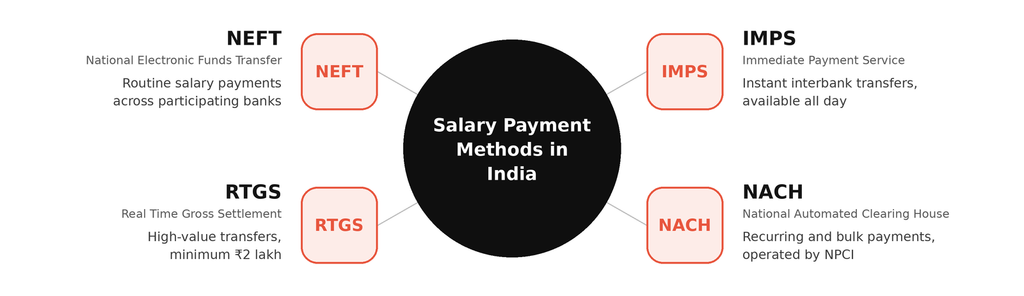
Some commonly used methods include:
1. NEFT (National Electronic Funds Transfer)
NEFT is an electronic payment system used to transfer funds between bank accounts.
Businesses can use NEFT to credit employee salaries to their respective bank accounts. It is commonly used for routine salary payments and supports transfers across participating banks.
2. RTGS (Real Time Gross Settlement)
RTGS is primarily used for high-value fund transfers. Under RBI rules, the minimum amount for an RTGS transaction is ₹2 lakh.
Larger organizations may use RTGS for eligible high-value payments, depending on their banking arrangements.
3. IMPS (Immediate Payment Service)
IMPS enables instant interbank fund transfers and is available throughout the day, subject to participating banks’ rules and transaction limits.
Businesses may use IMPS for eligible salary-related transfers or individual payments when immediate fund transfer is required.
4. NACH (National Automated Clearing House)
NACH is operated by NPCI to support recurring and bulk payment transactions.
Businesses can use suitable NACH arrangements for salary and other recurring payments, depending on their bank and mandate requirements.
Which method should businesses choose?
| Payment method | Common use | Key characteristic |
| NEFT | Regular salary transfers | Electronic bank transfers |
| RTGS | High-value transfers | Real-time gross settlement |
| IMPS | Immediate transfers | Instant fund transfer |
| NACH | Bulk and recurring payments | Automated payment processing |
An important consideration is that HRMS software may support payment preparation or integration with banking services, but the availability of each payment method depends on the bank and software provider.
What Are the Benefits of Automating Employee Salary Disbursement?
Automating salary disbursement makes it easier for businesses to manage employee payments without relying on multiple spreadsheets and repetitive manual tasks.
It helps HR and finance teams save time, reduce payment errors and keep salary records organized. Some key benefits include:
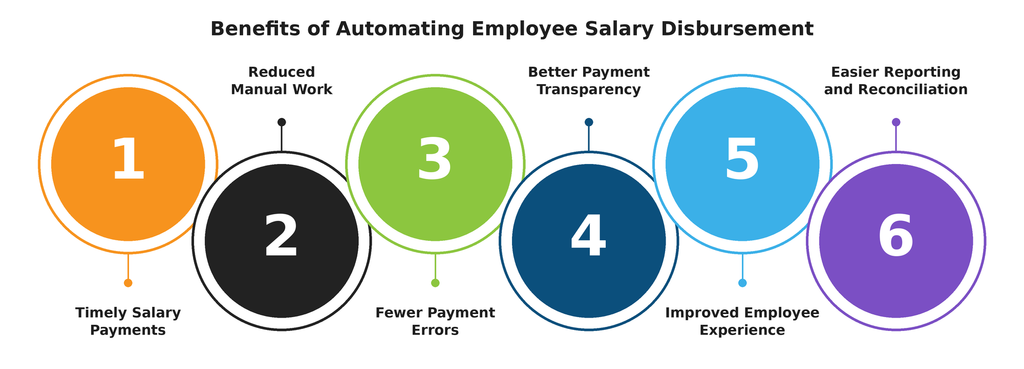
1. Timely Salary Payments
Employees expect their salaries to be credited on time every month. However, manual calculations, pending approvals and payment preparation can sometimes delay the process.
HRMS software helps organize payroll activities, automate salary calculations and simplify approvals. This allows HR and finance teams to prepare salary payments on schedule and reduce unnecessary delays.
2. Reduced Manual Work
Managing salary payments manually involves several tasks, such as checking attendance, calculating salaries, verifying bank details and preparing payment records.
HRMS software brings these activities together in one system. This reduces repetitive work and gives HR teams more time to focus on employee queries and other important responsibilities.
3. Fewer Payment Errors
Incorrect salary calculations, outdated bank details and manual data-entry mistakes can lead to payment errors.
HRMS software helps reduce these mistakes by using centralized employee records and automated salary calculations. Payroll teams can also review salary details before approving payments.
4. Better Payment Transparency
Employees often contact HR to understand their salary calculations, deductions or payslips.
With employee self-service functionality, they can access their payslips and view details of their earnings and deductions. This makes salary information easier to understand and reduces repeated queries to HR.
5. Improved Employee Experience
Receiving the correct salary on time is important for employee satisfaction.
A well-managed salary disbursement process helps businesses avoid unnecessary payment delays and calculation errors. Employees also benefit from easy access to their payslips and salary information.
6. Easier Financial Reporting and Reconciliation
HR and finance teams need to keep track of salary payments and monthly payroll expenses.
HRMS software helps maintain organized payroll records and generate reports for review. When connected with banking systems, it can also help track transactions and identify differences between approved payroll amounts and actual payments.
This makes salary records easier to manage and simplifies monthly financial reconciliation.
What Features Should You Look for in HRMS Software for Salary Disbursement?
Selecting the right Employee Salary Management Software requires more than checking whether it can calculate salaries.
Businesses should evaluate whether the system supports the complete salary administration process from employee information management to payment preparation and reporting.
Here are seven important features to consider.
| Feature | Why it matters |
| Payroll calculation automation | Helps to calculate earnings, deductions and net salary |
| Employee bank details management | Keeps salary payment information organized |
| Bank integration and bulk payment support | Simplifies payment preparation and transfers |
| Approval workflows | Establishes review and authorization processes |
| Payment tracking | Helps identify pending and failed transactions |
| Payslip generation | Provides employees with salary information |
| Reports and data security | Supports financial visibility and controlled access |
How Can Businesses Ensure Accurate and Timely Salary Disbursement?
HRMS software can simplify salary disbursement, but businesses still need proper checks and clear payroll processes to avoid delays and payment errors.
HR and finance teams can follow these practices to manage salary payments smoothly.
1. Keep Employee Records Updated
Make sure employee details are correct and up to date. Regularly check bank account numbers, IFSC codes and other important information. Also, verify any changes before updating employee records.
2. Set Clear Payroll Cut-Off Dates
Set deadlines for attendance management corrections, leave approvals, reimbursements and salary revisions. This gives HR and payroll teams enough time to prepare and review salary details before the payment date.
3. Review Salary Calculations Before Approval
Check employee-wise salary calculations before approving payroll and review earnings, shift allowances, deductions and final payable amounts to identify any mistakes in advance.
4. Coordinate with the Finance Team
HR and finance teams should work together to ensure salary payments are ready on time. The finance team should check fund availability and complete the required payment authorizations before the scheduled date.
5. Monitor Salary Payment Status
After initiating salary payments, check which transactions are successful, pending or failed. Use banking records or supported software integrations to identify payment issues and take action where needed.
6. Reconcile Salary Payments
Compare the approved payroll amount with the actual bank debit and transaction records. This helps identify differences and ensures that salary payments match the approved payroll.
7. Maintain Payslips and Payment Records
Keep payslips, payroll reports and payment records properly organized. These records help HR teams respond to employee salary queries and support financial reviews when required.
Following these practices along with HRMS automation helps businesses manage salary disbursement more accurately and on time.
Conclusion
Overall, Employee salary disbursement involves more than transferring money to employee bank accounts. Businesses must also manage accurate payroll calculations, employee banking information, payment approvals, transaction records and payslips.
That’s where HRMS software connects employee information, attendance, leave management and payroll calculations to simplify salary administration. With suitable banking integrations or payment-file support, businesses can also make bulk salary transfers easier to manage.
For HR managers, payroll professionals and business decision-makers, investing in the right HRMS can help create a more organized, transparent and efficient salary disbursement process.
Frequently Asked Questions (FAQs)
1. What is salary disbursement?
Salary disbursement is the process of transferring employees’ earned net salaries to their registered bank accounts after payroll calculations and necessary approvals. It generally takes place monthly and includes payment preparation, authorization and transaction recording.
2. How does HRMS software automate salary disbursement?
HRMS software connects employee records, attendance, leave information and payroll calculations to prepare accurate salary amounts. Depending on its capabilities, it can also generate bank payment files, integrate with banking services, support bulk transfers and track payment statuses.
3. Can HRMS software transfer salaries directly to employee bank accounts?
Yes, some HRMS solutions support direct salary transfers through integrated banks or payment providers. Other systems generate bank-compatible salary files that authorized finance personnel upload to their corporate banking platforms. The available functionality depends on the software and banking integration.
4. How do companies make bulk salary payments?
Companies generally use corporate banking facilities, bank payment files or supported payment integrations to transfer salaries to multiple employees. Payroll software or HRMS helps prepare employee-wise salary information and payment instructions, reducing the need for individual manual transfers.
5. Which payment methods are used for salary disbursement in India?
Common banking methods include NEFT, RTGS, IMPS and NACH. Businesses select the appropriate method based on transaction requirements, bank facilities, applicable limits and payment arrangements.
6. How does HRMS software handle failed salary transactions?
Where banking integration supports transaction tracking, HRMS software can help identify unsuccessful or pending payments. Finance teams can review the transaction details, correct relevant banking information and initiate the necessary payment again through the supported banking process.
7. How can businesses reduce salary disbursement errors?
Businesses can reduce salary disbursement errors by maintaining updated employee and bank records, automating payroll calculations, integrating attendance and leave data, introducing approval workflows and reconciling payment records after salary transfers.
8. Is salary disbursement part of payroll processing?
Salary disbursement is the final payment stage associated with payroll processing. Payroll processing determines the employee’s net salary, while salary disbursement involves transferring the approved amount to the employee’s bank account and maintaining payment records.