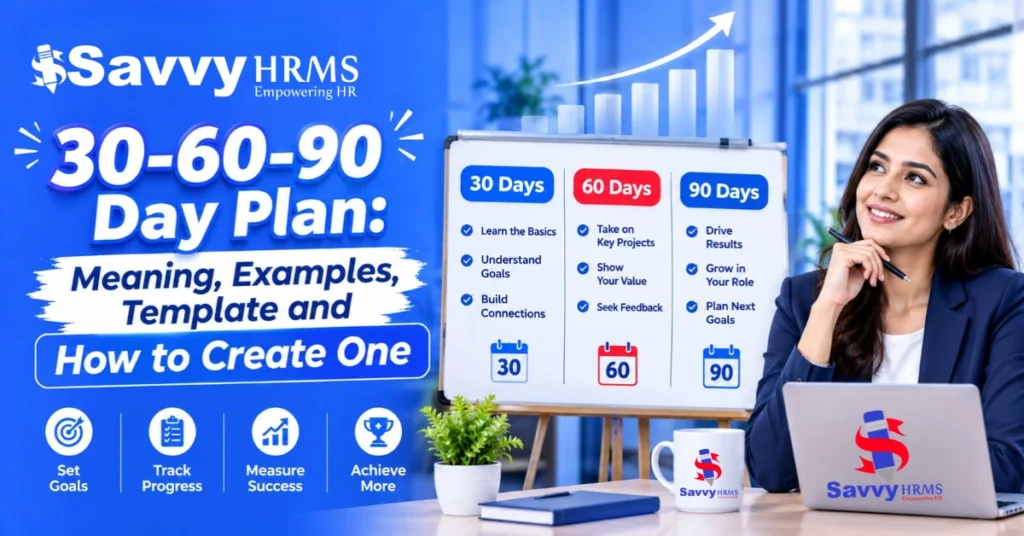
30-60-90 Day Plan: Meaning, Examples, Free Template and How to Create One


-
AuthorSalilendra Kumar
-
 Last Updated
November 03, 2026
-
 Reading Time
20 Mins
TL;DR
A 30-60-90 day plan is a structured roadmap that defines what an employee should learn, accomplish, and contribute during their first three months in a new role. It helps employees understand expectations and gives managers a consistent way to support and review their progress.
Here are the key things to remember:
- First 30 days – Learn: Understand company policies, job responsibilities, workplace processes, and team structure.
- First 60 days – Contribute: Apply what you’ve learned, handle assigned tasks, and work with team members.
- First 90 days – Take ownership: Manage responsibilities more independently and work towards agreed performance goals.
- Set clear goals: Define realistic and measurable objectives for each phase.
- Provide regular feedback: Conduct check-ins, discuss challenges, and update goals when needed.
- Use a template: Organize employee details, activities, success measures, and review dates in one place.
The first 90 days in a new job can shape an employee’s experience and performance. During this time, employees need to understand their responsibilities, learn company processes, connect with their teams, and become comfortable in their new roles. Without clear goals and proper guidance, this transition can be confusing for both employees and managers.
A 30-60-90-day onboarding plan makes this process easier by dividing the first three months into clear stages. It helps employees understand what they need to learn, what tasks they should handle, and what they are expected to achieve at each stage. Managers can also use it to provide guidance, track progress, and identify training needs.
In this guide, we’ll cover the meaning of a 30-60-90 day plan, its key benefits, how to create one, and examples for different job roles. You’ll also find a practical template that HR teams and managers can use to plan employee onboarding.
What Is a 30-60-90 Day Plan?
A 30-60-90 day plan is a structured document that outlines an employee’s learning goals, responsibilities, and expected outcomes during the first 30, 60, and 90 days in a new role. It helps employees understand what they need to achieve at each stage while giving managers a clear way to provide guidance and review progress.
The plan generally follows three stages:
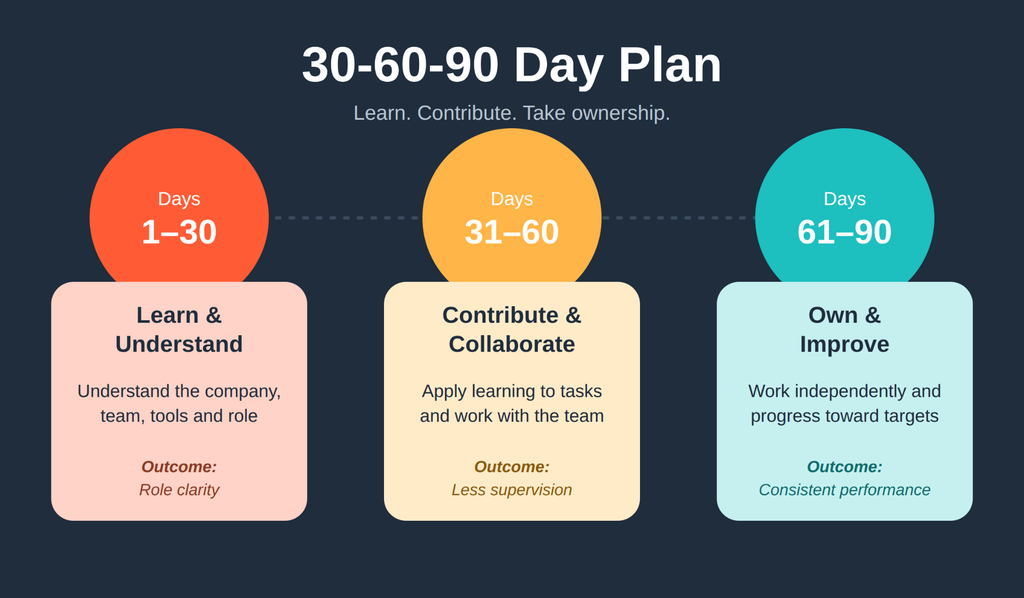
- Days 1–30 – Learning: Understand the organization, team, job responsibilities, and required tools.
- Days 31–60 – Contributing: Apply what has been learned and start handling assigned tasks.
- Days 61–90 – Taking ownership: Manage responsibilities more independently and work towards agreed performance goals.
A 30-60-90 day plan is usually prepared by the hiring manager or Core HR team in consultation with the employee. It can be customized according to the employee’s designation, experience, department, and responsibilities.
Is a 30-60-90 Day Plan the Same as an Onboarding Checklist?
No. A 30-60-90 day plan and an onboarding checklist are related, but they serve different purposes.
An onboarding checklist focuses on the activities that need to be completed when an employee joins an organization. These may include submitting documents, setting up system access, attending orientation, and completing mandatory training.
A 30-60-90 day plan focuses on the employee’s learning, contribution, and performance over a longer period.
| Basis | Onboarding checklist | 30-60-90 day plan |
| Main purpose | Complete joining and onboarding activities | Set goals and track progress |
| Focus | Administrative tasks and initial training | Learning, contribution, and performance |
| Timeline | Usually the first few days or weeks | First 90 days |
| Responsibility | HR, IT, managers, and employees | Primarily employee and reporting manager, with HR support |
| Outcome | Employee completes initial onboarding activities | Employee progresses towards role expectations |
Both can work together. An onboarding checklist helps employees complete essential joining activities, while a 30-60-90 day plan guides their progress after joining.
A 30-60-90-day onboarding plan template can help HR teams and managers organize employee goals, learning activities, responsibilities, and progress reviews for the first three months.
Why Is a 30-60-90 Day Plan Important?
A 30-60-90 day plan helps new employees understand their roles, set clear goals, and adjust to the workplace. It also helps managers guide employees, review their progress, and provide support during the first three months.
Here are some key benefits:
1. Sets Clear Expectations
New employees may know their job responsibilities but may not understand what to focus on first. A 30-60-90 day plan clearly explains what they need to learn, complete, and achieve at each stage.
This helps them stay focused and avoid confusion.
2. Makes Onboarding More Organized
A structured plan helps HR teams and managers arrange training, team introductions, and other onboarding activities.
For example, a new finance employee may need to learn accounting software, company policies, and approval processes. Adding these activities to the plan helps ensure nothing important is missed.
3. Helps Managers Track Progress
Managers can use the plan to check whether employees are meeting their goals and completing assigned tasks.
They can also identify challenges and provide support wherever needed.
4. Identifies Training Needs
Employees may need additional training to handle certain tasks. Regular reviews help managers identify these gaps early and arrange the right training or guidance.
5. Encourages Regular Feedback
The plan gives employees and managers a chance to discuss progress regularly. Employees can share their concerns, while managers can offer feedback and suggest areas for improvement.
6. Connects Employee Goals With Business Goals
A 30-60-90 day plan helps employees understand how their work supports team and business objectives.
For example, a new sales executive may focus on learning the product, following up with leads, and communicating with customers. These activities help the employee contribute to the sales team’s goals.
What Are the Three Phases of a 30-60-90 Day Plan?
A 30-60-90 day plan divides an employee’s first three months into learning, contribution, and ownership phases where each phase builds on the last, helping employees move from understanding their responsibilities to handling work more independently.
The exact goals depend on the job role, experience level, and organizational requirements. However, you can use the following structure as a starting point.
1-30 Days: Learning and Understanding
The first 30 days focus on helping employees understand the organization, their team, and their responsibilities.
At this stage, employees should have enough time to learn before being expected to handle complex tasks independently.
Key activities during the first 30 days:
- Understand company policies, values, and workplace culture.
- Learn about the department structure and reporting relationships.
- Meet team members, managers, and relevant stakeholders.
- Review the job description and understand key responsibilities.
- Attend initial training and orientation sessions.
- Learn how to use the tools and software required for the role.
- Understand important workflows and communication channels.
Example: A new HR executive may attend training on employee documentation, leave policies, attendance processes, and payroll procedures. They may also observe how the HR team handles employee requests.
Expected outcome: By the end of the first month, the employee should understand their role, know where to find relevant information, and be familiar with the basic processes required for their work.
Days 31-60: Contributing and Collaborating
During days 31–60, employees start applying what they learned in the first month. They gradually take on assigned responsibilities and become more involved in team activities.
Managers should provide guidance while allowing employees to handle suitable tasks.
Key activities during the first 60 days:
- Start working on assigned tasks and projects.
- Apply knowledge gained during initial training.
- Collaborate with colleagues and other departments.
- Handle routine responsibilities with appropriate guidance.
- Participate in team meetings and discussions.
- Identify challenges that affect day-to-day work.
- Receive feedback and work on improvement areas.
Example: The HR executive may begin updating employee records, processing routine documentation, and responding to basic employee queries under the guidance of a senior HR team member.
Expected outcome: By the end of the second month, the employee should be able to manage routine tasks and contribute to team activities with less supervision.
61-90 Days: Taking Ownership and Improving Performance
The final phase focuses on greater independence and consistent contribution. Employees should begin managing their assigned responsibilities and working towards agreed performance expectations.
Managers can use this stage to review the employee’s progress and discuss future development goals.
Key activities during the first 90 days:
- Manage assigned responsibilities independently, where appropriate.
- Work towards role-specific targets and performance goals.
- Complete assigned projects or deliverables.
- Identify opportunities to improve work processes.
- Demonstrate effective collaboration and communication.
- Review performance feedback and address improvement areas.
- Discuss future learning and development requirements.
Example: The HR executive may independently manage assigned employee documentation, coordinate routine HR activities, and prepare reports for manager review.
Expected outcome: By the end of 90 days, the employee should demonstrate progress towards the expected level of performance and have a clear understanding of their ongoing responsibilities.
30-60-90 Day Plan at a Glance
| Timeline | Main focus | Key activities | Expected outcome |
| Days 1–30 | Learning | Training, understanding policies, meeting the team | Understand the role and workplace |
| Days 31–60 | Contribution | Handling tasks, applying skills, collaborating | Start delivering assigned work |
| First 90 days | Ownership | Managing responsibilities, meeting goals, improving processes | Demonstrate progress towards role expectations |
Remember that these phases are guidelines, not strict deadlines. Some roles require longer training periods, while experienced employees may take on responsibilities sooner.
How to Create a 30-60-90 Day Plan?
To create an effective 30-60-90 day plan, understand the job requirements, divide expectations into three phases, set measurable goals, identify support requirements, and schedule regular reviews. The plan should be realistic and customized to the employee’s responsibilities.
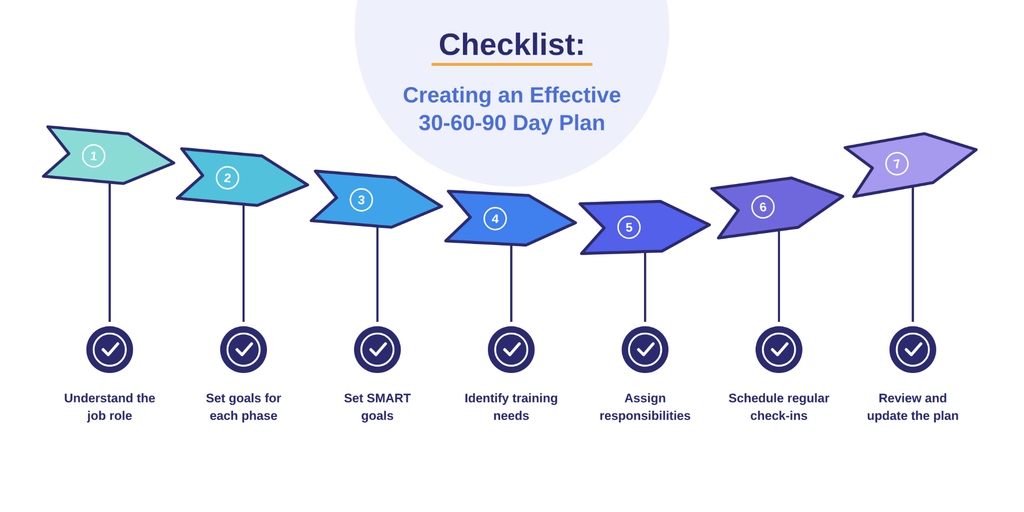
Follow these steps to create an effective 30-60-90 Day Plan as shown below:
1. Understand the Job Role and Responsibilities
Start by reviewing the employee’s job description and understanding what the organization expects from the role.
Identify the main responsibilities, required skills, reporting relationships, and important deliverables.
For example, a marketing executive may need to manage social media activities, coordinate campaigns, and prepare performance reports. A finance executive may need to handle invoices, maintain records, and support financial reporting. These differences should be reflected in their respective plans.
2. Set Goals for Each 30-Day Phase
Divide the employee’s goals into learning, contribution, and ownership stages. Try to avoid assigning complex responsibilities before the employee has received the necessary training.
For example:
- First 30 days: Learn the company’s products, policies, and internal processes.
- First 60 days: Start handling assigned responsibilities and completing routine tasks.
- First 90 days: Manage suitable responsibilities independently and work towards performance targets.
Each phase should have a manageable number of priorities. Three to five meaningful objectives per phase can be a useful starting point, depending on the complexity of the role.
3. Set SMART Goals
Goals should be specific and measurable so that employees and managers can understand whether progress has been made.
The SMART framework can help:
- Specific: Clearly explain what needs to be achieved.
- Measurable: Define how progress will be evaluated.
- Achievable: Set realistic expectations based on the employee’s experience and available resources.
- Relevant: Connect the goal with the employee’s responsibilities.
- Time-bound: Set a deadline for completion.
For example:
| Vague goal | SMART goal |
| Improve customer service | Resolve at least 90% of assigned customer queries within the agreed response time by the end of the 60 days. |
| Learn the HRMS | Complete the assigned HRMS training and demonstrate the ability to update employee records by day 30 |
| Improve sales | Complete product training and begin handling assigned sales leads by day 60 |
The targets should be based on actual job requirements and company standards. Avoid setting numerical targets without considering workload, training, and available resources.
These are illustrative examples as managers should set targets based on the role, workload, company standards, and available resources.
4. Identify Training and Development Needs
Determine what employees need to learn before they can perform their responsibilities effectively.
Training requirements may include:
- Company policies and procedures.
- Product or service knowledge.
- Job-specific technical skills.
- Internal software and tools.
- Communication and collaboration practices.
- Compliance and workplace safety requirements, where relevant.
Assign suitable training sessions, learning materials, or mentors to help employees develop these skills.
5. Assign Responsibilities to Employees and Managers
A 30-60-90 day plan should not place all the responsibility on the employee, as managers and HR teams also have a role in making the plan successful.
6. Schedule Regular Check-ins
Set review meetings at the end of each 30-day phase and during these discussions, managers should review completed goals, discuss challenges, and understand whether the employee needs additional support.
Check-ins should be two-way conversations rather than only performance evaluations. Employees should also have an opportunity to share their feedback about the onboarding experience.
7. Review and Update the Plan
A 30-60-90 day plan should be flexible. Employees may complete tasks early, face challenges, or take on new responsibilities.
Managers should review the plan regularly and update goals whenever needed. This keeps the plan relevant and helps employees stay on track.
What Should a 30-60-90 Day Plan Include?
A 30-60-90 day plan should include employee details, learning goals, performance objectives, action steps, expected deliverables, success measures, manager support, and review dates.
These components help employees understand what they need to do and how their progress will be evaluated.
| Component | What to include |
| Employee details | Name, designation, department, joining date |
| Manager details | Reporting manager and relevant team members |
| Learning goals | Training, company policies, tools, and processes |
| Performance goals | Role-specific targets and responsibilities |
| Action steps | Activities required to achieve each goal |
| Deliverables | Expected tasks, projects, or work outcomes |
| KPIs and success measures | How progress and results will be evaluated |
| Manager support | Training, resources, guidance, and mentoring |
| Review dates | 30-day, 60-day, and 90-day discussions |
| Feedback | Employee comments and manager observations |
It is also important to understand the difference between an activity, a goal, and an outcome. This distinction helps organizations create plans that focus on actual progress rather than simply completing a list of activities.
30-60-90 Day Plan Template (Copy and Customize)
Looking for a free 30-60-90 day plan template? Use the following format to organize onboarding goals, activities, responsibilities, and progress reviews for a new employee.
HR teams and managers can copy it into a Word document or spreadsheet and make changes based on the employee’s role and responsibilities.
Employee Information
Start by adding the employee’s basic details, department, joining date, and reporting manager. This information helps keep the plan organized and makes it easier to track.
| Details | Information |
| Employee name | |
| Job title | |
| Department | |
| Reporting manager | |
| Joining date | |
| Plan start date | |
| Plan review date |
30-60-90 Day Goal-Setting Template
Use this table to set goals for each phase, list the activities employees need to complete, and decide how their progress will be measured.
| Phase | Focus | Goals and action items | Success measures | Review date |
| Days 1–30 | Learning | Complete onboarding, understand company policies, attend training, and meet team members. | Training completion and understanding of job responsibilities. | |
| Days 31–60 | Contribution | Start handling assigned tasks, apply what you have learned, and work with the team. | Task completion, work quality, manager feedback | |
| Days 61–90 | Ownership | Manage assigned responsibilities, work towards targets, and suggest improvements. | Progress against role-specific goals and expected deliverables. |
Employee and Manager Feedback
Use this table during the 30, 60, and 90-day review meetings. Employees can share their experiences, while managers can provide feedback and suggest the next steps.
| Review stage | Employee comments | Manager feedback | Next steps |
| 30-day review | |||
| 60-day review | |||
| 90-day review |
How to use this template:
- Add the employee’s details and reporting manager’s information.
- List the main responsibilities of the job role.
- Set three to five goals for each phase, depending on the role.
- Add the activities employees need to complete and how their progress will be measured.
- Decide what support, training, or resources they may need.
- Schedule review meetings for the 30th, 60th, and 90th days.
- Update the goals based on the employee’s progress and feedback.
| Note: This free 30-60-90-day onboarding plan template for new employees can be copied into Excel or a document and customized according to the employee’s role, responsibilities, and learning needs. |
What Are Some 30-60-90 Day Plan Examples for Different Job Roles?
A 30-60-90 day plan for employees should reflect their job responsibilities, experience, and expected outcomes. The following examples show how organizations can customize goals for different job roles.
1. 30-60-90 Day Plan for an HR Executive
An HR executive should first understand company policies, employee records, and daily HR activities before taking on regular responsibilities. The following table shows how their goals can be divided across the first three months.
| Timeline | Goals and activities | Expected outcome |
| Days 1–30 | Learn HR policies, employee documentation, different types of leave processes, attendance procedures, and HRMS workflows | Understand basic HR operations |
| Days 31–60 | Update assigned employee records, respond to routine queries, and support onboarding activities | Handle routine HR tasks with guidance |
| First 90 days | Independently manage assigned HR activities, coordinate documentation, and prepare routine reports | Manage assigned HR responsibilities with greater independence |
Possible success measures: Completion of required training, accuracy of employee records, timely completion of assigned tasks, and manager feedback.
2. 30-60-90 Day Plan for a Sales Executive
A sales executive needs to understand the company’s products, target customers, and sales process before handling leads and customer interactions. Here is an example of how their first 90 days can be planned.
| Timeline | Goals and activities | Expected outcome |
| Days 1–30 | Learn product features, pricing, target customers, sales tools, and sales processes | Understand the product and sales approach |
| Days 31–60 | Start handling assigned leads, participate in sales calls, and maintain follow-up records | Begin contributing to sales activities |
| First 90 days | Manage assigned prospects, follow the sales pipeline, and work towards agreed sales targets | Handle assigned sales responsibilities |
Possible success measures: Product knowledge assessment, lead follow-ups, CRM record accuracy, and progress against agreed sales targets.
3. 30-60-90 Day Plan for a Marketing Manager
A marketing manager should understand the brand, target audience, ongoing campaigns, and marketing goals before planning new activities. The following example shows what they can focus on during each phase.
| Timeline | Goals and activities | Expected outcome |
| Days 1–30 | Review brand guidelines, marketing channels, existing campaigns, and audience profiles | Understand the current marketing strategy |
| Days 31–60 | Plan and execute assigned campaigns, coordinate with internal teams, and review campaign data | Start managing marketing activities |
| First 90 days | Evaluate campaign performance, recommend improvements, and plan upcoming activities | Take ownership of assigned marketing initiatives |
Possible success measures: Campaign delivery, content quality, stakeholder feedback, and progress against agreed campaign KPIs.
4. 30-60-90 Day Plan for a Team Manager
A new team manager needs to understand team responsibilities, ongoing projects, work processes, and department goals before managing the team independently.
Here is a sample plan for the first three months.
| Timeline | Goals and activities | Expected outcome |
| Days 1–30 | Meet team members, understand responsibilities, review ongoing projects, and learn reporting processes | Understand team structure and priorities |
| Days 31–60 | Conduct team discussions, review workflows, identify challenges, and coordinate activities | Build stronger team coordination |
| First 90 days | Manage team priorities, review progress against goals, and recommend process improvements | Take ownership of team operations |
Possible success measures: Completion of team priorities, employee feedback, project progress, and improvements in agreed team metrics.
These examples are starting points, not fixed performance standards so managers should adjust the goals according to the employee’s experience, job complexity, and available resources.
How Can Managers Track Progress During the First 90 Days?
Managers can track progress by reviewing agreed goals, checking completed deliverables, monitoring relevant KPIs, and conducting regular one-on-one discussions. The purpose is to understand whether the employee is receiving the right support and progressing towards role expectations.
Here are some practical ways to track progress.
1. Conduct 30-, 60-, and 90-Day Reviews
Schedule review meetings at the end of each phase. Discuss completed goals, pending activities, challenges, and the employee’s understanding of the role.
These reviews also allow managers to adjust expectations when required.
2. Monitor Relevant KPIs
Use role-specific measures to evaluate progress.
For example:
- HR executive: Accuracy of employee records and completion of assigned HR activities.
- Sales executive: Lead follow-ups and progress against agreed sales targets.
- Marketing manager: Campaign delivery and progress against campaign objectives.
- Team manager: Team project progress and completion of agreed priorities.
Avoid evaluating every employee using the same metrics as these measures should reflect the responsibilities of each role.
3. Collect Employee Feedback
Ask employees whether they have received sufficient training, understand their responsibilities, and have access to the tools they need. This helps managers identify onboarding challenges that may not be visible through performance metrics alone.
4. Provide Constructive Feedback
Managers should recognize completed goals and explain where improvement is needed. Feedback should be specific and actionable so instead of saying “Improve communication,” explain which communication practices need attention and what the employee can do differently.
5. Update Goals When Required
If an employee’s responsibilities or business priorities change, revise the plan accordingly.
A flexible plan is more useful than one that requires employees to follow goals that are no longer relevant.
These discussions help employees and managers share feedback openly, address challenges, and decide what the employee should focus on next.
Final Thoughts
A 30-60-90 day plan gives employees and managers a shared understanding of what the first three months should look like. It breaks a new role into manageable phases, helps employees build the required skills, and provides clear milestones for reviewing progress.
For HR teams, the key is to make the plan practical and role-specific. Set realistic goals, define measurable outcomes, provide the right training, and encourage regular conversations between employees and managers.
When used consistently, a 30-60-90 day plan can become a useful part of a structured employee onboarding and performance management process. It helps employees move from learning their role to contributing with greater confidence and clarity.
Frequently Asked Questions
1. What Are the Goals of a 30-60-90 Day Plan?
The goals of a 30-60-90 day plan are to help employees understand their responsibilities, learn workplace processes, contribute to team activities, and gradually take ownership of their work. It also helps managers set expectations, provide feedback, and review employee progress during the first three months.
2. Who Is Responsible for Creating a 30-60-90 Day Plan?
The hiring manager or reporting manager usually leads the creation of a 30-60-90 day plan, with support from HR. Employees should also participate in setting goals so that expectations, learning requirements, and responsibilities are clearly understood by everyone.
3. Is a 30-60-90 Day Plan the Same as an Onboarding Plan?
No. An onboarding plan covers the broader process of helping employees join and settle into an organization. A 30-60-90 day plan focuses on specific goals and expected outcomes during the first three months. It can be included as part of a wider onboarding process.
4. How Do You Measure the Success of a 30-60-90 Day Plan?
Measure success by reviewing completed goals, work quality, role-specific KPIs, training progress, and manager feedback. Conduct reviews at the end of each phase to understand whether the employee is meeting expectations and where additional support is required.
5. Can a 30-60-90 Day Plan Be Used for Existing Employees?
Yes. Organizations can use a 30-60-90 day plan when employees receive promotions, move to different departments, take on new responsibilities, or transition into leadership positions. The plan should reflect the expectations and learning requirements of the new role.
6. What Should a New Employee Achieve in the First 90 Days?
During the first 90 days, a new employee should aim to understand the organization, learn their responsibilities, build working relationships, complete relevant training, and begin contributing to team objectives. By the end of this period, they should demonstrate progress towards the performance expectations agreed with their manager.
7. How Often Should Managers Review a 30-60-90 Day Plan?
Managers should review a 30-60-90 day plan at the end of each phase, with regular informal check-ins in between. Monthly reviews help evaluate progress, discuss challenges, provide feedback, and update goals when business or role requirements change.