

Employee Benefits: Types, Examples and Benefits in India


-
AuthorAmit Kumar Jha
-
 Last Updated
November 25, 2026
-
 Reading Time
20 Mins
Summary
- Employee benefits are additional financial and non-financial provisions employees receive apart from their regular salary.
- Common types include health insurance, retirement benefits, paid leave, financial incentives, wellness programmes and professional development.
- Employee benefits in India include statutory provisions such as EPF, ESI, gratuity and maternity benefits, subject to applicable eligibility conditions.
- Companies also offer voluntary benefits such as group insurance, meal cards, flexible working and learning allowances.
- A well-designed employee benefits package can support employee well-being, engagement and retention.
Employee benefits are an important part of an employee’s overall compensation package. Beyond monthly salary, they provide financial security, healthcare protection, retirement savings and support for work-life balance. For employers, offering the right benefits can help attract skilled professionals, improve employee satisfaction and retain talent.
In India, employee benefits include statutory provisions such as Provident Fund (PF), gratuity and maternity benefits, along with additional facilities such as health insurance, flexible working arrangements, performance bonuses and wellness programmes. Understanding these benefits helps employees know their entitlements and enables HR teams to design better workplace policies.
What Are Employee Benefits?
Employee benefits are financial and non-financial rewards or facilities provided by employers in addition to an employee’s regular salary. They are designed to support employees’ health, financial security, professional growth and work-life balance.
These benefits may be required by applicable labour laws or voluntarily offered by companies as part of their employee compensation and workplace policies.
For example, an employee may receive a monthly salary along with employer PF contributions, group health insurance, paid annual leave and performance-based incentives. While some of these benefits are governed by statutory provisions, others depend on the company’s policies.
What Is the Difference Between Salary and Employee Benefits?
Salary is the regular monetary payment an employee receives for performing their job, whereas employee benefits are additional provisions offered by an employer to support employees beyond their regular pay.
Here is a simple comparison:
| Basis | Salary | Employee benefits |
| Meaning | Regular payment for work performed | Additional financial or non-financial provisions |
| Form | Usually paid in money | Can be monetary or non-monetary |
| Frequency | Generally monthly | Varies depending on the benefit |
| Examples | Basic salary, HRA and other salary components | Health insurance, PF, paid leave and wellness programmes |
| Purpose | Compensates employees for their work | Supports financial security and employee well-being |
Why Are Employee Benefits Important?
Employee benefits do more than add value to an employee’s salary. They provide financial support, improve access to healthcare and make it easier for employees to balance their work and personal lives.
For employers, offering the right benefits can help attract skilled people, retain employees and create a better workplace.
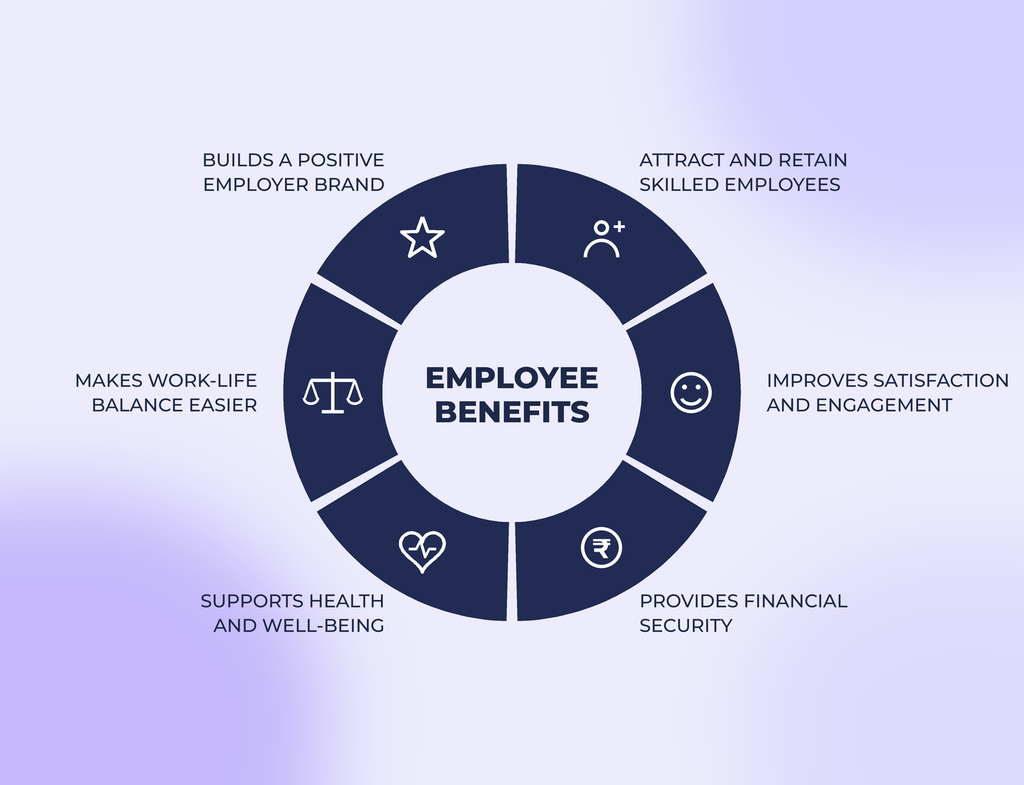
Let’s understand why employee benefits make a difference:
1. Helps to Attract and Retain Skilled Employees
When comparing job offers, candidates often look beyond the salary. Benefits such as health insurance, retirement savings, paid leave and flexible working arrangements can make one employer more attractive than another.
These benefits can also give existing employees more reasons to stay, particularly when they meet their changing personal and professional needs.
2. Improves Employee Satisfaction and Engagement
Employees feel more valued when their organization considers their well-being and everyday needs. Benefits such as healthcare coverage, paid time off, wellness programmes and recognition initiatives can make the overall work experience more positive.
When employees feel supported, they may be more motivated and connected to the organization.
3. Provides Financial Security
Benefits such as Provident Fund contributions, gratuity, insurance and performance bonuses can support employees’ financial needs at different stages of life.
For instance, retirement contributions help eligible employees build long-term savings, while health insurance can reduce the amount they need to pay for covered medical expenses.
4. Supports Employee Health and Well-Being
Medical insurance, regular health check-ups, counselling services and wellness programmes help employees to take better care of their health.
These benefits can be particularly helpful for employees working long hours or managing demanding responsibilities, as they make healthcare and mental health support more accessible.
5. Makes Work-Life Balance Easier
Flexible working hours, remote work, paid leave and childcare support can help employees manage their responsibilities outside work.
For example, employees with young children or long commutes may find flexible working arrangements especially useful.
6. Builds a Positive Employer Brand
Companies that offer meaningful employee benefits can develop a stronger reputation as places where people want to work. A well-planned benefits programme also shows that the organization values its employees and considers their well-being as part of its workplace culture.
This can help to attract potential candidates and improve how current employees view the organization.
What Are the Different Types of Employee Benefits?
Employee benefits in India can be divided into two broad categories which are statutory and non-statutory benefits. Statutory benefits are required under applicable laws when employees and establishments meet the relevant conditions.
Non-statutory benefits are additional facilities or rewards that employers choose to provide through their company policies.
These benefits can also be grouped by what they offer employees, such as healthcare, financial support, retirement savings, time off and career development.
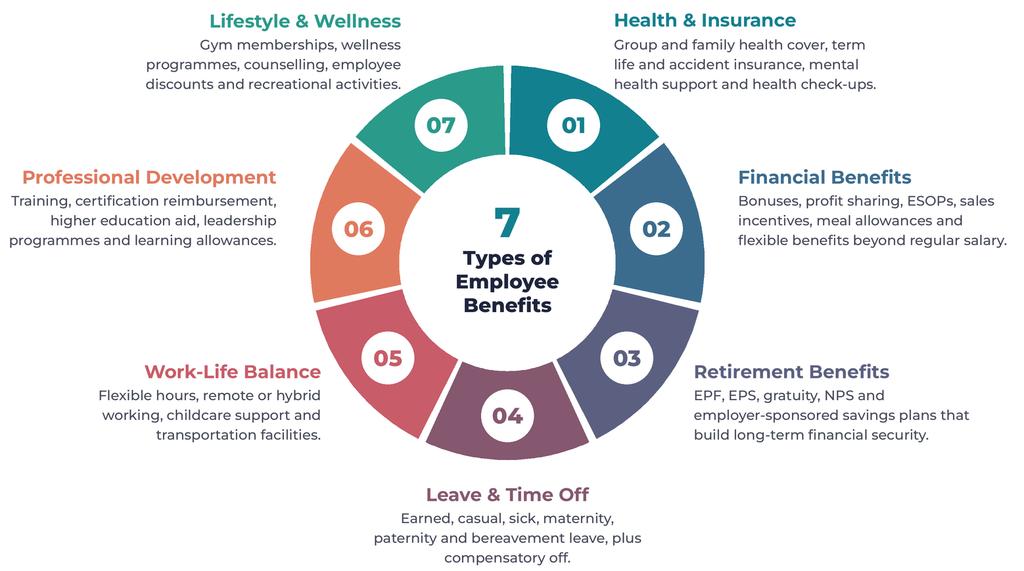
Let’s look at the major types of employee benefits and some common examples.
1. Health and Insurance Benefits
Health and insurance benefits help employees to manage medical expenses and protect themselves and their families against unexpected costs. Employers generally provide these benefits through group insurance policies and healthcare programmes.
Some common examples are:
- Group health insurance: Covers eligible medical expenses, such as hospitalisation, under an employer-sponsored policy.
- Family health insurance: Extends medical coverage to eligible family members, such as a spouse, children or parents, depending on the policy.
- Group term life insurance: Provides a benefit to the employee’s nominee if the insured employee dies during the policy term.
- Personal accident insurance: Offers financial protection against specified accidental injuries, disabilities or death.
- Mental health support: Gives employees access to counselling, therapy or employee assistance programmes.
- Preventive health check-ups: Helps employees to monitor their health through periodic medical examinations.
For example, a company may provide group medical insurance worth ₹5 lakh and allow employees to purchase additional family coverage.
2. Financial Benefits
Financial benefits give employees additional monetary rewards or assistance beyond their regular salary. These benefits may depend on individual performance, company results, sales targets or internal policies.
Common examples include:
- Performance bonuses: Additional payments given for meeting individual or team targets.
- Profit sharing: A portion of the organization’s profits distributed among eligible employees under a defined arrangement.
- Employee Stock Ownership Plans (ESOPs): Stock options that allow eligible employees to purchase company shares under specified conditions.
- Sales incentives and commissions: Additional earnings linked to sales performance or business targets.
- Meal allowances: Meal cards or financial assistance to help employees to manage food expenses.
- Flexible benefits: Employer-defined options that let employees to choose from selected benefits within a specified budget.
For example, a sales employee may receive an additional quarterly incentive for achieving the assigned sales target.
3. Retirement Benefits
Retirement benefits help employees to save for the future and build financial security after they stop working. Some are provided under statutory schemes, while others may be introduced by employers as additional retirement support.
These include:
- Employees’ Provident Fund (EPF): A retirement savings scheme funded through contributions from eligible employees and employers.
- Employees’ Pension Scheme (EPS): Provides pension-related benefits to eligible members under the applicable scheme.
- Gratuity: A lump-sum payment made to eligible employees when their employment ends, subject to applicable conditions.
- National Pension System (NPS): A retirement savings arrangement that employers may offer or contribute towards under applicable rules.
- Additional retirement savings plans: Employer-sponsored arrangements that provide employees with savings options beyond statutory schemes.
For example, an eligible employee can build retirement savings through regular EPF contributions and receive gratuity when the applicable eligibility conditions are met.
4. Leave and Time-Off Benefits
Leave benefits allow employees to take time off for personal needs, illness, family responsibilities or rest. The types of leave and the number of days available depend on applicable laws, state-specific rules and company policies.
Common examples include:
- Earned or privilege leave: Paid leave accumulated or provided according to applicable rules and company policy.
- Casual leave: Time off for personal matters or unexpected situations.
- Sick leave: Leave for employees who are unable to work because of illness.
- Maternity leave: Leave and related protections available to eligible women employees under applicable law.
- Paternity leave: Leave offered by employers to support employees following childbirth or adoption, where provided under company policy or applicable rules.
- Bereavement leave: Time off following the death of a family member, generally provided under company policy.
- Compensatory off: Time off granted for qualifying additional work, subject to applicable rules and company policy.
For example, a company may offer 18 days of annual paid leave, along with separate sick and casual leave. This is only an illustrative company policy, not a universal statutory entitlement.
5. Work-Life Balance Benefits
Work-life balance benefits give employees a more flexibility in managing their work alongside personal commitments. They are particularly useful for people who need to manage family responsibilities, commuting or other activities outside the workplace.
Some examples include:
- Flexible working hours: Employees can choose their start and finish times within a defined schedule.
- Remote working: Employees can work from home or another approved location, depending on company policy.
- Hybrid working: Employees divide their working days between the office and a remote location.
- Childcare support: Employers may provide childcare facilities or other eligible assistance.
- Transportation facilities: Company-provided transport or commuting assistance helps employees travel to and from work.
- Additional paid time off: Employers may offer extra leave beyond applicable statutory entitlements.
For example, an organization may allow employees to work remotely two days a week and choose their starting time within a fixed working-hours window.
6. Professional Development Benefits
Professional development benefits help employees to learn new skills, improve their knowledge and prepare for career growth. They also help companies to build a skilled workforce and develop talent internally.
These benefits may include:
- Training programmes: Sessions that help employees improve their technical and professional skills.
- Certification reimbursement: Financial support for approved professional certifications.
- Higher education assistance: Support for eligible courses, degrees or further studies.
- Leadership development: Training programmes that prepare employees for managerial and leadership roles.
- Learning allowances: An annual budget for books, online courses, workshops or learning platforms.
- Conference and seminar participation: Opportunities to attend industry events and learn from professionals.
For example, a company may offer an annual learning allowance of ₹15,000 to eligible employees for professional courses and certifications.
7. Lifestyle and Wellness Benefits
Lifestyle and wellness benefits focus on employees’ overall well-being, including their physical fitness, mental health and everyday convenience. Employers may offer these benefits through wellness programmes, memberships or additional allowances like shift and internet allowance.
Some common examples are:
- Gym memberships: Employer-sponsored access to fitness centres.
- Wellness programmes: Activities related to fitness, nutrition, stress management and healthy habits.
- Counselling services: Confidential support for personal or work-related concerns.
- Employee discounts: Special offers on selected products and services.
- Recreational activities: Team outings, sports events and workplace celebrations.
- Lifestyle allowances: Employer-defined allowances for eligible lifestyle-related expenses.
For example, an employer may give employees access to a wellness platform with fitness sessions, nutrition guidance and mental health resources.
What Are Some Common Employee Benefits Examples?
Employee benefits examples include health insurance, Provident Fund contributions, paid leave, performance bonuses, retirement savings, meal allowances and flexible working arrangements. Companies may offer a combination of these benefits depending on their budget, workforce requirements and applicable employment laws.
The following table highlights some common employee benefits offered by organizations in India.
| Employee benefit | Example | Purpose |
| Health insurance | ₹5 lakh group medical insurance | Covers eligible medical expenses |
| Family health insurance | Medical coverage for eligible dependants | Protects family members |
| Provident Fund | Employer and employee contributions | Builds retirement savings |
| Gratuity | Lump-sum payment on qualifying employment separation | Provides financial security |
| Paid annual leave | 18 days of annual leave under company policy | Supports personal time off |
| Performance bonus | Annual performance-linked payment | Rewards employee performance |
| ESOPs | Employee stock options | Provides potential ownership participation |
| Meal benefits | Monthly meal card | Helps manage food expenses |
| Transport benefits | Company-provided cab facility | Supports daily commuting |
| Life insurance | Group term life insurance | Provides financial protection to nominees |
| Maternity benefits | Eligible paid maternity leave | Supports employees during maternity |
| Flexible working | Adjustable working hours | Improves work-life balance |
| Remote working | Work-from-home arrangements | Provides location flexibility |
| Learning allowance | ₹15,000 annual learning budget | Supports professional development |
| Gym membership | Employer-sponsored fitness membership | Encourages physical fitness |
| Counselling support | Employee assistance programme | Supports mental well-being |
| Certification reimbursement | Reimbursement for approved courses | Encourages skill development |
| Wellness programmes | Health and fitness initiatives | Promotes employee well-being |
| Additional paid leave | Extra leave beyond standard entitlements | Provides additional time off |
Note: The amounts and arrangements above are illustrative examples, not standard industry entitlements. Actual benefits depend on company policies, employment terms and applicable laws.
How Do These Employee Benefits Work in Practice?
Let’s consider an example of an employee working at a private company with an annual CTC of ₹10 lakh.
Apart from the basic salary, the company may provide:
- Employer PF contributions as applicable.
- Group health insurance of ₹5 lakh.
- Annual paid leave according to company policy.
- Performance-linked annual incentives.
- A learning allowance for professional development.
- Flexible working arrangements.
In this example, the employee receives a combination of financial, healthcare and non-financial benefits. Some provisions may be included in the CTC, while others may be provided separately under company policies.
This shows why employees should look beyond the salary figure when evaluating an employment offer.
What Employee Benefits Are Mandatory in India?
Employee benefits in India include statutory provisions that employers must provide when the relevant legal requirements and eligibility conditions are met. These benefits cover retirement savings, medical protection, maternity support, gratuity, statutory bonuses and employment-related compensation.
The legal framework changed significantly when India’s four Labour Codes became effective on 21 November 2025, consolidating provisions from 29 existing central labour laws. These include the Code on Wages, Code on Social Security, Industrial Relations Code and Occupational Safety, Health and Working Conditions Code.
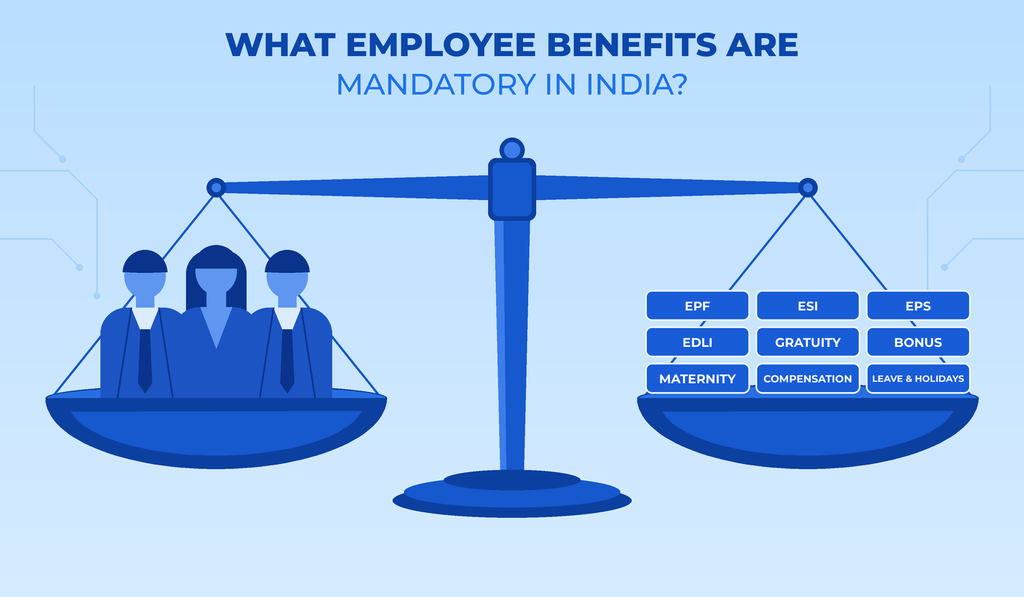
Here are the major statutory benefits that employees and employers should understand.
1. Employees’ Provident Fund (EPF)
The Employees’ Provident Fund is a retirement savings arrangement in which eligible employees and employers make contributions towards the employee’s provident fund account.
Key points include:
- EPF applies to establishments and employees covered under the applicable social security provisions.
- Both employer and employee contributions are generally calculated as a percentage of eligible wages.
- The standard contribution rate is generally 12% each, subject to applicable provisions and exceptions.
- The accumulated balance earns interest at the rate declared for the relevant financial year.
- Employees can access their PF savings through permitted withdrawal and settlement provisions.
EPF helps employees to build long-term savings while providing financial support after retirement or during specified qualifying situations.
2. Employees’ State Insurance (ESI)
Employees’ State Insurance provides medical care and other social security benefits to eligible employees covered under the scheme.
It is particularly relevant for employees working in covered establishments whose wages fall within the prescribed eligibility limit.
Key points include:
- ESI provides medical benefits to insured employees and eligible family members.
- It also provides benefits for sickness, maternity, disablement and employment-related injury, subject to applicable conditions.
- The standard contribution rates are 0.75% of wages from employees and 3.25% from employers.
- The currently notified wage ceiling for ESI coverage is ₹21,000 per month, with a higher limit for eligible persons with disabilities.
For example, an eligible employee covered under ESI can access medical services through the ESIC healthcare network.
The Ministry of Labour and Employment has clarified that the ₹21,000 monthly wage limit continues to apply for ESI coverage under the new framework.
3. Employees’ Pension Scheme (EPS)
The Employees’ Pension Scheme provides retirement and certain other pension-related benefits to eligible EPF members.
Key points include:
- EPS is administered through the Employees’ Provident Fund Organization (EPFO).
- A portion of the employer’s PF contribution is allocated towards EPS for eligible members.
- Eligible members may receive a monthly pension after meeting the prescribed age and service conditions.
- The scheme also provides certain benefits to eligible family members in qualifying situations.
EPS helps to provide a pension-related income stream to eligible employees after retirement.
4. Employees’ Deposit Linked Insurance (EDLI)
Employees’ Deposit Linked Insurance is an insurance scheme associated with EPF membership. It provides financial protection to the eligible nominee or family of an EPF member in the event of the member’s death while in service, subject to scheme conditions.
Key points include:
- EDLI coverage is generally linked to eligible EPF membership.
- The employer contributes towards the scheme.
- Employees are not required to make a separate EDLI contribution.
- The insurance benefit is paid to eligible nominees or family members according to scheme provisions.
EDLI provides an additional layer of financial protection for employees’ families.
5. Gratuity
Gratuity is a lump-sum benefit paid by an employer to an eligible employee as recognition of service. It generally becomes payable when employment ends due to retirement, resignation, superannuation or other qualifying circumstances.
Key points include:
- It is governed by the Code on Social Security, 2020.
- The general eligibility requirement is five years of continuous service.
- The five-year requirement does not apply in cases such as death or disablement.
- Special provisions apply to fixed-term employees.
- The amount is calculated using the employee’s last-drawn eligible wages and qualifying service, subject to statutory provisions.
For employees covered by the standard gratuity calculation, the commonly used formula is:

For example, if an eligible employee has last-drawn monthly wages of ₹40,000 and 10 years of qualifying service:

This is just an example calculation as the applicable wage definition, service calculation and statutory conditions must be considered when determining the actual gratuity payable.
6. Statutory Bonus
Statutory bonus is a payment that eligible employees receive under applicable bonus provisions. It is intended to provide employees with a share of the organization’s allocable surplus or the prescribed minimum bonus, as applicable.
Under the Code on Wages, 2019:
- Employees must meet the prescribed eligibility and wage conditions.
- The minimum bonus is generally 8.33% of wages or ₹100, whichever is higher.
- The maximum bonus is generally 20% of wages.
- The applicable calculation ceiling and eligibility limits are determined under the relevant provisions and notifications.
Statutory bonus is different from a discretionary performance bonus offered under a company’s incentive policy.
7. Maternity Benefits
Maternity benefits provide eligible women employees with paid leave and other protections during pregnancy, childbirth and related circumstances.
Under the applicable maternity benefit provisions:
- Eligible women may receive up to 26 weeks of paid maternity leave for the first two surviving children.
- The entitlement is generally 12 weeks for women with two or more surviving children.
- Eligible adoptive and commissioning mothers are entitled to prescribed maternity leave.
- Establishments meeting the applicable threshold must provide crèche facilities under the relevant provisions.
- Additional protections apply to maternity-related employment conditions.
The actual entitlement depends on the applicable eligibility requirements and statutory provisions.
8. Employee Compensation
Employee compensation provides financial protection to employees or their dependants in cases of qualifying employment-related injuries, disabilities or death.
Under the applicable provisions of the Code on Social Security, compensation may be payable where an employee suffers an injury arising out of and in the course of employment, subject to the law’s conditions and exceptions.
This benefit is particularly relevant for employees working in manufacturing, construction, transportation and other occupations involving workplace risks.
9. Statutory Leave and Holidays
Employees may also be entitled to leave, weekly rest and holidays under applicable labour laws, rules and state-specific requirements.
These provisions may include:
- Annual leave with wages.
- Weekly holidays.
- National and festival holidays under applicable laws.
- Other prescribed leave entitlements.
The exact leave entitlement depends on the employee’s establishment, nature of work, applicable legislation and state rules.
Important: Employers should not assume that one set of leave rules applies uniformly across India. As state-specific requirements and applicable establishment rules must also be considered.
Which Employee Benefits Do Employees Value the Most?
Employees value benefits that address their healthcare needs, financial security, professional development and work-life balance. However, the importance of individual benefits can vary depending on an employee’s age, family responsibilities, career stage and personal priorities.
For example, employees with dependants may prioritize family health insurance, while early-career professionals may place greater importance on learning opportunities and career development.
Some commonly valued employee benefits include:
1. Health Insurance and Medical Coverage
Health insurance is one of the important benefits employees consider when evaluating an employment package. Coverage for hospitalisation, medical treatment and eligible dependants can help employees manage healthcare expenses.
2. Flexible Working Arrangements
Flexible working hours, remote work and hybrid arrangements help employees to manage their professional and personal responsibilities. These benefits can be particularly valuable for employees with family or caregiving responsibilities.
3. Paid Time Off
Paid leave allows employees to take time away from work without losing their regular earnings. Annual leave, sick leave and other applicable leave entitlements support rest and personal well-being.
4. Career Development Opportunities
Training programmes, certification reimbursement and professional development allowances help employees to improve their skills and prepare for future career opportunities.
5. Retirement and Financial Benefits
Provident Fund contributions, pension-related benefits, gratuity and additional retirement savings arrangements can provide employees with greater long-term financial security.
6. Mental Health and Wellness Support
Counselling services, employee assistance programmes and wellness initiatives can help employees manage stress and maintain their overall well-being.
Conclusion
Overall, Employee benefits play an important role in creating a supportive and rewarding workplace. From statutory provisions such as EPF, ESI and gratuity to additional facilities such as health insurance, flexible working and professional development, these benefits contribute to employees’ financial security and overall well-being.
For employers, designing an effective employee benefits package involves understanding workforce requirements, meeting applicable legal obligations and offering benefits that employees genuinely value.
Managing these processes also requires accurate employee information, organized payroll records and efficient HR administration. An integrated HRMS solution can help organizations simplify these activities while creating a better employee experience.
Frequently Asked Questions
1. What are the five main types of employee benefits?
The five main types of employee benefits include health and insurance benefits, financial benefits, retirement benefits, leave benefits and work-life balance benefits. Companies may also offer professional development and lifestyle benefits depending on their policies.
2. What are the most common employee benefits in India?
Common employee benefits in India include Provident Fund, ESI for eligible employees, gratuity, maternity benefits, group health insurance, paid leave, performance bonuses and retirement-related benefits. Their applicability depends on statutory requirements and company policies.
3. Are employee benefits mandatory in India?
Some employee benefits are mandatory under Indian labour laws, including applicable EPF, ESI, gratuity, statutory bonus and maternity benefits. However, eligibility and applicability depend on the employee, establishment and relevant legal provisions.
4. Is health insurance a mandatory employee benefit in India?
Private group health insurance is not a universal statutory requirement for every private-sector employer in India. However, eligible employees may receive medical benefits through ESI, and certain employers may have specific healthcare-related obligations under applicable laws.
5. What is the difference between salary and employee benefits?
Salary is the regular monetary payment employees receive for their work, whereas employee benefits are additional financial or non-financial provisions offered by employers. Examples include health insurance, Provident Fund contributions, paid leave and wellness programmes.
6. Are bonuses considered employee benefits?
Yes, bonuses can be considered financial employee benefits. These include statutory bonuses payable to eligible employees and additional performance-based bonuses offered under company policies.
7. What is the difference between statutory and voluntary benefits?
Statutory benefits are legally required when the applicable conditions are met, whereas voluntary benefits are additional facilities employers choose to offer. EPF and eligible gratuity are examples of statutory benefits, while gym memberships and additional wellness allowances are voluntary benefits.
10. What are the best employee benefits to offer employees?
Some valuable employee benefits include group health insurance, retirement contributions, paid leave, flexible working arrangements, professional development opportunities, wellness programmes and performance incentives. The right combination depends on employee needs and the organization’s budget.