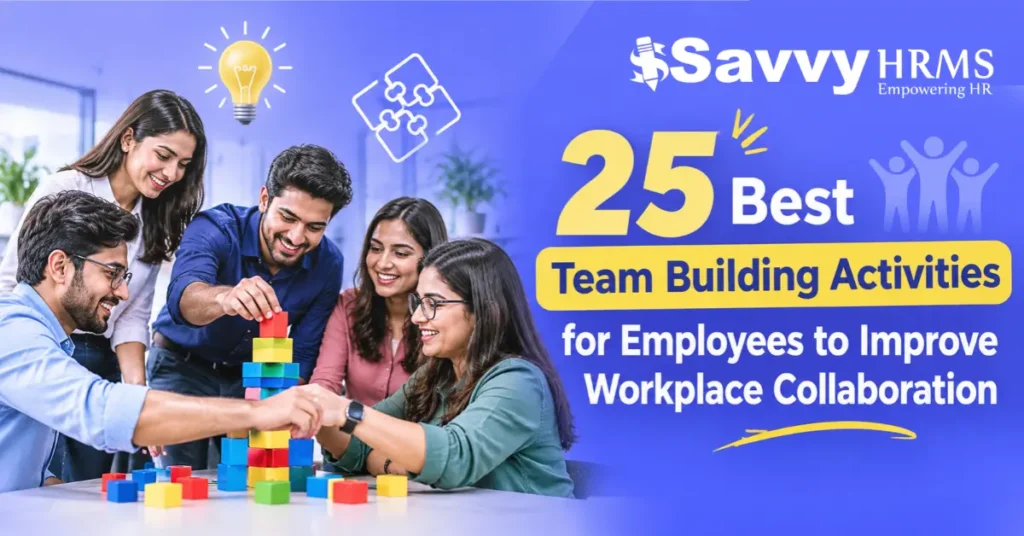
25 Best Team Building Activities for Employees to Improve Workplace Collaboration


-
AuthorRuchika Rajput
-
 Last Updated
November 18, 2026
-
 Reading Time
22 Mins
Key Takeaways
- Team building activities help employees to improve communication, collaboration, trust and workplace relationships.
- Companies can organize activities such as Human Bingo, Office Trivia, Paper Tower Challenge and Scavenger Hunts.
- Five-minute activities such as Would You Rather?, Quick Trivia and Emoji Check-In are suitable for daily meetings and short breaks.
- HR teams should consider employee preferences, team size, available time and budget before selecting activities.
- Regular team-building sessions can support employee engagement when they are inclusive, enjoyable and aligned with workplace objectives.
Good teamwork doesn’t happen just because people share an office or work on the same projects. Employees also need opportunities to get to know one another, exchange ideas and build relationships outside their everyday responsibilities. That’s where team building activities can make a difference.
From quick icebreakers to creative group challenges, the right activities can bring employees together in a relaxed setting. They give people a chance to interact with colleagues not for work, but to discover shared interests and practise skills such as communication, problem-solving and decision-making.
But you don’t need an elaborate event or an entire day away from work to bring your team closer. Even a 5-minute activity during a team meeting can get conversations started. In this guide, we’ll explore 25 team building activities for employees, including office-friendly games, problem-solving challenges and activities that take just five minutes.
What Are Team Building Activities?
Team building activities are games, exercises and group experiences that help employees to build stronger workplace relationships. They encourage colleagues to communicate, share ideas, solve problems and get to know one another outside their usual work routines.
These activities can be as simple as a quick icebreaker at the beginning of a meeting or as involved as an escape room challenge. Some focus on communication, while others encourage creativity, trust, collaboration or friendly competition.
For Core HR teams and managers, the goal isn’t simply to organize an entertaining event but to create opportunities for employees to interact, understand different perspectives and feel more connected to their teams.
25 Best Team Building Activities for Employees
Companies can choose different activities depending on their objectives, employee preferences and available resources. Some are suitable for quick office interactions, while others require more preparation and participation time.
The following team building activities can be organized in offices, meeting rooms and other suitable workplace spaces.
1. Two Truths and a Lie
Two Truths and a Lie is a simple icebreaker in which employees share three statements about themselves, two of which are true and one is false. However, other participants try to identify the false statement.
- Best for: Icebreaking and employee bonding
- Team size: 5–15 employees
- Duration: 10–20 minutes
- Materials required: None
How to Play:
- Ask each employee to share three statements about themselves.
- Two statements should be true, and one should be false.
- Let the other team members guess which statement is false.
- The employee reveals the correct answer and shares a little more about the true statements.
Why it works: Employees will learn more interesting things about their colleagues and find common interests. It is particularly useful for introducing new employees to an existing team.
2. Human Bingo
Human Bingo is a fun way for employees to get to know each other and find common interests or experiences.
- Best for: Getting to know colleagues and team bonding
- Team size: 10–30 employees
- Duration: 15–30 minutes
- Materials required: Bingo sheets and pens
How to Play:
- Prepare bingo sheets with statements such as “Has travelled to another country”, “Speaks three languages” or “Enjoys cooking”.
- Give one sheet to each employee.
- Ask employees to move around and find colleagues who match the statements.
- They write the names of those colleagues in the matching boxes.
- The first person to complete a row or the required pattern wins.
Why It Works: Human Bingo gives employees a reason to talk to colleagues they may not usually interact with. It works especially well during new employee onboarding, team gatherings and office events.
3. Office Trivia
Office Trivia is a team-based quiz in which employees answer questions about general knowledge, workplace culture or interesting facts about their organization.
- Best for: Team bonding and friendly competition
- Team size: 10–40 employees
- Duration: 15–30 minutes
- Materials required: Question sheets, presentation or quiz platform
How to play:
- Divide employees into small groups.
- Prepare questions across different categories, such as general knowledge, entertainment, technology and company history.
- Ask each team the same set of questions.
- Award points for correct answers.
- Announce the team with the highest score.
Why it works: Office Trivia encourages employees to collaborate, exchange knowledge and participate in friendly competition. Including different question categories also gives employees with varied interests an opportunity to contribute.
4. Back-to-Back Drawing
Back-to-Back Drawing is a communication exercise in which one employee describes an image while another attempts to recreate it without looking at the original.
- Best for: Communication and active listening
- Team size: 2–20 employees
- Duration: 15–20 minutes
- Materials required: Paper, pencils and simple images
How to play:
- Pair employees and ask them to sit back-to-back.
- Give one participant an image without showing it to the other.
- The first participant describes the image using verbal instructions.
- The second participant draws according to those instructions.
- Compare the original image with the drawing and discuss what could have been communicated more clearly.
Why it works: This activity demonstrates the importance of clear instructions, listening and asking questions when information is unclear.
5. Paper Tower Challenge
The Paper Tower Challenge requires employees to work together to build the tallest free-standing tower using limited materials.
- Best for: Collaboration and problem-solving
- Team size: 3–5 employees per group
- Duration: 20–30 minutes
- Materials required: Newspaper, paper sheets and tape
How to play:
- Divide employees into small teams.
- Give each team the same quantity of paper and tape.
- Set a time limit of 15–20 minutes.
- Ask teams to construct the tallest tower that can stand independently.
- Measure the completed towers and announce the winner.
Why it works: Employees need to share ideas, distribute responsibilities and make decisions together. The activity also encourages creative thinking when resources are limited.
6. Indoor Scavenger Hunt
An Indoor Scavenger Hunt is a fun team activity where employees search for office items or solve clues together.
- Best for: Teamwork and problem-solving
- Team size: 10–30 employees
- Duration: 30–45 minutes
- Materials required: Clue cards and a checklist
How to Play:
- Divide employees into small teams.
- Prepare a list of office items to find or clues to solve.
- Give each team the same checklist.
- Set a time limit for completing the hunt.
- Award points for each completed task and announce the team with the highest score.
Why It Works: Employees must share ideas, plan their next steps and work together to complete the hunt. It also gives colleagues from different departments a chance to interact and get to know each other.
7. Blind Drawing Challenge
Blind Drawing is another communication-based activity in which employees draw an object based only on verbal instructions.
- Best for: Active listening and communication
- Team size: 4–20 employees
- Duration: 15–20 minutes
- Materials required: Paper, pens and drawing prompts
How to play:
- Divide employees into pairs.
- Give one participant a picture or drawing prompt.
- Ask the other participant to draw the object without seeing the original.
- The person describing the image can provide verbal instructions but cannot show the picture.
- Compare the results and discuss the most helpful instructions.
Why it works: The activity encourages employees to communicate clearly, listen carefully and clarify instructions before acting.
8. Escape Room Challenge
An Escape Room Challenge is a problem-solving activity in which employees work together to solve puzzles and complete tasks within a fixed time.
- Best for: Critical thinking and collaboration
- Team size: 4–8 employees per group
- Duration: 45–60 minutes
- Materials required: Puzzle sheets, clues, envelopes or an escape-room setup
How to play:
- Divide employees into small teams.
- Prepare a series of puzzles, riddles and clues.
- Explain the objective and time limit.
- Ask teams to solve the challenges in the correct sequence.
- The team that completes the challenge first wins.
Why it works: Employees need to share information, divide tasks and combine their problem-solving abilities to achieve a common objective.
9. Minute to Win It
Minute to Win It consists of short challenges that employees must complete within 60 seconds. It is suitable for office events and informal team engagement sessions.
- Best for: Entertainment and friendly competition
- Team size: 5–30 employees
- Duration: 20–40 minutes
- Materials required: Cups, paper, balloons or other simple objects
How to play:
- Prepare several one-minute challenges.
- Divide employees into teams or invite individual participants.
- Explain the rules of each challenge.
- Give participants 60 seconds to complete each task.
- Award points for successful attempts and announce the winner.
Why it works: Short challenges create an energetic atmosphere and allow employees to interact outside their usual work responsibilities.
10. Office Charades
Office Charades is a fun guessing game where employees act out words or situations without speaking, and their teammates try to guess them.
- Best for: Team bonding and creativity
- Team size: 6–20 employees
- Duration: 20–30 minutes
- Materials required: Prepared word or phrase cards
How to play:
- Divide employees into two or more teams.
- Prepare cards containing movies, professions, common objects or workplace situations.
- Ask one participant to pick a card and act out the word without speaking.
- Their teammates must guess the answer within the given time.
- Award points for correct guesses.
Why it works: Office Charades encourages employees to observe, communicate non-verbally and work together while having fun.
11. Team Storytelling
Team Storytelling is a creative exercise in which employees build a story together by contributing one sentence at a time.
- Best for: Creativity and communication
- Team size: 5–15 employees
- Duration: 15–25 minutes
- Materials required: None
How to play:
- Ask employees to sit in a circle.
- Start with an opening sentence, such as “One morning, our team received an unexpected assignment.”
- Each employee adds one sentence to continue the story.
- Continue until everyone has contributed.
- Ask the group to discuss the different ideas that shaped the final story.
Why it works: Employees learn to listen to others, build on existing ideas and contribute creatively to a shared outcome.
12. Workplace Quiz Competition
A Workplace Quiz Competition is a simple group activity where employees answer questions about their company, industry or general knowledge.
- Best for: Knowledge sharing and collaboration
- Team size: 10–40 employees
- Duration: 20–30 minutes
- Materials required: Question sheets or a digital quiz platform
How to play:
- Divide employees into teams.
- Prepare questions about company milestones, industry developments, workplace policies and general knowledge.
- Give each team an equal opportunity to answer.
- Award points for correct responses.
- Announce the team with the highest score.
Why it works: Employees exchange knowledge, discuss answers and learn more about their organization in an interactive environment.
13. Marshmallow Tower Challenge
The Marshmallow Tower Challenge is a team activity where employees use simple materials to build the tallest free-standing tower they can.
- Best for: Creativity and problem-solving
- Team size: 3–5 employees per group
- Duration: 20–30 minutes
- Materials required: Marshmallows, spaghetti sticks and tape
How to Play:
- Divide employees into small teams.
- Give each team the same number of spaghetti sticks, marshmallows and pieces of tape.
- Ask each team to build the tallest tower they can within the time limit.
- Make sure the tower can stand on its own without support.
- Measure each tower and declare the tallest one the winner.
Why It Works: Employees learn to share ideas, plan their approach and try different solutions. They also practise working together and making the best use of limited materials.
14. Appreciation Circle
An Appreciation Circle is a simple activity where employees recognize their colleagues for their efforts, helpfulness or positive contributions.
- Best for: Recognition and workplace relationships
- Team size: 5–20 employees
- Duration: 15–20 minutes
- Materials required: None or appreciation cards
How to play:
- Ask employees to sit together in a circle.
- Invite each person to appreciate a colleague for something they have done.
- Encourage them to share a specific example instead of giving general compliments.
- Give everyone a chance to participate voluntarily.
- End the activity by reminding everyone to recognise each other’s efforts.
Why It Works: Employees feel valued when their contributions are recognized. It also helps colleagues understand and appreciate the efforts of others.
15. Problem-Solving Challenge
A Problem-Solving Challenge is a group activity where employees discuss a workplace problem and come up with practical solutions.
- Best for: Decision-making and critical thinking
- Team size: 4–8 employees per group
- Duration: 30–45 minutes
- Materials required: Scenario cards or presentation slides
How to play:
- Divide employees into small groups.
- Give each group a workplace situation to solve.
- Allow them some time to understand the problem and discuss possible solutions.
- Ask each group to present its solution.
- Discuss the different ideas and approaches as a team.
Why It Works: Employees learn to listen to different opinions, think through problems and find solutions together.
16. Team Cooking Challenge
A Team Cooking Challenge is a fun activity where employees work together to prepare a simple dish or create a food presentation.
- Best for: Collaboration and social bonding
- Team size: 4–6 employees per group
- Duration: 60–90 minutes
- Materials required: Ingredients, utensils and a suitable preparation area
How to play:
- Divide employees into small teams.
- Give each team a simple recipe or food challenge.
- Provide the required ingredients and utensils.
- Set a time limit for preparing the dish.
- Let each team present its creation to the others.
Why It Works: In this game, employees share responsibilities, coordinate their work and enjoy spending time together outside their usual work routine. Make sure to consider food allergies, dietary preferences and hygiene.
17. Office Olympics
Office Olympics is a series of light-hearted competitions in which employees participate in different challenges and earn points for their teams.
- Best for: Employee engagement and friendly competition
- Team size: 10–40 employees
- Duration: 30–60 minutes
- Materials required: Paper cups, soft balls and other safe equipment
How to play:
- Divide employees into teams.
- Prepare simple games such as cup stacking, paper-ball throwing or balancing challenges.
- Explain the rules before starting.
- Give each team a chance to participate in every activity.
- Add up the points and announce the winning team.
Why it works: Employees get to participate in fun challenges, cheer for their teammates and interact with colleagues in a relaxed setting. Choose activities that everyone can comfortably take part in.
18. Memory Wall
A Memory Wall is an activity where employees share their favourite workplace memories, team achievements or positive experiences.
- Best for: Employee bonding and recognition
- Team size: 5–30 employees
- Duration: 20–30 minutes
- Materials required: Sticky notes, pens and a display board
How to play:
- Set up a board in a common office area.
- Give employees sticky notes or small cards.
- Ask them to write about a memorable workplace experience, team achievement or positive interaction.
- Invite employees to place their notes on the board.
- Read selected contributions and discuss the experiences as a team.
Why it works: Employees reflect on shared experiences, recognise team achievements and develop a stronger sense of connection.
19. Team Timeline
Team Timeline is a collaborative activity in which employees create a visual timeline of important team milestones and achievements.
- Best for: Team identity and collaboration
- Team size: 5–20 employees
- Duration: 30–45 minutes
- Materials required: Chart paper, markers and sticky notes
How to play:
- Give employees a large sheet of paper or a whiteboard.
- Ask them to identify important team milestones, projects and achievements.
- Arrange these events in chronological order.
- Encourage employees to contribute memories and experiences.
- Discuss how the team has developed and what it wants to achieve next.
Why it works: Employees understand their shared journey, appreciate collective achievements and develop a stronger connection with their team.
20. Guess the Employee
Guess the Employee is a fun icebreaker where employees try to identify their colleagues through interesting facts shared without names.
- Best for: Employee bonding and getting to know colleagues
- Team size: 8–25 employees
- Duration: 15–25 minutes
- Materials required: Paper slips or digital forms
How to play:
- Ask each employee to share one interesting fact about themselves.
- Collect all the facts without adding names.
- Read each fact aloud to the group.
- Let everyone guess which colleague the fact belongs to.
- Reveal the correct answer and allow the employee to share more if they wish.
Why It Works: In this game, employees will learn new things about their colleagues and may discover common interests. Try to keep the activity light-hearted and let everyone decide whether they want to participate.
21. Build Something Together
Build Something Together is a creative challenge in which employees use basic materials to design or construct an object as a team.
- Best for: Creativity and collaboration
- Team size: 3–6 employees per group
- Duration: 20–40 minutes
- Materials required: Cardboard, paper, tape and craft supplies
How to play:
- Divide employees into small teams.
- Give each team the same set of materials.
- Assign a simple objective, such as building a bridge or designing a model office.
- Give teams a fixed amount of time to complete the task.
- Ask each group to present its creation and explain its design.
Why it works: Employees combine different ideas, divide responsibilities and make creative decisions together.
22. Workplace Treasure Hunt
A Workplace Treasure Hunt is a clue-based activity in which employees work together to find a hidden object or complete a series of challenges.
- Best for: Teamwork and logical thinking
- Team size: 10–30 employees
- Duration: 30–45 minutes
- Materials required: Clue cards and a final reward
How to play:
- Prepare clues and place them in suitable office locations.
- Divide employees into teams.
- Give each group the first clue.
- Ask teams to solve each clue to discover the next location.
- The first team to complete the hunt wins.
Why it works: Employees practise coordination, communication and problem-solving while working towards a shared goal. Keep the activity within permitted office areas and avoid disrupting regular work.
23. Role-Reversal Challenge
The Role-Reversal Challenge allows employees to understand the responsibilities and challenges associated with another team member’s role.
- Best for: Cross-functional understanding and empathy
- Team size: 6–15 employees
- Duration: 30–45 minutes
- Materials required: Role cards or prepared scenarios
How to play:
- Pair employees from different departments or functions.
- Give each participant a simple scenario based on the other person’s responsibilities.
- Ask them to explain how they would approach the situation.
- Allow each employee to describe the actual challenges associated with their role.
- Discuss how different departments depend on one another.
Why it works: Employees gain a better understanding of other roles, responsibilities and workplace challenges. Keep the exercise focused on learning rather than evaluating someone’s ability to perform another job.
24. Group Brainstorming Challenge
A Group Brainstorming Challenge is an activity where employees share ideas and work together to solve a common problem.
- Best for: Creative thinking and teamwork
- Team size: 4–10 employees per group
- Duration: 20–30 minutes
- Materials required: Whiteboard, sticky notes and markers
How to Play:
- Divide employees into small groups.
- Give each group a question or workplace problem to discuss.
- Allow everyone a few minutes to write down their ideas.
- Ask team members to share and discuss their suggestions.
- Let each group choose its most practical ideas and present them to everyone.
Why It Works: Everyone gets a chance to share their thoughts and suggest different solutions. It also helps employees listen to one another and make decisions as a team.
25. Team Lunch or Coffee Meetup
A Team Lunch or Coffee Meetup is an informal gathering where employees spend time together and talk outside their usual work routine.
- Best for: Informal bonding and building workplace relationships
- Team size: 5–30 employees
- Duration: 30–60 minutes
- Materials required: A suitable meeting or dining space and refreshments
How to Play:
- Choose a convenient time for employees to meet.
- Arrange a comfortable space where everyone can sit and interact.
- Encourage casual conversations instead of discussing work tasks.
- Use simple conversation starters if employees need help getting the discussion going.
- Ask for feedback to understand what employees enjoyed.
Why It Works: Employees get an opportunity to relax, talk about shared interests and get to know colleagues beyond their daily work responsibilities.
10 Team Building Activities That Take Just 5 Minutes
You don’t always need a dedicated event to bring employees together. A short activity at the beginning of a meeting or during a break can help people to connect and reset before returning to work.
Here are 10 team building activities that take around five minutes and need little or no preparation.
1. One-Word Check-In
Ask each employee to describe how they’re feeling in one word. It could be “focused”, “excited”, “busy” or “curious”. Give everyone a moment to explain their choice if they want to.
Why try it: It gives employees a quick opportunity to share how they’re doing and helps the team start a meeting with a little more awareness of one another.
2. Quick Trivia
Prepare three to five simple questions about general knowledge, company culture or industry topics and ask employees to answer individually or in small groups.
Why try it: A quick trivia round adds a little friendly competition and gets employees thinking and interacting.
3. Would You Rather?
Give employees two light-hearted options and ask them to choose one. For example: “Would you rather work from the mountains or beside the beach?” Invite a few people to explain their choices.
Why try it: It’s an easy way to discover shared interests and start conversations without putting anyone under pressure.
4. Emoji Check-In
Ask employees to choose an emoji that best describes their current mood. They can share it in a meeting chat, on a whiteboard or verbally.
Why try it: It’s a quick and informal way to check in with the team, especially during virtual meetings. Make participation voluntary and avoid asking employees to explain personal matters.
5. One-Minute Storytelling
Give employees a simple prompt, such as “a memorable weekend” or “something new I learned recently”. Invite one or two people to share a short story.
Why try it: Short stories help colleagues to learn about one another and create conversations that go beyond everyday work tasks.
6. Desk Object Introduction
Ask employees to pick an object from their desk and explain why they keep it nearby. It could be a favourite mug, a notebook or a small souvenir.
Why try it: Everyday objects often come with interesting stories. This activity gives employees an easy way to share something about themselves.
7. Rapid-Fire Questions
Prepare a few quick questions such as “tea or coffee?” “Morning person or night owl?” or “books or movies?” Then go around the room and let employees answer quickly.
Why try it: The short format keeps the conversation moving and helps employees discover common interests.
8. Compliment Circle
Invite employees to share one specific positive thing about a colleague. Keep the comments short and allow everyone to participate voluntarily.
Why try it: A genuine compliment can make employees feel appreciated and encourage a more supportive team environment.
9. Name That Tune
Play a few seconds of a familiar song and ask employees to guess its name. You can play individually or divide the group into teams.
Why try it: Music makes for a light-hearted guessing game and can bring employees together through shared interests.
10. Quick Team Guessing Game
Share a simple clue about a colleague, workplace object or company fact and ask employees to guess the answer. Keep the clues light and appropriate for the workplace.
Why try it: It encourages employees to pay attention, think quickly and share what they know about their team.
How to Choose the Right Team Building Activities for Your Workplace?
Choosing team building activities isn’t just about picking games that look fun. You also need to think about what your employees enjoy, how much time they have and what you want the activity to achieve.
An activity that works well for a small team may not suit a larger group, while some games may be difficult to organize in a busy office. Before making a choice, consider these five factors:
- Identify your objective: Decide whether you want to improve communication, encourage teamwork or help new employees connect.
- Consider team size: Choose activities that give everyone a chance to participate.
- Check time and budget: Match the activity to your available schedule and resources.
- Understand employee interests: Ask what types of games or challenges they enjoy.
- Keep the workplace inclusive: Consider different abilities, preferences and comfort levels so everyone feels welcome.
Conclusion
Overall, Team building activities give employees opportunities to communicate, collaborate and develop stronger workplace relationships beyond their everyday responsibilities. Whether it is a quick five-minute exercise during a team meeting or a longer group challenge, the right activity can encourage participation and create more opportunities for meaningful interaction.
For HR professionals, the focus should be on selecting activities that match employee preferences, available resources and organizational objectives. Regular feedback, inclusive participation and thoughtful planning can help make these activities a useful part of the overall employee experience.





Build a More Connected and Engaged Workplace with Savvy HRMS
Frequently Asked Questions
1. What Are the Best Team Building Activities for Employees?
Some popular team building activities for employees include Human Bingo, Two Truths and a Lie, Office Trivia, Paper Tower Challenge, Scavenger Hunts and Escape Room Challenges. The right choice depends on team size, available time and the objective of the activity.
2. What Are Some Team Building Activities in Office?
Companies can organise several team building activities in office spaces, including Back-to-Back Drawing, Office Charades, Paper Tower Challenge, Workplace Quiz Competitions, Appreciation Circle and Indoor Scavenger Hunts. Most can be conducted in meeting rooms or common office areas with basic materials.
3. What Are Some Team Building Activities That Take 5 Minutes?
Quick team building activities include One-Word Check-In, Would You Rather?, Quick Trivia, Emoji Check-In, Rapid-Fire Questions and Name That Tune. These exercises can be included in daily meetings, morning huddles and short team catch-ups.
4. How Do Team Building Activities Improve Workplace Collaboration?
Team building activities encourage employees to share ideas, communicate clearly, divide responsibilities and solve problems together. These experiences help employees understand different working styles and practise collaboration outside their regular job responsibilities.
5. How Can You Make Team Building Activities Fun for Employees?
Choose activities that match employees’ interests, keep the rules simple and provide opportunities for everyone to participate. Include a mix of creative exercises, quizzes, group challenges and informal interactions. Avoid making activities compulsory or excessively competitive.