HR Appraisal Form: Format, Samples, Templates and Examples for Employees


-
AuthorSatyam Chauhan
-
 Last Updated
November 17, 2026
-
 Reading Time
25 Mins
TL;DR
- An HR appraisal form helps managers to evaluate employee performance, review achievements, identify skill gaps, and plan future development.
- A standard employee appraisal form should include employee details, performance goals, KPI achievements, competency ratings, self-assessment, manager feedback, and development plans.
- Common types of employee appraisal forms include self-appraisal, manager appraisal, peer appraisal, 360-degree feedback, and probation appraisal forms.
- A five-point rating scale helps managers to assess employee performance, while weighted scores can give more importance to specific goals and competencies.
- HR teams can use role-specific appraisal criteria, measurable goals, and constructive feedback to make performance evaluations fair and consistent.
- HR software can simplify performance management by organizing employee records, tracking goals, maintaining performance information, and reducing manual documentation.
Employee performance appraisals help organizations to understand how well employees are meeting their responsibilities, achieving targets, and contributing to business goals. However, evaluating performance can become challenging when managers follow different assessment methods or rely on informal feedback. An HR appraisal form provides a structured way to review employee performance, record achievements, assess skills, and identify areas that need improvement.
Whether you are an HR professional setting up an appraisal process, a manager preparing for employee reviews, or a business owner exploring different HR appraisal methods, choosing the right employee appraisal form can make performance evaluations easier and more consistent.
In this guide, we cover different HR appraisal form formats, free templates, employee performance appraisal samples, rating scales, self-appraisal questions, and manager feedback examples that you can customize according to your organization’s requirements.
What Is an HR Appraisal Form?
An HR appraisal form is a structured document used by HR professionals and managers to assess an employee’s performance over a specific period. It records the employee’s achievements, goal completion, work quality, competencies, strengths, improvement areas, and feedback to support performance evaluation and development decisions.
An employee performance appraisal form typically contains information about the employee, their job responsibilities, predefined performance goals, and an assessment of how effectively they have fulfilled their responsibilities.
The form helps managers to compare actual performance with previously established expectations rather than relying entirely on personal opinions or informal observations.
Performance Appraisal vs Performance Review vs Performance Management
These terms are often used interchangeably, but they represent different aspects of employee performance evaluation.
| Term | Meaning |
| Performance appraisal | A formal assessment of an employee’s performance over a defined period. |
| Performance review | A discussion between an employee and manager about achievements, challenges, feedback, and future expectations. |
| Employee self-appraisal | An employee’s assessment of their own performance, contributions, and development needs. |
| Performance management | An ongoing process of setting goals, monitoring performance, providing feedback, and supporting employee development. |
For example, an organization may follow an ongoing performance management process throughout the year, conduct quarterly performance reviews, and complete a formal annual performance appraisal.
Why Is an Employee Appraisal Form Important?
An employee appraisal form helps core HR teams and managers to evaluate employee performance consistently, recognize achievements, identify skill gaps, and provide constructive feedback.
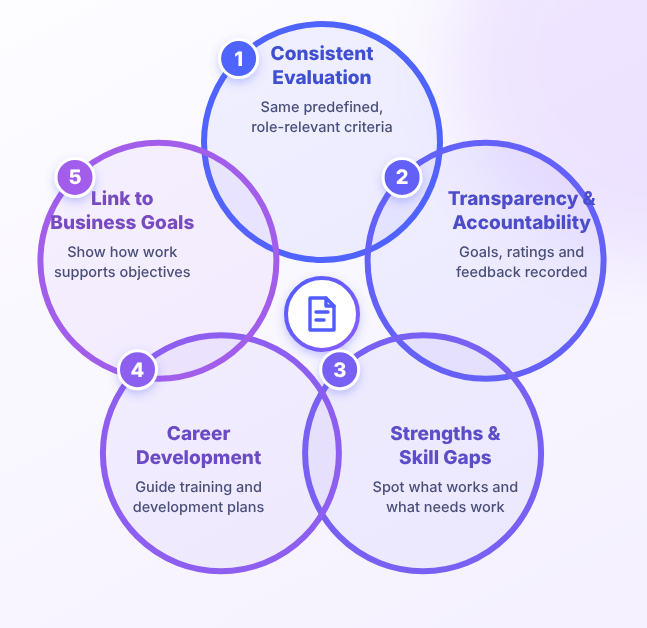
It also connects individual contributions with departmental goals and helps organizations to make informed decisions about employee development. Here are five key reasons why organizations should use a structured employee performance appraisal form.
1. Creates a Consistent Evaluation Process
A standardized appraisal form ensures that employees are assessed against predefined criteria relevant to their roles.
For example, two sales executives can be evaluated on sales targets, lead conversion, customer retention, and revenue generation. This makes performance comparisons more consistent while allowing departments to use role-specific KPIs.
2. Improves Transparency and Accountability
An appraisal form documents employee goals, achievements, ratings, and manager feedback. Employees can understand what is expected of them, how their performance is evaluated, and where they need to improve.
It also encourages managers to support their ratings with specific examples rather than vague comments.
3. Identifies Employee Strengths and Skill Gaps
Performance evaluations help managers to recognize employees strengths, such as technical knowledge, communication, leadership, and problem-solving. They also highlight areas requiring improvement.
For instance, an employee may consistently meet project deadlines but need to improve cross-functional communication.
4. Supports Employee Development and Career Planning
Appraisal forms help managers to understand employees’ career interests and development needs. Based on the evaluation, they can recommend relevant training, assign additional responsibilities, or prepare individual development plans.
5. Connects Individual Performance with Business Goals
Appraisals help employees to understand how their work contributes to organizational objectives. For example, a customer support team’s evaluation may include customer satisfaction, query resolution time, and complaint handling if the company aims to improve customer retention.
What Should an Employee Appraisal Form Include?
A comprehensive employee appraisal form should include employee information, appraisal period, performance goals, KPI achievements, competency assessments, manager feedback, improvement areas, and future development plans. The exact components may vary depending on the employee’s role and the organization’s evaluation process.
Here are the essential components HR teams should consider when preparing an employee performance appraisal form.
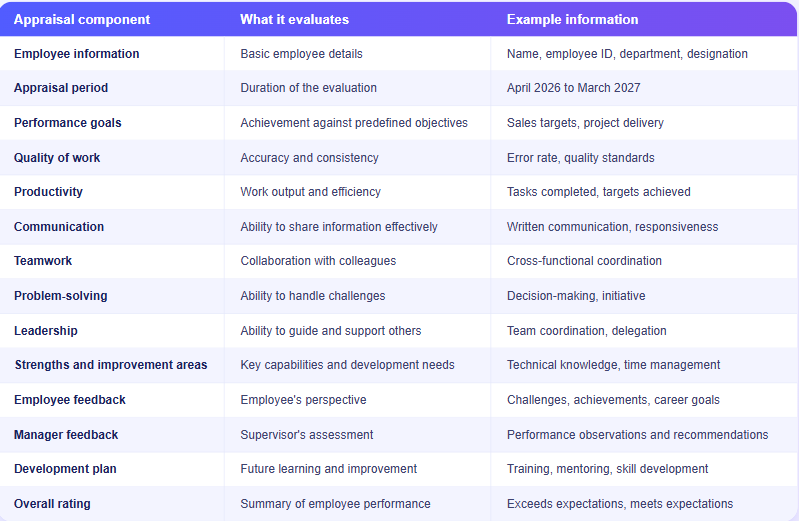
Let’s understand some of these components in more detail.
1. Employee Information
This section stores the basic employee details required to identify the person being evaluated.
It generally includes:
- Employee name.
- Employee ID.
- Designation.
- Department.
- Reporting manager.
- Date of joining.
- Appraisal period.
- Date of appraisal.
2. Performance Goals and KPIs
This section evaluates how effectively employees have achieved their predefined goals and key performance indicators (KPIs).
For example, a recruitment executive may have the following performance goals:
- Close 15 open positions within the appraisal period.
- Reduce the average time to hire.
- Improve candidate communication.
- Maintain accurate recruitment records.
The appraisal form should capture the target, actual achievement, and manager’s observations for each relevant goal.
3. Competency Assessment
Competencies refer to the skills, knowledge, and behaviours employees need to perform their jobs effectively.
Some common evaluation parameters include:
- Job knowledge.
- Communication skills.
- Problem-solving.
- Teamwork.
- Adaptability.
- Leadership.
- Time management.
- Decision-making.
Not every competency needs to apply to every employee as HR teams should customize the evaluation criteria according to job responsibilities and seniority.
4. Strengths and Improvement Areas
This section highlights an employee’s key strengths and the areas where they can improve.
For example:
- Strengths: Completes tasks on time, communicates well with clients, and takes responsibility for assigned work.
- Areas for improvement: Needs to delegate tasks better and share regular updates on project progress.
5. Employee and Manager Feedback
The employee should have an opportunity to share their perspective on achievements, challenges, and professional development requirements.
Managers should provide constructive feedback supported by specific examples and observations.
This makes the appraisal process more collaborative and allows both parties to discuss performance expectations.
6. Development Plan
The development plan defines the actions employees and managers will take to improve performance or build new competencies.
It may include:
- Technical training.
- Communication workshops.
- Leadership development.
- Mentoring sessions.
- Additional responsibilities.
- Future performance goals.
HR Appraisal Form Format: Free Template for HR Teams
An effective HR appraisal form format should include sections for employee details, performance goals, competency ratings, self-assessment, manager feedback, and development plans. HR teams can adjust these sections based on employee roles and the appraisal cycle.
Below is a practical employee appraisal form template that organizations can use for annual, half-yearly, or quarterly performance reviews.
Employee Performance Appraisal Form Template
Section 1: Employee Details
| Field | Information |
| Employee Name | __________________ |
| Employee ID | __________________ |
| Designation | __________________ |
| Department | __________________ |
| Date of Joining | __________________ |
| Reporting Manager | __________________ |
| Appraisal Period | __________________ |
| Appraisal Date | __________________ |
Section 2: Key Performance Goals and Achievements
This section compares the employee’s expected targets with their actual results. Managers can use the weightage and ratings to assess how well each goal was achieved during the appraisal period.
| Goal | Weightage | Expected Result | Actual Result | Rating | Comments |
| Goal 1 | 30% | [Target] | [Result] | [Rating] | [Comments] |
| Goal 2 | 25% | [Target] | [Result] | [Rating] | [Comments] |
| Goal 3 | 25% | [Target] | [Result] | [Rating] | [Comments] |
| Goal 4 | 20% | [Target] | [Result] | [Rating] | [Comments] |
Employee’s Comments:
What progress have you made towards your goals? Mention your key achievements and any challenges you faced.
Manager’s Comments:
How well did the employee achieve the assigned goals? Mention key results and areas that need improvement.
Section 3: Competency Assessment
This section evaluates the employee’s skills and workplace behaviour using the organization’s chosen rating scale.
| Competency | Rating (1–5) | Manager’s Comments |
| Job knowledge | [Rating] | [Comments] |
| Communication | [Rating] | [Comments] |
| Teamwork | [Rating] | [Comments] |
| Problem-solving | [Rating] | [Comments] |
| Time management | [Rating] | [Comments] |
| Initiative | [Rating] | [Comments] |
| Adaptability | [Rating] | [Comments] |
Section 4: Employee Self-Assessment
Employees can complete this section before the appraisal discussion to share their views about their performance and career development.
- What were your most important achievements during this appraisal period?
- Which skills or competencies have you improved?
- What challenges affected your performance?
- What skills would you like to develop further?
- What support or resources would help you perform better?
Section 5: Strengths and Areas for Improvement
This section allows managers to highlight the employee’s strengths and identify areas where additional support or improvement is needed.
| Strengths | Areas for Improvement |
| __________________ | __________________ |
| __________________ | __________________ |
| __________________ | __________________ |
Section 6: Manager’s Overall Feedback
The manager can use this section to summarize the employee’s overall performance during the appraisal period.
Key achievements:
Areas requiring improvement:
Additional observations:
Section 7: Employee Development Plan
This section records the actions employees can take to improve their skills and performance before the next appraisal cycle.
| Development Area | Action Required | Target Completion Date |
| [Skill/Area 1] | [Training/Action] | [Date] |
| [Skill/Area 2] | [Training/Action] | [Date] |
| [Skill/Area 3] | [Training/Action] | [Date] |
Section 8: Overall Performance Rating
Select the appropriate rating based on the organization’s performance evaluation criteria.
| Rating | Performance Level |
| 5 | Exceptional |
| 4 | Exceeds expectations |
| 3 | Meets expectations |
| 2 | Partially meets expectations |
| 1 | Does not meet expectations |
Final Performance Rating: __________
Manager’s Justification for the Rating:
Section 9: Acknowledgement
This section confirms that the appraisal discussion has taken place and allows employees to share their final comments.
Employee’s Comments:
Employee Signature: __________________
Manager Signature: __________________
HR Representative: __________________
Date: __________________
Note: This is an illustrative employee appraisal form format. Organizations should customize the evaluation parameters, goal weightages, rating definitions, and approval process according to their internal performance management policies. Signatures acknowledge the appraisal discussion and do not necessarily indicate agreement with every rating.
Employee Performance Appraisal Samples for Different Roles
A single appraisal form may not be suitable for every employee because performance expectations differ across departments and job responsibilities. HR teams should use role-specific evaluation criteria to assess employees more accurately.
Let’s explore five employee performance appraisal samples that HR professionals can use for different positions.
1. Marketing Executive Appraisal Sample
A marketing executive can be evaluated based on campaign performance, lead generation, content quality, audience engagement, and marketing contribution.
| Evaluation parameter | Target | Actual performance | Rating |
| Qualified lead generation | 1,000 leads | 1,150 leads | 4 |
| Campaign execution | 12 campaigns | 12 campaigns | 3 |
| Content delivery | 20 assets | 22 assets | 4 |
| Campaign reporting | Monthly reports | All submitted | 3 |
| Team collaboration | Effective coordination | Positive feedback | 4 |
Manager appraisal comments:
The employee completed marketing tasks on time and exceeded the qualified lead generation target. They performed well in coordinating campaigns and creating content. However, improving campaign analysis and budget management can help them achieve better results.
2. Sales Executive Appraisal Sample
A sales executive can be assessed based on revenue generation, sales target achievement, customer relationships, lead conversion, and follow-up activities.
| Evaluation parameter | Target | Actual performance | Rating |
| Monthly sales target | ₹10 lakh | ₹11.5 lakh | 4 |
| New customer acquisition | 20 customers | 18 customers | 3 |
| Lead conversion | 25% | 28% | 4 |
| Customer follow-ups | 100% scheduled | 95% completed | 3 |
| Sales reporting | Weekly updates | All submitted | 3 |
Manager appraisal comments:
The employee performed well in sales and exceeded the revenue target during the review period. They also maintained good customer relationships and converted leads effectively. More regular follow-ups and a focus on acquiring new customers can further improve their performance.
3. HR Executive Appraisal Sample
An HR executive may be evaluated on recruitment coordination, onboarding, employee documentation, HR operations, and employee query resolution.
| Evaluation parameter | Target | Actual performance | Rating |
| Recruitment coordination | 15 positions | 16 positions supported | 4 |
| Onboarding completion | 100% on time | 98% on time | 3 |
| Employee query resolution | Within 2 working days | Average 1.5 days | 4 |
| Employee documentation | 100% accuracy | 97% accuracy | 3 |
| HR reporting | Monthly reports | All submitted | 3 |
Manager appraisal comments:
The employee managed recruitment and onboarding tasks effectively. They responded to employee queries on time and maintained HR records regularly. Paying more attention to documentation accuracy and finding ways to improve HR processes can make their performance even better.
4. Software Developer Appraisal Sample
A software developer’s performance can be assessed based on code quality, project delivery, technical skills, collaboration, and problem-solving.
| Evaluation parameter | Target | Actual performance | Rating |
| Project delivery | 5 milestones | 5 completed | 4 |
| Code quality | Follow coding standards | Minor revisions required | 3 |
| Bug resolution | Within agreed timelines | 92% on time | 4 |
| Technical documentation | Complete documentation | 95% completed | 3 |
| Team collaboration | Regular coordination | Positive feedback | 4 |
Manager appraisal comments:
The employee completed project tasks on time and showed good problem-solving skills. They also worked well with the development team. Improving technical documentation and paying closer attention to code review feedback can help deliver better results.
5. Team Leader Appraisal Sample
A team leader should be evaluated on team performance, task allocation, decision-making, employee development, and achievement of departmental objectives.
| Evaluation parameter | Target | Actual performance | Rating |
| Team target achievement | 100% | 105% | 4 |
| Task allocation | Timely allocation | Consistently achieved | 4 |
| Employee development | Monthly coaching | 10 sessions completed | 3 |
| Issue resolution | Within agreed timelines | 95% on time | 4 |
| Team coordination | Effective collaboration | Positive feedback | 4 |
Manager appraisal comments:
The employee coordinated the team well and helped achieve departmental targets. They managed task allocation and resolved issues effectively. More regular employee guidance and better delegation can help improve their leadership skills.
Note: All the performance targets and ratings above are examples. Actual appraisal criteria should be based on the employee’s role, agreed goals, and company standards.
What Are the Different Types of Employee Appraisal Forms?
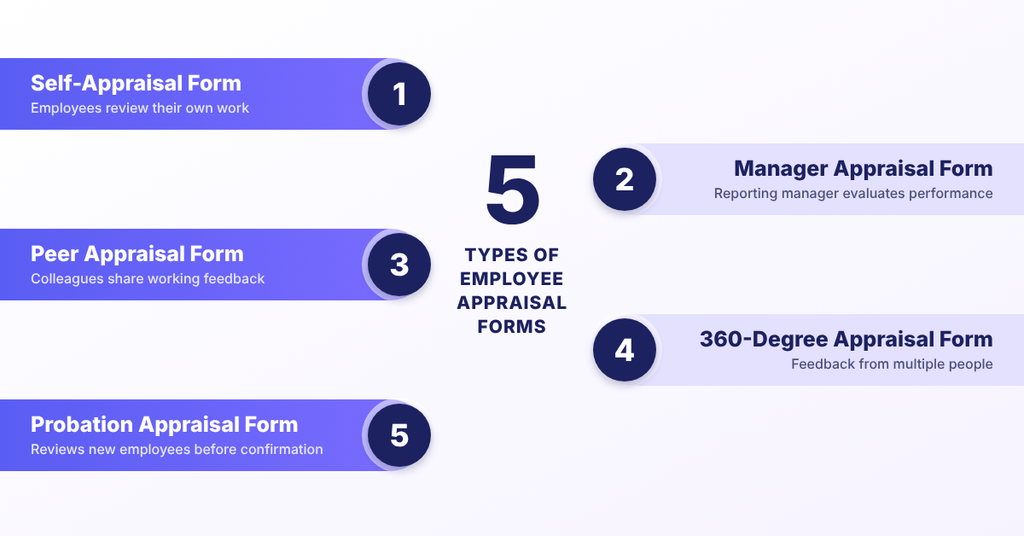
Employee appraisal forms are used to review performance from different perspectives. Some forms allow employees to assess their own work, while others collect feedback from managers, colleagues, or multiple people. The most common types include self-appraisal, manager appraisal, peer appraisal, 360-degree feedback, and probation appraisal forms.
These HR appraisal methods allow organizations to collect performance feedback from employees, managers, peers, and other relevant stakeholders.
Let’s look at each type and understand when to use it.
1. Self-Appraisal Form
A self-appraisal form allows employees to review their own work, achievements, challenges, and areas for improvement before meeting with their managers.
It helps employees reflect on their performance and share their views about their progress and career goals.
Sample self-appraisal questions:
- What were your main achievements during this review period?
- Which goals did you complete?
- What challenges did you face at work?
- Which skills have you improved?
- What would you like to improve?
- What support do you need from your manager?
Best suited for: Organizations that want employees to take an active part in performance reviews.
2. Manager Appraisal Form
A manager appraisal form is filled out by an employee’s reporting manager or supervisor. It helps to evaluate the employee’s work quality, productivity, goal achievement, skills, and overall contribution.
Common evaluation parameters:
- Achievement of assigned targets.
- Quality and accuracy of work.
- Reliability and responsibility.
- Communication and teamwork.
- Problem-solving skills.
- Workplace behaviour.
- Learning and development.
Sample manager feedback:
“The employee completes assigned tasks on time and works well with team members. Improving analytical skills and making decisions more independently can help to improve overall performance.”
Best suited for: Organizations where reporting managers are responsible for evaluating employee performance.
3. Peer Appraisal Form
A peer appraisal form collects feedback from colleagues who work with an employee regularly.
Since team members work together on daily tasks and projects, they can share useful feedback about communication, teamwork, knowledge sharing, and collaboration.
Common peer evaluation questions:
- Does the employee communicate well with colleagues?
- Do they contribute to team projects?
- Are they willing to share knowledge and help others?
- Do they complete shared tasks on time?
- How do they handle disagreements?
Best suited for: Organizations with collaborative teams, cross-functional departments, and project-based work.
4. 360-Degree Appraisal Form
A 360-degree appraisal form collects feedback from different people who work with an employee. This gives a broader view of their performance, behaviour, and working relationships.
Feedback may come from:
- Reporting managers.
- Colleagues and peers.
- Team members reporting to the employee.
- Internal stakeholders.
- The employee themselves.
For example, a department manager may receive feedback from their senior manager, team members, colleagues in other departments, and direct reports.
This approach helps organizations understand an employee’s leadership, communication, teamwork, and overall workplace behaviour.
Best suited for: Organizations that want to evaluate leadership skills, managerial performance, and teamwork from different perspectives.
5. Probation Appraisal Form
A probation appraisal form is used to review a new employee’s performance during their probation period. It helps managers to check whether the employee understands the role, completes assigned work, and meets the company’s expectations.
Common evaluation parameters:
- Understanding of job responsibilities.
- Quality of work.
- Ability to learn new skills.
- Attendance and punctuality, where relevant.
- Communication and teamwork.
- Ability to adjust to the workplace.
- Achievement of probation goals.
Sample probation appraisal questions:
- Does the employee understand their main job responsibilities?
- Can they complete assigned tasks independently?
- Do they have the skills required for the role?
- Have they adjusted well to the team?
- Do they need any additional training or support?
Best suited for: Organizations that review employee performance before confirming their employment after probation.
Employee Appraisal Rating Scale: How Does It Work?
An employee appraisal rating scale helps managers score different aspects of an employee’s performance. It shows whether an employee has performed above expectations, met expectations, or needs improvement during the review period.
A five-point rating scale is commonly used as it makes performance levels easy to understand and compare.
Five-Point Employee Performance Rating Scale
| Rating | Performance level | Explanation |
| 5 | Exceptional | Consistently delivers results significantly above expectations. |
| 4 | Exceeds expectations | Frequently performs above agreed requirements. |
| 3 | Meets expectations | Reliably fulfils the requirements of the role. |
| 2 | Partially meets expectations | Meets some requirements but needs improvement in important areas. |
| 1 | Does not meet expectations | Performance consistently falls below expected standards. |
Organizations should define each rating clearly before starting the appraisal cycle so that managers apply the scale consistently.
How to Calculate an Employee Appraisal Score?
An employee appraisal score can be calculated by averaging the ratings assigned to different performance parameters or by using weighted scores when some parameters are more important than others.
Method 1: Simple Average Rating
Formula:
Average Appraisal Score = Total Ratings ÷ Number of Evaluation Parameters
For example, consider an employee evaluated on five parameters:
| Evaluation parameter | Rating |
| Job knowledge | 4 |
| Work quality | 5 |
| Communication | 3 |
| Teamwork | 4 |
| Productivity | 4 |
| Total | 20 |
Average appraisal score:
20 ÷ 5 = 4.0
The employee receives an average rating of 4.0 out of 5.
Method 2: Weighted Appraisal Score
A weighted appraisal score is useful when certain performance parameters carry greater importance.
For example:
| Evaluation parameter | Weight | Rating | Weighted score |
| Goal achievement | 40% | 4 | 1.60 |
| Work quality | 25% | 5 | 1.25 |
| Communication | 15% | 3 | 0.45 |
| Teamwork | 10% | 4 | 0.40 |
| Initiative | 10% | 4 | 0.40 |
| Total | 100% | 4.10 |
Formula:
Weighted Appraisal Score = Sum of (Parameter Rating × Parameter Weight)
The final score is 4.10 out of 5.
However, a numerical score should not be the only basis for important employment decisions. Managers should also consider documented achievements, role-specific expectations, employee circumstances, and qualitative feedback.
Self-Appraisal Questions Employees Should Answer
Self-appraisal questions help employees reflect on their work, highlight achievements, identify challenges, and share their career goals. HR teams can add these questions to the appraisal form to encourage open and meaningful performance discussions.
Here are some useful questions to include in a self-appraisal form.
Questions About Employee Achievements
- What were your most important accomplishments during this appraisal period?
- Which assigned goals did you successfully achieve?
- How did your work contribute to your department’s objectives?
- Did you take responsibility for any additional projects or tasks?
- What work are you most proud of?
Questions About Strengths and Skills
- Which professional skills helped you perform your responsibilities effectively?
- What are your strongest competencies?
- Have you learned any new tools, technologies, or processes?
- How have you contributed to improving team productivity?
- Which skills would you like to develop further?
Questions About Challenges and Improvement Areas
- What challenges affected your performance?
- Which responsibilities did you find difficult to complete?
- What could you have done differently to improve your results?
- Have you received feedback that helped you improve your work?
- What additional support would help you perform better?
Questions About Future Goals
- What professional goals would you like to achieve in the next appraisal period?
- Are there any new responsibilities you would like to take on?
- What training or development opportunities would benefit you?
- Which skills would you like to strengthen?
- How would you like to contribute more effectively to the organization?
HR teams should select questions that are relevant to the employee’s role and appraisal objectives instead of asking every employee to answer an unnecessarily long questionnaire.
How to Write Effective Employee Appraisal Comments?
Employee appraisal comments should be clear, specific, and based on an employee’s actual work. Managers should explain what the employee does well, where they need to improve, and what steps can help them perform better.
Comments such as “good performance” or “needs improvement” are too general. Good feedback explains the reason behind the evaluation and gives examples wherever possible.
Here are some employee appraisal comment examples that HR teams and managers can use.
Positive Employee Appraisal Comments
Use these comments to appreciate employees for their work, skills, and contributions.
| Evaluation area | Example appraisal comment |
| Productivity | Completes assigned tasks on time and manages workload effectively. |
| Quality of work | Delivers accurate work and pays attention to small details. |
| Communication | Communicates clearly with team members and shares regular updates. |
| Teamwork | Works well with colleagues and supports team goals. |
| Problem-solving | Identifies problems early and takes practical steps to resolve them. |
| Initiative | Takes ownership of tasks and suggests ways to improve existing processes. |
| Leadership | Guides team members effectively and helps achieve departmental goals. |
| Adaptability | Adjusts well to changing priorities and is willing to learn new things. |
Employee Appraisal Comments for Areas of Improvement
Improvement-related comments should explain what needs to change and how the employee can work on it.
| Evaluation area | Example improvement comment |
| Time management | Needs to prioritize tasks better and complete important work within deadlines. |
| Communication | Should share regular updates with team members and other stakeholders. |
| Teamwork | Can improve collaboration by involving colleagues earlier in shared projects. |
| Problem-solving | Should identify potential issues early and try to find solutions independently. |
| Quality of work | Needs to review completed tasks carefully to avoid mistakes. |
| Leadership | Should improve task delegation and provide better guidance to team members. |
| Initiative | Can take more ownership by identifying and addressing process gaps. |
| Technical skills | Needs additional training to improve the technical skills required for the role. |
Overall Performance Appraisal Comments
Managers can also add an overall comment to summarize an employee’s performance during the review period.
For exceptional performance:
“Consistently performs well and achieves results beyond expectations. Takes responsibility for assigned work, supports team members, and makes valuable contributions to company goals.”
For meeting expectations:
“Completes assigned responsibilities as expected and maintains good working relationships with colleagues. Demonstrates a good understanding of the role and meets the required performance standards.”
For performance requiring improvement:
“Has shown progress in some areas but needs to be more consistent in meeting targets and completing tasks on time. Regular feedback and additional support can help improve performance.”
Managers should customize these comments based on each employee’s actual work and achievements. Avoid using the same feedback for everyone, as employees may have different responsibilities, goals, and areas of improvement.
Best Practices for Creating an Effective Employee Appraisal Form
HR teams should design appraisal forms with clear goals, role-specific criteria, and useful feedback.
A well-structured form helps managers to evaluate employees fairly and helps employees understand their performance and areas for improvement.
Let’s see some of the best practices HR can follow to design a better appraisal form:
1. Set Clear Performance Criteria
Use measurable goals instead of vague terms like “good performance”. Include criteria such as project completion, work quality, customer satisfaction, and target achievement.
2. Customize Forms for Different Roles
Appraisal criteria should match job responsibilities. For example, sales employees can be evaluated on revenue and conversions, while developers can be assessed on project delivery and code quality.
3. Use Both Numbers and Feedback
KPIs show measurable results, but they do not tell the whole story. Combine performance scores with manager observations and employee feedback to get a better understanding.
4. Encourage Two-Way Discussions
Give employees a chance to discuss their achievements, challenges, and career goals. This helps managers to understand their concerns and identify the support they need.
5. Keep Evaluations Fair
Managers should assess employees based on their work, not personal opinions. Use clear rating criteria, documented examples, and consistent evaluation standards.
6. Record Performance Regularly
Maintain performance notes throughout the year instead of relying only on recent events. Regular feedback also helps employees understand where they stand.
7. Link Appraisals to Employee Development
Use appraisal results to identify training needs, mentoring opportunities, and areas for skill development. Set clear improvement goals and review progress in the next appraisal cycle.
Common Employee Appraisal Mistakes HR Teams Should Avoid
Even when an organization uses a standardized performance appraisal form, mistakes in the evaluation process can reduce its effectiveness.
Here are some common mistakes HR teams and managers should avoid.
| Common mistake | Why it creates problems | How to avoid it |
| Using vague evaluation criteria | Employees do not understand performance expectations. | Define measurable and role-specific standards. |
| Giving ratings without evidence | Assessments become subjective. | Support ratings with documented examples. |
| Applying identical KPIs to all employees | Different job responsibilities require different measures. | Customize evaluation criteria by role. |
| Ignoring employee feedback | Employees may feel excluded from the process. | Include a self-appraisal and discussion stage. |
| Focusing only on weaknesses | Employee contributions and strengths may be overlooked. | Recognize achievements alongside improvement areas. |
| Conducting appraisals only once a year | Performance issues may remain unaddressed for too long. | Provide periodic feedback throughout the year. |
| Not following up on development plans | Identified skill gaps may remain unresolved. | Assign actions, responsibilities, and review dates. |
Avoiding these mistakes helps organizations create a more transparent and useful appraisal process.
How Can HR Software Simplify Employee Performance Appraisals?
HR software can make employee performance management easier by keeping employee details, performance records, and goal updates in one place. It also reduces the need to manage appraisal forms through separate spreadsheets and documents.
As a company grows, tracking appraisals through emails and spreadsheets can become difficult. HR teams may find it challenging to follow up on pending reviews, maintain past records, and collect feedback from different departments.
An integrated HRMS helps organize employee information and HR processes in one system, making it easier for HR teams to manage these activities.
Depending on the features available in the chosen platform, HR teams can benefit from:
- Centralized employee records: Maintain employee information in one place for easier access and administration.
- Performance tracking: Record relevant employee goals, achievements, and performance information.
- Structured appraisal processes: Follow consistent evaluation procedures across departments.
- Employee feedback: Support organized communication between employees and managers.
- Performance reporting: Review available employee performance information to identify trends and development requirements.
- Employee development: Use evaluation findings to identify training and skill development needs.
For organizations looking to reduce manual HR administration, choosing the right HRMS can help improve the way employee information and performance-related processes are managed.
Conclusion
Overall, an effective HR appraisal form does more than assign employees a performance rating. It gives HR teams and managers a structured way to recognize achievements, identify improvement areas, document feedback, and plan employee development.
By using role-specific evaluation criteria, measurable performance goals, clear rating scales, and practical feedback, organizations can make performance appraisals more consistent and meaningful.
Whether you are preparing an annual employee appraisal form, a probation review format, or a 360-degree feedback template, the key is to create a process that supports both employee growth and organizational objectives.





Want to Manage Employee Performance More Effectively?
Frequently Asked Questions
1. What is an HR appraisal form?
An HR appraisal form is a structured document used by HR professionals and managers to evaluate employee performance over a specific period. It records achievements, goal completion, competencies, strengths, improvement areas, and feedback to support performance discussions and development planning.
2. What should an employee appraisal form include?
An employee appraisal form should include employee details, appraisal period, job responsibilities, performance goals, KPI achievements, competency ratings, employee feedback, manager comments, strengths, improvement areas, and a development plan. Organizations can customize these sections according to job roles and evaluation requirements.
3. How do you fill out an employee appraisal form?
To fill out an employee appraisal form, provide accurate employee details, review previously established performance goals, record actual achievements, assess relevant competencies, and document strengths and improvement areas. Employees should also complete the self-assessment section, while managers should provide specific feedback and future development recommendations.
4. What are the five points of an appraisal rating scale?
A five-point appraisal rating scale generally includes exceptional, exceeds expectations, meets expectations, partially meets expectations, and does not meet expectations. Organizations should define each rating clearly so that managers can evaluate employees consistently.
5. What should employees write in a self-appraisal form?
Employees should highlight their major achievements, completed goals, contributions, challenges, strengths, and areas for improvement. They should also mention new skills acquired, professional development requirements, and goals they want to achieve during the next appraisal period.
6. How often should employee appraisals be conducted?
Employee appraisals may be conducted annually, half-yearly, or quarterly, depending on organizational requirements. Many organizations combine formal appraisal cycles with regular performance discussions to monitor progress, provide feedback, and address improvement areas throughout the year.
7. Who is responsible for completing an employee appraisal form?
The employee, reporting manager, and HR team may all participate in completing an employee appraisal form. Employees generally provide self-assessments, managers evaluate performance, and HR teams coordinate the process and maintain relevant documentation.
8. What are some examples of good employee appraisal comments?
Good employee appraisal comments are specific, constructive, and based on actual performance. Examples include “Consistently completes assigned tasks within agreed timelines” or “Demonstrates strong problem-solving skills and collaborates effectively with team members.” Improvement-related comments should also include clear recommendations.
9. Can an employee disagree with their performance appraisal?
Yes. Employees should be given an opportunity to discuss or clarify their appraisal ratings if they disagree with the evaluation. Organizations can provide a formal feedback or review mechanism through which employees submit their concerns and managers explain the assessment using documented performance examples.
10. Can HR software automate employee performance appraisals?
HR software can support different aspects of performance appraisal, depending on the platform’s capabilities. Relevant features may include goal tracking, appraisal workflows, employee feedback, performance records, and reporting. Organizations should verify the available features before selecting a solution.