Top 10 Recruitment Software in India for SaaS Companies


-
AuthorSatyam Chauhan
-
 Last Updated
November 14, 2026
-
 Reading Time
27 Mins
TL;DR
Choosing the right recruitment software in India can help SaaS companies streamline hiring, manage candidates and reduce manual recruitment work. Here is a quick look at 10 recruitment platforms and what each offers:
- Savvy HRMS: Uses AI-assisted recruitment to simplify candidate screening and management, while connecting manpower planning, interviews, offer letters and digital onboarding with wider HR operations.
- Deel: Combines AI-assisted recruitment with global workforce management, making it useful for companies hiring across countries.
- Darwinbox: Helps enterprises to manage structured hiring with requisitions, candidate matching, approval workflows and recruitment analytics.
- greytHR: Connects recruitment with HRMS and payroll through candidate scoring and offer-related workflows.
- Keka: Supports job posting, AI-assisted screening, interview collaboration, offer management and onboarding.
- Pocket HRMS: Uses GenAI for job descriptions, bulk resume parsing and candidate management within its wider HRMS.
- BambooHR: Keeps hiring organized with applicant tracking, team collaboration, candidate communication and reporting.
- ZingHR: Supports different stages of hiring with AI-assisted screening, video interviews, assessments and digital offers.
- Naukri RMS: Helps recruiters to reach Indian candidates through job postings, Resdex and other Naukri hiring products.
- Zoho Recruit: Offers a flexible ATS with job marketing, candidate management, workflow automation and integrations.
Hiring the right people is important for every SaaS company, especially when teams are growing. From software developers and product managers to sales executives and customer success professionals, each role requires different skills and hiring methods. Managing these vacancies through spreadsheets, emails and separate tools can make recruitment difficult as application numbers increase.
India’s technology sector added 60,000 employees in FY24, taking its workforce to 5.43 million, according to the Economic Survey 2024–25. This growth highlights the importance of having organized hiring processes as technology businesses expand.
That’s where Recruitment software can help HR teams to manage job postings, candidate screening, interviews and offers in one place. In this article, we explore 10 options for recruitment software in India, their key features and how they can support SaaS hiring needs.
What Is Recruitment Software?
Recruitment software is a digital platform that helps businesses to manage hiring activities, from creating job openings to selecting candidates and completing onboarding. It brings job requirements, candidate information, interview feedback and hiring updates into a central system.
For a SaaS company, the process may begin when a department raises a requirement for a backend developer, product manager or sales executive. The HR team can create the job opening, define the required skills, assign recruiters and publish the vacancy through selected channels.
As applications arrive, recruiters can review candidate profiles, shortlist suitable applicants and move them through different hiring stages. Hiring managers can participate in interviews, submit feedback and approve decisions.
Comparison of the Top 10 Recruitment Software in India
Before exploring each platform in detail, let’s compare the top 10 recruitment software based on their key features, AI capabilities, suitability for SaaS companies, and overall hiring support.
| Platform | Key Features | Best For | Pros | Cons | AI Integration |
| Savvy HRMS | Resume parsing, AI screening, requisitions, onboarding. | Indian SaaS companies. | Recruitment connects with HRMS. | Less specialised than standalone ATS tools. | High |
| Deel | AI sourcing, screening, matching and interview insights. | International hiring. | Connects recruitment with global workforce management. | Advanced features may require higher plans. | High |
| Darwinbox | AI recommendations, candidate scoring, approvals and analytics. | Large, multi-location SaaS teams. | Structured enterprise hiring workflows. | May be extensive for small startups. | High |
| greytHR | AI scoring, screening bot, interviews and offer workflows. | Indian businesses using HRMS. | Recruitment connects with payroll processes. | Check specialist assessment capabilities. | High |
| Keka | AI job descriptions, resume scoring, interviews and onboarding. | Growing SaaS companies. | Connects hiring with HR processes. | Features vary by plan. | High |
| Pocket HRMS | GenAI descriptions, resume parsing and AI screening. | Indian startups and growing businesses. | Recruitment and employee management in one platform. | Verify advanced sourcing options. | High |
| BambooHR | Candidate tracking, automated emails, scheduling and offers. | Companies needing straightforward ATS workflows. | Simple hiring and employee-record handoff. | Limited publicly documented AI-led ATS features. | Limited in ATS |
| ZingHR | AI ranking, video interviews, assessments and onboarding. | High-volume hiring teams. | AI supports multiple hiring stages. | Evaluate implementation and pricing. | Very High |
| Naukri RMS | Resdex, job posting, e-Apps and AI REX. | Indian talent sourcing. | Strong access to Naukri’s candidate ecosystem. | May need a separate end-to-end HRMS. | High for sourcing |
| Zoho Recruit | Zia matching, resume parsing, screening bots and workflows. | Companies needing a dedicated ATS. | Configurable recruitment and integrations. | Some AI features are plan-dependent. | Very High |
Note: AI Depth is a qualitative assessment based on publicly documented recruitment-related AI capabilities. “Very High” indicates multiple AI-led activities across sourcing, screening and evaluation; “High” indicates specific AI recruitment capabilities such as candidate matching, resume screening or scoring. “Limited in ATS” means AI capabilities are not clearly documented as part of the platform’s applicant tracking workflow. Actual availability may vary by plan.
Top 10 Recruitment Software in India
The following platforms approach recruitment in different ways. Some offer dedicated applicant tracking capabilities, while others connect recruitment with a broader HRMS or workforce management platform.
The right choice depends on your hiring volume, recruitment process, existing HR systems, AI integration and whether you hire only in India or across multiple countries.
1. Savvy HRMS
Savvy HRMS offers recruitment software in India as part of its broader HRMS platform. Instead of treating recruitment as a standalone candidate-tracking activity, the system connects manpower planning, job requisitions, candidate management, interviews, offer generation and digital onboarding.
This approach can be useful for a growing SaaS company that wants to manage hiring and employee administration via a connected HR software.
Core Recruitment Capabilities
Savvy HRMS covers several stages of the recruitment process:
- Manpower budgeting and planning: Allocate hiring budgets across positions and plan workforce requirements.
- Manpower requisition: Raise manpower requisitions for new or replacement positions.
- Candidate sourcing: Manage candidate sourcing and job distribution through supported channels.
- Resume management: Upload resumes in bulk, maintain candidate records and identify duplicate resumes.
- AI-assisted screening: Use resume parsing, AI-based job descriptions and deeper resume search to support candidate shortlisting.
- Requisition and application tracking: Monitor vacancies, assigned recruiters and candidate progress.
- Interview and assessment management: Schedule multiple interview rounds, attach online assessment templates and review test results.
- Offer letter generation: Generate offer letters, manage approval requirements and record candidate consent for the proposed CTC.
- Recruitment reports: Review requisition closure, project-wise hiring, joining status and vacancy tracker reports.
- Digital onboarding: Collect candidate information and documents, assign onboarding tasks and convert selected candidates into employees.
How Is Savvy HRMS Different from Other Recruitment Software in India?
Savvy HRMS brings recruitment and other HR activities together on one platform. Let’s see how its offerings are different from other recruitment software.
| Comparison Area | Savvy HRMS | What Other Software Offers |
| Integrated HRMS | Connects recruitment with other HR modules. | Offers standalone ATS or integrated HRMS solutions. |
| Manpower Planning | Supports manpower budgeting and hiring requests. | Provides job requisitions and approval workflows. |
| Candidate Management | Manages resumes, screening and applications. | Offers resume parsing, filtering and candidate tracking. |
| Recruitment to Onboarding | Supports offer generation and digital onboarding. | Offers onboarding features or third-party integrations. |
| HR and Payroll | Connects recruitment with HR and payroll management processes. | Provides HRMS integrations or focuses mainly on hiring. |
| Workforce Management | Includes attendance, leave, payroll and performance modules. | May require separate tools for these functions. |
India-Specific Features and Capabilities
For Indian businesses, recruitment workflows often involve manpower requisitions, position-wise budgets, CTC approvals, offer letters and employee document collection. Savvy HRMS includes features for manpower planning, customized CTC break-ups, digital offer acceptance and candidate-to-employee conversion.
Its recruitment reports also include project-wise and joining-status information. These can be relevant for SaaS companies hiring across departments, business units or project teams.
The platform’s wider HRMS offering can also be considered when a business wants recruitment to connect with employee records and other HR activities after a candidate joins.
Best For
Savvy HRMS can be considered by Indian SaaS startups and growing businesses that want recruitment management alongside broader HR operations at an affordable price. It may be particularly relevant for companies that need to manage manpower planning, recruitment approvals, interviews, offers and onboarding without treating each activity as a separate process.
Pros of Choosing Savvy HRMS
- Connects manpower planning and budgeting with recruitment activities.
- Supports multiple interview rounds and online assessment templates.
- Provides recruitment reports for vacancy tracking, requisition closure and joining status.
- Supports digital offer acceptance and candidate-to-employee conversion.
- Can connect recruitment with a wider HRMS environment.
Cons of Choosing Savvy HRMS
- Companies looking for a specialised global sourcing platform should check whether its available sourcing channels meet their requirements.
- SaaS businesses with complex technical assessments should verify the required assessment integrations and workflows.
2. Deel
Deel offers an ATS as part of its wider global workforce platform. Its recruitment solution helps companies to source candidates, screen applications, coordinate interviews, and move selected candidates toward onboarding.
Core Recruitment Capabilities
Deel’s ATS includes:
- Job distribution: Publish job openings across more than 1,000 connected job boards, according to Deel.
- AI-assisted sourcing: Find potential candidates from existing talent pools and connected external sources.
- AI-assisted screening: Compare candidate-submitted information with job requirements to support shortlisting.
- Interview intelligence: Record interviews with candidate consent, generate transcripts and create interview summaries.
- Onboarding handoff: Transfer candidate-to-hire information into Deel’s onboarding process.
India-Specific Features and Capabilities
For Indian SaaS companies hiring internationally, Deel can help manage recruitment and cross-border employment. For example, a company hiring employees in Singapore or Germany may find it useful. However, businesses should check its India-specific payroll, tax and statutory compliance capabilities before choosing it.
Best For
Deel is best suited to SaaS companies that recruit across countries and want recruitment connected with international workforce management.
Pros of Choosing Deel
- Connects recruitment with a broader international workforce platform.
- Offers AI-assisted candidate sourcing, screening and interview summaries.
- Supports job distribution across a large network of job boards.
- Helps reduce manual handoffs between recruitment and onboarding.
- Provides configurable hiring analytics.
Cons of Choosing Deel
- Companies hiring only in India may not need its wider global workforce capabilities.
- The ATS requires an HRIS foundation, according to Deel’s product FAQ, so buyers should review the platform requirements.
- Businesses should evaluate the cost and availability of the additional workforce services they may need.
3. Darwinbox
Darwinbox provides recruitment as part of its broader human capital management platform. Its talent acquisition solution focuses on structured hiring, connecting job requisitions, candidate sourcing, screening, interviews, offers and recruitment reporting.
Darwinbox’s recruitment solution is designed to connect these activities with the wider HR platform rather than operate only as a candidate database.
Core Recruitment Capabilities
Darwinbox’s recruitment platform includes:
- Requisition and job management: Allow managers to raise requisitions and create job openings through configurable workflows.
- Multi-channel sourcing: Source candidates through career portals, social media, internal job postings, referrals and job boards.
- AI-assisted job descriptions: Generate job descriptions with support from Darwinbox’s AI capabilities.
- Candidate recommendations: Identify relevant candidates from the existing talent pool.
- Smart shortlisting: Use AI-powered stack ranking, Boolean search and CV insights to support candidate review.
India-Specific Features and Capabilities
Darwinbox is relevant to Indian organizations that need structured recruitment across departments, business units and locations. Its requisition management and configurable approval workflows can help companies to maintain control over who raises vacancies and who approves hiring.
For a SaaS company operating from Bengaluru, Hyderabad and Pune, for example, hiring teams may need to manage different vacancies and approval processes across locations. Darwinbox’s job and requisition management capabilities can support this type of organized hiring structure.
Best For
Darwinbox can be considered by mid-sized and large SaaS companies with multiple hiring teams, departments and approval levels. It is particularly relevant when recruitment needs to be connected with broader workforce management and enterprise HR processes.
Pros of Choosing Darwinbox
- Supports structured requisition and approval workflows.
- Offers multi-channel sourcing and internal job posting.
- Provides AI-assisted candidate recommendations and resume insights.
- Includes offer proposal and counteroffer management.
- Connects recruitment with a wider HCM platform.
Cons of Choosing Darwinbox
- Smaller SaaS companies with simple hiring needs may find a broader enterprise HCM platform more than they currently require.
- Buyers should assess implementation effort and configuration requirements for their organization.
- AI functionality, integrations and terms of use should be verified as part of the package.
4. greytHR
greytHR Recruit is a recruitment solution that connects hiring activities with the greytHR HRMS and payroll environment. It supports job posting, candidate screening, interview scheduling, candidate communication and hiring.
What makes it unique is the transition from recruitment into HR operations. They claim that once an offer is made and the candidate is hired, candidate documents and the offered salary details can move into its HRMS and payroll workflows without you having to re-enter data.
Core Recruitment Capabilities
greytHR Recruit offers several recruitment-focused capabilities:
- Job setup and hiring stages: Create job postings, customise hiring stages and build hiring teams.
- Job distribution: Post openings to supported channels such as Naukri, LinkedIn, Hirist and IIMJobs.
- AI-based candidate scoring: Evaluate profiles against skills, experience, qualifications and location.
- Custom scoring weights: Adjust the importance of different criteria globally or for individual jobs.
- Internal hiring and referrals: Allow internal applicants and employee referrals through the employee self-service environment.
- Recruitment analytics: Review hiring progress and recruitment performance.
India-Specific Features and Capabilities
greytHR’s connection with its HRMS and payroll environment is particularly relevant for Indian businesses.
For a SaaS company hiring across India, the ability to manage candidate profiles, interview feedback and offer salary information in a connected system may reduce manual coordination between recruitment and payroll teams.
Best For
greytHR Recruit can be a suitable option for Indian SaaS companies already using greytHR or planning to manage recruitment with HRMS and payroll. It may be especially useful for teams that want candidate scoring and a structured hiring process without separating recruitment from their HR operations.
Pros of Choosing greytHR
- Connects recruitment data with greytHR HRMS and payroll.
- Offers configurable AI-based candidate scoring.
- Supports internal applications and employee referrals.
- Provides interviewer scorecards and calendar-based scheduling.
- Supports job posting to selected Indian recruitment platforms.
Cons of Choosing greytHR
- Companies using a different HRMS should evaluate the available integration options before selecting it.
- Buyers should check whether its recruitment workflows cover their technical assessment and specialist hiring requirements.
- Recruitment functionality and pricing should be evaluated separately from the core HRMS package.
5. Keka
Keka offers recruitment software through an ATS that connects hiring activities with its existing platform. Its recruitment workflow covers job creation, job distribution, candidate tracking, screening, interviews, offer management and onboarding handoff.
Keka also positions its recruitment solution for startups, SMEs and larger organizations, with capabilities intended to support different hiring volumes.
Core Recruitment Capabilities
Keka’s recruitment software includes:
- Job description creation: Create job descriptions with AI assistance.
- Job distribution: Publish vacancies to 15+ job boards, career sites and referral portals, according to Keka.
- Applicant tracking: Monitor candidate progress through recruitment stages using dashboards and role-based visibility.
- Resume parsing and screening: Use AI parsing, smart filters and candidate screening tools.
- Skill assessments: Connect screening with integrated skill tests.
- Interview collaboration: Coordinate interviews, capture feedback and align panel decisions.
- Offer management: Prepare offer letters with e-signature support.
- Onboarding handoff: Transfer candidate information into Core HR and support preboarding activities.
Keka also describes AI-assisted job descriptions, screening, workflow automation and predictive insights as part of its hiring capabilities. Source
India-Specific Features and Capabilities
Keka’s recruitment channels for job posting are Naukri, alongside LinkedIn and Indeed. This can be useful for SaaS companies that need to source both technical and business-facing roles in India.
According to the Keka, they states that its platform supports Indian DPDP Act and GDPR-related data protection requirements which buyers should review the vendor’s current security documentation and contractual terms to understand the scope of these commitments.
Best For
Keka can be a good option for SaaS startups, SMEs and growing businesses that want an ATS connected with wider HR operations. It may be useful for teams that need job distribution, screening, interview coordination and onboarding handoff in one platform.
Pros of Choosing Keka
- Combines job distribution, candidate tracking and interview collaboration.
- Offers AI-assisted job descriptions and resume screening.
- Supports skill assessments and offer management.
- Connects candidate information with Core HR.
- Provides recruitment workflows for different business sizes.
Cons of Choosing Keka
- Companies with advanced technical hiring requirements should verify the available assessment capabilities and integrations.
- Businesses should check which job boards and integrations are included in their selected package.
6. Pocket HRMS
Pocket HRMS provides a recruitment management system as part of its wider HR software offering. Their recruitment solution uses generative AI to support activities such as job description creation, bulk resume parsing, interview question generation and HR letter preparation.
Pocket HRMS positions its module recruitment system as a wider recruitment management solution more than only an applicant tracking tool.
Core Recruitment Capabilities
Pocket HRMS describes the following recruitment capabilities:
- AI-assisted job descriptions: Generate job descriptions based on role requirements.
- Bulk resume parsing: Process multiple resumes and extract candidate information.
- Candidate sourcing & screening: Manage applications received and shortlist applicants through different sourcing channels.
- Interview support: Generate personalised interview questions and coordinate interview activities.
- Candidate tracking & Offer generation: Manage candidate profiles, progress and prepare recruitment-related letters and offers.
- Candidate communication: Share relevant HR policies and information with recruits.
India-Specific Features and Capabilities
Pocket HRMS is an Indian HRMS provider, and its recruitment solution can be considered by businesses that want hiring connected with wider HR processes.
Its recruitment management content also discusses digital onboarding, employee document collection and PF/ESIC-related onboarding activities. These are relevant considerations for Indian employers, but companies should confirm the exact compliance workflows supported by the purchased product and configuration.
Best For
Pocket HRMS can be considered by Indian SMEs and growing SaaS companies looking for recruitment management with AI-assisted resume processing and a wider HRMS connection.
Pros of Choosing Pocket HRMS
- Uses GenAI for job descriptions and bulk resume processing.
- Supports personalised interview question generation.
- Connects recruitment with a wider HRMS environment.
- Covers recruitment activities beyond basic application tracking.
- Supports the transition from candidate selection to onboarding.
Cons of Choosing Pocket HRMS
- Companies requiring specialist technical assessments should verify the available assessment tools and integrations.
- Businesses should check which AI and recruitment capabilities are included in the selected plan.
7. BambooHR
BambooHR offers an applicant tracking system as part of its HR software platform. Its ATS focuses on making recruitment easier to manage through job posting, candidate communication, interview scheduling, collaborative reviews, offer letters and hiring reports.
Core Recruitment Capabilities
BambooHR’s ATS includes:
- Job posting: Manage job openings and connect with supported job boards.
- Collaborative hiring: Allow hiring teams to review candidates with permissions, alerts and in-system messaging.
- Automated communication: Send personalised emails at different stages of the hiring process.
- Interview self-scheduling: Allow candidates to select from interview time slots defined by the company.
- Candidate reporting: Use Candidate Sources and Candidate Funnel reports to understand sourcing performance and identify bottlenecks.
India-Specific Features and Capabilities
Indian SaaS companies that plan to buy BambooHR must verify if the solution is appropriate for their location-specific recruitment process. It should also support Indian job boards, local payroll, integration with Indian accounting & HR and country-specific employment workflows.
Best For
BambooHR can be considered by smaller and mid-sized SaaS companies looking for a straightforward ATS connected with a broader HR platform. It may be suitable when candidate communication, interview coordination and hiring reports are more important than complex recruitment automation or India-specific sourcing requirements.
Pros of Choosing BambooHR
- Offers a straightforward applicant tracking workflow.
- Supports candidate self-scheduling for interviews.
- Provides automated candidate communication.
- Includes candidate source and funnel reporting.
- Connects new-hire information with employee records.
Cons of Choosing BambooHR
- Indian companies should verify the availability of local job board and payroll integrations.
- Companies requiring extensive requisition, approval or high-volume sourcing workflows should compare their capabilities with more specialized recruitment platforms.
8. ZingHR
ZingHR offers talent acquisition through its ZingHire recruitment suite. Their approach is focused on using AI and automation across multiple hiring stages, from job description creation and candidate sourcing to screening, video interviews, offers and onboarding.
Core Recruitment Capabilities
ZingHR’s talent acquisition offering includes:
- AI job description creation: ZingBot AI can generate role-aligned job descriptions from hiring requirements.
- Multi-channel job distribution: Publish job openings across 150+ job boards, internal job postings, employee referrals and branded career portals, according to ZingHR.
- AI candidate ranking: Rank incoming applications using AI-based fitment scores.
- AI video interviews: Conduct first-round video interviews and generate scored transcripts.
- Background verification: Connect background verification through its AuthBridge integration.
- Recruitment analytics: Track time-to-hire, cost-per-hire, channel performance and offer acceptance through ZingIntel dashboards.
India-Specific Features and Capabilities
ZingHR’s talent acquisition solution includes features that may be relevant to Indian employers, such as job distribution, internal job postings, employee referrals, background verification integration and digital offer workflows.
Best For
ZingHR can be considered by mid-sized and large SaaS companies with high-volume or multi-location hiring requirements. It may be particularly relevant for organizations that want AI-assisted screening, video interviews, assessments and digital hiring workflows in one platform.
Pros of Choosing ZingHR
- Offers AI-assisted job descriptions and candidate ranking.
- Supports AI video interviews and scored transcripts.
- Provides multi-channel job distribution and internal hiring options.
- Connects recruitment with background verification and digital offers.
- Includes recruitment analytics through ZingIntel.
Cons of Choosing ZingHR
- Smaller SaaS companies with occasional hiring may not need its broader automation capabilities.
- Companies should verify the scope and configuration of AI interviews and assessments before implementation.
- Buyers should check the availability, pricing and integration requirements of connected services such as background verification and digital signatures.
9. Naukri RMS
Naukri RMS helps recruiters to find and connect with candidates through its large jobseeker and resume database. Its recruitment tools include job posting, Resdex for resume search, e-Apps for managing applications and AI REX for AI-based candidate sourcing and screening.
Core Recruitment Capabilities
Naukri’s recruiter products include:
- Job posting: Post vacancies and receive applications from jobseekers.
- Resdex resume database: Search a large resume database using filters and AI-assisted search capabilities.
- CV recommendations: Receive relevant candidate recommendations for job postings through supported packages.
- e-Apps application management: Review, shortlist, search and organize applications received for job postings.
- Quick contact and auto-reply: Contact shortlisted applicants and manage application communication.
- Recruiter insights: Monitor recruiter activity and hiring performance through available reports.
India-Specific Features and Capabilities
Naukri is useful for Indian SaaS companies because it gives recruiters access to candidates across different job platforms. Its product ecosystem also includes specialised platforms such as Hirist for technology hiring, iimjobs for management and professional roles, and Naukri Campus for graduate recruitment.
Best For
Naukri’s recruitment products can be considered by SaaS companies that rely heavily on sourcing candidates from the Indian job market.
Pros of Choosing Naukri RMS
- Provides access to a large Indian jobseeker and resume database.
- Offers sourcing options for technology and management roles.
- Supports job posting and application management.
- Provides AI-assisted sourcing and candidate outreach through AI REX.
- Offers different products for sourcing, screening and recruitment activities.
Cons of Choosing Naukri RMS
- Companies should distinguish between Naukri’s sourcing products and a complete end-to-end ATS or HRMS.
- Buyers should compare Resdex, job posting, e-Apps and AI REX separately to understand the features and costs they actually need.
10. Zoho Recruit
Zoho Recruit is a dedicated recruitment and applicant tracking platform for corporate HR teams and staffing agencies. It focuses on job marketing, candidate sourcing, applicant management, recruitment automation and collaboration.
Core Recruitment Capabilities
Zoho Recruit offers:
- AI assistance through Zia: Support job description creation, candidate sourcing, shortlisting, emails and assessments.
- Job marketing: Publish openings through career sites, social media and supported job boards.
- Candidate management: Store and manage applicant information through a central recruitment system.
- Recruitment automation: Use Blueprints, workflows and custom functions to automate hiring activities.
- Hiring collaboration: Provide portals for stakeholders such as hiring managers, vendors, clients and candidates.
- Recruitment integrations: Connect with applications such as Google Meet, Microsoft Teams, Slack, Mailchimp and other supported tools.
India-Specific Features and Capabilities
Zoho Recruit can be used by Indian SaaS companies that want a configurable ATS with job marketing, candidate management and workflow automation.
Its job posting and integration capabilities may help businesses to manage applications from different channels. However, buyers should check which Indian job boards are supported for their account and whether any required integrations involve additional setup or costs.
Best For
Zoho Recruit can be considered by SaaS startups and growing businesses that want a dedicated ATS with configurable workflows, candidate management and integrations. It may also suit companies that need more control over their recruitment process than a basic applicant tracking module provides.
Pros of Choosing Zoho Recruit
- Offers a dedicated ATS for corporate recruitment teams and staffing agencies.
- Supports configurable hiring workflows and automation.
- Provides job marketing and candidate management capabilities.
- Includes AI assistance through Zia.
- Connects with a wide range of business and collaboration applications.
Cons of Choosing Zoho Recruit
- Advanced automation and AI capabilities may require higher-tier plans.
- Companies should verify the availability of their preferred Indian job boards and integrations.
- Businesses wanting recruitment tightly connected with Indian payroll and statutory HR operations may need additional Zoho products or integrations.
What Features Should Recruitment Software for SaaS Companies Include?
Hiring software for SaaS Companies should support technical and non-technical hiring, automate routine tasks and help recruiters manage candidates from application to onboarding. Here are nine important features to consider.
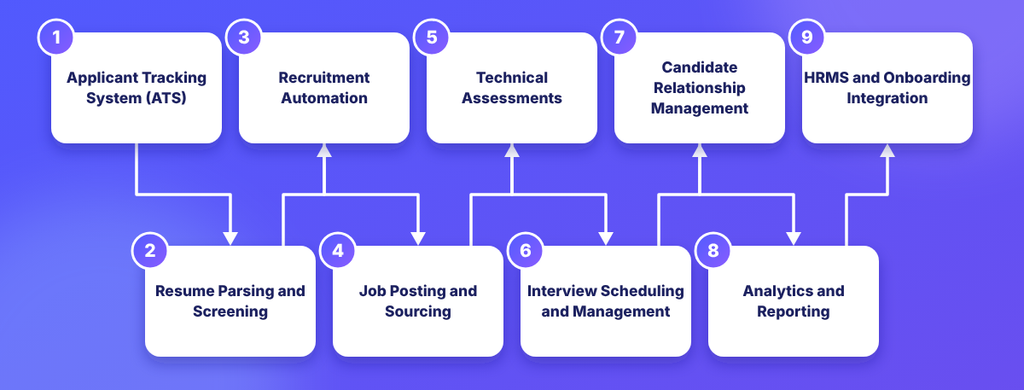
1. Applicant Tracking System (ATS)
An ATS stores resumes, candidate details, interview feedback and application status in one place. It helps recruiters track candidates through different hiring stages.
2. Resume Parsing and Candidate Screening
Resume parsing extracts skills, qualifications and experience from resumes. AI screening can help identify candidates with relevant technical skills, but recruiters should make the final selection.
3. Recruitment Automation
Look for automated application updates, interview reminders, feedback requests and offer generation to reduce repetitive work.
4. Job Posting and Candidate Sourcing
The software should support job posting across career pages, job portals and referral channels while tracking application sources.
5. Technical Assessments
Coding tests, online assessments and third-party integrations help evaluate developers, QA professionals and other technical candidates.
6. Interview Scheduling and Management
Calendar coordination, interview reminders and structured feedback help manage multiple interview rounds.
7. Candidate Relationship Management
Automated communication and talent pools help recruiters stay connected with applicants for future vacancies.
8. Recruitment Analytics and Reporting
Reports on time-to-hire, offer acceptance and hiring sources help identify delays and improve recruitment planning.
9. HRMS and Onboarding Integration
Connecting recruitment with Core HR and onboarding helps transfer candidate details into employee records after selection.
How to Choose the Best Recruitment Software for SaaS Companies?
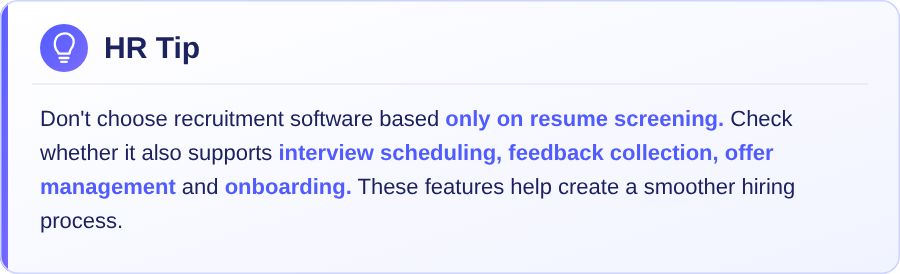
To choose the best recruitment software in India, compare its hiring features, automation, integrations, pricing, security and scalability. The platform should support your current hiring needs and adapt as your SaaS company grows.
Before making a decision, consider these seven factors:
1. Understand Your Hiring Requirements
Identify the roles you hire for, such as developers, product managers, sales executives and customer success specialists. Check whether the software supports different screening and interview processes.
2. Check Recruitment Automation
Look for automation in job posting, resume screening, interview scheduling, candidate updates and offer generation. This can reduce repetitive work for recruiters.
3. Evaluate ATS and Integrations
Check whether the platform tracks applications and connects with job portals, assessment tools, calendars, video meetings and your existing HRMS.
4. Consider Hiring Volume
Startups may need basic tracking, while growing and large SaaS companies may require multiple workflows, approval systems and advanced reporting.
5. Compare Pricing and Scalability
Review subscription costs, implementation fees, additional licences and integration charges. So always ensure the platform can support future growth.
6. Review Data Security
Check access controls, privacy policies and data protection practices for candidate information.
7. Check Support and Implementation
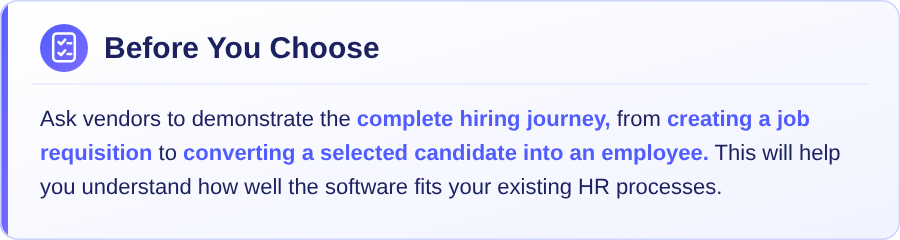
Ask about training, data migration and customer support then request a demo using your actual hiring process before making a decision.
What Are the Benefits of Having Cloud-Based Recruitment Software?
Cloud-based recruitment software allows authorized persons to access hiring information through an internet-connected system. This can be useful for SaaS companies where recruiters, hiring managers and interview panels may work from different locations.
Let’s see some important benefits of having cloud based recruitment management software as defined below:
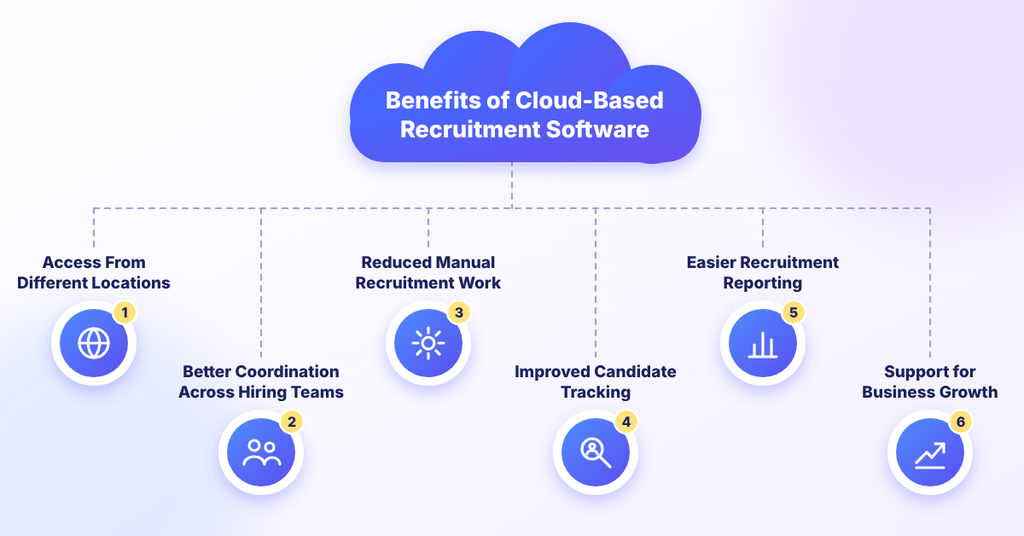
1. Access Recruitment Information from Different Locations
Recruiters and hiring managers can access candidate profiles, interview updates and recruitment progress without depending on a single office system. This can support hybrid and distributed hiring teams.
2. Better Coordination Between Recruiters and Managers
Cloud-based systems can provide shared candidate records, interview feedback and hiring updates. This helps recruiters and managers to work with the same information instead of exchanging multiple spreadsheets and email attachments.
3. Reduced Manual Recruitment Work
Automation can reduce repetitive tasks such as sending candidate updates, arranging interviews and moving applications through hiring stages. This allows recruiters to spend more time evaluating candidates and coordinating with hiring teams.
4. Improved Candidate Tracking
A central recruitment database helps HR teams to maintain candidate information and track application status. Recruiters can also search previous applicants when similar vacancies arise.
5. Easier Recruitment Reporting
Cloud-based recruitment platforms can provide dashboards and reports for hiring progress, recruiter activity, sourcing channels and vacancy status. These insights help businesses to find delays and review recruitment performance.
6. Support for Business Growth
As a SaaS company expands its teams or opens new locations, recruitment requirements may become more complex. A scalable cloud platform can help to manage additional vacancies, recruiters and hiring workflows, depending on its subscription and configuration.
Conclusion
Overall, choosing the right recruitment software in India can make hiring easier for SaaS companies as they grow. From sourcing candidates and screening resumes to scheduling interviews and managing offers, the right platform helps HR teams to organize each stage of recruitment.
However, the best choice depends on your hiring volume, team size, recruitment needs and existing HR processes. While some platforms focus mainly on applicant tracking, others connect recruitment with broader HR operations.

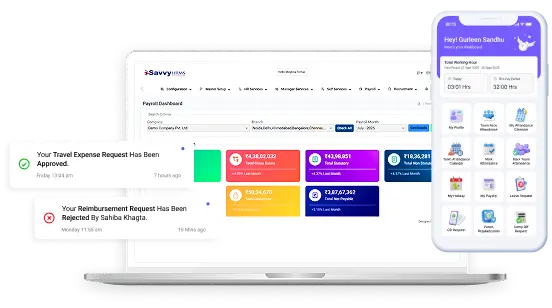


Want to Manage Recruitment and HR Operations in One Place?
Frequently Asked Questions
1. What Is the Best Recruitment Software in India for SaaS Companies?
The best recruitment software depends on a company’s hiring volume, recruitment process and HR requirements. Savvy HRMS, Keka, greytHR and Pocket HRMS offer recruitment capabilities connected with broader HR platforms, while Deel is relevant for international hiring, and Zoho Recruit offers a dedicated ATS. Naukri’s products are useful for sourcing candidates from the Indian job market.
2. Which Recruitment Software Is Best for SaaS Startups?
SaaS startups should look for software that supports job posting, candidate tracking, resume screening, interview scheduling and offer management. The right option depends on whether the startup needs a standalone ATS or wants recruitment connected with payroll, employee records and onboarding.
3. What Features Should Recruitment Software for SaaS Companies Include?
Recruitment software for SaaS companies should include applicant tracking, resume parsing, candidate screening, job posting, interview management, technical assessment support, recruitment automation and analytics. Integration with HRMS and onboarding tools is also useful for managing the transition from candidate to employee.
4. What Is the Difference Between ATS and Recruitment Management Software?
An ATS mainly manages candidate applications and tracks their progress through the hiring pipeline. Recruitment management software can cover a wider process, including manpower planning, job requisitions, sourcing, screening, interviews, offer management and onboarding.
5. How Much Does Recruitment Software Cost in India?
Recruitment software in India pricing varies by vendor, number of users, recruiter licences, active job openings, selected modules and implementation requirements. Some platforms offer free or entry-level plans, while enterprise solutions may require customized pricing. Always request a detailed quotation and check taxes, integrations and additional charges before subscribing.
6. Can Recruitment Software Automate Candidate Screening and Interview Scheduling?
Yes. Many recruitment platforms offer resume parsing, AI-assisted candidate matching, screening workflows and interview scheduling. The exact capabilities vary by vendor. Recruiters should review AI-generated recommendations and interview results before making hiring decisions.