Promotion Letter: Format, Samples, Templates and HR Guide for Indian Companies


-
AuthorRuchika Rajput
-
 Last Updated
November 16, 2026
-
 Reading Time
22 Mins
TL:DR
A promotion letter officially informs an employee about their new role and the changes that come with it. Here are the key points to understand:
- A promotion letter confirms the employee’s new designation, effective date, responsibilities and reporting manager.
- A good promotion letter format should include employee details, promotion terms, salary changes (if applicable) and an authorized signature.
- HR can use different promotion letter samples depending on whether the employee receives a salary increase, moves to a managerial role or changes departments.
- A promotion does not always come with a salary increment as both decisions should be communicated clearly.
- Employees can write a promotion request letter to express their interest in a higher position.
- Managers can use a promotion recommendation letter to support an employee’s promotion.
- After issuing the letter, HR should update employee records, payroll details and reporting structures.
- HRMS software can help HR teams to manage employee information and keep promotion-related records organized.
A promotion is an important step in an employee’s career, but communicating that decision requires more than simply changing their designation. HR must clearly explain the new role, effective date, responsibilities, reporting structure and any changes to compensation. A well-written promotion letter gives the employee a formal record of this decision and helps managers, HR and payroll teams to stay aligned.
For Indian companies, the letter should also reflect the organization’s promotion policy, approval process and applicable employment terms. Whether you are promoting an employee after a performance appraisal, moving them into a managerial position or recognising their contribution without a salary revision, the communication should be clear and specific.
In this guide, we cover how to write an employee promotion letter, what details to include, ready-to-use formats and samples, and what HR can do before and after issuing the promotion letter.
What Is a Promotion Letter?
A promotion letter is an official written communication issued by an employer to inform an employee that they have been moved to a higher position, designation or organizational grade. The document confirms the promotion decision and records important details such as the new role, effective date, responsibilities, reporting manager and revised compensation, if applicable.
A promotion letter may be issued in different situations, including:
- Performance-based promotion: When an employee consistently meets or exceeds performance expectations and demonstrates readiness for a higher role.
- Internal career progression: When an employee moves to the next level within the same department or function.
- Managerial promotion: When an employee takes on team management, leadership or decision-making responsibilities.
- Role or grade advancement: When an employee moves to a higher organizational grade or job level.
- Organizational restructuring: When a revised salary structure creates new positions or changes existing reporting levels.
Why Is a Promotion Letter Important for Employers and Employees?
A promotion letter provides written confirmation of a role change and ensures that everyone involved understands what has changed. It is useful for both the organization and the employee because it records the decision and sets expectations for the new position.
For Employers and HR Teams
- Keeps a formal record of the employee’s promotion, new designation and effective date.
- Helps to communicate the employee’s new responsibilities and role expectations.
- Makes it easier to coordinate salary revisions with the payroll management team, if applicable.
- Helps HR to keep employee details, designations and reporting structures up to date.
- Provides a record of internal movements that can support workforce planning and succession planning.
For Employees
- Gives them formal recognition for their contributions and career growth.
- Clearly explains their new designation, responsibilities and reporting manager.
- Confirms any salary revision or clarifies whether their compensation remains unchanged.
- Provides a written record they can refer to whenever they need details about their new role.
A promotion should not leave employees guessing about what changes from the effective date but the letter should make the decision and its practical implications easy to understand.
3. What Should Be Included in a Promotion Letter?
A professional employee promotion letter should have enough information to explain the change without making the document unnecessarily lengthy. HR should check that the details are accurate and consistent with the approved promotion decision.
Below are the essential elements to include:
| Element | What HR should mention |
| Company details | Company name, address and official contact details |
| Letter date | Date on which the promotion letter is issued |
| Employee details | Employee name, ID, department and current designation |
| Promotion details | New designation, grade or position |
| Effective date | Date from which the promotion takes effect |
| Responsibilities | Key changes in duties or role expectations |
| Reporting structure | New reporting manager or department, if applicable |
| Compensation | Revised salary or CTC details, if applicable |
| Employment terms | Any other approved changes to employment terms |
| Authorization | Name, designation and signature of the authorized signatory |
How Should HR Mention Salary Changes in a Promotion Letter?
If the promotion includes a salary revision, the letter should clearly state the revised compensation and the date from which it applies. Avoid using a broad statement such as “your salary will be revised” without specifying the approved details or explaining where the employee can find them.
Depending on the company’s compensation communication policy, HR may include:
- Revised annual CTC.
- Revised fixed and variable compensation.
- Applicable allowances or other salary components.
- Effective date of the revised compensation.
- Reference to an attached compensation annexure, if the complete breakdown is shared separately.
For Example:
“With effect from 1 December 2026, your annual Cost to Company (CTC) will be revised to ₹12,00,000. The detailed compensation structure is provided in the attached annexure.”
Remember that CTC is not the same as monthly take-home salary. It may include employer contributions, benefits and other components. If employees need to understand the impact on their monthly salary, HR should provide an appropriate compensation breakdown rather than implying that the full CTC will be paid as take-home pay.
If the promotion does not include a salary revision, state that clearly. Otherwise, this creates an expectation of an immediate increment.
Promotion Letter Format for Private Companies in India
Private companies can use a simple, professional promotion letter format that confirms the role change and records the approved terms. The format does not need to be complicated, but it should include the information the employee and relevant HR teams need.
You can adapt the following promotion letter format for different departments, designations, and promotion policies.
Standard Promotion Letter Format
Here’s a professional promotion letter format that HR teams can customise to suit different employee roles and designations.
[Company Name]
[Company Address]
[City, State, PIN Code]
Date: [DD/MM/YYYY]
To,
[Employee Name]
[Employee ID]
[Department Name]
[Company Name]
Subject: Promotion to [New Designation]
Dear [Employee Name],
We are pleased to inform you that, in recognition of your contributions and performance, you have been promoted from [Current Designation] to [New Designation], effective [Effective Date].
In your new position, you will be responsible for [briefly mention key responsibilities or refer to the updated job description]. You will report to [Reporting Manager’s Name/Designation], effective from the date mentioned above.
Compensation details:
[Include the revised annual CTC or salary details, if applicable. If the compensation structure is shared separately, refer to the attached annexure.]
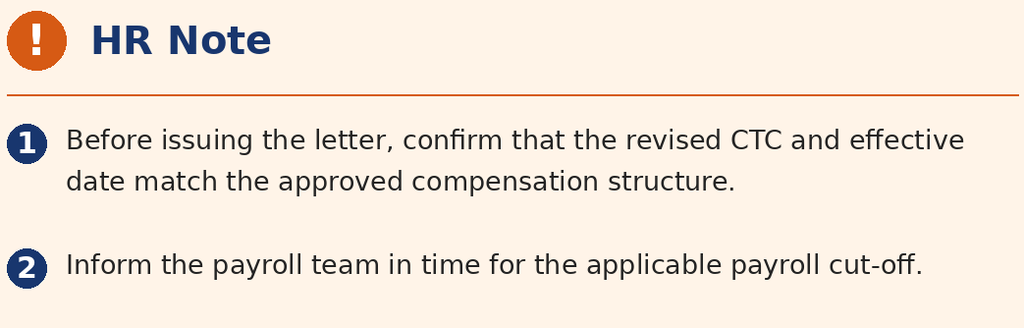
All other terms and conditions of your employment will remain unchanged unless specifically revised and communicated in writing.
We appreciate your contribution to [Company Name] and look forward to your continued growth and success in this new role.
Congratulations on your promotion.
Regards,
[Authorised Signatory’s Name]
[Designation]
[Company Name]
Employee acknowledgement, if required:
I acknowledge receipt of this promotion letter.
Employee Name: ____________________
Signature: ____________________
Date: ____________________
What Should HR Check Before Sending the Promotion Letter?
Before issuing the letter, HR should verify the following details:
- The employee’s name, ID, department and current designation are correct.
- The new designation matches the approved role and organizational structure.
- The promotion effective date has been confirmed.
- Any salary revision has been approved and checked with payroll.
- The new reporting manager and responsibilities are accurate.
- The letter has been reviewed and signed by an authorized person.
- Any required annexure or updated job description is attached.
The employee acknowledgement section should be included only when required by the organization’s process or policy.
Promotion Letter Samples for Different Employee Scenarios
Not every promotion is the same as an employee may receive a salary increase, move into a managerial position or take on a new role in another department. The promotion letter should reflect these changes so the employee clearly understands what their new position involves.
Let’s see five promotion letter samples that HR teams can use as a reference and adapt to their organization’s requirements.
1. Promotion Letter Sample with Salary Increment
Use this format when an employee’s promotion includes a change in designation along with a salary revision.
Subject: Promotion to [New Designation]
Dear [Employee Name],
We are pleased to inform you that you have been promoted from [Current Designation] to [New Designation], effective [Effective Date]. This decision recognises your hard work, consistent performance and contributions to the organization.
In your new role, you will be responsible for [mention key responsibilities]. You will report to [Reporting Manager’s Name/Designation].
Along with this promotion, your annual CTC will be revised to ₹[Revised CTC], effective from [Date]. Please refer to the attached compensation details for a breakdown of your revised salary.
We appreciate your efforts and look forward to seeing you take on this new responsibility.
Congratulations on your promotion!
Regards,
[authorized Signatory]
[Designation]
[Company Name]
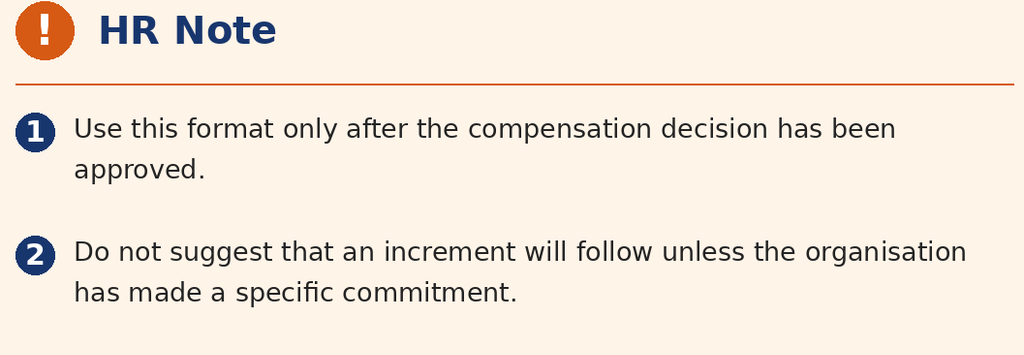
2. Promotion Letter Sample Without Salary Increment
Sometimes, an employee may receive a higher designation or additional responsibilities without an immediate salary increase. In such cases, HR should clearly explain the compensation decision to avoid confusion.
Subject: Promotion to [New Designation]
Dear [Employee Name],
We are pleased to inform you that you have been promoted from [Current Designation] to [New Designation], effective [Effective Date].
Your performance, dedication and contributions have played an important role in this decision. In your new position, you will be responsible for [mention key responsibilities] and will report to [Reporting Manager’s Name/Designation].
Please note that your current compensation will remain unchanged as part of this promotion. Any future salary revision, if applicable, will be communicated separately after the required review and approval.
We appreciate your continued commitment and wish you success in your new role.
Regards,
[authorized Signatory]
[Designation]
[Company Name]
3. Promotion Letter Sample for a Managerial Position
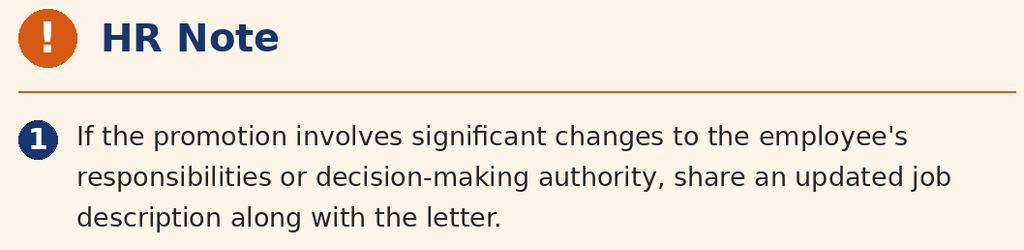
When an employee is promoted to a managerial position, the letter should explain their new leadership responsibilities, team structure and reporting arrangements.
Subject: Promotion to [Managerial Designation]
Dear [Employee Name],
We are pleased to inform you that you have been promoted from [Current Designation] to [New Managerial Designation], effective [Effective Date].
In this role, you will lead the [Team/Department Name], coordinate team activities, monitor performance and work towards achieving departmental goals. You will report to [Senior Manager/Department Head].
Your revised compensation details, where applicable, are provided below:
- Revised annual CTC: ₹[Amount]
- Effective date: [Date]
- Compensation details: [Attached/Shared Separately]
We are confident that your experience and skills will help you manage these responsibilities effectively. We look forward to your contribution and leadership in this new role.
Congratulations on your promotion!
Regards,
[authorized Signatory]
[Designation]
[Company Name]
4. Promotion Letter Sample for an Internal Department Move
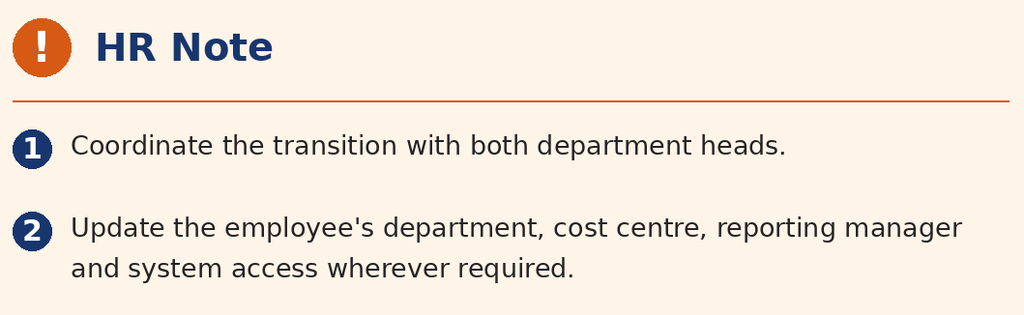
This format is useful when an employee is promoted to a higher position in a different department. The letter should mention the new designation, department, responsibilities and reporting manager.
Subject: Promotion and Department Change to [New Designation]
Dear [Employee Name],
We are pleased to inform you that you have been promoted from [Current Designation] in the [Current Department] to [New Designation] in the [New Department], effective [Effective Date].
In your new role, you will be responsible for [mention key responsibilities]. You will report to [New Reporting Manager’s Name/Designation].
Your compensation will [remain unchanged/be revised to ₹Amount], effective from [Date]. Any other changes to your employment terms will be communicated separately, where applicable.
We appreciate your contributions to the organization and look forward to your continued growth in your new role.
Regards,
[authorized Signatory]
[Designation]
[Company Name]
5. Promotion Letter Sample After Performance Appraisal
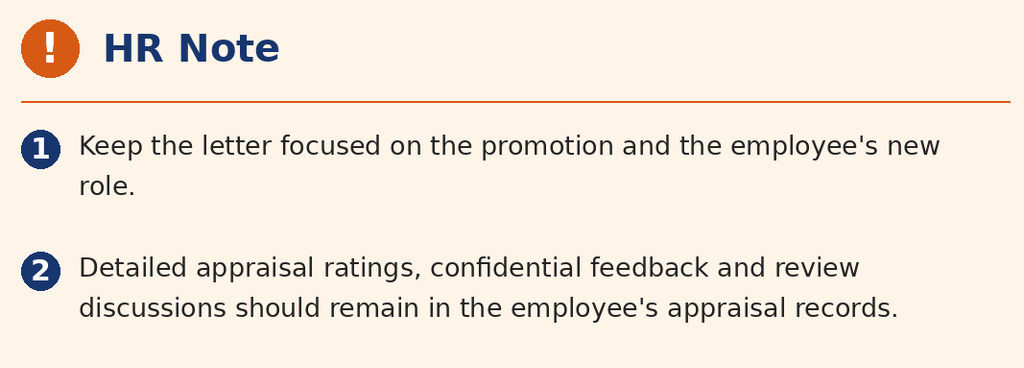
When a promotion follows a performance appraisal, the letter can briefly acknowledge the employee’s achievements and explain the new role.
Subject: Promotion Following Performance Review
Dear [Employee Name],
Following your recent performance review, we are pleased to inform you that you have been promoted from [Current Designation] to [New Designation], effective [Effective Date].
Your contributions to [mention relevant project, function or business area] and your skills in [mention relevant skills] have been valuable to the organization and have contributed to this decision.
In your new position, you will be responsible for [mention new responsibilities] and will report to [Reporting Manager’s Name/Designation].
[Include the revised compensation details, if applicable. If there is no salary revision, clearly mention that the current compensation will remain unchanged.]
Thank you for your continued efforts and commitment. We wish you all the best as you take on this new responsibility.
Regards,
[authorized Signatory]
[Designation]
[Company Name]
How to Write a Promotion Letter?
Writing a promotion letter requires clear communication about the employee’s new position, responsibilities and any changes to their employment terms. HR team should ensure that all details are approved and accurate before issuing the letter.
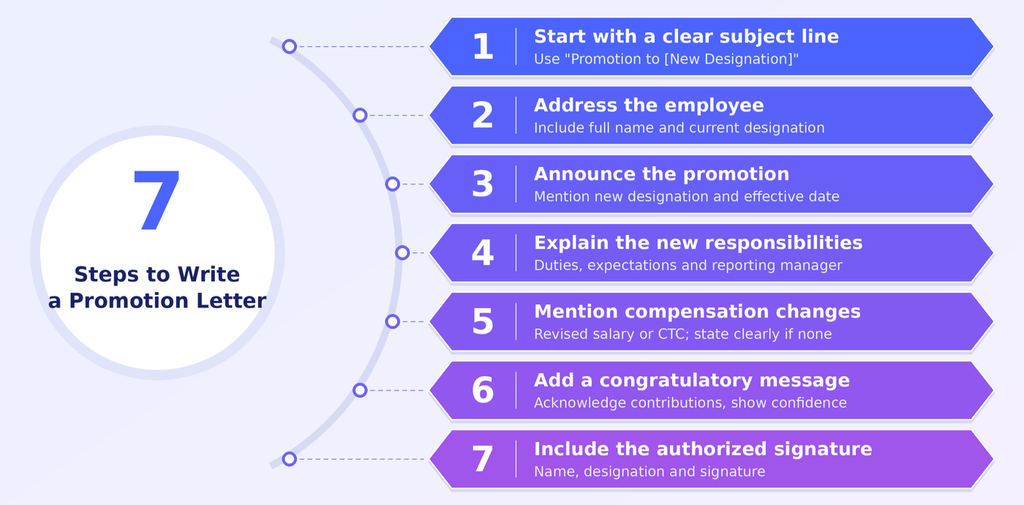
Follow these steps to prepare a professional promotion letter:
- Start with a clear subject line: Use a subject such as “Promotion to [New Designation]” so the purpose of the letter is immediately clear.
- Address the employee: Include the employee’s full name and current designation.
- Announce the promotion: Clearly mention the new designation and the effective date of the promotion.
- Explain the new responsibilities: Briefly describe the employee’s updated duties, role expectations and reporting manager.
- Mention compensation changes: Include the revised salary or CTC, if applicable. If there is no salary revision, communicate that clearly.
- Add a congratulatory message: Acknowledge the employee’s contributions and express confidence in their new role.
- Include the authorized signature: Add the name, designation and signature of the authorized person.
Before sending the letter, verify all details with the concerned manager and payroll team as this helps to avoid confusion about the employee’s designation, salary or effective date.
How to Write a Promotion Request Letter?
A promotion request letter is written by an employee who wants their manager or HR team to consider them for a higher position. Unlike an employer-issued promotion letter, it does not confirm a promotion. It formally communicates the employee’s interest in career progression.
An employee should focus on their achievements, responsibilities and readiness for the proposed role rather than simply requesting a higher designation.
What Should a Promotion Request Letter Include?
A well-structured request should mention:
- Employee’s current designation and department.
- Position or designation they want to be considered for.
- Relevant achievements and contributions.
- Additional responsibilities they have handled.
- Skills or experience that support their request.
- A polite request for a discussion or review.
Promotion Request Letter Format
Subject: Request for Consideration for Promotion
Dear [Manager’s Name],
I am writing to formally request consideration for promotion from [Current Designation] to [Desired Designation].
During my time with the organization, I have contributed to [mention key projects, responsibilities or achievements]. I have also developed skills in [mention relevant skills] that I believe align with the requirements of the proposed role.
Over time, I have taken on additional responsibilities such as [mention examples, if applicable]. I would appreciate the opportunity to discuss my career progression and understand whether I may be considered for this position.
Thank you for your time and consideration.
Regards,
[Employee Name]
[Current Designation]
[Department]
Promotion Letter vs Increment Letter: What Is the Difference?
A promotion letter and an increment letter are not the same. A promotion confirms a change in designation, level or role, while a salary increment letter communicates a salary increase. An employee may receive one without receiving the other.
| Basis | Promotion Letter | Increment Letter |
| Purpose | Confirms movement to a higher role or level | Confirms a salary increase |
| Designation | Usually changes | May remain the same |
| Responsibilities | May increase or change | Usually remain unchanged |
| Salary | May or may not increase | Increases |
| Career progression | Reflects a role or level change | Reflects a compensation revision |
| Reporting structure | May change | Usually remains the same |
Can an Employee Get a Promotion Without an Increment?
Yes. An organization may promote an employee to a higher designation or grade without changing their compensation at that time. The decision should be approved and communicated clearly.
Can an Employee Get an Increment Without a Promotion?
Yes. Employees may receive a salary increment during an annual appraisal or compensation review without changing their designation or responsibilities.
HR should issue the correct communication so that the employee understands whether the organization has approved a role change, a salary revision or both.
Promotion Recommendation Letter Format and Example
A promotion recommendation letter is written by a manager, team lead or department head to recommend an employee for a higher position. It provides HR or management with a documented justification for considering the promotion.
Unlike a promotion letter, a recommendation letter does not confirm the final decision. The promotion is subject to the organization’s approval process.
What Should a Promotion Recommendation Letter Include?
A manager should cover:
- Employee’s name, current designation and department
- Proposed designation or position
- Performance and significant contributions
- Skills and competencies relevant to the new role
- Examples of additional responsibilities handled
- Reasons the employee is ready for the promotion
- Clear recommendation and approval request
Promotion Recommendation Letter Sample
Subject: Recommendation for Employee Promotion
Dear [HR Manager/Management Team],
I would like to recommend [Employee Name], currently working as [Current Designation] in the [Department Name], for promotion to [Proposed Designation].
During their tenure, [Employee Name] has consistently demonstrated strong performance, accountability and the ability to manage responsibilities effectively.
Their contributions to [mention relevant projects or achievements], along with their capabilities in [mention relevant skills], demonstrate readiness to take on additional responsibilities.
Based on their performance and suitability for the proposed role, I recommend considering [Employee Name] for this promotion, subject to the organization’s applicable eligibility criteria and approval process.
Please let me know if any further information is required.
Regards,
[Manager Name]
[Designation]
[Department]
| HR tip: A recommendation should be supported by relevant examples and role requirements. Avoid relying only on general statements such as “hardworking” or “deserves a promotion.” |
What Should HR Consider Before Promoting an Employee?
A promotion decision should consider more than an employee’s current performance. HR and managers should assess whether the employee is ready for the responsibilities and expectations of the next position.
Let’s discuss some factors to review before approving a promotion.
1. Performance History and Contributions
Review the employee’s performance over an appropriate period rather than depending on one successful project or recent achievement.
Consider:
- Consistency in meeting goals and deadlines.
- Quality of work.
- Contribution to team or business objectives.
- Ability to handle complex assignments.
- Feedback from managers and relevant stakeholders.
2. Skills Required for the Next Role
An employee may perform very well in their current role but still need additional skills to succeed in a higher position.
For example, a high-performing individual contributor may need communication, delegation, planning and conflict-resolution skills before moving into a people-management role.
Compare the employee’s existing capabilities with the requirements of the proposed position.
3. Readiness for Additional Responsibilities
Assess whether the employee can handle the scope and accountability of the new role.
For a managerial position, this may include team management, resource planning, decision-making and performance monitoring. For a technical position, it may involve architecture decisions, mentoring or ownership of complex projects.
4. Eligibility Under Company Policy
Check the organization’s promotion policy for applicable criteria, such as:
- Minimum time in the current role.
- Performance appraisal requirements.
- Required skills or qualifications.
- Disciplinary or conduct considerations, where relevant under policy.
- Approval requirements.
- Availability of an approved position.
Eligibility rules should be applied consistently and in line with applicable employment terms.
5. Business Requirements and Role Availability
A promotion should also align with the organization’s workforce requirements. Check whether the new position exists in the approved structure, whether the department needs the role and whether the reporting hierarchy is clear.
6. Budget and Compensation Approval
If the promotion includes a salary revision, then confirm that the proposed compensation is within the approved budget and salary structure.
HR should coordinate with finance and management before communicating any compensation commitment to the employee.
What Should HR Do After Issuing a Promotion Letter?
Issuing the promotion letter does not complete the process as HR must ensure that the approved changes are reflected across employee records, payroll, reporting structures and relevant business systems.
Use the following checklist after the letter has been shared.
1. Update the Employee’s Records
Change the employee’s designation, grade, department and other relevant information in the HR database. Always keep the previous designation and effective date as part of the employee’s employment history.
2. Coordinate with Payroll
If the promotion includes a salary revision then share the approved compensation details and effective date with payroll. Check the applicable payroll cut-off and ensure that the revised structure is processed correctly.
3. Update the Reporting Structure
If the employee moves to a different manager or department then update the organizational hierarchy and notify the relevant stakeholders.
4. Review Access and Responsibilities
A new position may require different system permissions, approval authority or access to business information. Coordinate with IT and relevant department heads to make the necessary changes.
5. Share the Updated Job Description
Where the role has changed, provide the employee with an updated job description or responsibility document. This helps both the employee and manager to understand the expectations of the new position.
6. Store the Promotion Documentation
Keep the final promotion letter, approvals and any compensation annexures in the appropriate employee record. Limit access to authorized personnel, particularly where the documents contain salary information.
7. Schedule a Follow-up Discussion
A follow-up meeting with the employee and manager can help identify any training needs, role-related questions or transition challenges.
How HRMS Software Helps Manage Employee Promotions
Managing promotions via emails, spreadsheets and different employee files can become difficult for organization when grows. So, HR teams may need to coordinate approvals, update employee details, inform payroll and maintain promotion records across multiple departments.
An HRMS can help to connect these activities by maintaining employee information and supporting related HR workflows. Depending on the platform and modules selected, it may help HR teams to:
- Maintain employee records
- Manage promotion workflows
- Coordinate payroll changes
- Maintain reporting structures
- Store employee documents
- Support performance reviews
For example, when an employee is promoted from Senior Executive to Assistant Manager, HR may need to update the designation, reporting manager, compensation structure and employee records.
A connected HRMS can help to reduce repeated data entry and keep these changes organized.
Conclusion
Overall, A promotion letter is more than a formal announcement of a new designation. It records an important employment decision and helps employees to understand their new responsibilities, reporting arrangements and compensation details, where applicable.
For HR teams, the process should begin with a fair assessment and the required approvals. The letter should then communicate the decision clearly, using accurate employee and role details. After issuing it, HR should update employee records, payroll and reporting structures so that the promotion is reflected across the organization.
Using a consistent format and a documented process can make employee promotions easier to manage while reducing avoidable communication and record-keeping errors.



Make Employee Promotion Management Easier with Savvy HRMS
FAQs About Promotion Letters
1. How do I write a promotion letter for an employee in India?
Start with the company and employee details, followed by the current and new designation, promotion effective date, responsibilities and reporting manager. Include revised compensation details if applicable, obtain the required approval and issue the letter through an authorized signatory.
2. What should a promotion letter include to make it formal and legally clear?
It should include the employee’s name and designation, new role, effective date, responsibilities, reporting structure and approved compensation changes, if any. It should also clarify whether other employment terms remain unchanged or whether specific terms are being revised.
3. Can you share a promotion letter format for a private company?
Yes. A private company can use a format containing the company details, employee information, current and new designation, effective date, role responsibilities, compensation details where applicable and an authorized signature. The format should be adapted to the company’s policies and employment terms.
4. Is a salary increment mandatory with a promotion?
Not necessarily. A promotion may involve a higher designation or additional responsibilities without an immediate salary revision. The organization should communicate the compensation decision clearly and ensure that any changes comply with applicable employment terms and legal requirements.
5. What is the difference between a promotion letter and an increment letter?
A promotion letter confirms an employee’s move to a higher designation, grade or role. An increment letter confirms a salary increase. A promotion may or may not include an increment, while an increment does not necessarily involve a change in designation.
6. Can an employee request a promotion in writing?
Yes. An employee can submit a promotion request letter to their manager or HR team. It should explain their current role, desired position, relevant achievements, additional responsibilities and reasons they believe they are ready for the next level.
7. Who can issue or approve an employee promotion letter?
The approval process depends on the organization’s HR policy and authority structure. A manager or department head may recommend a promotion, while HR, senior management or another authorized person may review and approve it. The final letter should be issued by an authorized signatory.
8. What should HR do after issuing a promotion letter?
HR should update the employee’s designation and records, inform payroll about approved compensation changes, revise reporting structures, review system access, share the updated job description where needed and store the promotion letter and approvals in the employee’s records.