

HR Portal: How It Simplifies Leave, Attendance & Payroll Management


-
AuthorRuchika Rajput
-
 Last Updated
September 26, 2026
Last Updated
September 26, 2026
-
 Reading Time
16 Mins
Reading Time
16 Mins
TL;DR:
- An HR portal centralizes leave, attendance, and payroll so data flows automatically between them, instead of being tracked in separate spreadsheets.
- It simplifies leave approvals, biometric/app-based attendance tracking, and automated salary + statutory deduction (PF, ESI, Professional Tax, TDS) calculations.
- Employers benefit from fewer payroll errors, faster HR processing, and stronger audit readiness; employees get self-service access to leave, attendance, and payslips.
- Choosing the right portal depends on compliance coverage, multi-state support, self-service quality, and integration capability, not price alone.
- Common implementation mistakes include poor data migration, skipping employee training, and misconfigured state-specific compliance rules.
- It aligns with India’s shift toward mandatory digital labour compliance, including the EPF Scheme, 2026, and the Ministry of Labour’s Shram Suvidha Portal.
Most HR teams don’t set out to run leave, attendance, and payroll as three separate systems; it just ends up that way as headcount grows. A leave tracker in one spreadsheet, an attendance register in another, and a payroll calculation sheet that tries to reconcile both at month-end. An HR portal exists specifically to close that gap, connecting these functions so information entered once flows through automatically instead of being re-entered and cross-checked by hand at every stage.
India’s labour compliance landscape has grown more digital-first than ever. The Ministry of Labour and Employment’s own Shram Suvidha Portal already brings together return filing and inspection reporting for more than 44 labour laws under one platform, and the newly notified EPF Scheme, 2026 has made electronic filing, digital KYC, and online contribution reporting mandatory for employers rather than optional. In this environment, businesses that still run leave, attendance, and payroll through spreadsheets aren’t just working harder than they need to; they are increasingly out of step with how compliance itself is being enforced.
This guide breaks down what an HR portal actually does, how it simplifies each of these three functions, and what to look for before you invest in one.
What Is an HR Portal?
An HR portal is a software platform, usually cloud-based, that centralizes core HR functions such as employee records, leave requests, attendance tracking, payroll processing, and compliance reporting into a single system accessible by HR teams, managers, and employees.
Instead of HR maintaining separate attendance registers, leave trackers, and payroll spreadsheets that all need to be manually reconciled every month, an HR portal connects these functions so that data flows automatically between them. When an employee’s attendance is marked, it reflects in their leave balance. When leave and attendance are finalized, payroll picks them up automatically for salary calculation.
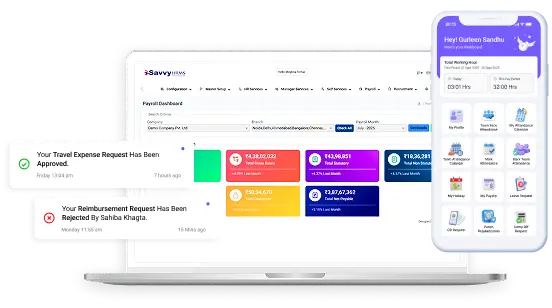
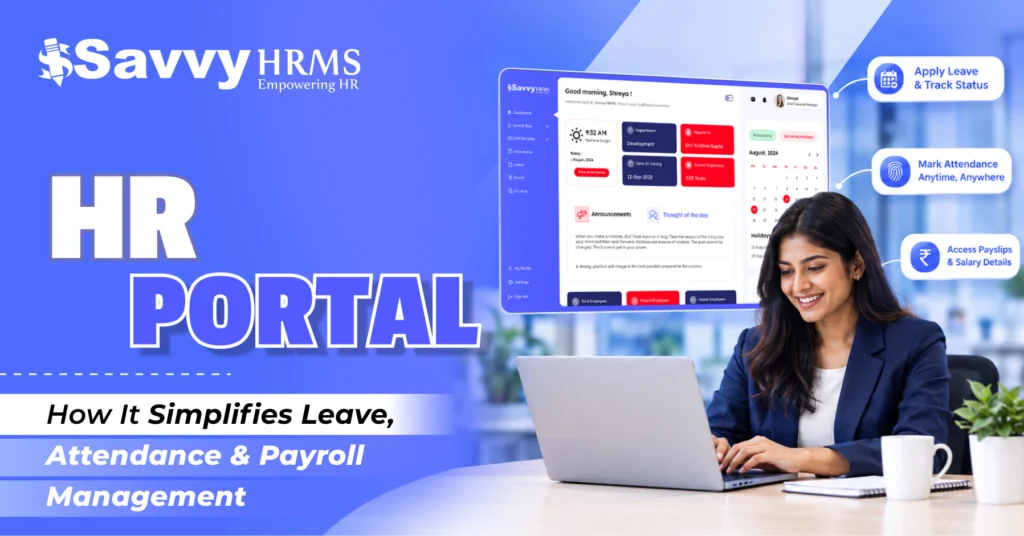
Most modern HR portals also include an employee self-service (ESS) component, where employees can apply for leave, check attendance, view payslips, and update personal details without routing every request through HR.
Why Do Businesses Need an HR Portal for Leave, Attendance & Payroll?
As a company grows past a handful of employees, manual HR management stops scaling. A few realities make this especially true in India:
- Compliance keeps getting more digital, not less. The EPF Scheme, 2026 requires employers to electronically report new joiners, exits, monthly contributions, and ownership changes, and to maintain employment records in digital form wherever applicable, according to the Ministry of Labour and Employment’s own notification. Manual, paper-based HR processes are increasingly incompatible with these requirements.
- Multiple statutory thresholds must be tracked simultaneously. PF, ESI, Professional Tax, and TDS each have different eligibility criteria, wage ceilings, and filing timelines. ESIC’s own contribution structure, for instance, applies differently depending on whether an employee’s wages fall under the prescribed threshold. Tracking this manually across a growing workforce is error-prone.
- Late or incorrect filings carry real penalties. Under the EPF Scheme, 2026, delayed filing of statutory returns attracts a late fee, in addition to graded damages for delayed payments, a cost that scales with the size of the delay and the organization.
- Leave and attendance directly affect payroll accuracy. Any gap between recorded attendance and actual salary calculation shows up as either an overpayment or an underpayment, both of which create disputes and rework.
In our evaluation of businesses transitioning away from spreadsheet-based HR, the trigger point is rarely a single crisis; it’s usually the slow accumulation of reconciliation errors, missed leave approvals, and last-minute payroll corrections that eventually cost more HR hours than the switch to a portal would have.
There’s also a growing workforce-scale argument for digital HR infrastructure. The government’s own National Career Service (NCS) portal, a Ministry of Labour and Employment initiative, connects employers to a jobseeker base running into crores, which reflects how much of India’s hiring and workforce management activity has already shifted online. Employers sourcing talent through digital channels but still onboarding, tracking, and paying that talent through spreadsheets are left with a disconnect between how people are hired and how they’re managed once they join.
The Cost of Delaying an HR Portal
Businesses often underestimate what manual HR management actually costs, because the cost is distributed across many small inefficiencies rather than one visible expense:
1. HR Staff Time
Every payroll cycle, HR teams lose valuable hours consolidating attendance registers, chasing pending leave approvals across departments, and manually recalculating deductions- time that could otherwise go toward strategic workforce planning instead of repetitive data entry.
2. Compliance Exposure
Applying outdated PF, ESI, or Professional Tax rates creates real compliance risk, since these statutory rules are revised frequently. Manual tracking makes it easy to miss updates, leaving businesses exposed to incorrect deductions and potential penalties.
3. Late Fees and Damages
Under the EPF Scheme, 2026, delayed filing of statutory returns attracts a fixed late fee per day, along with a graded damages structure for delayed contribution payments- costs that automated, timely processing makes entirely avoidable.
4. Employee Trust Erosion
Repeated payslip errors or delayed leave approvals quietly erode employee trust over time. This dissatisfaction rarely surfaces as direct complaints, but shows up indirectly through lower engagement, higher attrition, and reduced confidence in HR processes.
None of these costs appear as a single line item, which is exactly why they tend to be underestimated until a business actually compares its manual process against an automated one.
How Does an HR Portal Simplify Leave Management?
Leave management is often the first place manual HR processes break down, especially once a company has multiple departments, shift patterns, or leave policies.
An HR portal simplifies this by:
1. Automated Leave Balance Calculations
Leave balances update automatically based on configured policies, casual, sick, or earned leave, giving employees and managers accurate, real-time visibility without manual tracking or spreadsheet cross-checking at any point.
2. Automatic Approval Routing
Leave requests route automatically to the correct manager based on the organization’s reporting structure, eliminating email chains and physical forms while ensuring approvals happen faster and consistently across departments.
3. Policy Violation Flagging
The system flags policy violations instantly, such as requests exceeding available balance or falling within blackout periods, before approval, preventing errors that would otherwise surface only during payroll processing.
4. Leave-to-Payroll Syncing
Approved leave syncs directly with attendance and payroll, so Loss of Pay calculations happen automatically. This removes the manual cross-checking that generally causes salary discrepancies at month-end.
5. Leave Audit Trail
Every leave request and approval is logged automatically, creating a reliable audit trail. This supports internal HR queries and demonstrates consistent, policy-driven decision-making during compliance audits.
For companies with employees across multiple states, this also matters because leave entitlements and public holidays vary regionally, something a portal can handle through location-based policy configuration, but a shared spreadsheet generally cannot.
Leave Types an HR Portal Typically Manages
Most Indian organizations configure several leave categories within a portal, including:
- Casual Leave (CL)
- Sick Leave (SL)
- Earned/Privilege Leave (EL/PL)
- Maternity and Paternity Leave, in line with applicable statutory entitlements
- Compensatory Off (Comp-Off) for overtime or weekend work
- Loss of Pay (LOP), applied automatically when leave balance is exhausted
Configuring these correctly at setup, including carry-forward rules, encashment policies, and probation-period restrictions, is what allows the portal to calculate leave-linked payroll adjustments without manual intervention later.
How Does an HR Portal Simplify Attendance Management?
Attendance is the operational backbone of both leave and payroll, which is why inaccurate attendance tracking tends to create downstream errors in both.
An HR portal generally simplifies attendance through:
- Biometric, geo-tagged, or app-based check-ins, reducing manual entry and buddy-punching (one employee marking attendance for another).
- Real-time attendance dashboards, giving HR and managers visibility into who’s present, on leave, or absent without needing to consolidate multiple registers.
- Shift and roster management, especially useful for organizations with rotational shifts, field employees, or multi-location teams.
- Automatic overtime and late-arrival tracking, calculated against configured policy rules rather than manually reviewed.
- Direct integration with payroll, so attendance data doesn’t need to be re-entered or reconciled separately before salary processing.
In our evaluation of attendance-related payroll disputes across client onboarding conversations, a large share traces back to manual attendance registers that were updated inconsistently, not to actual policy disagreements. Automating capture at the source removes most of this friction.
Attendance Methods Commonly Used in HR Portals
- Biometric devices (fingerprint or facial recognition), best suited for office-based or factory environments.
- Mobile app with geo-tagging, useful for field employees, sales teams, or hybrid workforces, allowing check-ins to be verified by location.
- Web-based punch-in/out, for fully remote or desk-based teams.
- Card/RFID-based system, common in larger manufacturing or industrial setups.
The right method depends on workforce structure more than on the software itself; a portal that supports multiple attendance capture methods simultaneously tends to serve mixed workforces (e.g., office staff plus field sales) far better than one built around a single method.
How Does an HR Portal Simplify Payroll Management?
Payroll is where leave and attendance data ultimately converge, and it’s also where compliance risk is highest. An HR portal simplifies payroll by:
- Auto-calculating gross and net salary using finalized attendance, leave, and LOP data, removing manual spreadsheet formulas that are prone to copy-paste errors.
- Applying statutory deductions automatically– PF, ESI, Professional Tax, and TDS- based on configured, regularly updated rules, rather than requiring HR to manually track every rate change.
- Keeping pace with regulatory updates. For example, salary TDS for payments made from April 2026 onward falls under the Income Tax Act, 2025, with the salary withholding provision under Section 392(1), per the Income Tax Department. A portal with updated compliance logic reflects this automatically; a spreadsheet does not.
- Generating digital payslips and reports without manual formatting for every employee, every cycle.
- Supporting multi-state payroll, where Professional Tax rates, labour welfare requirements, and filing deadlines differ by location.
- Creating a built-in audit trail: every change to salary structure, deduction, or approval is logged, which helps significantly during statutory audits or inspections.
This is also where the EPF Scheme, 2026’s digital-first compliance requirements become most relevant: employers are now expected to facilitate UAN generation, maintain digital employment records, and provide records electronically during inspections. An HR portal with payroll built in is largely designed around exactly this kind of requirement; a manual system has to be retrofitted to meet it.
Why Statutory Wage Thresholds Matter for Payroll Automation
Several statutory obligations in India depend on wage thresholds that must be checked for every employee, every cycle, not just once at onboarding:
- The EPF wage ceiling has remained at ₹15,000 per month since 2014, meaning contribution applicability needs to be checked against this figure consistently as salaries change.
- ESI eligibility applies up to a specified monthly wage threshold, with a higher threshold for persons with disabilities, per ESIC’s published rules.
- Professional Tax slabs vary by state, meaning the same salary figure can trigger different deduction amounts depending purely on the employee’s work location.
Manually checking every employee against these thresholds each month is exactly the kind of repetitive, rule-based task an HR portal is built to automate, and exactly the kind of task where manual processes are most likely to introduce errors as headcount grows.
Key Features to Look for in an HR Portal
Not every HR portal offers the same depth of functionality. Here’s what to prioritize:
| Feature | Why It Matters |
| Employee self-service (ESS) | Reduces HR’s manual workload for routine requests |
| Biometric/app-based attendance | Improves accuracy, reduces proxy attendance |
| Configurable leave policies | Supports multiple leave types, locations, and teams |
| Automated statutory compliance (PF, ESI, PT, TDS) | Keeps pace with regulatory changes without manual tracking |
| Multi-state payroll support | Essential for businesses operating across Indian states |
| Payslip generation & distribution | Removes manual formatting, improves transparency |
| Real-time reporting & analytics | Supports better workforce planning and audits |
| Role-based access control | Protects sensitive salary and personal data |
| Integration capability (biometric devices, accounting software) | Avoids duplicate data entry across systems |
| Data security & compliance with India’s data protection framework | Protects employee personal and financial information |
Benefits of Using an HR Portal for Employers and Employees
For Employers
- Reduced compliance risk: automated updates to PF, ESI, Professional Tax, and TDS rules reduce the chance of applying outdated rates.
- Fewer payroll errors: automatic data flow between attendance, leave, and payroll removes manual reconciliation.
- Time savings for HR teams: routine tasks like leave approval, payslip generation, and attendance consolidation no longer require manual effort each cycle.
- Better audit readiness: digital records and audit trails make it significantly easier to respond to inspections or statutory queries, which aligns directly with the electronic record-keeping expectations under the EPF Scheme, 2026.
- Scalability: a portal can accommodate a growing headcount and additional office locations far more easily than spreadsheet-based systems.
- Improved decision-making: real-time dashboards give leadership visibility into headcount costs, attendance trends, and leave patterns without waiting for manual reports.
For Employees
- Faster leave approvals, no more waiting on email threads or physical forms.
- Self-service access: employees can check leave balances, attendance records, and payslips whenever they need to, without depending on HR’s availability.
- Greater pay transparency: clear digital payslips reduce confusion around deductions and net pay.
- Fewer disputes: accurate, automated attendance-to-payroll syncing means fewer disagreements over LOP or salary discrepancies.
- Consistency across the organization: every employee is subject to the same automated policy logic, reducing the perception (or reality) of inconsistent manual decision-making.
HR Portal vs. Manual/Spreadsheet-Based Management
| Aspect | Manual/Spreadsheet-Based | HR Portal |
| Leave approval | Email/paper-based, slower | Automated routing, real-time |
| Attendance tracking | Manual registers, error-prone | Biometric/app-based, real-time |
| Payroll calculation | Manual formulas, reconciliation needed | Automated, synced with attendance/leave |
| Statutory compliance | Manually tracked rate changes | Automatically updated compliance logic |
| Audit trail | Limited or inconsistent | Built-in, digital, timestamped |
| Multi-state payroll | Difficult to standardize | Configurable by location |
| Employee visibility | Low, depends on HR responsiveness | High, self-service access |
| Scalability | Breaks down as headcount grows | Designed to scale |
| Error risk | Higher, manual data entry at multiple points | Lower, single data flow across functions |
How to Choose the Right HR Portal for Your Business
When evaluating HR portals, consider:
1. Does It Cover Your Full Compliance Scope?
Confirm the portal handles PF, ESI, Professional Tax, and the updated TDS framework under the Income Tax Act, 2025, not just basic payroll math, but the complete statutory deduction chain your business is legally required to manage.
2. Can It Scale With Multi-State Operations?
If you operate, or plan to operate, across multiple states, confirm the portal supports state-specific Professional Tax slabs and labour welfare rules, since a single default configuration rarely holds up once operations expand beyond one location.
3. How Strong Is the Employee Self-Service Experience?
A portal employees actually use reduces HR’s workload far more than one that sits idle in the background.
4. Does It Integrate With Your Existing Systems?
Biometric devices, accounting software, and banking systems should connect directly to the portal without requiring manual data exports or duplicate entry.
5. What Does Implementation and Support Actually Look Like?
In our evaluation of onboarding processes across different HR software vendors, the quality of data migration support and initial configuration assistance is one of the biggest predictors of whether a business actually adopts the system successfully within the first three months.
6. Is Data Security Clearly Addressed?
Given the personal and financial data involved, ask specifically how the platform secures data and aligns with India’s data protection requirements before onboarding your workforce.
Common Mistakes Businesses Make When Implementing an HR Portal
1. Migrating Incomplete or Inaccurate Employee Data
If historical attendance, leave balances, or salary structures are migrated incorrectly, errors compound in the first few payroll cycles.
2. Skipping Employee Training on Self-Service Features
A portal only reduces HR’s workload if employees actually use the self-service tools instead of routing requests back to HR manually every time.
3. Not Configuring State-Specific Compliance Rules
Businesses with multi-state operations sometimes apply a single default configuration, leading to incorrect Professional Tax or labour welfare deductions across different employee locations.
4. Underestimating the Transition Period
Running the old manual process in parallel with the new portal for at least one full payroll cycle helps catch configuration errors before they affect real salary payments.
5. Choosing a Portal Based on Price Alone
A lower-cost platform that doesn’t keep pace with regulatory changes, like the shift to the Income Tax Act, 2025 framework, can create more compliance risk than it actually saves in cost.
6. Not Assigning Clear Internal Ownership
Even with automation, someone needs to own portal configuration, approvals, and compliance monitoring; a portal reduces manual work but doesn’t remove the need for oversight.
Conclusion
An HR portal doesn’t just digitize leave, attendance, and payroll; it connects them, so that data recorded once flows accurately through every downstream process. As India’s labour compliance framework continues shifting toward mandatory digital reporting, from the Shram Suvidha Portal’s unified compliance filings to the EPF Scheme, 2026’s electronic record-keeping requirements, businesses depending on manual, disconnected systems face a growing compliance and efficiency gap.
For growing organizations, the question is less about whether to adopt an HR portal and more about choosing one that genuinely covers the full scope of leave, attendance, payroll, and statutory compliance, rather than treating them as separate problems to solve individually.
Frequently Asked Questions (FAQs)
1. What is an HR portal used for?
An HR portal is used to manage core HR functions, primarily leave management, attendance tracking, and payroll processing, through a single centralized digital platform, reducing manual data entry and reconciliation.
2. Is an HR portal only useful for large companies?
No. While large enterprises benefit from scale, small and growing businesses often see the biggest relative time savings, since manual HR processes tend to break down proportionally faster as headcount increases without dedicated HR staff.
3. Can an HR portal handle multi-state payroll compliance in India?
Yes, most modern HR portals support state-specific configuration for Professional Tax, labour welfare requirements, and holiday calendars, which is essential for businesses operating across multiple Indian states.
4. Does an HR portal stay updated with changing labour laws?
A good HR portal should update its compliance logic when regulations change, for example, reflecting the EPF Scheme, 2026’s digital compliance requirements or the TDS framework under the Income Tax Act, 2025. This is worth confirming directly with any vendor before purchase.
5. How does an HR portal reduce payroll errors?
By automatically syncing attendance and leave data directly into payroll calculations, an HR portal removes the manual re-entry and reconciliation steps where most spreadsheet-based errors typically occur.
6. Is employee data safe on an HR portal?
Reputable HR portals use role-based access control, encryption, and secure hosting to protect employee personal and financial data. Businesses should confirm a vendor’s specific data security practices before onboarding.
Sources referenced:
- Ministry of Labour and Employment, Shram Suvidha Portal
- Employees’ Provident Fund Organisation (EPFO), EPF Scheme, 2026 notification, Ministry of Labour and Employment
- Employees’ State Insurance Corporation (ESIC), contribution rate structure
- Income Tax Department, Income Tax Act, 2025, salary TDS provisions (Section 392)