

Top 6 Payroll and Attendance Software for Enterprises in India in 2026


-
AuthorRaghvendra Bhardwaj
-
 Last Updated
September 24, 2026
Last Updated
September 24, 2026
-
 Reading Time
17 Mins
Reading Time
17 Mins
The top 6 payroll and attendance software for enterprises in India in 2026 are compared here for HR and finance leaders who need accuracy, statutory compliance, and scale. Enterprise payroll is no longer a spreadsheet job; it is a multi-state, multi-entity compliance function.
Choosing the right payroll and attendance software for enterprises affects every payslip, every EPF challan, and every audit. A single wage-base error across 5,000 employees can multiply into lakhs of rupees in penalties and interest within one financial year.
This guide ranks six platforms, including Savvy HRMS, Zoho People, Darwinbox, Keka, greytHR, and ZingHR, using compliance depth, automation, scalability, and support as core criteria, so enterprises can shortlist confidently for 2026 and beyond.
TL;DR
- Enterprise payroll requires accuracy, automation, compliance, and scalability across locations and employee groups.
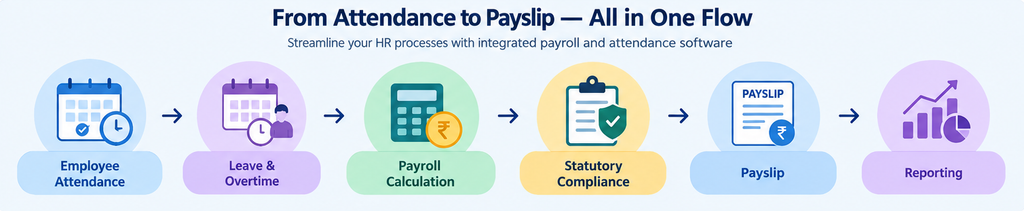
- Integrated software connects attendance, shifts, leave, overtime, and payroll to reduce manual work and errors.
- Key features include EPF/ESI compliance, multi-state payroll, biometric attendance, ESS, integrations, analytics, and audit trails.
- The blog compares 6 options: Savvy HRMS, Darwinbox, Keka, greytHR, Zoho People, and ZingHR.
- Enterprises should evaluate workforce size, compliance needs, integrations, security, support, scalability, and total cost.
- A pilot using real payroll data can help validate calculations and workflows before full implementation.
Why Enterprises in India Need Integrated Payroll and Attendance Software
Indian enterprises operate under one of the world’s most layered statutory frameworks: EPF, ESI, Professional Tax, Labour Welfare Fund, TDS, and now the Code on Social Security, 2020, all enforced state-by-state. The Employees’ Provident Funds Scheme, 2026, effective 29 June 2026, keeps the 12% EPF contribution rate and ₹15,000 wage ceiling unchanged, but shifts the wage base definition and introduces stricter digital filing and penalty timelines for employers. ESI still applies at 4% of gross wages (3.25% employer, 0.75% employee) up to a ₹21,000 monthly ceiling. Manual tracking of these rules across hundreds or thousands of employees, several states, and multiple legal entities is where enterprise payroll errors originate.
Attendance data mixed the problem. When shift rosters, biometric logs, leave balances, and overtime aren’t connected to the payroll engine, HR teams re-key data every cycle, and every manual entry is a fresh chance for error. India’s HR technology market was valued at roughly USD 1.2 billion in 2025 and is projected to grow at a 7.5 – 7.9% CAGR through the early 2030s, largely because enterprises are consolidating fragmented HR, attendance, and payroll systems into single platforms.
An integrated payroll and attendance software for enterprises removes this duplication: attendance and leave data flow directly into wage calculation, statutory deductions apply automatically at the correct wage base, and every payroll run leaves an audit trail. For enterprises with distributed teams, factory floors, warehouses, retail stores, and remote offices, this integration isn’t a convenience; it’s the only realistic way to stay compliant at scale.
Quick Snapshot: Why This Matters for Enterprises
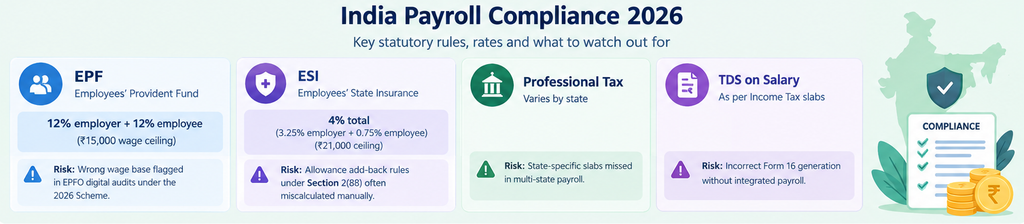
| Compliance Area | 2026 Rate / Ceiling | Risk of Manual Handling |
| EPF (Employees’ Provident Fund) | 12% employer + 12% employee, ₹15,000 wage ceiling | Wrong wage base flagged in EPFO digital audits under the 2026 Scheme |
| ESI (Employees’ State Insurance) | 4% total (3.25% employer + 0.75% employee), ₹21,000 ceiling | Allowance add-back rules under Section 2(88) often miscalculated manually |
| Professional Tax | Varies by state | State-specific slabs missed in multi-state payroll |
| TDS on Salary | As per Income Tax slabs | Incorrect Form 16 generation without integrated payroll |
What Are the Key Features to Look for in Enterprise Payroll and Attendance Software
Enterprises evaluating payroll software for enterprises and attendance software for enterprises should look beyond basic salary processing. The right platform should function as a single compliance and workforce system of record, not a collection of disconnected modules.
- Automated statutory compliance for EPF, ESI, PT, TDS, LWF, and gratuity, updated automatically when rules change (as with the EPF Scheme, 2026).
- Multi-state and multi-entity payroll processing with entity-wise and location-wise wage rules.
- Biometric, geo-fencing, or face-recognition attendance capture for distributed and field workforces.
- Real-time attendance-to-payroll sync, including overtime, shift differentials, and leave encashment.
- Role-based access and audit trails for finance and compliance teams during internal or statutory audits.
- Employee self-service (ESS) for payslips, tax declarations, reimbursements, and leave requests.
- Scalability to handle workforce growth, mergers, or seasonal hiring spikes without re-implementation.
- API and ERP integrations with SAP, Oracle, Tally, and accounting systems already in use.
- Data security and residency, including ISO 27001 or SOC 2 certification, critical for enterprise vendor risk reviews.
- Analytics and reporting on payroll cost, attrition, attendance trends, and compliance status by business unit.
How We Selected the Top Payroll and Attendance Software for Enterprises
Each platform on this list was assessed against 6 weighted criteria relevant specifically to enterprise buyers in India, not only startups or small teams. The scoring favors compliance automation and scale, since these are the two areas where enterprise payroll failures are most costly.
| Selection Criteria | What We Evaluated | Why It Matters for Enterprises |
| Statutory Compliance Depth | EPF, ESI, PT, TDS, LWF automation and update speed | Directly affects legal risk and penalty exposure |
| Scalability | Support for 500 to 50,000+ employees, multi-entity structures | Enterprises need one system that grows with headcount |
| Attendance Integration | Biometric, geo-fencing, face recognition, shift management | Reduces manual entry errors at scale |
| Enterprise Support & SLAs | Dedicated account management, uptime guarantees | Enterprises can’t tolerate payroll downtime |
| Integration Ecosystem | ERP, accounting, and HRIS API connectivity | Avoids duplicate data entry across systems |
| Total Cost of Ownership | Implementation time, per-employee pricing, hidden costs | Impacts long-term ROI for large workforces |
At a Glance
| Rank | Software | Best For | Overall Fit |
| 1 | Savvy HRMS | Compliance-heavy manufacturing, FMCG, and contract-workforce enterprises | Excellent all-in-one fit for large Indian enterprises |
| 2 | Darwinbox | Large multinational and India-origin enterprises wanting AI-led HCM | Strong for enterprise-scale, high-customization needs |
| 3 | Keka | Fast-growing mid-to-large Indian enterprises | Best balance of usability and payroll depth |
| 4 | greytHR | Multi-state enterprises prioritizing statutory compliance | Reliable, compliance-first specialist |
| 5 | Zoho People | Enterprises already invested in the Zoho ecosystem | Strong value when paired with Zoho Payroll and Zoho apps |
| 6 | ZingHR | Large enterprises wanting AI-driven, zero-touch payroll | Best for boardroom-level workforce and payroll intelligence |
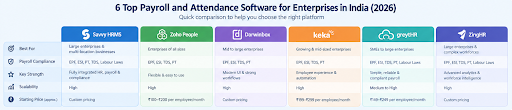
Top 6 Payroll and Attendance Software for Enterprises in India (2026)
1. Savvy HRMS
Savvy HRMS was founded in 2015 with a clear goal: to make HR operations stress-free for growing and large enterprises. It began as an idea from three IT professionals and grew into a unified people-management ecosystem now trusted across manufacturing, FMCG, IT, healthcare, and logistics sectors in India.
The platform is backed by Orasis Infotech, a technology company established in 2005, giving Savvy HRMS over a decade of engineering depth. Today, with 11+ years in the market and 1,000+ enterprise clients, Savvy HRMS positions itself as a cloud-ready, AI-enabled payroll and attendance software for enterprises rather than a single-purpose payroll tool.
Key Features of Savvy HRMS
- Automated payroll engine covering PF, ESI, PT, and TDS statutory calculations
- AI face-recognition and biometric attendance for accurate time tracking
- Contract Labour Management System (CLMS) for manpower planning and billing
- Statutory compliance module built for audit-proof monthly and annual filings
- Leave management with one-click approval workflows for large teams
- Loan management with flexible payout and recovery scheduling
- Reimbursement and travel expense claims with transparent digital tracking
- Savvy AI tools including attrition prediction and an intelligent appraisal engine
- Mobile app access for payroll, attendance, and approvals on the go
- Multiple secure login options including SSO, 2FA, and Active Directory integration
Who Should Choose Savvy HRMS
Enterprises in manufacturing, FMCG, logistics, and IT with large contract or blue-collar workforces should consider Savvy HRMS. It suits organizations needing biometric or face-recognition attendance, strong statutory compliance automation, and contract labour billing in one unified platform rather than stitching together multiple point solutions for payroll and workforce tracking.
Who Might Not Need Savvy HRMS
Very small startups with fewer than 50 employees and simple, single-location payroll needs may find Savvy HRMS more comprehensive than necessary. Enterprises operating purely across multiple countries with no significant India-based workforce, and teams wanting only a minimal payroll calculator, may prefer a lighter, narrower tool instead.
Best For
Manufacturing, FMCG, logistics, and IT enterprises in India needing unified payroll, attendance, statutory compliance, and contract workforce management under one system.
2. Darwinbox
Darwinbox is a cloud-native HCM platform built specifically for large enterprise scale, combining payroll, attendance, performance, and talent modules with an AI assistant for HR workflows and decision support.
Key Features of Darwinbox
- AI-powered virtual assistant for employee and HR queries
- Modular marketplace for adding payroll, ATS, or engagement tools
- Mobile-first design built for large distributed workforces
- Multi-country payroll support alongside India-specific compliance
- Configurable workflows for complex approval hierarchies
- Advanced people analytics and workforce dashboards
Who Should Choose Darwinbox
Large enterprises with 1,000+ employees, multiple business units, or multinational operations that need heavy customization, an AI-led employee experience, and enterprise-grade scalability will benefit most from Darwinbox’s flexible, modular architecture and strong implementation support.
Who Might Not Need Darwinbox
Small and mid-sized businesses with straightforward payroll needs, tighter budgets, or simpler organizational structures may find Darwinbox’s extensive customization and implementation timeline more than what a leaner operation requires.
Best For
Large multi-location and multinational enterprises seeking AI-driven HCM with deep customization and a strong mobile employee experience.
3. Keka
Keka has grown into one of India’s most widely adopted HR and payroll platforms for mid-to-large enterprises, built around an intuitive interface that combines payroll accuracy with performance and engagement tools.
Key Features of Keka
- Automated payroll with built-in statutory compliance updates
- Integrated performance reviews alongside payroll and attendance data
- Project and time tracking linked directly to payroll calculations
- Expense and reimbursement management with approval workflows
- Employee self-service mobile app for payslips and leave
Who Should Choose Keka
Mid-size to large Indian enterprises with 200 to 5,000 employees that want an intuitive, modern system combining payroll, performance, and engagement without a steep learning curve should shortlist Keka, especially fast-growing companies scaling headcount quickly.
Who Might Not Need Keka
Very large corporations exceeding 20,000 employees with highly complex multi-country operations, or enterprises needing deep customization beyond Keka’s standard configuration options, may need a more enterprise-heavy platform instead.
Best For
Fast-growing Indian enterprises wanting a unified payroll, performance, and engagement platform with a genuinely easy-to-use interface.
4. greytHR
greytHR has operated as a compliance-first payroll specialist in India for close to two decades, serving both SMEs and large enterprises with a focus on getting statutory calculations right the first time.
Key Features of greytHR
- Automated PF, ESI, Professional Tax, and TDS compliance engine
- Multi-state statutory filing support with built-in form generation
- Biometric device integration for attendance capture
- Employee self-service portal for payslips and tax declarations
- Detailed payroll audit trails for finance and compliance reviews
Who Should Choose greytHR
Enterprises operating across multiple Indian states that prioritize dependable, audit-ready statutory compliance and straightforward payroll processing over extensive talent management features will find greytHR’s compliance depth and long track record particularly reassuring for risk-averse finance teams.
Who Might Not Need greytHR
Enterprises looking for a full talent management suite with deep performance, learning, and succession planning modules alongside payroll may find greytHR narrower in scope, since its strength lies primarily in payroll, attendance, and compliance rather than broader HCM.
Best For
Compliance-focused, multi-state Indian enterprises that need dependable, audit-ready payroll processing above all else.
5. Zoho People
Zoho People is the HR and attendance module within the broader Zoho ecosystem, offering leave management, biometric and geofencing attendance, performance appraisals, and employee lifecycle tracking, with payroll handled through its companion product, Zoho Payroll.
Key Features of Zoho People
- Biometric, web, and geofencing-based attendance tracking
- Leave management with configurable, India-specific policies
- Integration with Zoho Payroll for statutory salary processing
- Performance appraisals with goals and 360-degree feedback
- HR help desk to reduce repetitive employee queries
- Deep integration across the wider Zoho application suite
Who Should Choose Zoho People
Enterprises already using Zoho’s business applications (CRM, Books, Analytics) for finance and operations will find Zoho People a natural fit, especially those wanting attendance, leave, and performance management tightly integrated with Zoho Payroll and the rest of their existing Zoho software stack.
Who Might Not Need Zoho People
Enterprises with complex, India-specific statutory payroll needs may find that full compliance requires stitching Zoho People to the separate Zoho Payroll product, which adds setup steps compared to platforms offering payroll and attendance natively within a single module from day one.
Best For
Enterprises already invested in the Zoho ecosystem that want attendance and HR management tightly integrated with Zoho Payroll and other Zoho apps.
6. ZingHR
ZingHR is an AI-driven, agentic HCM platform built for enterprise boards and CXOs, unifying payroll, attendance, compliance, and workforce analytics on a single data layer with automated anomaly detection before salary disbursement.
Key Features of ZingHR
- Zero-touch payroll engine processing all pay structures and locations automatically
- AI-driven anomaly detection that flags payroll errors before disbursement
- Real-time attendance-to-payroll sync across biometric, mobile, and geo-fenced check-ins
- State-wise automated PF, ESI, PT, and TDS compliance calculations
- Unified single-database architecture across 35+ HCM modules
- Board-level analytics connecting HR, finance, and operations data
Who Should Choose ZingHR
Large enterprises with 1,000+ employees, particularly in BFSI, pharma, manufacturing, and QSR sectors, that want AI-powered anomaly detection, zero-touch payroll processing, and board-level workforce intelligence in one unified platform should shortlist ZingHR for its enterprise-scale automation depth.
Who Might Not Need ZingHR
Smaller enterprises under 500 employees, or organizations that don’t need agentic AI-driven anomaly detection and board-level analytics, may find ZingHR’s advanced feature set more sophisticated than a simpler payroll and attendance need requires.
Best For
Large enterprises wanting AI-driven, zero-touch payroll with real-time anomaly detection and unified workforce intelligence for leadership decision-making.
| Software | Best For | Biggest Advantage | Potential Integration | Ideal Employee Size |
| Savvy HRMS | Manufacturing, FMCG, logistics, contract workforce | Contract labour management + biometric/face attendance | Tally, ERP, biometric devices, SSO | 200 – 50,000+ |
| Darwinbox | Large multinational and India-origin enterprises | AI-led HCM with deep customization | SAP, Oracle, global HRIS | 1,000 – 50,000+ |
| Keka | Fast-growing mid-to-large enterprises | Intuitive UX with strong payroll-performance link | Accounting tools, Slack, Teams | 200 – 5,000 |
| greytHR | Multi-state compliance-focused enterprises | Deep statutory compliance automation | Biometric devices, Tally, banks | 100 – 10,000 |
| Zoho People | Enterprises in the Zoho ecosystem | Deep integration with Zoho Payroll and Zoho apps | Zoho Payroll, Zoho Analytics, Zoho CRM | 50 – 5,000 |
| ZingHR | Large enterprises wanting AI-led payroll intelligence | Zero-touch payroll with AI anomaly detection | ERP, finance systems, biometric devices | 1,000 – 50,000+ |
What Are the Benefits of Using Payroll and Attendance Software for Enterprises
Enterprises that move from manual or semi-manual payroll to an integrated platform generally see measurable improvements across accuracy, speed, and cost.
- Reduced payroll errors: Automated wage-base calculations eliminate the manual re-entry that causes most EPF and ESI miscalculations.
- Faster payroll cycles: Attendance data flows directly into payroll, cutting processing time from days to hours for large headcounts.
- Lower compliance risk: Automatic updates to statutory rules, such as the EPF Scheme, 2026 changes, reduce exposure to penalties and EPFO notices.
- Improved employee trust: Self-service portals give employees visibility into payslips, tax declarations, and leave balances, reducing HR query volume.
- Better workforce visibility: Real-time dashboards let finance and HR leaders track payroll costs, attendance trends, and headcount changes by location or business unit.
- Stronger audit readiness: Digital audit trails mean statutory or internal audits can be completed faster, with fewer manual document requests.
- Scalability without re-hiring HR staff: A single enterprise system can absorb workforce growth, new locations, or M&A activity without proportionally increasing payroll headcount.
How Payroll and Attendance Software Helps Ensure Payroll Compliance in India
India’s payroll compliance landscape changed materially in 2026 with the EPF Scheme, 2026, which came into effect on 29 June 2026 under the Code on Social Security, 2020. While the 12% EPF contribution rate and ₹15,000 wage ceiling remain unchanged, the scheme formalizes stricter digital filing requirements, faster claim settlement timelines, and greater EPFO scrutiny of the wage base used for contributions.
ESI compliance carries its own complexity: the 4% total contribution (3.25% employer, 0.75% employee) applies to gross wages up to ₹21,000 per month, but “wages” for ESI purposes include basic pay, dearness allowance, HRA, and other regular allowances, with an add-back rule that can pull employees into ESI eligibility even when their gross salary looks like it exceeds the ceiling. Some payroll systems only updated to this correct wage-base treatment in late 2025 or early 2026, meaning legacy or manually maintained systems may still be calculating ESI incorrectly.
Enterprise-grade payroll and attendance software addresses this in several concrete ways:
| Compliance Function | Manual Process Risk | Automated Software Handling |
| EPF wage base calculation | Wrong wage definition used post-2026 Scheme | Auto-applies correct wage base per current EPFO rules |
| ESI eligibility check | Allowance add-back rule missed | Recalculates gross wages with add-back logic monthly |
| Multi-state Professional Tax | State slabs applied inconsistently | State-mapped PT rules applied per employee location |
| TDS and Form 16 | Manual tax slab errors | Auto-updates with each Union Budget’s tax changes |
| ECR and challan filing | Missed deadlines, manual uploads | Auto-generates and schedules statutory filings |
By automating these calculations and keeping pace with regulatory updates, payroll software converts compliance from a recurring manual risk into a background, audit-ready process, which is precisely why compliance depth was the heaviest-weighted criterion in this ranking.
How to Choose the Right Payroll and Attendance Software for Your Enterprise
Selecting among the top payroll and attendance software for enterprises comes down to matching platform strengths to your organization’s actual workforce structure, not just feature checklists.
1. Map Your Workforce Composition First
Identify how many employees are blue-collar, contract, or field-based versus white-collar and office-based. ZingHR and Savvy HRMS suit distributed, contract-heavy teams, while Keka, Darwinbox, and Zoho People fit white-collar, office-first enterprises better.
2. Weight Compliance Automation Heavily
- Check EPF, ESI, PT, and TDS automation depth across states
- Confirm the platform updates automatically with new statutory rules
- Prioritize greytHR or Savvy HRMS for proven multi-state compliance
- Ask vendors how quickly they adapted to the EPF Scheme, 2026
3. Check Attendance Capture Methods
Match attendance technology to your workforce type. Biometric, face-recognition, and geo-fencing tools matter most for manufacturing floors and field teams, while mobile self-service check-ins work fine for remote or hybrid office staff.
4. Evaluate Integration with Existing Systems
- Confirm API connectivity with SAP, Oracle, or Tally
- Check bank integration for automated salary disbursement
- Verify accounting software sync to avoid duplicate entries
- Ask about integration timelines during implementation
5. Assess Vendor Support and SLAs
Enterprise payroll cannot tolerate downtime during a payroll run. Verify dedicated account management, guaranteed uptime, and clear escalation paths before signing, since a delayed pay cycle affects employee trust and finance credibility.
6. Run a Pilot with Real Data
- Test on one location or business unit first
- Use actual payroll data, not sample datasets
- Validate statutory calculations against your current system
- Involve finance and HR before full rollout
7. Review Total Cost of Ownership
Compare per-employee pricing, implementation timelines, and hidden costs such as biometric hardware or premium support tiers across shortlisted vendors, since the cheapest license price rarely reflects the true, long-term cost of ownership.
Conclusion
Enterprise payroll in India in 2026 sits at the intersection of scale and regulation, a combination that manual processes and disconnected tools simply cannot handle reliably anymore. The EPF Scheme, 2026 and ongoing ESI wage-base scrutiny make automated, audit-ready compliance a baseline requirement rather than a nice-to-have feature.
Among the top 6 payroll and attendance software for enterprises covered here, the right choice depends on workforce composition and compliance complexity: Savvy HRMS and greytHR lead for compliance-heavy, contract-intensive Indian operations; Darwinbox and ADP suit large multinational and highly customized enterprise needs; Keka fits fast-growing mid-market enterprises; and PeopleStrong serves large, distributed, blue-collar workforces best.
A few things to keep in mind before you decide:
- Prioritize compliance automation over flashy extras; it’s where enterprise payroll actually fails.
- Match attendance technology to your real workforce (biometric for factories, mobile self-service for office staff).
- Always pilot with real payroll data before a company-wide rollout.

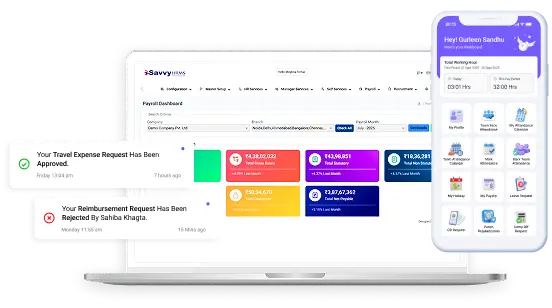









Still weighing your options for 2026?
Savvy HRMS combines payroll, attendance, and contract workforce management in one audit-ready platform. Request a free demo today and see how it stacks up against a real payroll cycle.
Frequently asked questions (FAQs)
1. Which is the best payroll and attendance software for enterprises in India in 2026?
The best choice depends on workforce type. Savvy HRMS and greytHR suit compliance-heavy, multi-state enterprises; Darwinbox and ZingHR fit large, AI-driven operations; Keka works well for fast-growing mid-market companies; and Zoho People suits enterprises already using Zoho tools.
2. How does payroll software help with EPF and ESI compliance in India?
Payroll software automatically applies the correct wage base for EPF (12%, ₹15,000 ceiling) and ESI (4%, ₹21,000 ceiling), including allowance add-back rules. This removes manual calculation errors and keeps enterprises aligned with the EPF Scheme, 2026 and current ESIC regulations.
3. What is the difference between payroll software and HRMS software?
Payroll software focuses specifically on salary processing, statutory deductions, and payslips. HRMS software is broader, covering recruitment, attendance, leave, performance, and employee lifecycle management. Many enterprise platforms combine both into a single integrated system for efficiency.
4. What features should enterprises prioritize when choosing payroll and attendance software?
Enterprises should prioritize automated statutory compliance, multi-state payroll support, biometric or geo-fencing attendance capture, ERP integrations, and strong vendor SLAs. Scalability matters too, since the platform must handle headcount growth, new locations, and mergers without requiring re-implementation.
5. How much does enterprise payroll software cost in India?
Enterprise payroll software generally costs anywhere from ₹50 to ₹300+ per employee per month, depending on modules, headcount, and support tier. Implementation fees, biometric hardware, and premium compliance support can add to the total cost of ownership.