

HRMS Software Comparison: Savvy HRMS vs Other Leading HRMS Platforms


-
AuthorChandra Shekhar Verma
-
 Last Updated
September 29, 2026
Last Updated
September 29, 2026
-
 Reading Time
14 Mins
Reading Time
14 Mins
Choosing the right Human Resource Management System (HRMS) has become an important business decision as organizations move from manual HR processes to integrated digital workforce management. Modern HR teams need more than basic employee records; they need payroll, attendance, recruitment, onboarding, performance management, compliance, analytics, and employee self-service in one connected platform.
The Indian HR technology market is growing rapidly. According to Grand View Research, India’s HR software market generated approximately USD 705.4 million in revenue in 2025 and is projected to reach USD 2.89 billion by 2033, representing a projected CAGR of 19.38% from 2026 to 2033.
With hundreds of HR technology solutions available, businesses need a structured way to evaluate different platforms. In this blog, we compare Savvy HRMS vs other leading HRMS platforms across payroll, attendance, recruitment, employee management, performance, analytics, compliance, scalability, integrations, ease of use, and business requirements.
According to our perspective, the right HRMS should not be selected simply by counting features. Businesses should evaluate how effectively the platform connects HR processes, supports Indian payroll and compliance requirements, scales with workforce growth, and simplifies everyday HR activities.
What Is HRMS Software and Why Does It Matter for Modern Businesses?
HRMS, or Human Resource Management System, is software designed to centralize and automate an organization’s HR processes. Instead of maintaining separate spreadsheets or disconnected applications for employee information, attendance, leave, payroll, recruitment, and performance, an HRMS connects these activities through a centralized platform.
Modern HRMS software can manage multiple stages of the employee lifecycle, including:
- Employee information and Core HR
- Recruitment and applicant management
- Digital onboarding
- Attendance and shift management
- Leave management
- Payroll processing
- Statutory compliance
- Performance management
- Learning and development
- Employee self-service
- Travel and expense management
- Employee assets
- Employee separation
- HR analytics and reporting
The major advantage of HRMS software is process integration. For example, attendance information can be used for payroll processing, employee information can flow from recruitment into onboarding, and performance information can support appraisal and workforce planning.
The growth of HR technology demonstrates the increasing demand for digital HR management. Current industry research estimates India’s HR technology market at more than USD 1 billion, with continued double-digit growth expected over the coming years.
For a company with 50 employees, managing HR through spreadsheets may still be manageable. However, as the organization grows to 500 or 1,000 employees, manual management of attendance corrections, leave balances, salary structures, employee documents, payroll inputs, approvals, and reports can become significantly more complicated.
This is where an integrated HRMS becomes valuable.
Instead of HR teams repeatedly collecting, verifying, updating, and transferring information between different systems, an HRMS can establish a single source of workforce information.
In our view, the strongest HRMS platforms are those that connect administrative HR with strategic HR rather than treating every HR activity as an independent function.
How to Choose the Right HRMS Software for Your Business
There is no universal HRMS that fits every organization. The right HRMS depends on workforce size, industry, locations, payroll complexity, compliance requirements, HR processes, budget, integrations, and future growth plans.
When evaluating HRMS software in India, businesses should consider the following areas:
| Evaluation Area | What to Evaluate |
| Core HR | Employee database, documents, workflows and employee lifecycle |
| Payroll | Salary structures, deductions, taxes and statutory calculations |
| Attendance | Shifts, rosters, overtime, biometric and mobile attendance |
| Leave | Accruals, approvals, carry-forward and encashment |
| Recruitment | Candidate management, hiring workflows and onboarding |
| Performance | Goals, KRAs, appraisals, feedback and ratings |
| Analytics | Dashboards, MIS reports and workforce insights |
| Compliance | Payroll compliance, statutory reports and calculations |
| Integrations | ERP, accounting, biometric and third-party integrations |
| Scalability | Support for increasing employees and organizational complexity |
1. Identify your biggest HR challenges
Before comparing vendors, identify the HR processes that consume the most time.
If payroll is the biggest challenge, focus on salary structures, deductions, statutory calculations, arrears, reimbursements, loans, reports, and full-and-final settlement.
If workforce management is the priority, evaluate attendance, shifts, rosters, overtime, leave, mobile attendance, and biometric integration.
If talent management is the main requirement, look at recruitment, onboarding, performance management, learning, and employee engagement.
2. Look beyond the number of modules
A platform having 20 modules does not automatically mean that it is better suited to your organization than a platform having 10 modules.
The more important question is:
How deeply does each module support your actual HR workflows?
For example, payroll should be evaluated based on its ability to manage salary components, deductions, statutory requirements, arrears, reimbursements, loans, reports, and settlement, not merely whether the vendor lists “Payroll” as a module.
3. Evaluate implementation and support
An HRMS can have extensive functionality but still create challenges if implementation is complicated.
Consider:
- Data migration
- Configuration
- Employee onboarding
- Training
- Customer support
- Integrations
- Workflow customization
- Reporting requirements
4. Consider total cost
HRMS pricing should not be evaluated only on subscription cost.
Businesses should also consider:
- Implementation costs
- Data migration
- Integration charges
- Customization
- Additional modules
- Support
- Training
- Future employee growth
Savvy HRMS vs Other Leading HRMS Platforms: What’s the Difference?
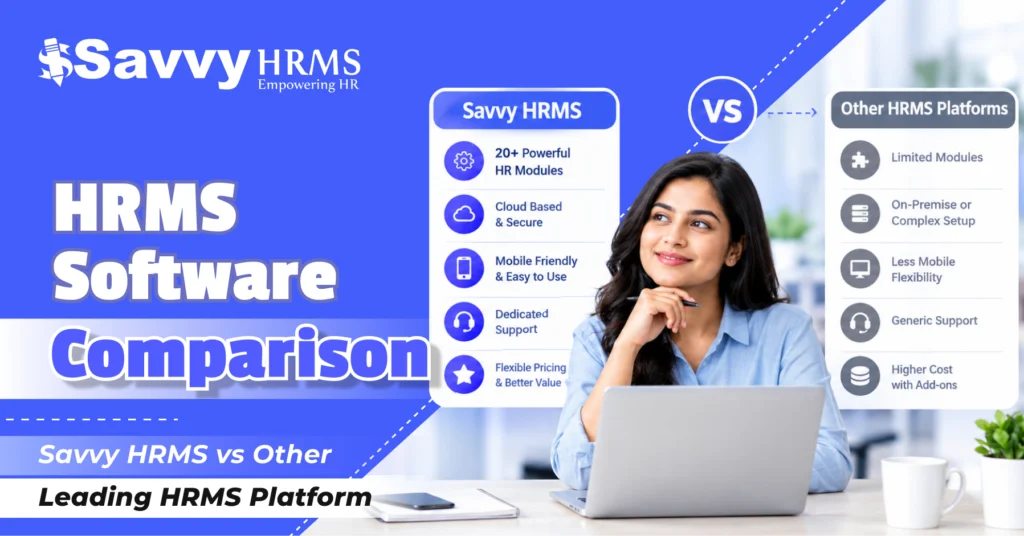
When comparing Savvy HRMS vs other leading HRMS platforms, businesses should consider feature coverage, automation, Indian payroll compliance, scalability, and ease of use.
| Feature | Savvy HRMS | Other Leading HRMS Platforms |
| HR Modules | 20+ HR modules | Varies by platform |
| Core HR | Employee database & lifecycle management | Available with varying features |
| Payroll | Payroll, salary structures, deductions & F&F | Varies by platform |
| Attendance & Leave | Attendance, shifts, overtime & leave management | Varies by platform |
| Recruitment | Recruitment & digital onboarding | Varies by platform |
| Performance | KRA, appraisal, feedback & ratings | Varies by platform |
| Analytics | Dashboards & 100+ payroll reports | Varies by platform |
| Compliance | PF, ESIC, TDS, LWF & Professional Tax | Depends on provider |
| Integrations | API and multiple third-party integrations | Varies by platform |
| AI Capabilities | AI-powered HR and payroll features | Availability varies |
| Scalability | Suitable for growing and multi-location businesses | Depends on platform |
In short, Savvy HRMS combines core HR, payroll, workforce management, performance, analytics, and compliance within one platform, while the capabilities and focus of other HRMS platforms differ based on their features, plans, and target businesses.
How Do HRMS Platforms Compare on Payroll, Attendance, and Leave Management?
Payroll, attendance, and leave management are among the most closely connected HR processes.
A modern HRMS should ideally allow these processes to work together rather than requiring HR teams to manually transfer information between separate systems.
1. Payroll management
A comprehensive payroll system may need to manage:
- Employee salary structures
- Earnings
- Deductions
- Allowances
- Overtime
- Attendance inputs
- Leave deductions
- Loans and advances
- Reimbursements
- Arrears
- PF
- ESIC
- TDS
- Professional Tax
- Labour Welfare Fund
- Gratuity
- Full-and-final settlement
- Statutory reports
For example, the standard EPF contribution structure generally involves a 12% employee contribution, with employer contributions distributed between EPF and related statutory components according to applicable rules.
This demonstrates why Indian payroll software needs to account for statutory calculations rather than simply performing gross-to-net salary calculations.
Savvy HRMS publishes payroll functionality covering multiple salary structures, formula-based and non-formula calculations, bulk salary uploads, increments, loans, reimbursements, PF, ESIC, TDS, LWF, professional tax, gratuity statements, salary reconciliation, and full-and-final settlement.
2. Attendance management
Attendance becomes more complicated as organizations introduce multiple:
- Shifts
- Branches
- Locations
- Employee categories
- Work schedules
- Overtime policies
Savvy HRMS provides features such as multiple shift creation, rosters, overtime planning and actual tracking, biometric integration, attendance locking, web attendance, location-based holiday calendars, and attendance reports.
3. Leave management
A modern leave management system can automate:
- Leave applications
- Leave approvals
- Leave accrual
- Carry-forward
- Leave encashment
- Compensatory leave
- Multiple leave policies
- Backdated leave
- Approval workflows
The real value comes when these three areas are connected.
For example:
Attendance → Leave → Payroll → Payslip → Reporting
How Do HRMS Platforms Compare on Recruitment, Onboarding, and Employee Management?
Recruitment is an increasingly important part of HR technology.
Industry research indicates that recruitment represents a significant portion of HR technology spending in India, with one market assessment estimating that recruitment accounted for approximately 25% of the Indian HR technology market by application in 2025.
An HRMS with recruitment capabilities can help organizations manage the complete hiring journey:
Candidate Sourcing → Screening → Interview → Selection → Offer → Onboarding → Employee Database
The advantage of integrating recruitment with Core HR is that employee information can move from one stage to the next without requiring repeated data entry.
1. Recruitment
Businesses should evaluate whether an HRMS provides:
- Candidate database
- Job requisition management
- Interview scheduling
- Candidate tracking
- Selection workflows
- Offer letter generation
- Recruitment reports
- Hiring approvals
2. Onboarding
Modern onboarding can involve:
- Digital documentation
- Employee information collection
- Offer and joining documentation
- Department allocation
- Reporting manager assignment
- Policy acknowledgment
- Asset allocation
- Payroll setup
Savvy HRMS highlights automated recruitment workflows, candidate management, offer generation, digital onboarding, and employee lifecycle management.
3. Employee management
After onboarding, the HRMS becomes a centralized employee database.
Employee records may include:
- Personal details
- Employment information
- Department
- Designation
- Reporting structure
- Salary
- Documents
- Attendance
- Leave
- Performance
- Assets
- Training
- Separation information
This creates continuity across the employee lifecycle.
For a company growing from 100 to 1,000 employees, this centralized approach can become increasingly important because HR teams have more employee records, approvals, policies, and transactions to manage.
How Do Savvy HRMS and Other HR Platforms Handle Performance Management?
Performance management has evolved beyond the traditional annual appraisal.
Modern performance management can include:
- Goal setting
- KPIs
- KRAs
- Competencies
- Self-appraisal
- Manager review
- Continuous feedback
- 180-degree feedback
- 360-degree feedback
- Performance ratings
- Nine-box matrix
- Performance dashboards
- Promotion recommendations
Savvy HRMS publishes performance management capabilities including KRA management, employee feedback, self-review, approver review, customized rating scales, competency management, 180/360-degree feedback, nine-box matrix, bell-curve functionality, performance indicators, analytical dashboards, and promotion recommendations.
What should businesses compare?
When evaluating performance management software, organizations should ask:
- Can employees define or receive goals?
- Can managers conduct reviews?
- Can HR configure rating scales?
- Does the system support KRAs?
- Can employees provide self-assessments?
- Can managers provide feedback?
- Are multiple appraisal methods available?
- Can HR generate performance reports?
- Can performance information support promotion and increment processes?
An integrated approach can connect:
Goals → Performance → Feedback → Appraisal → Development → Promotion
According to our perspective, this is more useful than treating performance management as a once-a-year appraisal activity.
How Do HRMS Platforms Compare on HR Analytics and Reporting?
HR analytics helps organizations transform employee data into meaningful workforce information.
Common HR analytics areas include:
- Headcount
- Attrition
- Attendance
- Absenteeism
- Payroll cost
- Overtime
- Leave utilization
- Recruitment
- Performance
- Training
- Workforce demographics
- Department-level trends
Industry reports increasingly identify workforce planning and analytics as an important category within the HR software market.
Savvy HRMS states that its payroll platform provides 100+ analytical reports, including salary registers, overtime reports, reimbursement reports, incentive reports, and multiple dashboards.
Consider an organization with 800 employees.
If overtime expenses increase by 18% over three months, management needs to understand what caused the increase.
An integrated HR analytics system can potentially help examine:
Overtime → Department → Location → Shift → Attendance → Payroll Cost
Similarly:
Attrition → Department → Tenure → Performance → Recruitment → Replacement Requirement
This illustrates the difference between basic reporting and workforce analytics.
HR analytics should answer business questions
Instead of simply asking:
“How many employees do we have?”
HR analytics can help organizations examine:
- Which departments have the highest attrition?
- Where is absenteeism increasing?
- Which locations generate the highest overtime?
- How is payroll cost changing?
- How long does recruitment take?
- Which teams have outstanding performance goals?
- How are leave patterns changing?
How Do Savvy HRMS and Other HRMS Platforms Handle Compliance in India?
Indian organizations need to manage multiple payroll and employment-related compliance requirements.
Depending on the organization, payroll processes may involve:
- Provident Fund
- Employee State Insurance
- Professional Tax
- Tax Deducted at Source
- Labour Welfare Fund
- Gratuity
- Minimum wage requirements
- Statutory reports
- Challans
- Full-and-final settlement
Savvy HRMS provides support for PF, ESIC, UAN management, TDS, LWF, professional tax, gratuity statements, statutory challans, and related payroll reports.
Why Indian payroll localization matters
An HRMS designed for Indian businesses should account for relevant local payroll requirements and state-level variations where applicable.
For example, Professional Tax is administered at the state level, meaning requirements can vary between states.
Therefore, companies operating across several states should verify whether the HRMS supports the specific locations and statutory requirements relevant to their workforce.
Data protection and employee information
Compliance evaluation should also extend beyond payroll.
HRMS platforms process employee personal information, salary information, bank details, attendance information, documents, and other workforce data.
India’s Digital Personal Data Protection Act, 2023 introduces obligations relating to the processing of digital personal data and establishes a framework involving Data Fiduciaries, Data Principals, and related responsibilities.
Businesses should therefore evaluate:
- Role-based access
- User permissions
- Authentication
- Data security
- Audit controls
- Data access
- Data retention
- Employee information handling
- Vendor security practices
How Do HRMS Platforms Compare on Scalability, Integrations, and Ease of Use?
Scalability becomes particularly important for growing businesses.
Consider a company moving from:
100 employees → 300 employees → 500 employees → 1,000 employees
The employee count is not the only thing changing.
The organization may also add:
- More departments
- More managers
- More locations
- Multiple shifts
- Additional salary structures
- New approval workflows
- More HR policies
- More reporting requirements
- More compliance complexity
1. Scalability
An HRMS should be able to accommodate increasing employee numbers and organizational complexity.
Savvy HRMS positions its solution for SMEs and larger organizations and highlights capabilities designed for multi-location and diverse workforce environments.
However, businesses should validate actual scalability during product demonstrations and implementation discussions.
2. Integrations
HRMS integrations can connect HR data with:
- Accounting software
- ERP systems
- Biometric devices
- Banking systems
- APIs
- Third-party applications
Savvy HRMS states that its payroll solution supports integration with 20+ software systems, with API integration capabilities and connections with systems such as SAP, Oracle, and Tally.
3. Ease of use
Usability is another important factor.
A platform may offer dozens of modules, but if employees find basic activities difficult, adoption can become a challenge.
A practical workflow could look like:
Employee: Apply Leave → Check Attendance → Download Payslip
Manager: Approve Leave → Review Attendance → Complete Appraisal
HR: Process Payroll → Review Compliance → Generate Reports
Management: Review Dashboard → Analyze Workforce → Make Decisions
What Types of Businesses Can Benefit From Savvy HRMS?
Savvy HRMS can be considered by organizations looking for a centralized platform covering administrative HR, payroll, workforce management, talent management, employee services, and analytics.
The platform’s published use cases span industries including FMCG, logistics, healthcare, manufacturing, IT, and other business environments.
1. Small and medium businesses
Growing businesses often need to move away from spreadsheets while avoiding unnecessary complexity.
An HRMS can centralize:
- Employee records
- Attendance
- Leave
- Payroll
- Documents
- Approvals
- Employee self-service
2. Multi-location businesses
Organizations with multiple offices, branches, plants, or operational locations may need:
- Location-based policies
- Multiple shifts
- Attendance management
- Centralized payroll
- Branch-level reporting
- Approval hierarchies
3. Manufacturing organizations
Manufacturing businesses often have complex workforce structures involving shifts, overtime, biometric attendance, and location-specific workforce policies.
Therefore, attendance, shift management, overtime, payroll, and employee lifecycle management can be important HRMS evaluation criteria.
4. IT and professional services companies
IT and professional services organizations may place greater emphasis on:
- Recruitment
- Onboarding
- Employee self-service
- Performance management
- Learning
- Analytics
- Employee engagement
5. Healthcare, hospitality, retail, and logistics
These sectors may have distributed teams, multiple locations, shift-based employees, attendance requirements, and operational workforce management needs.
6. Businesses scaling from 50 to 5,000 employees
For growing companies, scalability is not just about the number of employees.
As an organization grows from 50 to 5,000 employees, it may need more:
- Approval levels
- Departments
- Locations
- Salary structures
- Shifts
- HR policies
- Compliance processes
- Analytics
This makes an integrated HRMS increasingly relevant.
Conclusion
Choosing between Savvy HRMS vs other leading HRMS platforms requires a structured evaluation of payroll, attendance, recruitment, performance, analytics, compliance, integrations, scalability, usability, implementation, and total cost. The rapid growth of India’s HR technology market makes selecting the right platform an increasingly strategic business decision.
Savvy HRMS provides 20+ powerful HR modules covering Core HR, recruitment, attendance, leave, payroll, compliance, performance, learning, employee self-service, analytics, travel and expense, and workforce management. Its published information also highlights AI capabilities and 1,000+ clients, providing businesses with a broad platform to evaluate against their specific HR requirements.

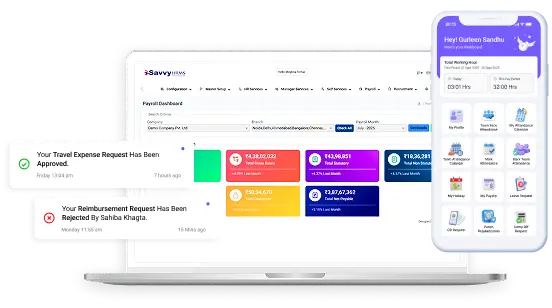









Ready to simplify HR management?
Explore Savvy HRMS and discover how an integrated HRMS can simplify your organization's employee lifecycle, payroll, compliance, and workforce management.
Frequently Asked Questions (FAQs)
1. What is HRMS software?
HRMS software is a centralized digital platform that helps businesses manage employee records, payroll, attendance, leave, recruitment, onboarding, performance, compliance, and reporting. It reduces manual HR work while providing employees, managers, and HR teams with connected workforce management tools.
2. How does Savvy HRMS compare with other HRMS platforms?
Savvy HRMS offers 20+ powerful HR modules covering Core HR, payroll, attendance, recruitment, performance management, compliance, analytics, employee self-service, and workforce management. Its integrated approach helps businesses manage multiple HR processes through one centralized platform.
3. Is Savvy HRMS suitable for Indian businesses?
Yes, Savvy HRMS is designed with India-focused payroll and compliance requirements, supporting areas such as PF, ESIC, TDS, LWF, Professional Tax, gratuity, and statutory reporting, helping Indian businesses streamline payroll processing and compliance-related HR activities.
4. What should businesses consider when comparing HRMS software?
Businesses should compare HRMS platforms based on features, payroll capabilities, Indian compliance, attendance, recruitment, performance management, analytics, integrations, scalability, security, ease of use, implementation, customer support, and total cost of ownership before making a decision.
5. Can Savvy HRMS support growing businesses?
Yes, Savvy HRMS can support growing and multi-location businesses by bringing employee management, payroll, attendance, recruitment, performance, compliance, analytics, and employee self-service together. This integrated approach can help organizations manage increasing workforce complexity more efficiently.