

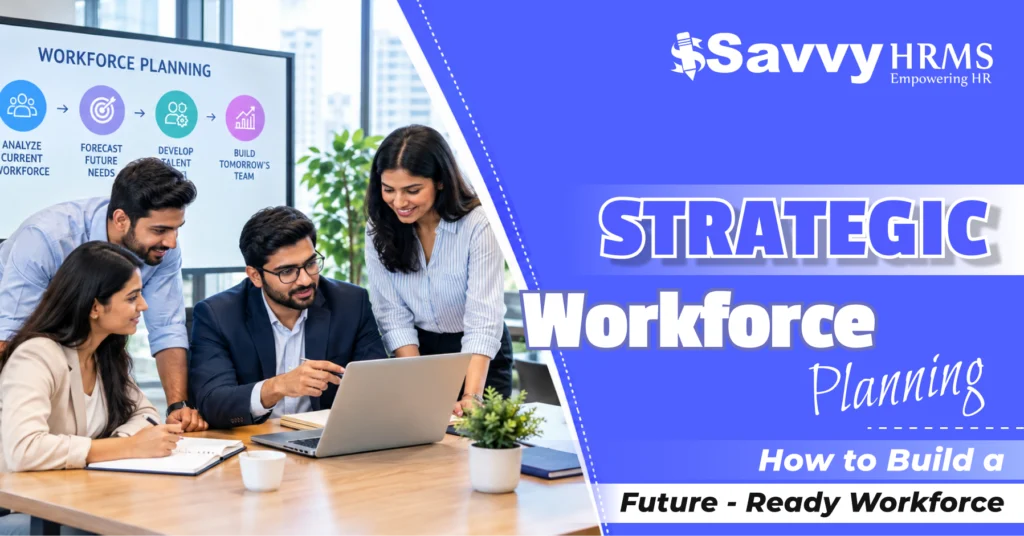
Strategic Workforce Planning: How to Build a Future-Ready Workforce


-
AuthorSalilendra Kumar
-
 Last Updated
September 24, 2026
Last Updated
September 24, 2026
-
 Reading Time
18 Mins
Reading Time
18 Mins
Businesses today are operating in an environment where technology, employee expectations, market conditions, and required skills are changing rapidly. Strategic workforce planning helps organizations prepare for these changes by ensuring they have the right people, skills, roles, and capabilities at the right time.
According to the World Economic Forum’s Future of Jobs Report 2025, employers expect 39% of workers’ existing core skills to change or become outdated by 2030. The same report identifies skills gaps as a major barrier to business transformation, with 63% of employers citing them as a significant challenge.
This makes workforce planning more than a traditional HR activity. It is a business strategy that connects workforce requirements with organizational goals, helping companies forecast talent needs, identify skills gaps, develop employees, and make informed hiring decisions. A well-designed workforce plan can help businesses become more agile and prepared for future changes.
TL;DR
- Strategic workforce planning helps businesses prepare for future talent, skills, and workforce requirements.
- It connects business strategy, workforce demand, and available talent to identify gaps early.
- Key steps include workforce analysis, demand forecasting, gap identification, talent planning, implementation, and monitoring.
- Upskilling and reskilling help organizations prepare employees for changing roles and technologies.
- Important KPIs include headcount, turnover, time to fill, skills gaps, internal mobility, and training outcomes.
- HRMS software supports workforce planning through centralized employee data, analytics, recruitment, performance, training, and workforce cost insights.
- Regular workforce reviews and scenario planning help businesses build a more adaptable, future-ready workforce.
What Is Strategic Workforce Planning?
What is strategic workforce planning, and how does it help organizations prepare for the future? Strategic workforce planning is the process of analyzing an organization’s current workforce and forecasting the people, skills, roles, and capabilities it will need to achieve future business goals.
Unlike short-term hiring plans, strategic workforce planning looks beyond immediate vacancies. It considers factors such as business growth, technology adoption, employee turnover, changing job roles, emerging skills, workforce demographics, and future market requirements. This allows HR teams and business leaders to prepare before workforce gaps become operational problems.
Strategic workforce planning generally connects three areas: business strategy, workforce demand, and talent supply. HR teams first understand where the organization wants to go, then determine what workforce will be required to get there, and finally assess whether the existing workforce can meet those requirements.
| Workforce Planning Area | Key Question |
| Current workforce | Who do we have today? |
| Workforce skills | What can our employees do? |
| Future demand | What will the business need? |
| Skills gaps | What capabilities are missing? |
| Talent strategy | How will we close those gaps? |
In simple terms, strategic workforce planning answers one important question: “Do we have the right people with the right skills in the right roles to achieve our future business goals?”
Why Is Strategic Workforce Planning Important for Businesses?
Why is strategic workforce planning important for businesses? It helps organizations prepare their workforce before business requirements change. Instead of reacting to sudden talent shortages, HR teams can forecast future workforce needs and create hiring, training, succession, and employee development strategies in advance.
Modern businesses face continuous changes caused by artificial intelligence, automation, economic conditions, demographic shifts, new technologies, and developing customer expectations. The World Economic Forum reports that 170 million jobs could be created globally by 2030 while 92 million jobs could be displaced, resulting in a projected net increase of 78 million jobs.
These changes make workforce agility increasingly important. A company may have enough employees today but still lack the skills required two or three years from now. Strategic workforce planning helps identify this difference early and provides a framework for addressing it.
Key Benefits of Strategic Workforce Planning
| Benefit | How It Helps |
| Better workforce forecasting | Predicts future talent requirements |
| Skills gap identification | Highlights missing capabilities |
| Smarter hiring | Focuses recruitment on future needs |
| Employee development | Supports targeted upskilling |
| Cost management | Reduces unnecessary hiring and workforce costs |
| Succession planning | Prepares employees for critical roles |
| Business agility | Helps organizations respond to change |
Strategic workforce planning also helps HR become more closely aligned with business strategy. Instead of focusing only on employee administration, HR can contribute to decisions about growth, expansion, technology adoption, organizational design, and long-term talent requirements.
What Are the Key Objectives of Strategic Workforce Planning?
The primary objective is to ensure that an organization has the workforce capacity and capabilities required to achieve its strategic goals. This involves balancing workforce demand with available talent while preparing for future changes.
Another important objective is to identify workforce gaps before they affect business performance. These gaps may involve employee numbers, technical skills, leadership capabilities, geographical availability, or specialized expertise. Once identified, organizations can decide whether to hire, train, redeploy, automate, outsource, or redesign roles.
Strategic workforce planning also aims to improve workforce productivity and control costs. By forecasting workforce requirements, businesses can avoid excessive hiring, reduce unnecessary vacancies, and allocate employees more effectively across departments and locations.
Major Objectives
- Forecast future workforce requirements.
- Identify current and future skills gaps.
- Align talent strategy with business objectives.
- Improve workforce productivity.
- Support succession and leadership planning.
- Strengthen employee development programs.
- Reduce talent shortages and unnecessary hiring.
- Prepare employees for technological change.
- Improve workforce cost management.
- Build a flexible and future-ready workforce.
The overall goal is not simply to increase headcount. It is to create the right workforce structure for the organization’s future.
How Does Strategic Workforce Planning Work?
It generally works by comparing the organization’s current workforce capabilities with the workforce it expects to need in the future. HR and business leaders then identify gaps and develop strategies to close them.
The process begins with understanding business objectives. For example, if a company plans to expand into three new cities, launch a new technology platform, or increase production by 30%, its workforce requirements will change accordingly.
HR teams then assess current employees, skills, roles, productivity, turnover, retirement risks, and workforce costs. This information is compared with projected workforce demand to identify gaps. The organization can then create action plans around recruitment, employee development, succession planning, internal mobility, automation, or workforce restructuring.
Strategic Workforce Planning Flow
Business Strategy → Current Workforce Analysis → Future Workforce Forecast → Gap Analysis → Workforce Strategy → Implementation → Monitoring
A continuous approach is important because workforce planning should not be treated as a once-a-year exercise. Business priorities and talent requirements can change throughout the year.
What Are the Key Steps to Build a Future-Ready Workforce?
Organizations need to understand their current workforce, anticipate future requirements, identify capability gaps, and create practical strategies for addressing those gaps.
The first step is to understand the organization’s business direction. Workforce planning becomes effective when HR understands upcoming products, markets, technology investments, expansion plans, revenue targets, and operational changes.
The next step is to create a detailed workforce baseline. This includes employee numbers, departments, job roles, skills, experience, location, performance, turnover, and succession risks. Once the baseline is established, HR can forecast future workforce requirements.
7 Key Steps
1. Understand Business Strategy
Start by understanding the organization’s growth plans, business objectives, expansion goals, technology investments, and upcoming changes. These factors help HR determine what workforce size, skills, and capabilities will be needed.
2. Analyze the Current Workforce
Review your existing employees, including headcount, roles, skills, experience, performance, turnover, and critical positions. This workforce assessment helps HR understand current capabilities and identify areas that may require improvement or development.
3. Forecast Future Workforce Demand
Estimate how many employees and which skills the organization will require in the future. Workforce forecasting should consider expected business growth, new projects, technology adoption, market changes, productivity goals, and potential employee turnover.
4. Identify Workforce and Skills Gaps
Compare current workforce capabilities with future requirements to identify shortages in employee numbers, skills, experience, or leadership capabilities. This gap analysis helps organizations determine where hiring, training, reskilling, or internal mobility may be required.
5. Develop Talent Strategies
Create strategies to address identified workforce gaps through recruitment, employee development, succession planning, internal mobility, upskilling, reskilling, or automation. The right combination depends on business priorities, workforce availability, costs, and future capability requirements.
6. Implement Workforce Initiatives
Put the workforce plan into action by launching recruitment programs, learning initiatives, succession plans, internal mobility opportunities, or organizational changes. Assign responsibilities, timelines, and resources so workforce strategies can be implemented effectively.
7. Monitor Results and Adjust
Regularly track workforce planning metrics such as headcount, turnover, skills gaps, hiring time, internal mobility, and training outcomes. Review these results periodically and adjust workforce strategies as business requirements and market conditions change.
A future-ready workforce requires both workforce capacity and workforce capability. Organizations therefore need to consider not only how many employees they will need but also which skills those employees must possess.
How to Assess Your Current Workforce?
HR teams should create a workforce inventory that provides a clear picture of employee numbers, roles, skills, experience, performance, location, compensation, turnover, and critical positions.
A workforce skills inventory can help identify employees who already possess high-demand capabilities and those who may require additional development. HR can also use employee surveys, performance reviews, skills assessments, competency frameworks, and manager feedback to improve workforce visibility.
Important workforce data includes headcount by department, average employee tenure, turnover rate, absenteeism, critical-role coverage, internal mobility, retirement eligibility, and employee skills. Combining these indicators creates a stronger foundation for workforce forecasting.
Current Workforce Assessment Checklist
- Total headcount
- Headcount by department
- Job roles and responsibilities
- Employee skills and certifications
- Critical and hard-to-fill roles
- Employee turnover
- Retirement and attrition risks
- Performance trends
- Leadership pipeline
- Internal mobility
- Workforce costs
- Location and availability
Organizations can then categorize roles based on their business importance. Critical roles should receive greater attention because vacancies or skill shortages in these positions may have a larger impact on business continuity.
How to Identify Future Workforce Needs?
They should start with the organization’s strategic plans and translate business objectives into workforce requirements. Every major business initiative can create new requirements for people, skills, roles, or leadership capabilities.
For example, entering a new market may require sales and customer-support employees. Implementing automation may increase demand for technology and data skills while reducing some repetitive tasks. Opening a new facility may require additional operational, supervisory, and compliance-related roles.
HR teams should also consider external factors such as technology trends, industry developments, talent availability, labor-market conditions, demographic changes, and changing employee expectations. This creates a more realistic workforce demand forecast.
Questions HR Should Ask
- What business capabilities will we need in the next 1 – 3 years?
- Which roles are likely to grow?
- Which roles may change because of technology?
- Which skills will become more important?
- Which current skills may become less relevant?
- Where could talent shortages occur?
- Can existing employees be trained for future roles?
The World Economic Forum expects 39% of existing worker skills to be transformed or become outdated by 2030, demonstrating why organizations need to continuously evaluate future skill requirements rather than depending only on current job descriptions.
How to Align Workforce Planning With Business Goals?
HR should translate business objectives into specific workforce requirements. This means every major workforce initiative should connect to a measurable business outcome such as growth, productivity, expansion, innovation, customer service, or cost efficiency.
For example, a business planning to increase production by 25% may require additional employees, supervisors, technical skills, or automation. Similarly, a company entering a new geographical market may require local sales, customer service, compliance, and operational talent.
HR and business leaders should therefore work together when developing workforce plans. Workforce planning should not operate separately from finance, operations, technology, sales, or leadership planning.
Business Goal to Workforce Requirement
| Business Goal | Potential Workforce Requirement |
| Expand into new markets | Local sales and operations talent |
| Increase production | Additional skilled workforce |
| Adopt AI | AI, data, and technology skills |
| Reduce costs | Workforce optimization and automation |
| Improve customer service | Customer-facing talent and training |
| Develop future leaders | Succession and leadership programs |
The World Economic Forum reports that 85% of surveyed employers expect to prioritize workforce upskilling between 2025 and 2030, highlighting the growing connection between business transformation and employee capability development.
What Is the Role of Upskilling and Reskilling in Future Workforce Planning?
They help organizations prepare existing employees for changing job requirements. Upskilling improves capabilities within an employee’s existing area, while reskilling prepares an employee for a substantially different role.
Upskilling can be useful when an employee needs advanced knowledge in their current profession. For example, an HR professional may learn people analytics or AI-based HR tools. Reskilling may involve preparing an employee from one role for another position where future demand is increasing.
This approach can reduce dependence on external hiring while improving internal mobility and employee career development. It can also help organizations retain institutional knowledge by preparing existing employees for new responsibilities.
Upskilling vs. Reskilling
| Factor | Upskilling | Reskilling |
| Purpose | Improve existing skills | Learn skills for a new role |
| Career direction | Same or related role | Different role |
| Example | HR analytics training | HR employee moving into data role |
| Workforce benefit | Higher capability | Internal talent mobility |
According to the WEF, 63% of employers identify skills gaps as a major barrier to business transformation, while 85% expect to prioritize upskilling.
This makes learning and development an important part of strategic workforce planning rather than a separate HR activity.
What Are the Common Challenges in Strategic Workforce Planning?
Organizations often struggle with inaccurate workforce data, uncertain business forecasts, changing skill requirements, limited HR resources, and difficulty connecting HR data with business strategy.
Another major challenge is skills visibility. An organization may know how many employees it has but may not have a reliable understanding of the skills each employee possesses. Without accurate skills data, identifying future workforce gaps becomes more difficult.
Resistance to change can also affect workforce planning. Employees may need to learn new technologies, move into different roles, or adapt to redesigned processes. Organizations therefore need effective communication, employee development, and leadership support.
Common Workforce Planning Challenges
| Challenge | Potential Impact |
| Inaccurate workforce data | Poor forecasting |
| Skills gaps | Difficulty filling critical roles |
| High turnover | Workforce instability |
| Changing technology | Outdated skills |
| Poor business-HR alignment | Misaligned hiring |
| Limited analytics | Weak decision-making |
| Resistance to change | Slow workforce transformation |
The WEF identifies organizational culture and resistance to change as a transformation barrier for 46% of surveyed employers, while 32% cite inadequate data and technical infrastructure.
Organizations can address these challenges through better workforce data, regular planning cycles, employee communication, skills mapping, scenario planning, and HR technology.
How Does HRMS Software Support Strategic Workforce Planning?
An HRMS (Human Resource Management System) brings employee information, workforce data, and HR processes into one centralized platform. This helps HR teams analyze the current workforce, identify gaps, track employee development, and make more informed workforce planning decisions.
1. Centralized Employee Data
An HRMS stores employee information such as job roles, departments, skills, experience, attendance, performance, and employment history in one place. This gives HR teams a clearer view of their current workforce and supports more accurate workforce analysis.
2. Workforce Analytics and Reporting
HRMS analytics can help organizations track headcount, turnover, absenteeism, workforce costs, performance trends, and other important indicators. These insights allow HR leaders to identify workforce patterns and make decisions based on reliable employee data.
3. Identifying Skills Gaps
By maintaining employee skills and competency information, an HRMS can help HR teams identify existing capabilities and areas requiring development. This supports skills gap analysis and helps organizations plan targeted upskilling and reskilling programs.
4. Supporting Recruitment Planning
Workforce planning requires organizations to understand when and where additional talent may be needed. HRMS recruitment capabilities can help HR manage vacancies, monitor hiring requirements, track candidates, and align recruitment activities with projected workforce demand.
5. Employee Development and Reskilling
An HRMS can support learning and development by helping organizations manage training programs, employee development plans, certifications, and skill-building initiatives. This makes it easier to prepare existing employees for changing roles and future business requirements.
6. Performance and Talent Management
Performance management data can help organizations identify high-performing employees, potential leaders, and employees who may require additional development. This information supports succession planning, internal mobility, and long-term talent management strategies.
7. Workforce Cost Management
HRMS platforms can provide visibility into salary, payroll, benefits, and other workforce-related costs. HR and finance teams can use this information when evaluating workforce budgets, hiring plans, departmental costs, and future workforce investments.
8. Data-Driven Workforce Decisions
By combining employee information with HR analytics and reporting, an HRMS helps organizations move from manual workforce planning to a more data-driven approach. This allows HR leaders to continuously monitor workforce trends and adjust their strategies as business needs change.
What Workforce Planning Metrics and KPIs Should HR Teams Track?
HR teams should monitor metrics that show workforce availability, capability, cost, productivity, retention, and future talent requirements. The right KPIs help organizations determine whether their workforce strategy is supporting business objectives.
No single metric can measure workforce planning effectiveness. Instead, organizations should combine several indicators. For example, a low turnover rate may appear positive, but if critical positions remain vacant or employees lack required skills, the organization could still face significant workforce risks.
Important Workforce Planning KPIs
1. Headcount and Workforce Growth
Headcount shows the number of employees currently working in the organization. Comparing current headcount with historical and projected figures can help HR identify workforce growth patterns.
2. Employee Turnover Rate
Turnover measures the percentage of employees leaving the organization during a specific period. High turnover in critical positions can create workforce planning risks and increase recruitment costs.
3. Time to Fill
Time to fill measures how long it takes to fill an open position. Tracking this metric for critical roles can help HR understand future recruitment capacity.
4. Skills Gap Percentage
A skills gap percentage can show the proportion of required future skills that are currently unavailable or insufficient within the workforce.
5. Internal Mobility Rate
Internal mobility measures how frequently employees move between roles, departments, or career levels. A healthy internal mobility strategy can help organizations make better use of existing talent.
6. Training and Development Metrics
Training completion, skill improvement, certification rates, and post-training performance can help HR understand whether workforce development programs are closing identified capability gaps.
The most useful approach is to connect workforce KPIs with business outcomes. For example, instead of tracking training completion alone, HR can evaluate whether training improved productivity, filled a skills gap, supported internal movement, or reduced external hiring requirements.
How Can Businesses Make Strategic Workforce Planning a Continuous Process?
Organizations should establish regular workforce reviews and update workforce forecasts whenever significant changes occur in business strategy, technology, employee numbers, or market conditions.
Quarterly workforce reviews can help HR identify changes earlier. These reviews can include headcount trends, hiring requirements, turnover, critical roles, skills gaps, employee development, succession plans, and workforce costs.
Scenario planning can also strengthen workforce readiness. HR teams can create different scenarios such as rapid growth, moderate growth, economic slowdown, technology-driven restructuring, or expansion into new markets.
Example Workforce Scenarios
- Rapid Business Growth: Increase hiring and workforce capacity.
- Moderate Growth: Combine targeted hiring with internal mobility.
- Technology Adoption: Focus on upskilling, reskilling, and specialized hiring.
- Business Slowdown: Optimize workforce costs and resource allocation.
- New Market Entry: Hire location-specific sales and operational talent.
- Skills Disruption: Introduce targeted training, reskilling, and capability development.
This approach makes workforce planning more flexible. Instead of creating one fixed workforce plan, organizations can prepare several possible responses and adjust them as business conditions change.
Conclusion
Strategic workforce planning helps businesses prepare for future talent and skill requirements instead of reacting to workforce problems after they occur. By analyzing the current workforce, forecasting demand, identifying skills gaps, and developing targeted talent strategies, organizations can build greater workforce agility.
A future-ready workforce requires continuous planning, employee development, data-driven decision-making, and alignment between HR and business leadership. With HRMS technology, workforce analytics, upskilling, reskilling, and regular workforce reviews, organizations can create a workforce capable of adapting to changing business needs.









Build a future-ready workforce with Savvy HRMS and simplify workforce planning with smarter HR technology. Explore Savvy HRMS today and turn your workforce data into smarter decisions.
Frequently Asked Questions (FAQs)
1. What is strategic workforce planning?
Strategic workforce planning is a structured process that helps businesses determine the people, skills, and capabilities they need to achieve future goals. It involves analyzing the current workforce, forecasting future requirements, identifying gaps, and developing strategies to ensure the right talent is available when needed.
2. Why is strategic workforce planning important?
Strategic workforce planning helps organizations prepare for changing business requirements, technology adoption, skills shortages, and workforce changes. It enables HR teams to make informed hiring and development decisions, control workforce costs, improve productivity, reduce talent gaps, and create a more adaptable and future-ready workforce.
3. What are the key steps in strategic workforce planning?
The key steps include understanding business objectives, assessing the current workforce, forecasting future workforce demand, identifying skills and talent gaps, developing workforce strategies, implementing initiatives, and regularly monitoring results. These steps help organizations continuously align their workforce with changing business priorities and future requirements.
4. How does HRMS support strategic workforce planning?
HRMS software supports strategic workforce planning by centralizing employee information and providing useful workforce insights. HR teams can monitor headcount, employee performance, recruitment, attendance, skills, training, turnover, and other workforce metrics, helping them identify trends and make more informed workforce planning decisions.
5. What are the important workforce planning KPIs?
Important workforce planning KPIs include headcount, workforce growth rate, employee turnover, time to fill, cost per hire, absenteeism, internal mobility, skills gaps, training completion, critical-role coverage, revenue per employee, and labor cost. Tracking these metrics helps HR evaluate workforce effectiveness and identify areas requiring attention.