



As a company grows, so does the complexity of managing its workforce. What starts with a few employee records and simple HR processes can quickly turn into hundreds of leave requests, attendance records, payroll inputs, documents, approvals, and compliance requirements. Keeping all of this organized is where HR operations become important.
Think of HR operations as the system that keeps the employee journey moving smoothly behind the scenes. From onboarding a new employee and maintaining accurate records to managing attendance, leave, payroll, compliance, and employee requests, it connects multiple HR activities into structured and consistent processes.
In this guide, we will explore what HR operations is, its roles and responsibilities, key functions, major processes, common challenges, and the role of HR technology and HRMS. We will also look at how HR operations supports compliance in India and the best practices businesses can follow to build a more efficient and scalable HR function.
TL;DR
- HR operations manages the day-to-day processes that support employees and HR teams.
- Key areas include onboarding, employee records, attendance, leave, payroll, compliance, and employee support.
- Efficient HR operations help reduce manual work, minimise errors, and improve employee experience.
- HRMS can automate repetitive HR tasks and provide centralised, real-time employee data.
- Strong HR operations help businesses stay compliant, make faster decisions, and scale HR processes smoothly.
What Is HR Operations?
HR operations refers to the day-to-day processes, systems, and activities involved in managing employees throughout their lifecycle in an organization. It generally covers employee data management, onboarding, attendance, leave, payroll coordination, compliance, employee services, reporting, and separation.
In simple words, HR operations makes sure that everyday HR processes actually work.
Strategic HR may focus on workforce planning, company culture, talent strategy, employee development, and long-term business objectives. HR operations focuses more on the execution of the processes that support employees and managers every day.
For example, when a new employee joins an organization, HR operations may be responsible for:
- Creating the employee’s profile
- Collecting and verifying documents
- Completing onboarding formalities
- Assigning policies and leave rules
- Setting up attendance
- Mapping salary and payroll information
- Maintaining statutory details
- Providing employee documents
- Managing HR requests
- Updating employee records during transfers or promotions
- Supporting the employee during separation
HR Operations at a Glance
| HR Operations Area | What It Covers |
| Employee Data | Employee profiles, documents and records |
| Onboarding | Joining formalities and workflows |
| Attendance | Working hours, shifts, overtime and attendance |
| Leave | Leave policies, balances and approvals |
| Payroll | Salary inputs, deductions and payroll coordination |
| Compliance | Statutory records, calculations and reporting |
| Employee Services | Requests, documents and self-service |
| Performance | Operational support for performance processes |
| Separation | Exit workflows and final settlement inputs |
| Reporting | HR MIS, dashboards and workforce analytics |
The exact scope of HR operations differs from company to company. However, the primary goal remains the same: to make employee-related processes accurate, consistent, efficient, and easy to manage.
What Are the Roles and Responsibilities of HR Operations?
The primary responsibility of HR operations is to ensure that routine HR processes are completed accurately, on time, and according to company policies and applicable regulations.
An HR operations professional often works with multiple departments because employee data and HR processes are connected to payroll, finance, IT, administration, and management.
Key HR Operations Responsibilities
1. Employee Data Management
HR operations maintains employee information such as:
- Personal details
- Job information
- Department and designation
- Reporting manager
- Location
- Employment status
- Salary-related information
- Documents
- Statutory information
Accurate employee data is important because the same information may be used across attendance, payroll, benefits, compliance, and reporting.
2. Employee Onboarding
HR operations ensure that new employees complete joining formalities efficiently.
This can include document collection, employee profile creation, policy acknowledgement, onboarding checklists, and system access.
3. Attendance and Leave Administration
HR operations may manage:
- Attendance
- Shifts
- Rosters
- Late marks
- Overtime
- Attendance regularization
- Leave balances
- Leave approvals
4. Payroll Coordination
Payroll depends on accurate HR information. HR operations may coordinate employee master data, attendance, leave, overtime, incentives, deductions, and other payroll inputs.
5. Compliance Support
HR operations helps maintain employee records, payroll information, documentation, and workflows required for applicable statutory and organizational compliance.
6. Employee Support
Employees regularly need assistance with:
- Payslips
- Attendance
- Leave
- Employee documents
- HR policies
- Benefits
- HR requests
HR operations help ensure these queries are handled systematically.
7. HR Reporting
HR operations can generate reports related to:
- Headcount
- Attendance
- Leave
- Payroll
- Employee movement
- Attrition
- Workforce costs
- Compliance
- HR process performance
What Are the Key Functions of HR Operations?
The key functions of HR operations cover the employee lifecycle, from joining and onboarding to daily workforce management, payroll, compliance, employee services, and separation.
1. Core HR
Core HR is the foundation of HR operations.
It includes:
- Employee master data
- Organization structure
- Departments
- Designations
- Employee documents
- Reporting relationships
- Locations
- Employment status
2. Recruitment and Onboarding
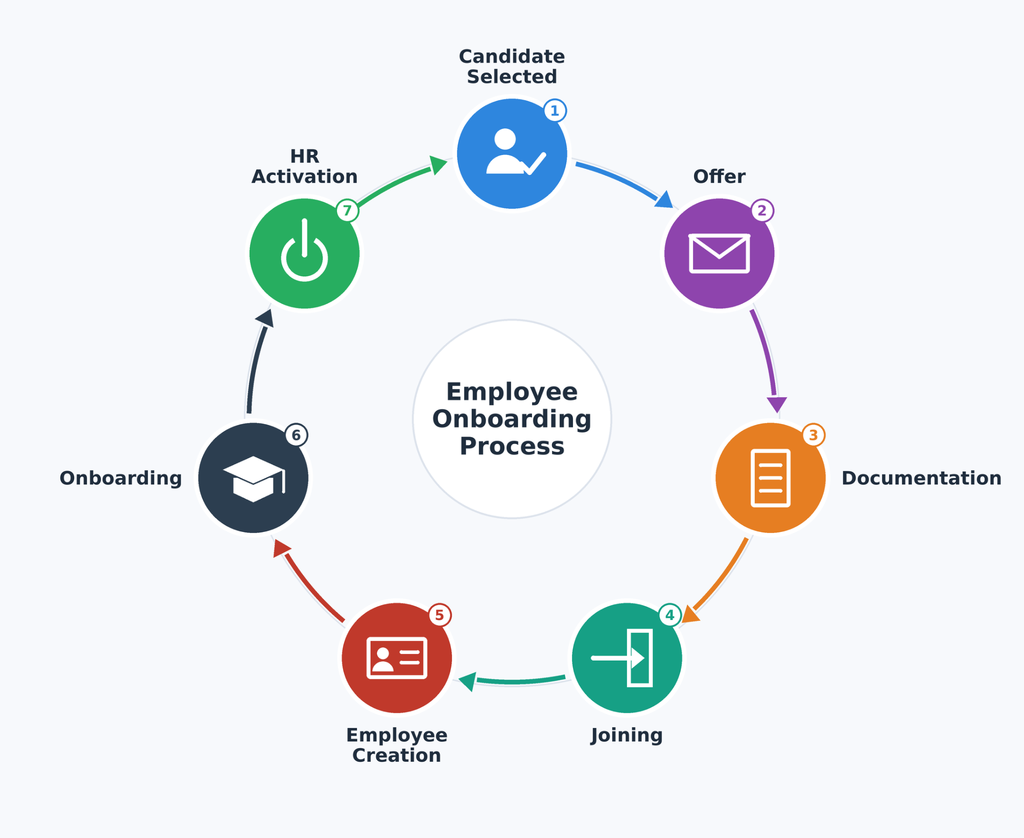
HR operations often work alongside recruitment teams to ensure that candidates transition smoothly from selection to employment.
The operational process may include:
3. Attendance Management
Attendance becomes increasingly complex when organizations have:
- Multiple locations
- Different shifts
- Field employees
- Hybrid employees
- Remote workers
- Overtime
- Flexible working arrangements
HR operations can help manage attendance data and ensure it is available for payroll and reporting.
4. Leave Management
Leave management includes:
- Leave policies
- Leave eligibility
- Leave balances
- Leave applications
- Manager approvals
- Holiday calendars
- Leave reports
5. Payroll Support
Payroll depends on several HR inputs, including:
- Salary structures
- Attendance
- Leave
- Overtime
- Incentives
- Deductions
- Employee status
- Statutory information
6. Compliance Management
HR operations support compliance by maintaining accurate employee records and ensuring that relevant processes, documentation, calculations, and reports are handled appropriately.
7. Employee Self-Service
Modern HR operations increasingly enable employees to perform routine activities themselves.
For example, employees can:
- Apply for leave
- View attendance
- Download payslips
- Access documents
- Raise HR requests
- View policies
- Update selected information
8. HR Reporting and Analytics
HR operations also converts employee data into useful information for HR leaders and managers.
What Does an HR Operations Team Do?
An HR operations team manages the execution of everyday HR processes and ensures that employee-related workflows are completed accurately and consistently.
Think of the team as the bridge between HR policies and actual employee experiences.
For example:
HR Policy: Employees are entitled to a defined number of annual leave days.
HR Operations: Configures the leave rule, assigns eligibility, maintains balances, manages requests, routes approvals, updates records, and generates reports.
This distinction is important.
HR operations is not simply about creating HR policies. It is about implementing and managing those policies through repeatable processes.
A General HR Operations Day
An HR operations team might simultaneously:
- Complete onboarding for new employees
- Resolve attendance corrections
- Process leave requests
- Validate payroll inputs
- Update employee information
- Respond to employee queries
- Prepare HR reports
- Monitor compliance activities
- Coordinate with finance
- Process employee transfers
- Support employee exits
The larger the workforce, the greater the volume of these activities.
Why Are HR Operations Important?
HR operations are important because they create structure and consistency across everyday employee processes. Efficient HR operations can reduce administrative work, improve employee data accuracy, support compliance, speed up approvals, and create a better employee experience.
Imagine a business with 1,000 employees.
If employee information, attendance, leave, payroll inputs, documents, and requests are maintained through separate spreadsheets, emails, and manual processes, even a small discrepancy can require significant effort to identify and correct.
The HR Operations Value Chain
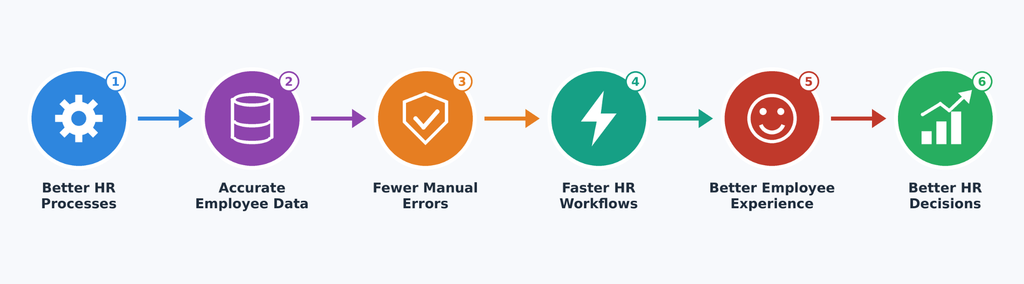
Strong HR operations can help businesses:
- Reduce repetitive administrative work
- Standardize processes
- Improve data accuracy
- Reduce approval delays
- Improve payroll inputs
- Give employees self-service access
- Improve HR reporting
- Support compliance
- Improve process visibility
- Scale HR as the workforce grows
A Workforce Perspective
According to EPFO’s provisional payroll data, 14.58 lakh net members were added in March 2025, including approximately 7.54 lakh new subscribers. This illustrates the scale of workforce administration involved in India’s formal employment ecosystem.
For HR teams, workforce growth means more:
Employees → Records → Attendance Events → Leave Requests → Payroll Inputs → Compliance Activities
This is why scalable HR operations become increasingly important as organizations grow.
What Are the Main HR Operations Processes?
The main HR operations processes generally follow the complete employee lifecycle, from recruitment and onboarding to attendance, payroll, compliance, employee support, and exit.
HR Operations Process Flow
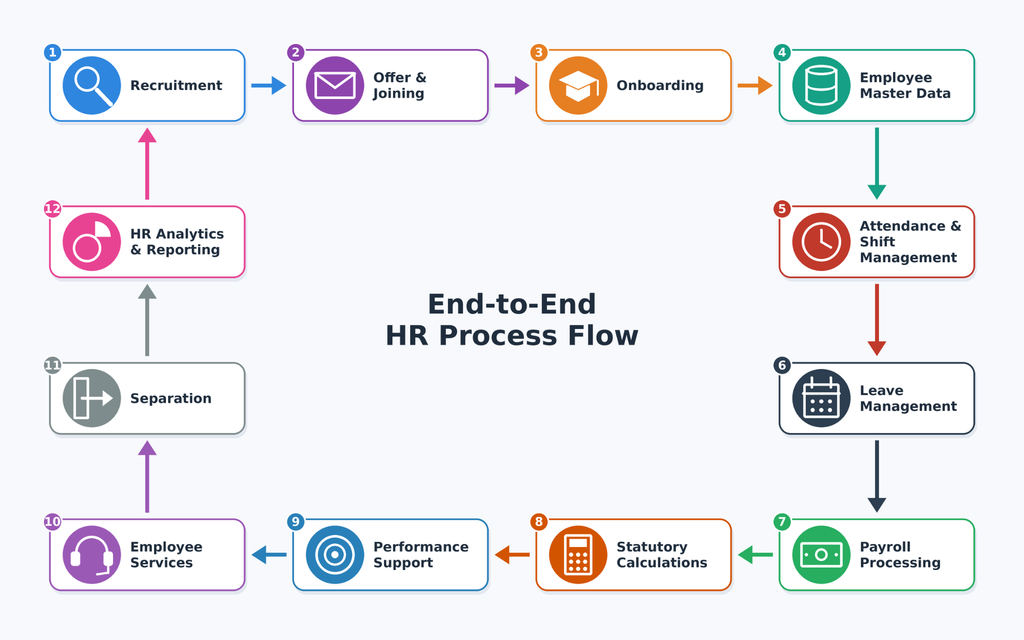
Let’s understand each stage.
1. Recruitment
The process begins when an organization identifies a workforce requirement and starts hiring.
2. Joining and Onboarding
Once selected, the candidate becomes an employee and completes documentation and joining formalities.
3. Employee Master Creation
Employee information becomes part of the organization’s HR database.
4. Attendance and Shift Management
The employee’s attendance, shifts, working hours, overtime, and related information are managed.
5. Leave Management
Leave eligibility, balances, applications, approvals, and holiday calendars are maintained.
6. Payroll
HR and payroll teams use employee information and attendance-related inputs to calculate salary and applicable deductions.
7. Compliance
Applicable statutory requirements are supported through accurate employee, payroll, and employment information.
8. Employee Services
Employees require ongoing access to documents, requests, policies, payslips, and HR information.
9. Separation
When an employee leaves, HR operations supports exit formalities, clearances, documentation, and final settlement inputs.
What Are the Biggest HR Operations Challenges?
As a business grows, HR operations can become harder to manage. More employees mean more attendance records, leave requests, payroll inputs, documents, approvals, and compliance requirements. When these processes are handled manually, even routine HR tasks can take more time and become prone to errors.
Another challenge is keeping everything connected and up to date. HR teams may have to work across spreadsheets, emails, attendance systems, and payroll tools, making it difficult to maintain accurate data and provide quick support to employees. Some of the most common HR operations challenges include:
- Manual and repetitive work that consumes HR time
- Scattered employee data across multiple systems
- Attendance and payroll errors caused by incorrect or delayed inputs
- Slow approval processes for leave and attendance requests
- Complex compliance requirements, especially across multiple locations
- Difficulty scaling HR processes as the workforce grows
- Limited real-time reporting for HR decision-making
- High volume of repetitive employee queries
How Does HRMS Improve HR Operations?
An HRMS (Human Resource Management System) improves HR operations by centralizing employee information and connecting important HR processes through digital workflows.
Instead of maintaining separate spreadsheets for employee data, attendance, leave, payroll, and reports, an HRMS can create a connected HR ecosystem.
Manual HR vs HRMS-Based HR Operations
| Manual HR Operations | HRMS-Based Operations |
| Multiple spreadsheets | Centralized employee database |
| Email-based approvals | Digital approval workflows |
| Manual attendance consolidation | Automated attendance processing |
| Manual leave tracking | Digital leave management |
| Repeated payroll inputs | Connected HR and payroll data |
| Manual reports | Automated dashboards |
| Paper-based documents | Digital records |
| HR handles routine queries | Employee self-service |
Example: Attendance to Payroll
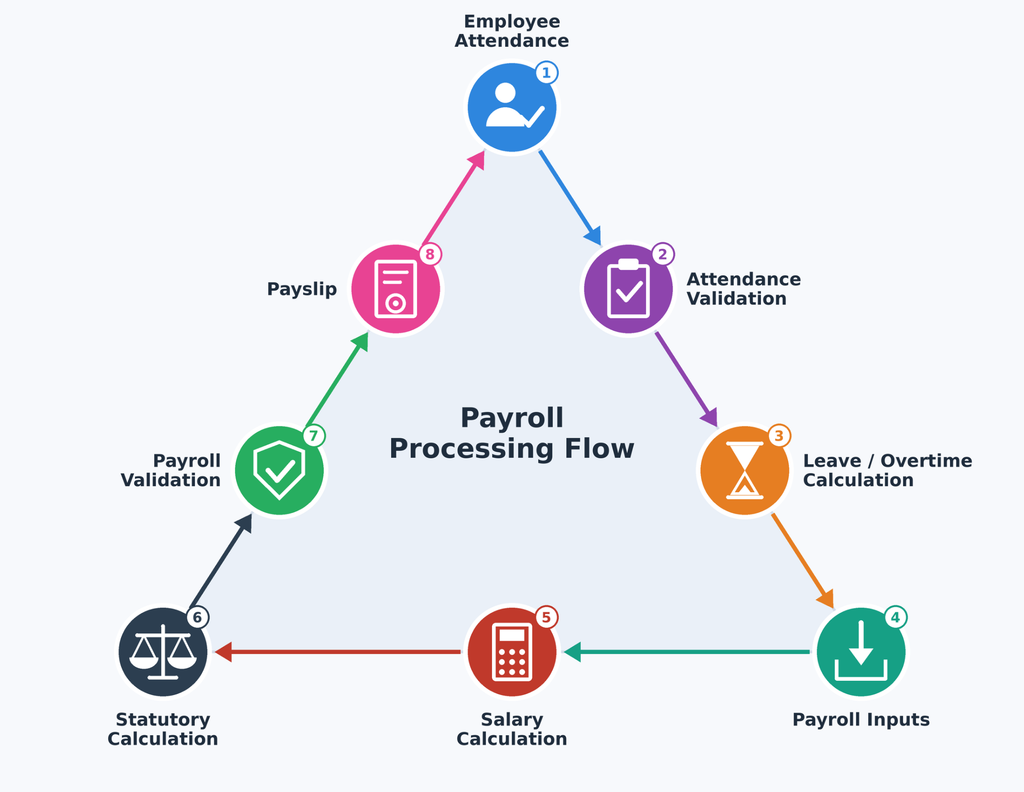
This connected approach reduces the need to repeatedly enter or transfer the same information between systems.
HRMS Can Help With
- Employee database management
- Attendance management
- Leave management
- Payroll
- Statutory compliance
- Recruitment
- Performance management
- Employee self-service
- HR reporting
- Workflow automation
- Mobile HR access
For businesses managing hundreds or thousands of employees, this centralization can become particularly valuable.
What Is the Role of HR Tech in HR Operations?
HR technology provides the systems and digital infrastructure that help HR teams automate, connect, analyze, and scale their operations.
Modern HR technology is moving HR operations away from repetitive administration and toward more connected, data-driven processes.
1. Automation
Technology can automate repetitive activities such as:
- Leave approvals
- Attendance calculations
- Payroll processing
- Notifications
- Employee onboarding tasks
- Report generation
2. Centralized Employee Data
A centralized employee database creates a consistent source of information for different HR functions.
3. Employee Self-Service
Employees can access information and complete routine tasks without depending on HR for every request.
4. Analytics
HR dashboards can help HR leaders monitor workforce trends and operational KPIs.
5. Integration
HR technology can connect:
Employee Data → Attendance → Leave → Payroll → Compliance → Reporting
6. Mobile HR
Mobile applications allow employees and managers to access HR services from smartphones, which can be particularly useful for field and distributed workforces.
7. AI-Assisted HR
AI is increasingly being incorporated into HR technology for tasks such as employee support, information retrieval, workflow assistance, analytics, and automation.
The goal is not to remove the human element from HR. Instead, technology can reduce repetitive work so HR professionals have more time for employee relations, workforce planning, engagement, organizational development, and strategic HR.
What Is the Difference Between HR Operations, HR Generalist, and HR Manager?
Although HR operations, HR generalist, and HR manager roles can overlap, their primary focus is different.
| Area | HR Operations | HR Generalist | HR Manager |
| Primary focus | HR processes and execution | Broad HR support | HR leadership and strategy |
| Employee data | High involvement | High involvement | Oversight |
| Attendance & leave | Core responsibility | Often involved | Oversees |
| Payroll | Coordinates/supports | May support | Oversees |
| Recruitment | Operational support | Often involved directly | Plans/oversees |
| Employee relations | Supports processes | Handles many cases | Handles complex cases |
| Compliance | Process and record support | Coordinates compliance | Ensures compliance |
| HR policies | Implements processes | Helps communicate/interpret | Develops/approves |
| Reporting | Generates operational reports | Uses HR reports | Uses data for decisions |
| Team management | May manage HR operations, team | Usually individual contributor | Often manages HR team |
| Strategic HR | Limited to moderate | Moderate | High |
| Main objective | Process efficiency | Broad employee support | Business-aligned people management |
In Simple Terms
HR Operations:
“How can we make HR processes work efficiently?”
HR Generalist:
“How can we support employees across different HR functions?”
HR Manager:
“How can we lead HR and align people practices with business goals?”
In smaller organizations, one person may perform all three types of responsibilities. As a company grows, these responsibilities often become more specialized.
How Does HR Operations Support Compliance in India?
Compliance can quickly become one of the most demanding parts of HR operations, especially for businesses managing employees across different locations. From maintaining employee records to handling payroll deductions, leave, attendance, and statutory requirements, HR teams need to make sure that everyday processes follow applicable labour laws and company policies.
The good news is that compliance does not have to be a last-minute activity. When compliance is built into day-to-day HR operations, businesses can reduce errors, maintain proper documentation, and respond more confidently during audits or inspections.
1. Maintaining Accurate Employee Records
Good compliance starts with accurate employee data. HR operations teams maintain important information such as employee details, joining dates, salary structures, attendance, leave records, and employment documents.
Keeping this information updated helps HR teams avoid errors and makes it easier to retrieve records whenever they are required for reporting, audits, or internal checks.
2. Managing Payroll and Statutory Deductions
Payroll is closely connected with compliance. HR operations need to ensure that salary calculations and applicable statutory deductions are processed correctly and on time.
Depending on the organization and applicable laws, this can involve areas such as EPF, ESI, Professional Tax, TDS, gratuity, bonus, and other statutory requirements.
Automating these calculations through HR technology can reduce manual errors and make payroll processing more consistent.
3. Tracking Attendance, Leave and Working Hours
Attendance and leave management may look like routine HR activities, but they can have a direct impact on compliance and payroll accuracy.
HR operations teams need to maintain reliable records of working days, leave, overtime, holidays, and attendance exceptions. A structured attendance system helps ensure that payroll inputs are based on accurate and traceable data.
4. Keeping Up With Changing Labour Laws
Indian labour regulations and statutory requirements can change over time. HR teams therefore need a process for monitoring regulatory updates and assessing how changes may affect their organization.
This becomes even more important for companies operating across multiple states, where some requirements may vary based on location and employee category.
5. Maintaining Documents for Audits
Imagine being asked for a particular employee record during an audit and having to search through multiple spreadsheets, emails, and physical files. It can quickly become stressful.
HR operations help prevent this by maintaining organized employee documentation, payroll records, attendance data, policy documents, and compliance-related information. Proper record-keeping makes audits and internal reviews much easier.
6. Using HRMS to Make Compliance Easier
An HRMS can bring several compliance-related HR processes together in one system. Instead of maintaining separate spreadsheets for employee information, attendance, leave, payroll, and reports, HR teams can manage these activities through connected workflows.
This can help businesses:
- Reduce manual data-entry errors
- Standardize HR processes
- Maintain centralized employee records
- Automate payroll-related calculations
- Track attendance and leave accurately
- Generate reports more quickly
- Maintain better documentation and audit trails
- Improve visibility into compliance-related activities
Compliance Should Be Part of Everyday HR Operations
The key takeaway is simple: HR compliance works best when it is built into everyday processes rather than treated as a separate task. Accurate data, timely payroll, organized records, proper approvals, and regular monitoring all contribute to a stronger compliance framework.
With the right HR processes and technology in place, businesses can spend less time chasing paperwork and more time focusing on their employees and growth, while keeping compliance firmly under control.
How Can Businesses Measure HR Operations Efficiency?
One of the most important steps toward better HR operations is measurement.
Instead of simply asking whether the HR team is busy, organizations should ask:
How efficiently are HR processes being completed?
1. Payroll Accuracy
A simple measure can be:
Payroll Accuracy = Correct Payroll Transactions ÷ Total Payroll Transactions × 100
2. Onboarding Completion Rate
Onboarding Completion Rate = Completed Onboardings ÷ Total New Joiners × 100
3. HR Query Resolution Time
Track the average time required to resolve employee questions.
4. Leave Approval Turnaround
Measure the time between leave submission and final approval.
5. Employee Data Accuracy
Track the percentage of employee records that are complete and consistent.
6. Process Automation Rate
Organizations can also monitor what proportion of eligible HR processes are automated.
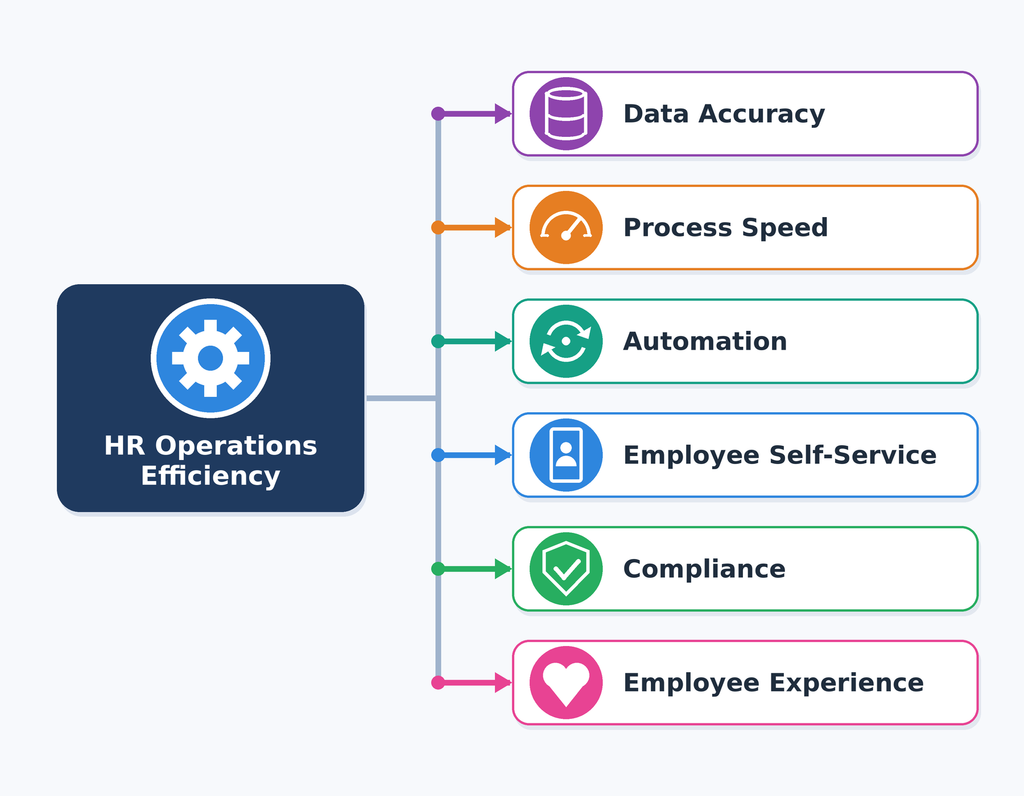
Together, these metrics provide a more complete view of HR operations performance.
Conclusion
HR operations is the foundation that keeps an organization’s everyday people processes running smoothly. From employee onboarding and data management to attendance, leave, payroll, compliance, employee support, and separation, efficient HR operations create consistency across the entire employee lifecycle.
As organizations grow, managing these activities manually becomes increasingly difficult. Standardized processes, accurate data, employee self-service, automation, analytics, and the right HR technology can help HR teams build an operation that is faster, more reliable, and easier to scale.

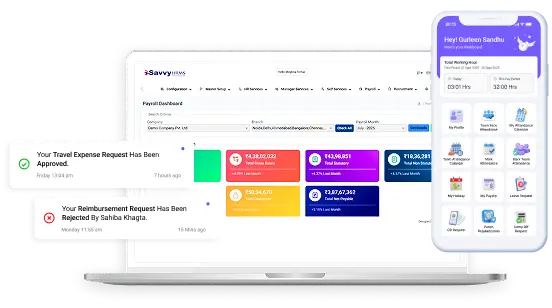









Simplify Your HR Operations with Savvy HRMS
Transform everyday HR processes with Savvy HRMS, an integrated HRMS solution designed to simplify employee management, attendance, leave, payroll, compliance, workflows, reporting, and employee self-service from one platform.
Frequently Asked Questions (FAQs)
1. What is the role of HR operations?
HR operations manages the day-to-day processes that keep an organisation’s workforce running smoothly. This includes employee records, onboarding, attendance, leave, payroll coordination, benefits, compliance, HR documentation, and employee support. The goal is to make HR processes accurate, consistent, efficient, and easy to manage.
2. What are the 7 functions of HR?
The seven key functions of HR are generally workforce planning, recruitment and onboarding, employee training and development, performance management, compensation and benefits, employee relations, and HR compliance. Together, these functions help organisations attract, manage, develop, and retain employees effectively.
3. What is HR operations salary?
HR operations salary varies depending on factors such as job role, experience, location, company size, and industry. Entry-level HR operations professionals generally earn less than experienced HR operations executives, managers, and specialists. In India, salary can range from entry-level packages to significantly higher compensation for professionals managing large or complex HR operations
4. What are the 5 main areas of HR?
The five main areas of HR are commonly considered recruitment and staffing, employee development, compensation and benefits, employee relations, and HR administration and compliance. These areas cover the major stages of the employee lifecycle, from hiring and onboarding to development, payroll, engagement, and exit.
5. Why is HR operations important for businesses?
HR operations are important because they create the processes and systems needed to manage employees efficiently. It helps businesses maintain accurate employee data, streamline attendance and leave management, support payroll, improve compliance, reduce repetitive manual work, and provide employees with faster HR support. As a company grows, efficient HR operations also make it easier to scale HR processes without adding unnecessary administrative complexity.