




Imagine you have just received a job offer that says “₹10 LPA”. It sounds straightforward; you might immediately divide ₹10 lakh by 12 and assume your monthly salary will be around ₹83,333.
But then your first salary arrives, and the amount credited to your bank account is much lower.
So, where did the difference go?
This is exactly why understanding what is LPA in salary matters. LPA tells you the annual value of your salary, but it does not necessarily tell you how much you will receive every month. Your CTC structure, basic salary, employer contributions, income tax, PF, professional tax, and other deductions can all affect your actual take-home pay.
In this blog, we will break down LPA salary meaning, LPA calculation, monthly salary from LPA, CTC vs LPA, in-hand salary, tax deductions, and salary packages in India. By the end, you’ll know how to look beyond the headline number and understand what an LPA offer actually means for your pocket.
TL;DR
- LPA means Lakhs Per Annum and represents annual salary in lakh rupees.
- ₹1 LPA means an annual salary value of ₹1,00,000.
- To convert LPA into annual rupees, multiply the LPA figure by ₹1 lakh.
- To find the basic monthly equivalent, divide the annual amount by 12.
- LPA is not necessarily the same as in-hand salary.
- CTC can be higher than your actual gross or take-home salary because it may include employer contributions and benefits.
- For example, ₹10 LPA equals approximately ₹83,333 per month before deductions if ₹10 lakh is the annual gross salary.
- Your actual in-hand salary depends on salary components, PF, income tax, professional tax, insurance, and other deductions.
- Under the FY 2026-27 new tax regime, the income-tax slabs range from 0% up to ₹4 lakh to 30% above ₹24 lakh.
- A good LPA salary depends on your experience, job role, location, industry, skills, and cost of living, not just the number itself.
What Is LPA in Salary?
LPA in salary means Lakhs Per Annum. It is a commonly used way of expressing annual salary in India.
“Lakh” means ₹1,00,000, while “per annum” means per year. Therefore:
1 LPA = ₹1,00,000 per year
So, if a company offers you 6 LPA, the annual salary value is ₹6,00,000.
Similarly:
| LPA Salary | Annual Salary | Approx. Monthly Equivalent* |
| 3 LPA | ₹3,00,000 | ₹25,000 |
| 5 LPA | ₹5,00,000 | ₹41,667 |
| 6 LPA | ₹6,00,000 | ₹50,000 |
| 8 LPA | ₹8,00,000 | ₹66,667 |
| 10 LPA | ₹10,00,000 | ₹83,333 |
| 12 LPA | ₹12,00,000 | ₹1,00,000 |
| 15 LPA | ₹15,00,000 | ₹1,25,000 |
| 20 LPA | ₹20,00,000 | ₹1,66,667 |
*Monthly equivalent assumes the full annual amount is divided equally across 12 months. It does not represent guaranteed monthly in-hand salary.
This difference is important. When a recruiter says “₹10 LPA salary”, you should ask whether ₹10 lakh refers to CTC, gross salary, fixed compensation, or total compensation.
A salary offer can look attractive on paper but have a significantly different monthly payout depending on its structure.
A simple way to understand LPA
Annual salary → Divide by 12 → Monthly gross equivalent → Subtract applicable deductions → Approx. in-hand salary
That is why knowing what is LPA in salary is only the first step. Understanding what makes up that LPA is equally important.
What Is the Full Form of LPA?
The full form of LPA in salary is “Lakhs Per Annum.”
It is primarily used in India to describe an employee’s annual compensation.
For example:
- 4 LPA = ₹4 lakh per year
- 7 LPA = ₹7 lakh per year
- 10 LPA = ₹10 lakh per year
- 18 LPA = ₹18 lakh per year
The term is especially common in job descriptions, recruitment discussions, offer letters, salary negotiations, and employee compensation structures.
One common mistake is assuming that “10 LPA” automatically means ₹83,333 will be credited to your bank account every month.
That calculation only works if the entire ₹10 lakh represents annual gross salary with no deductions or excluded components.
In reality, salary structures can include components such as:
- Basic salary
- House Rent Allowance (HRA)
- Special allowance
- Performance bonus
- Employer PF contribution
- Gratuity
- Insurance benefits
- Other allowances and benefits
Therefore, always look at the salary breakup instead of focusing only on the LPA figure.
How Is LPA Calculated in Salary?
Calculating LPA salary is simple when you know the annual compensation.
Formula
LPA = Annual Salary ÷ ₹1,00,000
For example, if your annual salary is ₹8,00,000:
₹8,00,000 ÷ ₹1,00,000 = 8 LPA
To convert LPA back into annual salary:
Annual Salary = LPA × ₹1,00,000
For example:
10 LPA × ₹1,00,000 = ₹10,00,000 per year
To calculate the monthly equivalent:
Monthly Salary = Annual Salary ÷ 12
Therefore:
₹10,00,000 ÷ 12 = ₹83,333 per month approximately
However, this is only the monthly equivalent, not necessarily your monthly take-home salary.
LPA calculation flow
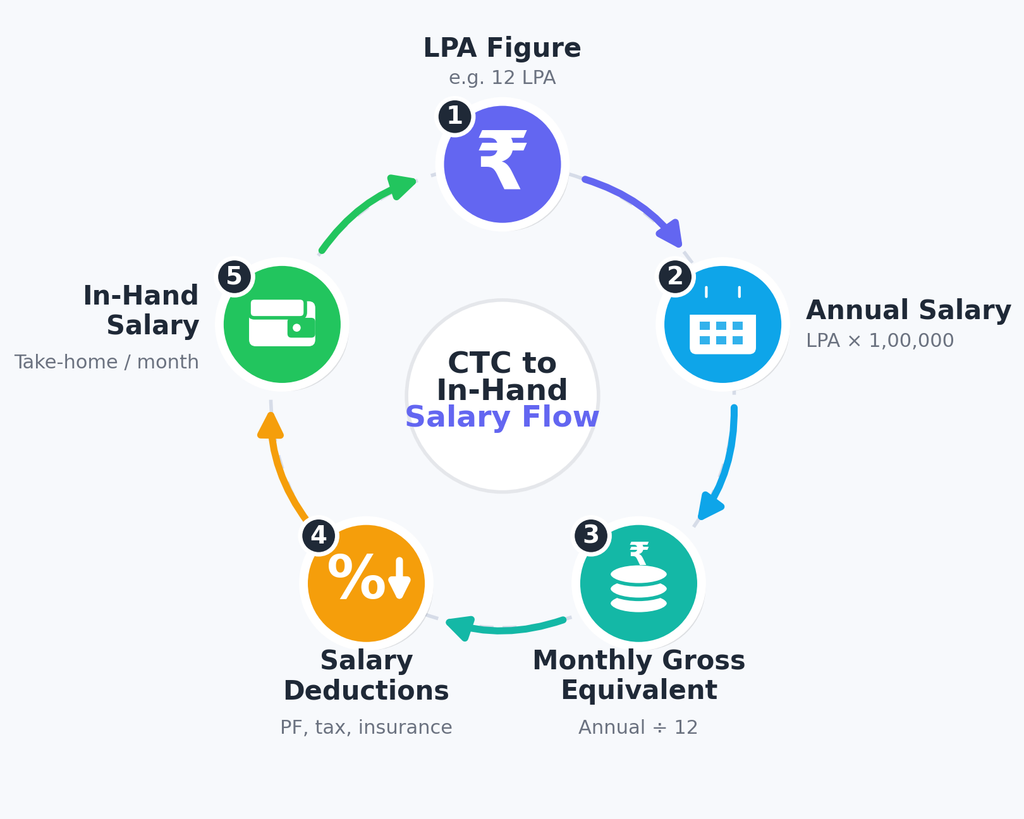
For example:
10 LPA → ₹10,00,000 annually → ₹83,333 monthly equivalent → PF + tax + other deductions → Actual bank credit
This simple flow is useful when comparing job offers because it prevents you from treating annual CTC and monthly take-home pay as the same thing.
Is LPA the Same as CTC?
No. LPA and CTC are not necessarily the same thing.
LPA is simply a way of expressing an annual amount. CTC, or Cost to Company, represents the total annual cost that an employer incurs for an employee under the company’s compensation structure.
For example, suppose your offer says:
CTC = ₹10 LPA
Your CTC may include:
- Basic salary
- HRA
- Other allowances
- Employer PF contribution
- Gratuity
- Medical or insurance benefits
- Variable pay or performance bonus
So, your actual monthly salary may be lower than ₹83,333.
Consider an illustrative salary structure:
| Component | Annual Amount |
| Basic + allowances | ₹8,20,000 |
| Employer PF contribution | ₹72,000 |
| Gratuity/other benefits | ₹48,000 |
| Variable pay | ₹60,000 |
| Total CTC | ₹10,00,000 |
In this example, the employee does not receive the entire ₹10 lakh as monthly y.
This is why candidates should ask recruiters:
“Is this ₹10 LPA fixed salary, gross salary, or total CTC?”
That one question can make a major difference when comparing two offers.
LPA to Monthly Take-Home Salary: Old Tax Regime vs New Tax Regime
Your LPA salary and monthly take-home salary are connected, but they are not identical.
Tax is one of the factors that can reduce your final salary, and the applicable tax regime can influence the amount you retain.
For FY 2026-27, the new tax regime continues with slabs starting at 0% up to ₹4 lakh and reaching 30% above ₹24 lakh. The government did not change these slab rates for FY 2026–27.
New Tax Regime: FY 2026-27
| Taxable Income | Tax Rate |
| Up to ₹4 lakh | Nil |
| ₹4 lakh-₹8 lakh | 5% |
| ₹8 lakh-₹12 lakh | 10% |
| ₹12 lakh-₹16 lakh | 15% |
| ₹16 lakh-₹20 lakh | 20% |
| ₹20 lakh-₹24 lakh | 25% |
| Above ₹24 lakh | 30% |
The new regime also provides a Section 87A rebate for eligible resident individuals with taxable income up to ₹12 lakh, subject to the applicable conditions. For salaried employees, the ₹75,000 standard deduction means a gross salary of up to approximately ₹12.75 lakh can potentially result in zero income tax under the new regime, assuming the relevant conditions are met.
The old regime continues to have different slab rates and allows a wider range of deductions and exemptions.
Why your tax regime matters
Consider an employee with a ₹15 lakh annual gross salary.
Under the new regime, assuming only the ₹75,000 standard deduction and no other taxable-income adjustments:
₹15,00,000 − ₹75,000 = ₹14,25,000 taxable income
The slab-based tax before cess would be approximately:
- ₹0-₹4 lakh: ₹0
- ₹4-₹8 lakh: ₹20,000
- ₹8-₹12 lakh: ₹40,000
- ₹12-₹14.25 lakh: ₹33,750
Total tax = ₹93,750
After 4% health and education cess, the amount would be approximately ₹97,500, subject to the individual’s exact tax position.
This is an illustration, not a universal in-hand salary calculation. PF, professional tax, insurance, variable pay, and the actual salary structure can further change the amount credited to your account.
The important takeaway is simple:
Higher LPA does not automatically mean the same proportionate increase in take-home pay.
Is LPA the Same as In-Hand Salary?
No. LPA salary and in-hand salary are different.
LPA generally describes an annual compensation figure, while in-hand salary is the amount that actually reaches your bank account after applicable deductions.
For example:
10 LPA annual salary
could translate into:
₹83,333 monthly gross equivalent
But your actual bank credit may be lower because of:
- Employee PF contribution
- Income tax/TDS
- Professional tax, where applicable
- Insurance deductions
- Other employee deductions
- Salary sacrifice or benefits
- Variable-pay structure
This is why two employees earning the same LPA can receive different monthly amounts.
For example, Employee A may have a higher basic salary and therefore a higher PF contribution, while Employee B may have a different salary structure.
The headline “10 LPA” is the same, but their take-home salary can differ.
How Much Is 5 LPA Salary Per Month?
If the annual salary is exactly ₹5 lakh:
₹5,00,000 ÷ 12 = ₹41,667 per month approximately
So, 5 LPA salary equals approximately ₹41,667 per month before deductions.
However, the actual in-hand amount can be lower depending on the salary structure.
Under the FY 2026-27 new tax regime, a ₹5 lakh taxable income falls within the lower slabs, and eligible taxpayers may also benefit from the Section 87A rebate. Therefore, income tax may not be the biggest deduction at this salary level.
For a fresher receiving a 5 LPA package, it is particularly important to check whether the offer includes:
- Variable pay
- Employer PF
- Gratuity
- Insurance
- Joining or retention bonuses
A ₹5 LPA CTC should not automatically be interpreted as ₹41,667 of monthly take-home pay.
How Much Is 10 LPA Salary Per Month?
For a ₹10 lakh annual salary:
₹10,00,000 ÷ 12 = ₹83,333 per month approximately
Therefore, 10 LPA salary is approximately ₹83,333 per month before deductions, assuming ₹10 lakh represents annual gross salary.
If the ₹10 lakh figure represents CTC, your actual gross monthly salary may be lower.
For example, if employer PF, gratuity, insurance, and variable pay are included within CTC, the monthly fixed salary could be significantly different from ₹83,333.
For FY 2026-27, an employee with ₹10 lakh gross salary who qualifies for the new-regime standard deduction and applicable rebate may have no final income-tax liability, subject to the applicable conditions. This does not mean the entire ₹10 lakh becomes take-home pay because PF and other deductions can still apply.
How Much Is 15 LPA Salary Per Month?
A ₹15 lakh annual salary works out to:
₹15,00,000 ÷ 12 = ₹1,25,000 per month
So, 15 LPA salary equals approximately ₹1.25 lakh per month before deductions, if the ₹15 lakh figure represents annual gross salary.
Under the FY 2026-27 new tax regime, after applying the ₹75,000 standard deduction, ₹15 lakh gross salary would give an illustrative taxable income of ₹14.25 lakh. The calculated income tax before cess is approximately ₹93,750, or approximately ₹97,500 after 4% cess, before considering other applicable factors.
If employee PF were, for illustration, ₹72,000 annually, the amount remaining after that PF and the illustrative tax would be around:
₹15,00,000 − ₹72,000 − ₹97,500 = ₹13,30,500 annually
That equals approximately:
₹1,10,875 per month
Again, this is an illustrative calculation, not a guaranteed take-home salary. Actual salary structures vary considerably.
What Is the Difference Between LPA, CTC, Gross Salary and In-Hand Salary?
These four terms are often used together, but they describe different things.
| Term | Meaning |
| LPA | A unit used to express annual salary in lakh rupees |
| CTC | Total annual cost incurred by the employer for the employee |
| Gross Salary | Salary earned before employee-side deductions |
| In-Hand Salary | Amount actually credited after applicable deductions |
Think of it this way:
CTC → Gross/Fixed Salary → Deductions → In-Hand Salary
For example, a ₹10 LPA CTC may contain employer contributions and benefits. Your gross salary may therefore be lower than ₹10 lakh. After employee deductions and applicable taxes, the final amount deposited into your bank account may be lower still.
Why this difference matters
Suppose Company A offers:
₹10 LPA CTC
and Company B offers:
₹9.2 LPA fixed compensation
At first look, Company A appears better.
But if Company A includes a large variable component, gratuity, employer PF, and insurance within its ₹10 LPA CTC, Company B could potentially provide a higher predictable monthly salary.
So, when comparing salary offers, don’t compare only the LPA number.
Compare:
Fixed pay + variable pay + employer contributions + benefits + expected deductions + actual monthly take-home
That gives you a much more realistic picture.
What Factors Affect In-Hand Salary From LPA?
Your LPA is only one part of the calculation. Several factors can affect the amount that finally reaches your bank account.
1. Salary structure
The split between basic salary, HRA, allowances, special pay, variable pay, and other components affects deductions and benefits.
2. Employee PF contribution
EPF contributions are generally linked to eligible basic wages and applicable rules. In establishments where the 12% rate applies, employee and employer contributions are generally calculated at 12% of the relevant wage base, subject to statutory provisions.
3. Income tax
Your tax liability depends on taxable income, selected regime, deductions/rebates, and other applicable provisions.
4. Professional tax
Some states levy professional tax on eligible employees. The amount and rules vary by state.
5. Variable pay
A portion of your LPA may be linked to performance or company targets rather than being paid as fixed monthly salary.
6. Employer contributions
Employer PF, gratuity, insurance, and other benefits can form part of CTC without appearing as cash in your monthly salary.
7. Insurance and other benefits
Health insurance premiums or other employee-benefit costs may be included within the overall compensation structure.
8. Location and state-specific rules
Salary-related deductions and payroll requirements can vary based on the employee’s work location and applicable state regulations.
Therefore, there is no single “10 LPA in-hand salary” figure that applies to everyone.
How Do Income Tax, PF, and Other Deductions Affect LPA Salary?
Think of your salary as moving through several stages.
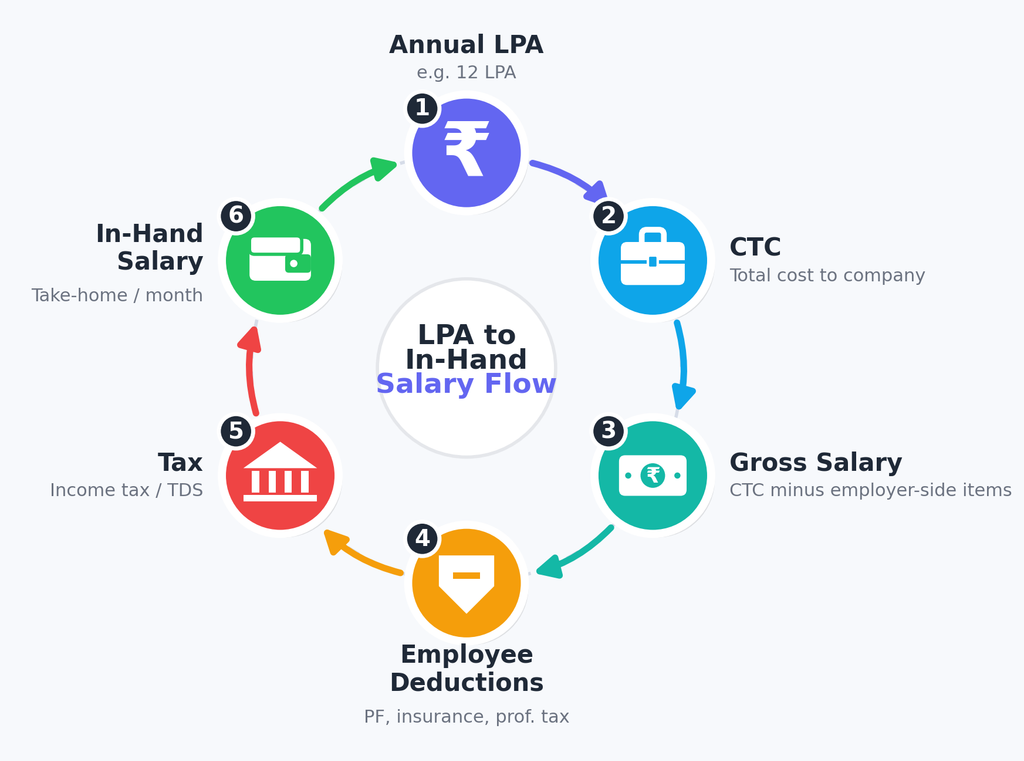
For example, suppose an employee has a ₹15 LPA gross salary.
The calculation may look broadly like this:
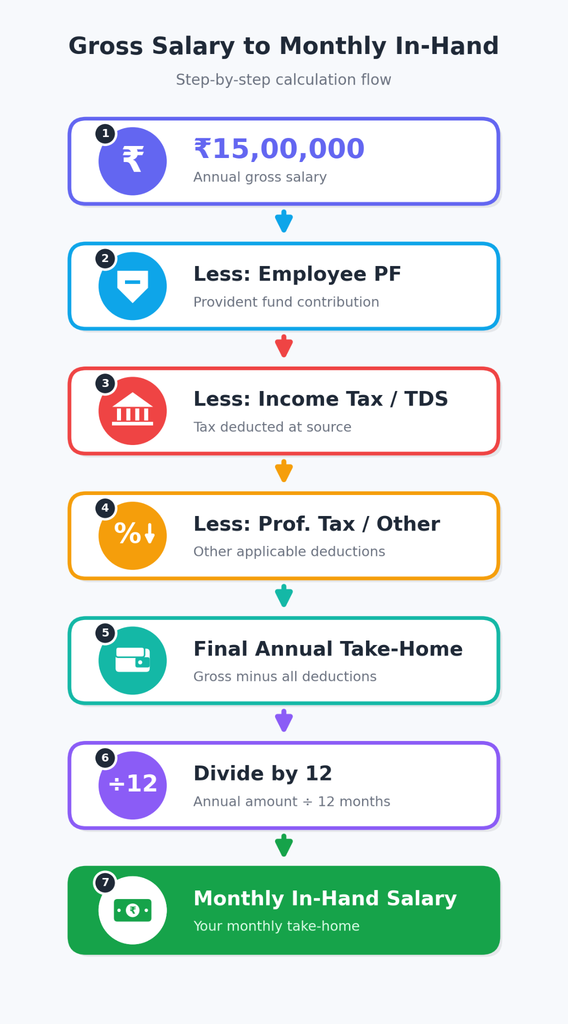
The actual calculation depends heavily on the company’s salary structure.
Why PF matters
PF is not simply “money lost from salary.” It is a statutory retirement-oriented contribution that helps build long-term savings.
This means an employee might see a lower monthly bank credit while simultaneously building retirement savings through PF.
That is why comparing job offers only on monthly cash can sometimes give an incomplete picture.
Why TDS matters
TDS, or Tax Deducted at Source, allows employers to deduct applicable income tax from salary and deposit it with the government.
Your monthly TDS may vary during the year depending on your projected annual taxable income, declarations, regime selection, and payroll calculations.
This is another reason why monthly salary can change during a financial year.
How to Calculate In-Hand Salary From LPA?
There is no universal formula that can produce exact in-hand salary from LPA without knowing the salary structure.
However, you can use this basic approach:
Step 1: Identify the annual LPA
Suppose:
LPA = ₹12 lakh
Step 2: Find out whether it is CTC or gross salary
This is important.
If it is CTC, identify employer PF, gratuity, insurance, variable pay, and other components.
Step 3: Calculate gross/fixed salary
Remove components that are not directly paid as monthly salary.
Step 4: Calculate employee-side deductions
These may include:
- Employee PF
- Professional tax
- Insurance
- Other payroll deductions
Step 5: Calculate income tax
Apply the relevant tax regime, standard deduction, eligible deductions/rebates, and applicable tax rates.
Step 6: Divide annual take-home by 12
This gives an approximate monthly in-hand salary.
In-hand salary calculation flow
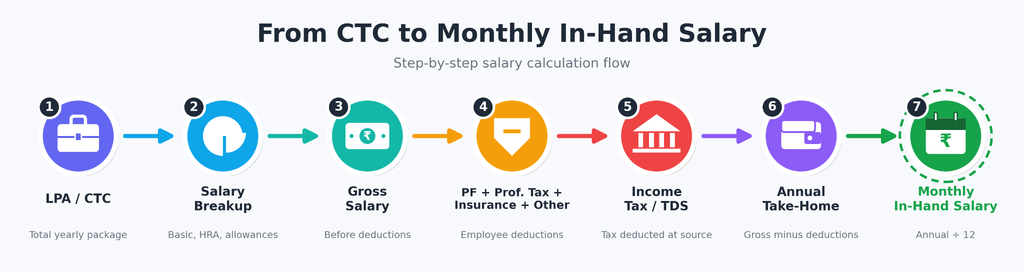
This approach is much more accurate than simply dividing CTC by 12.
What Should You Check in an LPA Salary Package?
Before accepting a job offer, don’t stop at the LPA figure.
Check the complete compensation structure.
1. Fixed Salary
Check how much of the quoted LPA is guaranteed as fixed compensation. A higher fixed component generally gives you a clearer picture of your predictable monthly earnings.
- Monthly fixed pay
- Annual fixed compensation
- Guaranteed allowances
2. Variable Pay
Understand how much of your salary depends on performance, targets, or company results. Variable pay may not be paid fully every month or every year.
- Performance bonus
- Sales incentives
- Annual variable pay
- Target-based incentives
3. Basic Salary
Basic salary is an important component because it can influence PF, gratuity, and other salary-linked calculations. Check its proportion within your overall salary structure.
- Basic salary amount
- Percentage of gross salary
- Impact on PF and gratuity
4. Employer PF & Gratuity
Check whether employer PF contributions and gratuity are included in your quoted CTC. These amounts can increase CTC without directly increasing your monthly in-hand salary.
- Employer PF contribution
- Gratuity component
- Whether included in CTC
- Amount payable directly vs accrued benefits
5. Income Tax & Other Deductions
Your actual take-home salary depends on applicable income tax, PF, professional tax, insurance, and other deductions. Review these before estimating your monthly bank credit.
- Income tax/TDS
- Employee PF
- Professional tax
- Insurance or other deductions
6. Monthly Gross & In-Hand Salary
Don’t assume that dividing LPA by 12 gives your actual take-home pay. Ask the employer for an indicative monthly gross and expected in-hand salary.
- Monthly gross salary
- Expected monthly take-home
- Estimated deductions
- Salary credit date
7. Bonus & Other Benefits
Check whether bonuses, insurance, reimbursements, or other benefits form part of the quoted package. These can make the total compensation look higher than the regular monthly salary.
- Joining bonus
- Retention bonus
- Health insurance
- Reimbursements
- Other employee benefits
8. Salary Revision & Employment Terms
A good salary package should also be evaluated alongside future growth and employment conditions. A slightly lower starting salary may offer better long-term career and compensation progression.
- Appraisal cycle
- Expected salary revision
- Notice period
- Probation terms
- Career-growth opportunities
Quick checklist:
LPA → CTC breakup → Fixed Pay → Variable Pay → PF & Gratuity → Tax & Deductions → In-Hand Salary → Benefits & Growth
Conclusion
Understanding what is LPA in salary is important because the number mentioned in a job offer is not always the amount you receive every month. LPA represents annual compensation, while CTC, gross salary, deductions, and in-hand salary describe different stages of your actual pay.
Before comparing two salary offers, look beyond the headline LPA. Check fixed pay, variable components, PF, tax, benefits, deductions, and expected monthly take-home. A clear salary breakup helps you make a more informed career and financial decision.

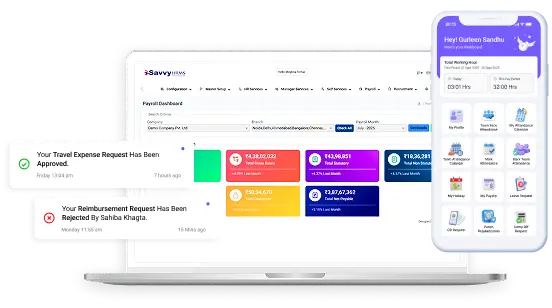









Want to simplify salary calculations, payroll processing, deductions, and employee compensation management?
Explore Savvy HRMS to manage payroll and HR processes more efficiently.
Frequently Asked Questions (FAQs)
What is LPA in salary?
LPA stands for Lakhs Per Annum and is used to express annual salary in India. For example, 5 LPA means an annual salary of ₹5 lakh, before considering applicable salary deductions.
What is 1 LPA salary?
1 LPA means ₹1 lakh per year. Dividing ₹1,00,000 by 12 gives an approximate monthly salary of ₹8,333 before deductions. The actual in-hand amount depends on the salary structure and applicable deductions.
What is 50 LPA in salary?
50 LPA means ₹50 lakh per year. Divided by 12, it equals an approximate monthly salary of ₹4,16,667 before deductions. The actual take-home salary will depend on taxes, PF, salary components, and other deductions.
Is LPA the same as CTC?
No. LPA is a way of expressing an annual salary or compensation amount, while CTC (Cost to Company) represents the total annual cost incurred by an employer. CTC can include employer PF, gratuity, insurance, bonuses, and other benefits.
How much is 10 LPA salary per month?
A 10 LPA salary equals ₹10 lakh annually, which works out to approximately ₹83,333 per month before deductions. The actual in-hand salary may be lower depending on tax, PF, and the employee’s salary structure.
Is LPA the same as in-hand salary?
No. LPA represents an annual compensation figure, whereas in-hand salary is the amount actually credited to your bank account. PF, income tax, professional tax, insurance, and other deductions can reduce the final monthly amount.