

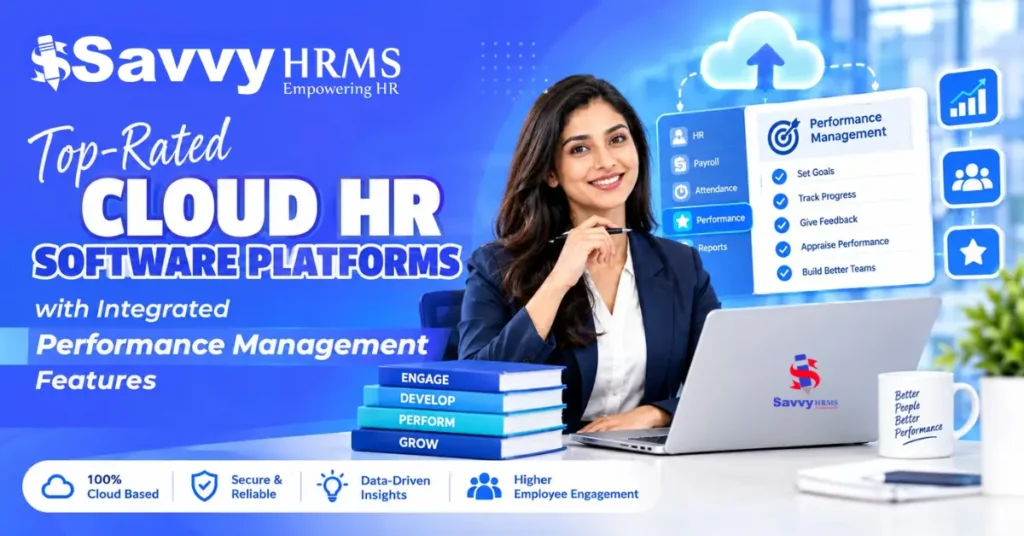

Top-rated cloud HR software platforms are changing the way organizations manage employees, performance, payroll, attendance, and everyday HR tasks. Instead of depending on spreadsheets, emails, and separate tools, companies can now bring employee information, goals, reviews, feedback, and HR processes together in one cloud-based platform.
But choosing the right platform is not always easy. There are many HR software providers in India, and each one approaches performance management differently. Some focus heavily on appraisals, while others include OKRs, continuous feedback, talent analytics, or enterprise-wide HR automation.
In this blog, we compare some leading cloud HR software platforms, including Savvy HRMS, Darwinbox, greytHR, Keka HR, ZingHR, and PeopleStrong. We will look at their performance management capabilities, employee reviews, goal tracking, suitability for different business sizes, pricing considerations, and the features you should evaluate before making a decision.
TL;DR
- Cloud HR software combines HR processes with performance management in one platform.
- Top options include Savvy HRMS, Darwinbox, greytHR, Keka HR, ZingHR, and PeopleStrong.
- Key features include goal tracking, KRA/KPI management, appraisals, 360° feedback, OKRs, and performance analytics.
- The right platform depends on business size, HR requirements, performance framework, and budget.
- Integrated HR and performance management can reduce manual work and improve performance visibility and employee development.
- Businesses should compare features, pricing, integrations, scalability, and ease of use before choosing a platform.
What Is Cloud HR Software with Integrated Performance Management?
Cloud HR software is an online HR management platform that allows organizations to manage employee-related processes through a centralized system. Because the software is hosted in the cloud, HR teams and employees can access relevant information through the internet without depending entirely on locally installed systems.
When performance management is integrated into cloud HR software, organizations can connect employee information with goals, KRAs, KPIs, appraisals, feedback, reviews, and performance reports.
In simple terms, instead of using:
Excel → Email → Separate appraisal tool → Attendance system → Payroll software → Reports
a company can use:
Cloud HRMS → Employee Data → Goals → Performance → Payroll → Analytics
This integration is important because employee performance rarely exists in isolation. Attendance, job roles, compensation, learning, goals, feedback, and employee development can all influence how HR teams evaluate performance.
For example, Savvy HRMS combines HR processes with performance management capabilities such as goal setting, KRA/KPI weightage, performance monitoring, 180/360-degree feedback, Balanced Scorecard, Nine Box Grid, and performance-linked increments.
Cloud HR software generally brings together:
- Core HR and employee records
- Attendance and leave management
- Payroll and statutory compliance
- Employee self-service
- Goal and KPI management
- Performance reviews
- 180/360-degree feedback
- Appraisal workflows
- Performance analytics
- Learning and development
- Recruitment and onboarding
- Employee engagement
The biggest advantage is connected data. HR does not have to move information manually between multiple systems every time a performance cycle begins.
What Are the Best Cloud HR Software Platforms with Performance Management?
There is no single HR software that is automatically the best for every organization. The right choice depends on employee strength, HR complexity, industry, budget, required integrations, performance framework, and the level of customization required.
For businesses evaluating cloud HR software in India, these six platforms are worth considering:
| Platform | Performance Management | Goal/KPI Management | Feedback | Best Suited For |
| Savvy HRMS | Yes | KRA/KPI, goals, Balanced Scorecard | 180°/360° | Indian businesses looking for integrated HRMS |
| Darwinbox | Yes | OKRs, MBO, multiple frameworks | Continuous & multi-stakeholder | Mid-market and enterprise organizations |
| greytHR | Yes | Goal plans | Continuous & 360° | SMBs and growing businesses |
| Keka HR | Yes | Goals & OKRs | 360°, continuous feedback | Growing and mid-sized companies |
| ZingHR | Yes | KPIs, OKRs, BSC | 360° | Organizations seeking broad HCM capabilities |
| PeopleStrong | Yes | OKRs, MBO, BSC | 360° & continuous | Larger organizations and enterprises |
These cloud HR platforms offer different approaches to performance management, including goal tracking, appraisals, feedback, analytics, and talent development. Features, pricing, integrations, and availability vary, so businesses should compare options based on their specific requirements.
Which Cloud HR Software Has the Best Performance Management Features?
If performance management is the primary buying criterion, look beyond the simple presence of an “appraisal” module.
A strong performance management system should ideally cover the complete performance cycle:
Goal Setting → Goal Tracking → Feedback → Review → Calibration → Analytics → Development → Rewards
1. Savvy HRMS
Savvy HRMS offers integrated performance management features including goal setting, KRA and KPI weightage, real-time performance monitoring, 180- and 360-degree feedback, Balanced Scorecard, Nine Box Grid, performance analytics, and structured appraisal workflows for organizations.
Its performance management capabilities can also connect with broader HR processes, including employee management, attendance, payroll, and increment management. This integrated approach helps businesses manage performance reviews and related HR activities through a centralized cloud-based platform.
2. Darwinbox
Darwinbox provides configurable performance management with OKRs, MBO, goal cascading, continuous feedback, check-ins, multi-stakeholder reviews, and analytics. Its platform is designed for organizations looking for a flexible performance framework and broader talent management capabilities across different teams.
3. greytHR
greytHR offers goal planning, performance reviews, 360-degree feedback, and performance calibration. Its calibration capabilities help organizations create more consistent evaluations, while its performance management tools support structured appraisal cycles and employee development.
4. Keka HR
Keka HR combines performance reviews with goals, OKRs, 360-degree feedback, continuous feedback, and one-on-one conversations. Its approach focuses on making performance management an ongoing process that supports employee development, manager engagement, and regular performance discussions.
5. ZingHR
ZingHR supports performance management through KPIs, OKRs, Balanced Scorecard, 360-degree feedback, bell-curve analysis, and career planning. These capabilities help organizations structure performance evaluations, monitor employee progress, identify development needs, and support data-driven talent decisions.
6. PeopleStrong
PeopleStrong provides configurable performance cycles, goals, continuous feedback, 360-degree reviews, and performance analytics. It supports frameworks such as OKRs, MBO, and Balanced Scorecards, along with capabilities including 9-box talent mapping, bell-curve analytics, and performance diaries.
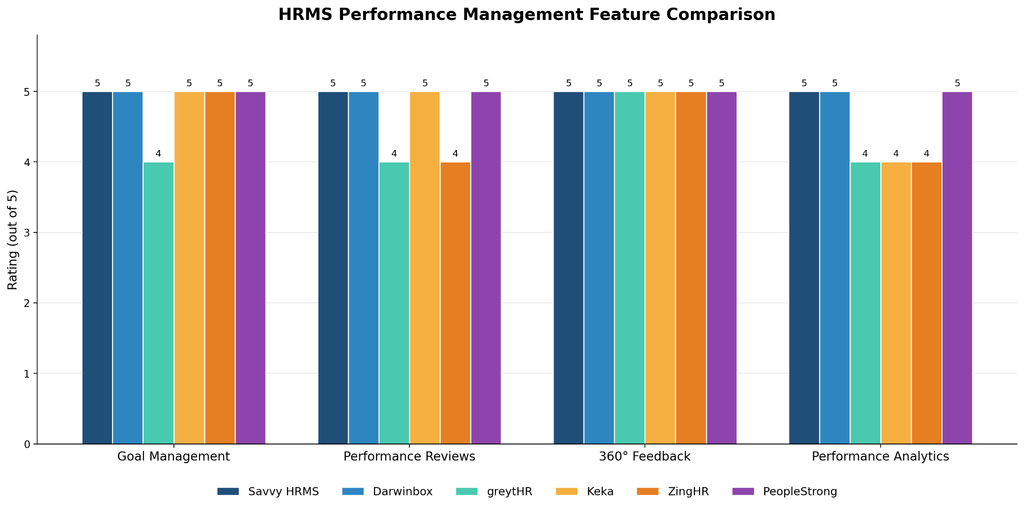
This visual is an editorial comparison based on the breadth of features publicly described by each vendor; it is not an independent performance score or user-review rating.
What Features Should Cloud HR Software Include for Performance Management?
The best cloud HR software should make performance management an ongoing process rather than something HR does once a year.
Here are the most important features to look for:
1. Goal and KPI Management
Employees should know exactly what they are expected to achieve. The platform should allow HR and managers to define measurable goals, KRAs, KPIs, or OKRs and monitor progress.
2. Flexible Review Cycles
Not every organization follows an annual appraisal cycle. Look for software that supports annual, half-yearly, quarterly, or other customized review frequencies.
Savvy HRMS, for example, lists flexible review and appraisal frequencies as part of its performance management offering.
3. Self-Appraisal and Manager Reviews
Employees should be able to assess their own performance while managers provide structured evaluations. This creates a two-way performance conversation rather than a one-sided rating exercise.
4. 180° and 360° Feedback
360-degree feedback brings multiple perspectives into the review process, including feedback from managers, peers, subordinates, or other contributors.
5. Continuous Feedback
Waiting 12 months to discuss performance can make feedback less useful. Continuous feedback helps managers address issues closer to when they happen.
6. Performance Calibration
Calibration can help organizations make ratings more consistent across teams and managers. Some software providers, for example, provide a calibration feature using a Bell Curve approach.
7. Performance Analytics
Dashboards can help HR identify:
- High performers
- Employees needing support
- Goal completion trends
- Department-level performance
- Skill gaps
- Rating distributions
- Development requirements
8. Nine Box Grid
A Nine Box Grid can help HR evaluate employees based on performance and potential. Savvy HRMS includes Nine Box Grid functionality in its performance management system.
9. Integration With Rewards and Compensation
Performance becomes more useful when appraisal outcomes can support decisions around increments, rewards, promotions, and development.
Which Cloud HR Software Is Best for Employee Performance Reviews?
For employee performance reviews, the best choice depends on how structured and configurable your review process needs to be.
Savvy HRMS is a strong option for businesses that want performance reviews integrated with HR, payroll, and other employee processes. Its published features include self-review, approver review, self-appraisal, approver appraisal, KRA acceptance, and feedback.
Darwinbox is particularly suitable for organizations that need highly configurable performance reasoning and multiple stakeholder feedback. Its platform supports customized review cycles, continuous feedback, and multi-stakeholder participation.
greytHR provides structured review cycles, ratings, comments, assessment timelines, and 360-degree feedback.
Keka focuses on 360-degree reviews, one-on-ones, and continuous feedback alongside goal management.
PeopleStrong supports customizable review cycles, ratings, feedback, and automated rating mechanisms.
For a company that simply wants to move away from spreadsheet-based appraisals, almost any of these platforms can represent an improvement. The more important question is whether the software fits the company’s actual appraisal philosophy.
Which Cloud HR Software Is Best for Goal Setting and OKR Tracking?
Goal management is one of the most important parts of modern performance management.
A good platform should connect:
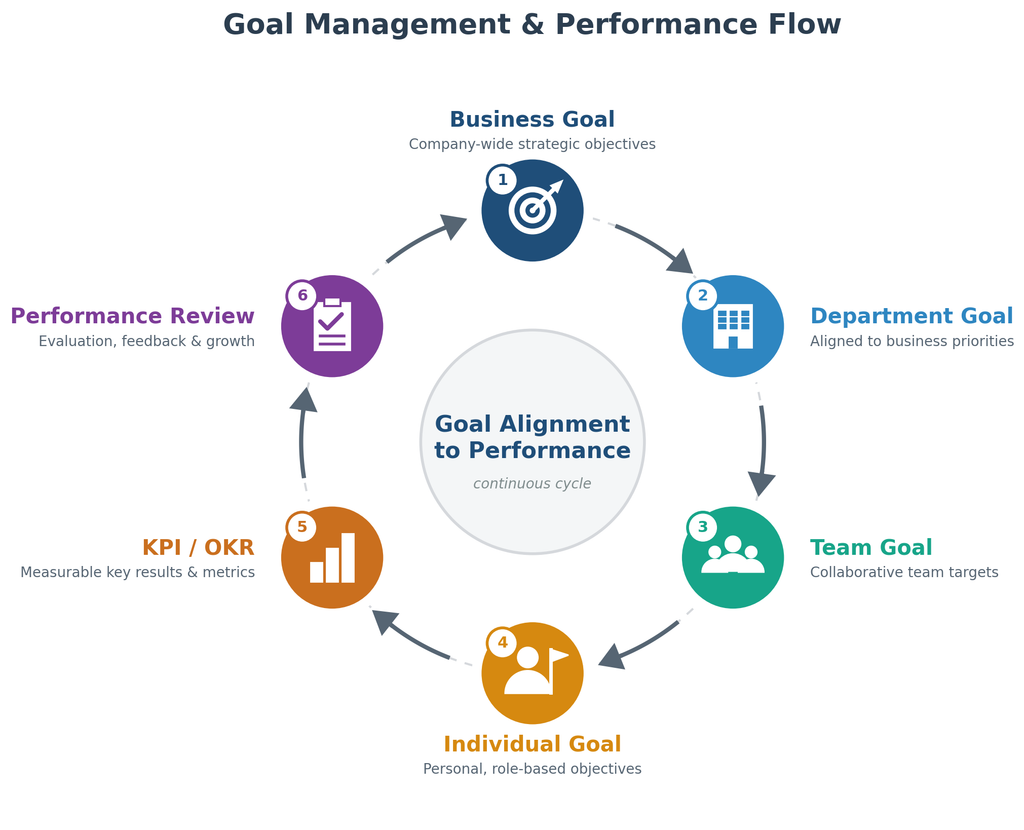
Savvy HRMS focuses on management- and employee-driven KRAs/KPIs and real-time performance monitoring. Its performance system also supports Balanced Scorecard functionality.
Darwinbox has a particularly strong emphasis on OKRs. Its platform supports goal cascading, goal plans, auto-sync goal achievement, and multiple performance frameworks.
Keka supports collaborative goals and OKRs and allows employees to track their progress.
PeopleStrong supports OKRs, MBO, and Balanced Scorecard frameworks, while ZingHR promotes KPIs, OKRs, and BSC as part of its performance management system.
What should you choose?
- KRA/KPI-focused organization: Savvy HRMS
- Highly configurable enterprise OKRs: Darwinbox
- Goal plans with broader HR workflows: greytHR
- OKRs + continuous feedback: Keka
- OKR/KPI/BSC combination: ZingHR
- Multiple performance frameworks: PeopleStrong
The right answer depends less on which platform has the longest feature list and more on which performance methodology your organization actually uses.
Which Cloud HR Software Is Best for Small Businesses?
Small and growing businesses usually have different HR software requirements from large enterprises.
They often want:
- Easy implementation
- Simple employee management
- Payroll integration
- Attendance and leave management
- Performance reviews
- Affordable pricing
- Employee self-service
- Minimal administrative complexity
Savvy HRMS can be a practical choice when a growing Indian business wants performance management alongside core HR, attendance, and payroll instead of purchasing various disconnected systems. Its pricing page currently lists Core and Edge plans and places Talent & Performance capabilities in the Pulse tier and above.
greytHR is another option worth evaluating for small and growing organizations. Its performance management module is available as an add-on or within higher plans, according to its current plan information.
Keka can also suit growing organizations that want performance management with goals, OKRs, 360-degree reviews, and continuous feedback.
For a small business, however, “best” should mean easy enough for employees and managers to actually use. A feature-rich system that nobody adopts will not produce better performance management.
Which Cloud HR Software Is Best for Large Enterprises?
Large organizations generally need more than basic appraisal software.
They may require:
- Multiple business units
- Complex approval hierarchies
- Multiple performance frameworks
- Goal cascading
- 360-degree feedback
- Calibration
- Talent analytics
- Succession planning
- Career development
- Learning integration
- Advanced reporting
- Enterprise integrations
- Mobile access
Savvy HRMS can be considered by larger Indian organizations that want a unified HRMS covering attendance, payroll, performance, and related employee processes. Its OCCL case study, for example, describes a 2,000+ employee manufacturing organization using Savvy HRMS to consolidate attendance, leave, performance appraisals and training.
Darwinbox is positioned strongly toward enterprise performance management, with configurable frameworks, continuous feedback, analytics, multi-stakeholder feedback, and talent development capabilities. Darwinbox currently reports more than 1,400 enterprises on its performance management page.
PeopleStrong also targets larger organizations with performance management, talent management, analytics, and multiple performance frameworks.
Enterprise selection rule
For large enterprises, prioritize configuration, integrations, data security, scalability, reporting, implementation support, and change management over simply counting features.
Which Cloud HR Software Is Best for Businesses in India?
For Indian businesses, cloud HR software should do more than manage employee performance.
It should fit Indian HR workflows around:
- Payroll
- PF
- ESIC
- Professional Tax
- TDS
- Attendance
- Leave policies
- Multiple shifts
- Employee self-service
- Statutory compliance
- Performance management
This is where an India-focused HRMS can have a practical advantage.
Savvy HRMS is particularly relevant for Indian organizations because its platform combines HR management, attendance, payroll, and performance management, while its pricing and product structure are presented specifically for the Indian market.
Darwinbox, greytHR, Keka, ZingHR, and PeopleStrong are also established options for organizations operating in India, but their ideal customer profiles and implementation requirements can differ.
India-focused comparison
| Requirement | Savvy HRMS | Darwinbox | greytHR | Keka | ZingHR | PeopleStrong |
| Core HR | ✓ | ✓ | ✓ | ✓ | ✓ | ✓ |
| Performance Management | ✓ | ✓ | ✓ | ✓ | ✓ | ✓ |
| Payroll | ✓ | ✓ | ✓ | ✓ | ✓ | ✓ |
| Attendance | ✓ | ✓ | ✓ | ✓ | ✓ | ✓ |
| Goal/KPI Management | ✓ | ✓ | ✓ | ✓ | ✓ | ✓ |
| 360° Feedback | ✓ | ✓ | ✓ | ✓ | ✓ | ✓ |
| Enterprise Talent Features | ✓ | ✓ | ✓ | ✓ | ✓ | ✓ |
The table is a high-level editorial comparison, not a statement that every feature is included in every pricing tier.
How Much Does Cloud HR Software with Performance Management Cost?
There is no universal price for cloud HR software.
Pricing can depend on:
- Number of employees
- Modules selected
- Payroll requirements
- Performance management features
- Implementation
- Integrations
- Customization
- Support
- Contract duration
- Enterprise requirements
For example, Savvy HRMS currently lists its Edge plan at ₹6,000/month, starting from ₹120 per employee, while its Pulse plan adds Talent & Performance features and requires contacting sales.
greytHR currently states that its Performance Management Software is available as an add-on, with pricing starting at ₹35 per user per month.
These figures should be treated as published starting prices, not guaranteed final quotes.
A simple way to calculate your expected software budget
Estimated annual software cost = Monthly platform cost × 12 + implementation/integration costs
For example, if a business has 200 employees and a vendor quotes ₹100 per employee per month:
200 × ₹100 × 12 = ₹2,40,000 per year
Actual costs can be higher or lower depending on the package and commercial terms.
Pricing comparison graph
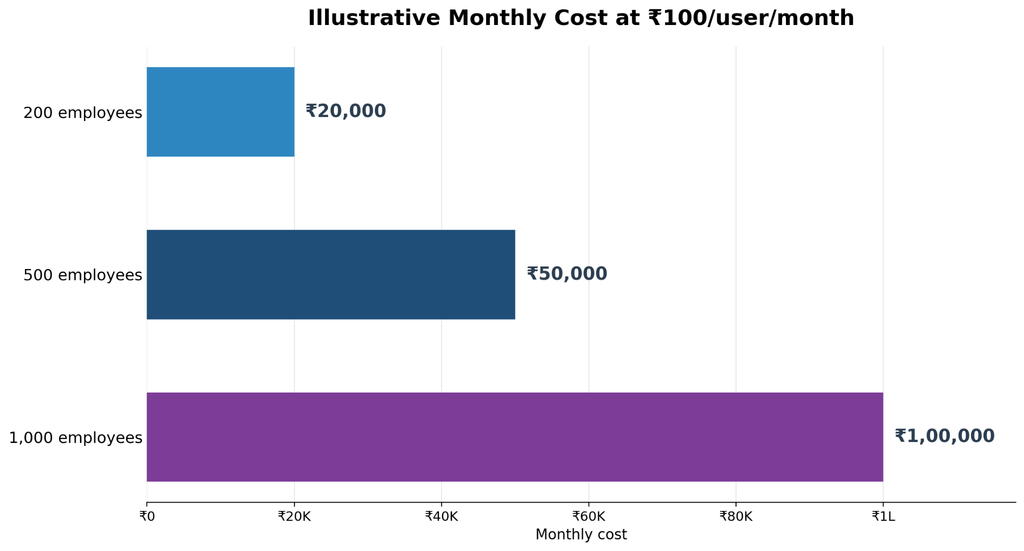
Illustrative calculation only; this is not vendor pricing.
The important point is that the cheapest HR software is not necessarily the lowest-cost solution. If a platform reduces manual work, improves data accuracy, and eliminates multiple disconnected systems, its total business value may be higher.
How Does Cloud HR Software Improve Employee Performance?
Cloud HR software improves performance management mainly by making information available at the right time.
Instead of waiting for an annual review, managers can see goals, feedback, progress, and performance information throughout the year.
1. Clearer goals
Employees can see what they are expected to achieve and how their goals connect with team or organizational objectives.
2. Faster feedback
Managers can provide feedback closer to the actual event instead of trying to remember an entire year’s performance.
3. Less manual work
Automated reminders, review workflows, and reports reduce the administrative work involved in performance cycles.
4. Better performance visibility
Dashboards allow HR and managers to identify trends across departments, teams, and individuals.
5. More consistent evaluations
Standardized rating scales, review workflows, and calibration can make performance evaluations more structured.
6. Better development decisions
Performance data can reveal skill gaps and help HR determine where training or development is required.
Savvy HRMS, for example, describes its platform as supporting real-time performance monitoring, continuous feedback, performance analytics, and identification of training needs based on performance scores.
Darwinbox similarly connects performance information with talent development, career planning and succession-related processes.
How Do the Top Cloud HR Software Platforms Compare?
Rather than asking which software has the most features, compare platforms against the areas that matter most to your organization.
| Evaluation Area | Savvy HRMS | Darwinbox | greytHR | Keka | ZingHR | PeopleStrong |
| HRMS integration | Strong | Strong | Strong | Strong | Strong | Strong |
| Performance reviews | Strong | Strong | Strong | Strong | Strong | Strong |
| KRA/KPI | Strong | Strong | Strong | Strong | Strong | Strong |
| OKRs | Available/goal-focused | Strong | Goal-focused | Strong | Strong | Strong |
| 360° feedback | ✓ | ✓ | ✓ | ✓ | ✓ | ✓ |
| Continuous feedback | ✓ | ✓ | ✓ | ✓ | ✓ | ✓ |
| Analytics | ✓ | Advanced | ✓ | ✓ | ✓ | Advanced |
| Calibration | ✓ | ✓ | ✓ | Available | ✓ | ✓ |
| Nine Box | ✓ | Talent analytics | — | — | — | ✓ |
| Payroll integration | ✓ | ✓ | ✓ | ✓ | ✓ | ✓ |
| India HR workflows | Strong | Strong | Strong | Strong | Strong | Strong |
Feature availability can vary by plan, edition, configuration, and implementation. Always validate specific requirements with the vendor.
Vendor-reported performance data
Some vendors publish customer or product metrics that help illustrate scale, but these should not be treated as independent rankings.
- Savvy HRMS: publishes a case study involving OCCL, a 2,000+ employee organization, where the platform was used to consolidate HR processes including performance appraisals.
- Darwinbox: reports 97% on-time performance-cycle completion and 90% 360-degree feedback adoption on its performance management page.
- PeopleStrong: reports a case study with 1,166 branches, 87% alignment with system-computed ratings, and 100% HR-team adoption for that customer example.
- Keka: states that more than 10,000 organizations use its platform and that 19,750+ HR executives use Keka daily on one of its performance pages.
What these numbers tell you
The numbers demonstrate that vendors have different ways of measuring product adoption and outcomes. They should be used as supporting evidence, not as a substitute for product demonstrations, customer references, or your own requirements analysis.
What Are the Benefits of Integrated HR and Performance Management Software?
The biggest benefit of integrated HR and performance management software is simple: HR data stays connected.
Instead of maintaining employee information in one system and performance information somewhere else, an integrated cloud HRMS creates a shared data environment.
Key benefits include:
1. One employee record
Employee information, roles, departments, and other HR data can feed into performance workflows.
2. Less spreadsheet dependency
Automated workflows reduce the need to maintain separate performance trackers.
3. Faster appraisal cycles
Automated notifications and approval workflows can reduce delays.
4. Better goal alignment
Business goals can be translated into departmental and individual objectives.
5. More transparent reviews
Employees can participate through self-reviews, feedback, and goal tracking.
6. Better HR analytics
HR teams can identify performance patterns and development requirements.
7. Stronger employee development
Performance data can support learning, training, and career planning.
8. Better compensation decisions
Where supported, performance results can contribute to increments and reward decisions.
Savvy HRMS specifically links its performance management capabilities with increment software, allowing organizations to connect performance ratings with performance-based increments.
How to Choose the Best Cloud HR Software for Your Business?
Choosing cloud HR software should start with your HR problems, not with a vendor’s feature list.
Use this checklist before making a decision.
1. Define your performance process
Do you use:
- KRAs?
- KPIs?
- OKRs?
- MBO?
- Balanced Scorecard?
- 180-degree feedback?
- 360-degree feedback?
The software should support your preferred approach.
2. Check how configurable the system is
Ask whether you can customize:
- Rating scales
- Review cycles
- Approval workflows
- Goal structures
- Competencies
- Weightages
- Employee hierarchies
3. Check integration with payroll and attendance
If performance data needs to influence compensation, make sure the performance module works with your payroll and employee data.
4. Evaluate employee experience
Ask employees and managers to test the platform.
A technically powerful system will not deliver value if users find it difficult to navigate.
5. Review reporting capabilities
Look for dashboards that answer questions such as:
- Which employees are high performers?
- Which goals are falling behind?
- Which departments have lower performance?
- Where are skill gaps appearing?
- How are ratings distributed?
6. Check mobile access
For distributed and field teams, mobile access can make goal tracking, feedback, and employee self-service more practical.
7. Understand the total cost
Don’t compare only the monthly subscription.
Ask about:
- Implementation
- Migration
- Customization
- Integrations
- Support
- Additional modules
- Additional users
- Training
8. Ask for a live demonstration
A product demo should use your actual HR workflow, not only a generic presentation.
For example, ask the vendor to demonstrate:
Employee Creation → Goal Assignment → KRA/KPI Weightage → Self-Appraisal → Manager Review → 360° Feedback → Calibration → Final Rating → Increment
If the entire process can be completed smoothly, you have a much better basis for comparison.
Quick buying checklist
Before selecting a cloud HR software platform, ask:
☐ Does it support our performance framework?
☐ Can HR customize review cycles?
☐ Can employees complete self-reviews?
☐ Does it support 180°/360° feedback?
☐ Can managers track goals in real time?
☐ Does it provide performance analytics?
☐ Can it integrate with payroll and attendance?
☐ Is mobile access available?
☐ Can it scale as our workforce grows?
☐ What is the complete annual cost?
☐ What implementation and support are included?
☐ Can we test the platform before purchasing?
Conclusion
The best cloud HR software with integrated performance management is not necessarily the platform with the longest feature list. It is the one that fits your organization’s HR processes, employee size, performance philosophy, budget, and future growth.
For Indian businesses looking for an integrated HRMS, Savvy HRMS is a strong option to evaluate first, particularly when you want HR management, payroll, attendance, and performance management connected in one platform. Its performance capabilities cover goals, KRAs/KPIs, flexible appraisal cycles, self and manager reviews, 180/360-degree feedback, Balanced Scorecard, Nine Box Grid, and performance analytics.
Darwinbox is worth considering for organizations that need highly configurable enterprise performance frameworks and advanced talent capabilities. greytHR can appeal to businesses looking for structured PMS workflows, while Keka combines performance management with goals, OKRs, 360-degree reviews and continuous feedback. ZingHR provides a broader HCM approach with KPIs, OKRs, BSC and 360-degree feedback, while PeopleStrong offers multiple performance frameworks, analytics and talent management capabilities.
The final decision should come down to one question: Which platform can make your HR team’s performance management process simpler, more measurable, and easier for employees and managers to use?
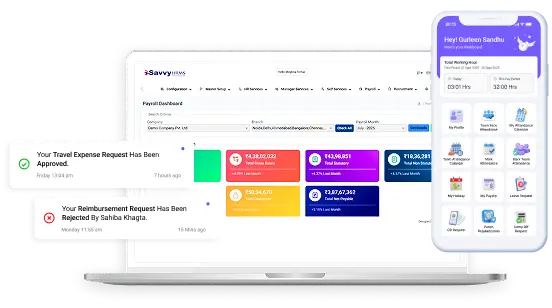





Ready to simplify HR and performance management in one place?
Explore Savvy HRMS and see how its integrated cloud HRMS, payroll, attendance, and performance management capabilities can help your organization build a more structured and data-driven HR process.
Frequently Asked Questions (FAQs)
1. What is cloud HR software with performance management?
Cloud HR software with performance management combines core HR functions with tools for setting goals, tracking KPIs, conducting performance reviews, collecting feedback, and analyzing employee performance through a centralized online platform.
2. Which cloud HR software is best for performance management?
The best cloud HR software depends on your organization’s size, performance framework, budget, and required features. Leading options include Savvy HRMS, Darwinbox, greytHR, Keka HR, ZingHR, and PeopleStrong.
3. What features should performance management software include?
Important features include goal and KPI tracking, KRA management, performance reviews, self-appraisals, 180- or 360-degree feedback, continuous feedback, customizable rating scales, performance analytics, calibration, and development tracking.
4. How much does cloud HR software with performance management cost?
Cloud HR software pricing varies based on employee count, modules, features, implementation, integrations, and support requirements. Some providers offer per-user pricing, while others provide customized plans based on organizational requirements.
5. Can cloud HR software improve employee performance?
Yes. Cloud HR software can improve performance management by making goals clearer, automating review workflows, enabling continuous feedback, providing performance insights, and helping managers identify development opportunities using centralized employee data.