

What is ESIC Number? Meaning, Benefits and How to Check Online


-
AuthorRuchika Rajput
-
 Last Updated
June 17, 2026
Last Updated
June 17, 2026
-
 Reading Time
12 Mins
Reading Time
12 Mins
If a salaried employee in India takes a close look at their salary slip, chances are the term ESIC is right there, quietly getting deducted every month. Most employees notice it but never quite understand what it covers or how to actually use it.
So let’s clear that up right now.
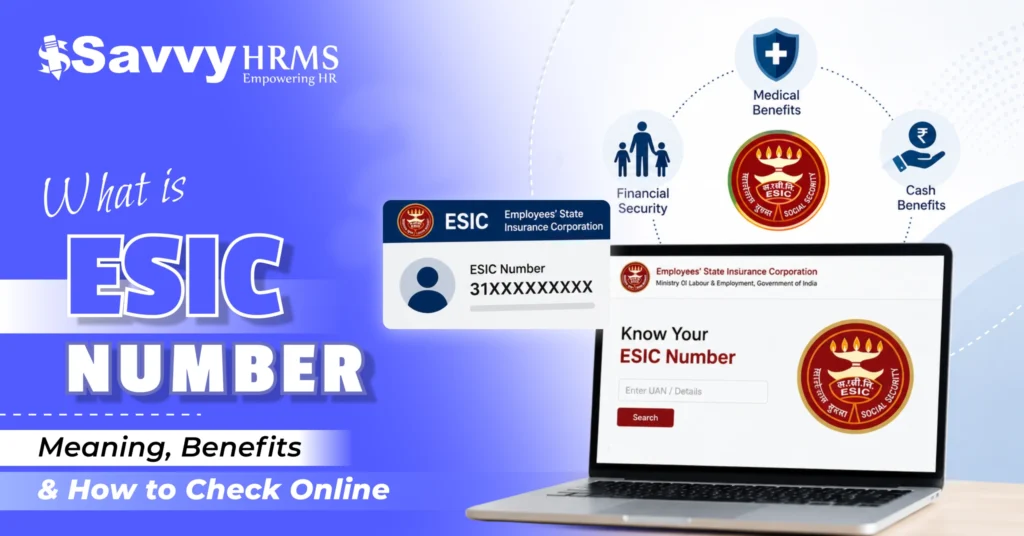
ESIC, which stands for Employees’ State Insurance Corporation, is a government-run social security scheme designed to protect workers and their families during tough times. Think medical emergencies, maternity leave, workplace injuries, or even job loss. An ESIC number is an employee’s personal key to accessing all of these benefits, and for those who don’t know theirs yet, it’s time to find out.
In this blog, we will walk through everything, including what is ESIC number is, why it matters, how to get it, check it, and make the most of it. Let’s dive in.
What is ESIC Number?
Let’s start with the basics!
ESIC full form is Employees’ State Insurance Corporation. The ESIC, Employees’ State Insurance Corporation, is a government body under the Ministry of Labour and Employment that runs this scheme. Think of it as a social security safety net for employees across India.
An ESIC number (also called an insurance number) is a unique 17-digit number assigned to every employee who registers under the ESI scheme. This number serves as the employee’s identity within the ESIC system. It is linked to health records, contribution history, and the benefits an employee is eligible for under the scheme.
Simply put: no ESIC number = no access to ESIC benefits. So yes, it’s kind of a big deal.
Why is ESIC Important?
Medical emergencies, workplace accidents, or even a prolonged illness, life is unpredictable, and not everyone has the financial support to handle these situations on their own. That’s exactly why the ESI scheme exists. It acts as a social security safety net for millions of Indian employees, ensuring that a health crisis doesn’t turn into a financial one. And at the heart of it all is the ESIC number, the gateway to every benefit the scheme offers.
1. Affordable Healthcare for Employees and Their Families
Through the ESIC portal, protected employees and their family members get access to free medical treatment at ESIC hospitals and selected clinics. From routine check-ups to major surgeries, it’s all covered without burning a hole in anyone’s pocket.
2. Income Protection During Illness
If an employee is too sick to work, ESIC doesn’t leave them hanging. The scheme provides a sickness benefit of 70% of daily wages for up to 91 days a year, so the focus can stay on recovery without the added worry of lost income.
3. Support for Working Women
Female employees covered under ESIC are qualified to receive paid maternity leave of up to 26 weeks, one of the most generous maternity benefits available to organised sector workers in India.
4. Coverage for Workplace Injuries
Accidents at work can happen in any industry. ESIC ensures that in the case of a temporary or permanent disability due to a work-related injury, the employee receives up to 90% of their wages as a disablement benefit.
5. Protection for the Family
In the unfortunate event of an employee’s death due to a workplace injury, ESIC provides a monthly pension to the family members, making sure the family isn’t left without support.
6. Unemployment Allowance
For employees who lose their jobs unintentionally, the Rajiv Gandhi Shramik Kalyan Yojana under ESIC offers an unemployment allowance for up to 2 years, providing breathing room while looking for the next opportunity.
ESIC Contribution Rate
One of the most common questions around ESIC is, How much actually gets deducted?
Here’s the current ESIC contribution rate breakdown:
| Contributor | Rate |
| Employer | 3.25% of gross wages |
| Employee | 0.75% of gross wages |
So for an employee earning ₹15,000/month, the personal ESIC contribution is just ₹112.50, a pretty small amount for the level of coverage received in return. Employers contribute a larger share, making this a heavily employer-supported benefit.
Employees earning up to ₹176/day are exempt from contributing, though they still enjoy the full benefits of the scheme.
These contributions are made every month and can be tracked through ESIC payment records on the ESIC portal.
For more info, visit: https://savvyhrms.com/esi-contribution-rate/
What is the IP Number in ESIC?
This is something that confuses a lot of people. Those who have logged into the ESIC login portal may have come across the term “IP Number” and wondered, ” Is that the same as the ESIC number?
Yes! IP stands for Insured Person. So the IP number in ESIC is essentially the ESIC insurance number, the unique 17-digit identifier tied to an employee’s profile. It is used across all ESIC services, from checking contribution history to accessing medical care at ESIC hospitals and dispensaries.
When registering on the ESIC portal, keeping the IP number handy is important. It’s the key to the entire system.
What Are the Benefits of ESIC Number?
This is where it gets really good. The ESIC scheme offers a wide range of benefits, not just for employees but for their families too. Here’s a quick look at what an active ESIC number unlocks:
1. Medical Benefit
Employees, along with their family members, get free medical care at ESIC hospitals, dispensaries, and selected hospitals. This covers everything from OPD visits to major surgeries.
2. Sickness Benefit
If an employee falls sick and can’t work, ESIC pays 70% of wages for up to 91 days per year. For long-term illnesses, this coverage extends further.
3. Maternity Benefit
Female insured employees are entitled to paid maternity leave of up to 26 weeks, along with other maternity-related benefits.
4. Disablement Benefit
In case of a work-related injury causing temporary or permanent disability, ESIC covers up to 90% of the employee’s wages.
5. Dependent Benefit
If an insured employee passes away due to a work injury, their dependents receive a monthly pension.
6. Unemployment Allowance
Under the Rajiv Gandhi Shramik Kalyan Yojana, employees who lose their jobs involuntarily can receive an unemployment allowance through ESIC for up to 2 years.
All these benefits are accessible only when there is an active ESIC number and the employer has been making regular ESIC payment contributions on the employee’s behalf.
How to Apply for an ESIC Card?
Applying for an ESIC card is mostly handled by the employer, but knowing the process helps employees follow up if something’s missing. Here’s how it works, step by step.
1. Employer Registers on the ESIC Portal
The first step starts with the employer. They need to log in to the ESIC gateway at esic.gov.in using their ESIC login credentials and register the company under the ESI scheme. This is mandatory for any organisation with 10 or more eligible employees.
2. Employee Details Are Added
Once the company is registered, the employer adds each employee’s details to the ESIC portal, including name, date of birth, salary, joining date, and bank account information. This is what triggers the creation of a unique ESIC number for each employee.
3. Temporary ID Card Is Issued
As soon as registration is complete, a temporary ESIC card is generated. This card is valid for 3 months and can be used to access medical benefits at ESIC hospitals and dispensaries right away, so employees aren’t left waiting.
4. Biometric Verification & Permanent Card
After the temporary period, the details go through a verification process. Once verified, a permanent ESIC Pehchan Card is issued with the employee’s photo, ESIC number, and family member details. This is the long-term identity card under the scheme.
5. Family Members Are Added
ESIC benefits extend to an employee’s dependents too. The employer, or the employee through the ESIC portal, can add a spouse, children, and dependent parents to the profile so they are also covered under the scheme.
6. Confirmation via SMS
Once registration is complete and the ESIC number is generated, a confirmation is sent to the employee’s registered mobile number. That number should be saved; it is needed every time the ESIC login portal is accessed or an ESIC facility is visited.
How to Download ESIC Card?
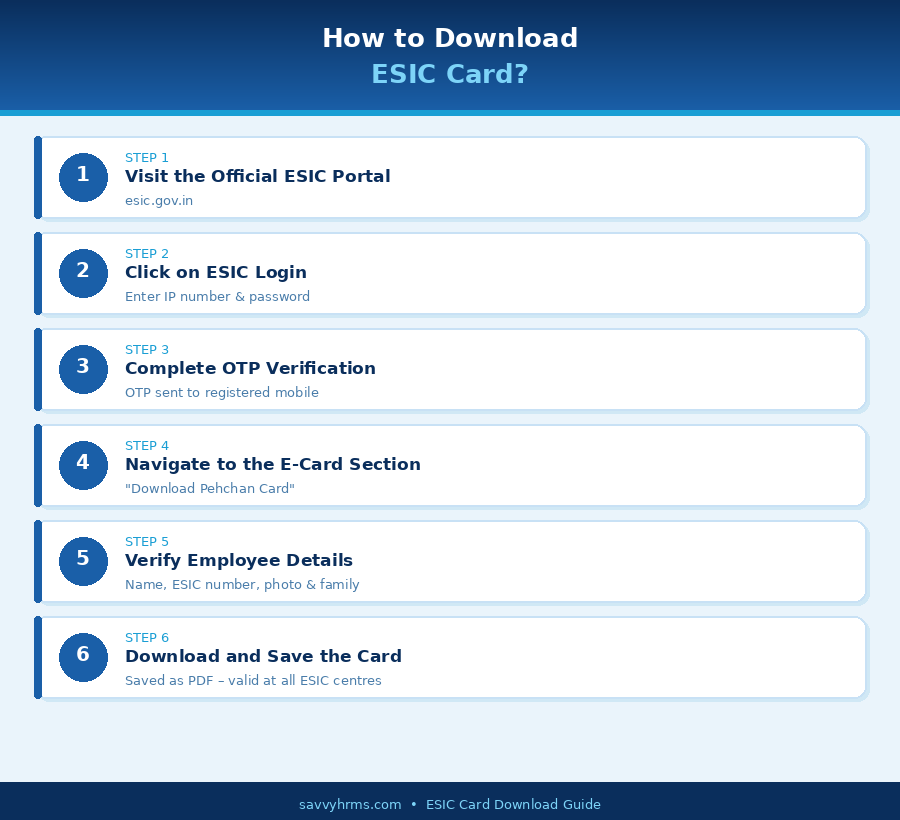
There’s no need to visit any government office to get an ESIC card. The entire process is digital and can be completed in just a few minutes. Here’s a step-by-step breakdown of how it works.
Step 1: Visit the Official ESIC Portal
Open any browser and go to the official website, esic.gov.in. This is the only authorised platform for downloading the ESIC card, so it’s important to avoid any third-party websites.
Step 2: Click on ESIC Login
On the homepage, click on the ESIC login option. Employees will need to enter their IP number (Insured Person number) along with the registered mobile number or password to access the account.
Step 3: Complete OTP Verification
After entering the login credentials, an OTP will be sent to the registered mobile number. Entering this OTP completes the verification process and grants access to the employee’s ESIC dashboard.
Step 4: Navigate to the E-Card Section
Once logged in, look for the option labelled “Download Pehchan Card” or the e-card section within the dashboard. This is where the ESIC card is stored and made available for download.
Step 5: Verify Employee Details
Before downloading, the portal displays the employee’s details, name, ESIC number, photo, and family member information. It’s a good idea to cross-check these details to ensure everything is accurate.
Step 6: Download and Save the Card
Click the download button, and the ESIC card will be saved as a PDF file. This digital card is valid for use at all ESIC hospitals, dispensaries, and selected clinics across India.
How to Get an ESIC Number?
For employees already covered under the ESI scheme, the employer handles this process. But here’s the full picture:
For Employees:
- When an employee joins a covered employer, the employer registers them on the ESIC portal.
- The 17-digit ESIC number is auto-generated during registration.
- The number is shared through SMS or directly through the employer.
For Employers:
- Visit the ESIC portal and complete ESIC login registration for the company.
- Add employee details, name, salary, joining date, and bank details.
- The system generates individual ESIC numbers for each employee.
- Make monthly ESIC payment of contributions before the 15th of every month.
Self-employed individuals and those in the unorganised sector generally don’t fall under ESIC, though the government has been expanding coverage over the years.
How to Check ESIC Number?
Lost track of an ESIC number? Don’t panic, it’s easy to recover.
Option 1: Check the Salary Slip
Most employers mention the ESIC number on monthly salary slips.
Option 2: ESIC Portal Login
- Go to esic.gov.in
- Use the ESIC login with the registered mobile number.
- The IP number and other details will be visible in the profile.
Option 3: ESIC Pehchan Card
If the ESIC card has already been received, the 17-digit number is printed right on it.
Option 4: Contact HR
The HR or payroll team maintains ESIC records and can provide the number instantly.
Option 5: ESIC Mobile App
ESIC also has a mobile app where employees can log in and check their details on the go.
ESIC Compliance Checklist for Employers
For businesses running a team, here’s a quick checklist to make sure all the ESIC compliance boxes are ticked:
- Register the business on the ESIC portal if there are 10+ employees earning ≤ ₹21,000/month
- Register all eligible employees within 10 days of joining
- Deduct 0.75% from employee wages every month
- Contribute 3.25% as the employer’s share
- Submit ESIC payment by the 15th of the following month
- File half-yearly returns on the ESIC portal
- Maintain ESIC records for at least 5 years
- Update employee details (salary changes, exits) promptly on the portal
- Issue ESIC cards to all registered employees
Non-compliance can attract penalties and legal action, so staying on top of this every month is strongly advised.
ESIC Login & Portal, A Quick Guide
Navigating the ESIC gateway for the first time can feel a bit confusing, but it gets easier with time.
Here’s what can be done on the ESIC portal (esic.gov.in):
- Employers: Register the company, add or update employees, make ESIC payments, file returns, and download challans
- Employees: Check contribution history, download e-card, apply for benefits, and find the nearest ESIC hospital
- Insured Persons (IP): Track claim status, update KYC, check IP number
For ESIC login, employers use their employer code, while employees use their IP number along with a registered mobile OTP. The process is now fairly smooth, especially after the ESIC portal’s digital upgrades in recent years.
Conclusion
The ESIC scheme is one of India’s most comprehensive social security programmes for the working class. Whether it’s healthcare, maternity support, disability cover, or unemployment protection, an ESIC number is the key that unlocks all of it. And for employers, staying ESIC-compliant isn’t just a legal requirement; it’s a way of genuinely taking care of the workforce.
For HR professionals and business owners, managing ESIC contributions, registrations, and compliance manually can be a real headache, especially as the team grows.
That’s where Savvy HRMS comes in. Savvy HRMS is a smart, all-in-one HR and payroll management platform that automates ESIC calculations, payment tracking, and compliance filing, so deadlines are never missed, and audits are never a surprise. From generating payslips with accurate ESIC deductions to maintaining employee records and filing returns, Savvy HRMS handles it all in one place.
Ready to simplify ESIC compliance?
Get started with Savvy HRMS today and let HR run on autopilot!
Book a Free Demo Today