

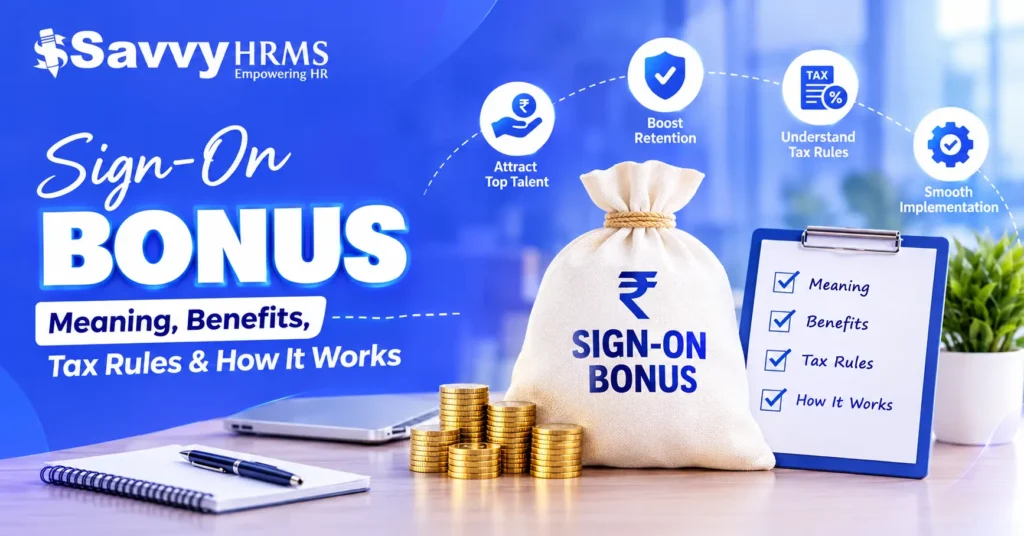
Sign-On Bonus: Meaning, Benefits, Tax Rules & How It Works


-
AuthorSalilendra Kumar
-
 Last Updated
October 12, 2026
Last Updated
October 12, 2026
-
 Reading Time
19 Mins
Reading Time
19 Mins
Imagine you have just received a job offer. The salary looks good, the role is exciting, and then HR tells you, “We’re also offering you a ₹1 lakh sign-on bonus.”
Sounds great, right?
But then a few questions come to mind: When will I actually receive it? Is it taxable? Is it the same as a joining bonus? What happens if I leave the company within a year? And how does the employer process it through payroll?
That is where understanding a sign-on bonus becomes important.
A sign-on bonus, also called a joining bonus in many employment contexts, is a one-time payment offered to a new employee as an incentive to accept a job offer and join the organization. Companies may use it to attract talent, compensate candidates for benefits they are giving up by changing jobs, or make an offer more competitive.
For employees, however, the headline amount is not always the amount they ultimately keep. The payment terms, tax treatment, payroll processing, and any clawback condition can significantly affect its value.
This guide explains what a sign-on bonus is, how it works, how it is calculated, when it is paid, its tax implications in India for FY 2026-27, and how HR and payroll teams can manage it efficiently.
TL;DR
- A sign-on bonus is generally a one-time payment offered to a new employee when they join an organization.
- Companies use it to attract talent, make job offers more competitive, and support faster hiring.
- The bonus may be paid with the first salary, after joining, or after completing a specified period.
- A sign-on bonus can be structured as a lump-sum payment, instalments, or a conditional payment.
- In India, the tax treatment depends on the nature and timing of the payment and the applicable tax provisions.
- Under the FY 2026-27 new tax regime, income-tax slabs range from 0% to 30%, with rates increasing progressively as taxable income rises.
- Employers may include a clawback clause requiring employees to repay some or all of the bonus if they leave before completing an agreed period.
- HR and payroll teams need to track the bonus amount, payment date, eligibility, tax deduction, documentation, and clawback terms.
- A sign-on bonus is different from a performance bonus because it is generally linked to joining, rather than achievement of performance targets.
What Is a Sign-On Bonus?
A sign-on bonus is a one-time financial incentive offered by an employer to a candidate who accepts a job offer and joins the organization.
For example, suppose an employee is offered:
| Salary Component | Amount |
| Annual fixed salary | ₹12,00,000 |
| Sign-on bonus | ₹1,00,000 |
| Total first-year gross opportunity | ₹13,00,000* |
*Subject to the terms and conditions of the employment offer and applicable taxes.
The sign-on bonus is usually separate from the employee’s regular salary. It may also be referred to as a joining bonus, although the exact terminology and contractual conditions can differ between employers.
A company may offer a sign-on bonus when it wants to make an employment offer more attractive without permanently increasing the employee’s fixed salary.
Why is it called a sign-on bonus?
Unlike a performance bonus, which is usually linked to achieving specific goals, a sign-on bonus is primarily associated with the employee accepting and joining the new employer.
Simple example
Suppose a software company wants to hire a developer who currently earns ₹10 lakh per year.
The company offers:
₹12 lakh annual salary + ₹1.5 lakh sign-on bonus
The additional ₹1.5 lakh may make the offer more attractive without requiring the company to increase the employee’s recurring salary structure.
How Does a Sign-On Bonus Work?
The process is usually straightforward, but the terms and conditions can vary significantly between companies.
A general sign-on bonus process looks like this:
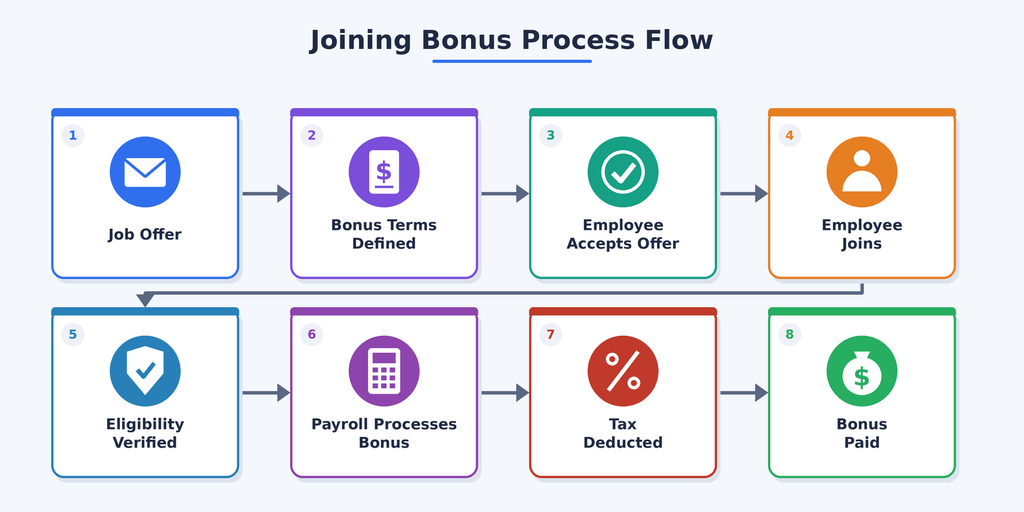
Step 1: Employer decides the bonus
The company determines whether a sign-on bonus is required and how much it should offer.
Factors may include:
- Candidate’s experience
- Job level
- Market demand for the role
- Candidate’s current compensation
- Notice-period requirements
- Benefits being forfeited from the previous employer
- Hiring difficulty
- Internal compensation policies
Step 2: Bonus terms are included in the offer
The offer letter or employment agreement should clearly explain:
- Bonus amount
- Eligibility
- Payment date
- Payment method
- Conditions attached to payment
- Tax treatment
- Clawback provisions, if applicable
Step 3: Employee joins
The employee must generally complete the required joining formalities and satisfy the conditions specified in the employment agreement.
Step 4: Payroll processes the payment
Once eligibility is confirmed, the bonus is processed through payroll.
The payroll team may need to calculate the applicable tax deduction and ensure that the payment is correctly reflected in payroll records.
Step 5: Employee receives the payment
Depending on the company’s policy, the payment may be made:
- Along with the first salary
- Within a specified number of days after joining
- After completion of a probation period
- After completing a minimum service period
- In multiple instalments
Important: Employees should not assume that signing the offer automatically means the bonus will be credited immediately. The actual payment date depends on the contractual terms.
Why Do Companies Offer Sign-On Bonuses?
A sign-on bonus is essentially a recruitment and compensation tool.
Companies may use it for several reasons.
1. To attract in-demand talent
When skilled candidates have multiple offers, a sign-on bonus can help an employer stand out.
For example:
Company A: ₹15 lakh fixed salary
Company B: ₹14 lakh fixed salary + ₹2 lakh sign-on bonus
Depending on the candidate’s priorities, the second offer could become more attractive because of the additional upfront incentive.
2. To compensate for lost benefits
An employee changing jobs may lose:
- An annual bonus
- Retention bonus
- Stock benefits
- Deferred compensation
- Other benefits from their current employer
A sign-on bonus can help bridge that gap.
3. To compensate for a lower fixed salary
Instead of permanently increasing fixed compensation, an organization may offer a one-time payment.
This can give the employee additional first-year compensation without creating the same recurring salary cost.
4. To accelerate hiring
Some employers use sign-on incentives to encourage candidates to accept offers quickly and reduce hiring delays.
5. To compete for specialized talent
Roles involving scarce skills can require stronger compensation packages.
A sign-on bonus gives employers another lever beyond fixed salary.
How Is a Sign-On Bonus Calculated?
There is no single statutory formula that determines the amount of a sign-on bonus for every employee.
Companies generally decide the amount based on their compensation policy, market conditions, candidate profile, and business requirements.
A simple approach can be:
Sign-On Bonus = Agreed Bonus Amount
For example:
Annual salary = ₹15,00,000
Sign-on bonus = 10% of annual salary
Bonus = ₹15,00,000 × 10% = ₹1,50,000
However, employers can also use a fixed amount.
Example of different approaches
| Calculation Method | Example | Sign-On Bonus |
| Fixed amount | ₹1,00,000 | ₹1,00,000 |
| Percentage of annual salary | 10% of ₹12 lakh | ₹1,20,000 |
| Percentage of monthly salary | 2 × ₹1,00,000 monthly salary | ₹2,00,000 |
| Replacement compensation | Lost bonus from previous employer | Based on agreed amount |
The important point is that the gross sign-on bonus and the amount actually received after applicable deductions may not be the same.
When Do Employees Receive a Sign-On Bonus?
There is no universal payment date for every sign-on bonus.
The payment schedule depends on the employer’s policy and the terms in the employment agreement.
Common arrangements include:
1. Payment with the First Salary
Some companies pay the sign-on bonus along with an employee’s first salary after joining. This approach provides the employee with the additional amount during their initial payroll cycle.
2. Payment Shortly After Joining
Employers may choose to release the sign-on bonus within a specified period after the employee joins. The offer letter generally mentions the exact timeline and eligibility conditions.
3. Payment After Probation
In some cases, employees receive their sign-on bonus only after successfully completing the probation period. This helps employers ensure that new hires continue with the organization before payment.
4. Payment in Instalments
Instead of paying the entire bonus at once, employers may divide it into multiple instalments. For example, ₹1,00,000 may be paid after joining and ₹1,00,000 after 12 months.
5. Payment After a Minimum Service Period
Some employers make sign-on bonus payments conditional on completing a specific service period. Employees may need to remain with the organization for six, twelve, or more months to qualify.
Therefore, before accepting an offer, employees should check the exact payment timeline rather than focusing only on the headline bonus amount.
What Are the Benefits of a Sign-On Bonus for Employees and Employers?
A sign-on bonus can benefit both sides, but the benefits are different.
Benefits for employees
- Higher first-year compensation: A sign-on bonus can increase total first-year earnings.
- Helps offset switching costs: It can compensate for a lost annual bonus, relocation expenses, or other financial costs associated with changing jobs.
- Immediate financial incentive: Depending on the payment terms, employees may receive additional cash soon after joining.
- Improves offer attractiveness: Two jobs with similar salaries can look very different when one includes a sign-on bonus.
Benefits for employers
- Faster hiring: An attractive offer can help reduce delays in closing candidates.
- Better talent attraction: It can make an employer more competitive in a tight hiring market.
- Flexible compensation: A one-time payment does not necessarily create the same recurring salary commitment as an increase in fixed pay.
- Targeted hiring strategy: Companies can offer bonuses selectively for important roles instead of changing compensation structures for an entire workforce.
A simple value comparison
Suppose two employers make the following offers:
| Component | Employer A | Employer B |
| Annual salary | ₹14 lakh | ₹13 lakh |
| Sign-on bonus | ₹0 | ₹2 lakh |
| First-year gross compensation | ₹14 lakh | ₹15 lakh |
In the first year, Employer B’s offer provides ₹1 lakh more in gross compensation, even though its fixed salary is ₹1 lakh lower.
However, from the second year onward, the comparison may change because the sign-on bonus is generally a one-time payment.
What Are the Different Types of Sign-On Bonus Structures in India?
Companies can structure sign-on bonuses in different ways depending on their hiring strategy.
1. Lump-Sum Sign-On Bonus
The employee receives the entire sign-on bonus as a single payment, usually after joining or completing the employer’s specified eligibility requirements.
Example:
₹1,50,000 paid as one lump-sum amount.
2. Instalment-Based Bonus
Instead of paying the full amount at once, the employer divides the sign-on bonus into two or more payments based on predefined milestones.
Example:
- Total bonus: ₹2,00,000
- First payment: ₹1,00,000 after joining
- Second payment: ₹1,00,000 after completing 12 months
3. Conditional Sign-On Bonus
A conditional sign-on bonus is paid only when the employee fulfils specific requirements mentioned in the employment agreement.
Common conditions may include:
- Completing the probation period
- Remaining employed for a specified duration
- Joining by a particular date
- Completing required documentation
- Meeting specific eligibility criteria
4. Replacement Bonus
A replacement bonus helps compensate employees for financial benefits they may lose when leaving their previous employer. It can make switching jobs financially more attractive.
For example:
An employee gives up a ₹2 lakh annual bonus at their current company. The new employer may offer a similar amount as a sign-on bonus to compensate for that loss.
5. Retention-Linked Sign-On Bonus
A retention-linked sign-on bonus encourages employees to stay with the organization for a predetermined period. The payment is often connected to a clawback clause.
General conditions may include:
- Minimum service period
- Partial or full repayment if the employee leaves early
- Different repayment amounts based on the duration completed
- Specific terms for resignation or termination
Are Sign-On Bonus and Joining Bonus the Same?
In many employment contexts, the terms sign-on bonus and joining bonus are used interchangeably.
Both generally describe a one-time incentive offered to a new employee for accepting and joining a company.
However, the actual terms matter more than the label.
For example, one company may call it a “joining bonus” and pay it with the first salary, while another may call it a “sign-on bonus” and pay it after six months.
So, instead of focusing only on whether it is called a sign-on or joining bonus, employees should check:
- Amount
- Eligibility
- Payment date
- Minimum service requirement
- Tax treatment
- Clawback conditions
- Repayment obligations
In simple terms:
Sign-On Bonus ≈ Joining Bonus in many hiring situations, but the contractual conditions can differ.
What Are the Tax Implications of a Sign-On Bonus in India for FY 2026-27?
This is one of the most important questions for employees and payroll teams.
A sign-on bonus should not be assumed to be tax-free simply because it is a one-time payment.
The Income Tax Department explains that taxable salary can include salary components such as wages, fees, commissions, perquisites, and profits in lieu of salary. The current income-tax framework also specifically covers certain amounts received before or after employment under the provisions dealing with profits in lieu of salary.
Therefore, the nature of the payment and the applicable tax rules need to be examined carefully.
What does this mean for a sign-on bonus?
If an amount is taxable as employment-related income, it can increase the employee’s taxable income for the relevant tax year.
For FY 2026-27, the new tax regime provides the following slab rates:
| Total Income | New Regime Tax Rate |
| Up to ₹4 lakh | Nil |
| ₹4 lakh-₹8 lakh | 5% |
| ₹8 lakh-₹12 lakh | 10% |
| ₹12 lakh-₹16 lakh | 15% |
| ₹16 lakh-₹20 lakh | 20% |
| ₹20 lakh-₹24 lakh | 25% |
| Above ₹24 lakh | 30% |
These rates are reflected in the government’s provisions for tax year 2026-27.
Example: How a bonus can affect taxable income
Suppose an employee has taxable income of:
₹15 lakh
and receives a taxable sign-on bonus of:
₹2 lakh
The bonus can increase the employee’s relevant taxable income to:
₹17 lakh, subject to the employee’s complete tax position, deductions/exemptions available under the chosen regime and other applicable rules.
The additional amount can therefore fall across the employee’s applicable marginal tax rates.
Important point about the ₹12 lakh rebate
Under the new regime, the Income Tax Department states that the Section 87A rebate is increased to ₹60,000 for eligible taxpayers with total income up to ₹12 lakh from AY 2026-27 onwards.
However, employees should not interpret this as meaning that every sign-on bonus is automatically tax-free. The employee’s total income and eligibility for the relevant rebate matter.
Does the month of payment matter?
Yes, the payment date can affect the payroll calculation and the tax year in which the amount is considered.
The Income Tax Department notes that taxable salary is generally considered on a due basis or receipt basis, whichever is earlier, subject to the applicable provisions.
That makes accurate payroll treatment particularly important when a sign-on bonus is paid around the end of a financial year.
Note: Tax treatment can depend on the exact facts, employment agreement, timing, and applicable tax regime. Employers and employees should verify the applicable provisions for their specific situation rather than treating a general example as tax advice.
What Is a Sign-On Bonus Clawback?
A sign-on bonus clawback is a contractual provision under which an employee may have to repay some or all of the bonus if certain conditions are not met.
The most common condition is a minimum service period.
For example:
Sign-on bonus: ₹2,00,000
Minimum service period: 12 months
If the employee leaves before completing 12 months, the employment agreement may require repayment of the bonus, depending on its terms.
Why do employers use clawbacks?
The employer is providing money upfront to encourage the employee to join and stay.
Without a clawback, an employee could potentially:
Join → Receive bonus → Leave shortly afterward
A clawback reduces this risk.
Common clawback structures
Full clawback: The employee repays 100% if they leave before the required period.
Pro-rata clawback: The repayment amount reduces as the employee completes more of the required service period.
For example:
| Service Completed | Potential Repayment |
| 0-3 months | 100% |
| 4-6 months | 75% |
| 7-9 months | 50% |
| 10-12 months | 25% |
This is only an illustrative structure; the actual terms depend on the employer’s agreement.
Employees should check these clauses carefully
Before accepting a sign-on bonus, review:
- Minimum service period
- Full vs pro-rata repayment
- Resignation conditions
- Termination conditions
- Treatment during probation
- Whether the clause applies if the employer terminates employment
- Repayment deadline
- Whether the agreement explains the treatment of taxes already deducted
How Can HR and Payroll Teams Manage Sign-On Bonuses?
For HR and payroll teams, managing a sign-on bonus is more than simply adding an extra amount to an employee’s salary.
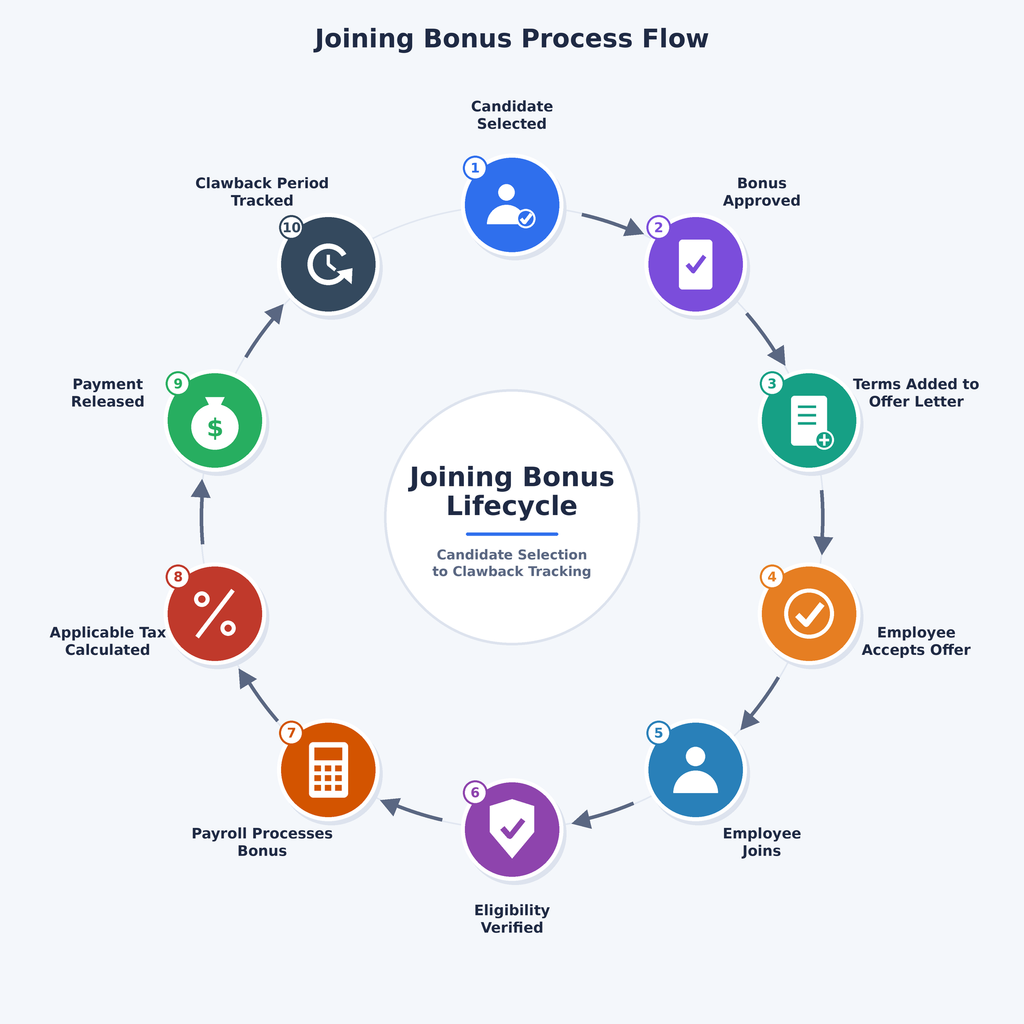
The organization needs to track the entire lifecycle of the payment.
A practical sign-on bonus workflow
Key information HR should maintain
| Data Point | Why It Matters |
| Employee ID | Identifies the employee |
| Bonus amount | Determines payment |
| Offer date | Establishes agreement |
| Joining date | Determines eligibility |
| Payment date | Supports payroll tracking |
| Payment status | Prevents missed payments |
| Tax treatment | Supports accurate payroll |
| Clawback period | Helps track retention conditions |
| Repayment amount | Useful if clawback is triggered |
| Approval details | Supports auditability |
Why HRMS and payroll automation can help
When companies manage bonuses manually through spreadsheets, they may face problems such as:
- Missed payment dates
- Incorrect bonus amounts
- Duplicate payments
- Poor visibility into clawback deadlines
- Manual tax calculations
- Disconnected HR and payroll data
- Difficulty tracking multiple bonus structures
An integrated HRMS and payroll system can help centralize employee compensation data and connect joining information with payroll processing.
For example:
Offer Management → Employee Master → Payroll → Tax Calculation → Payslip → Reports
This creates a more connected compensation workflow.
A useful KPI dashboard for HR
HR teams can also track metrics such as:
- Average sign-on bonus: Total sign-on bonuses ÷ number of recipients
- Bonus utilisation rate: Employees receiving sign-on bonus ÷ eligible new hires × 100
- Early attrition rate: Employees leaving during clawback period ÷ sign-on bonus recipients × 100
- Clawback recovery rate: Amount recovered ÷ amount subject to clawback × 100
These metrics can help organizations understand whether their sign-on bonus strategy is actually supporting recruitment and retention.
Sign-On Bonus vs Performance Bonus: What’s the Difference?
Although both are additional compensation, their purpose and eligibility are different.
| Factor | Sign-On Bonus | Performance Bonus |
| Primary purpose | Attract a new employee | Reward performance |
| Usually paid to | New hires | Existing/eligible employees |
| Trigger | Joining/accepting offer | Achieving targets |
| Frequency | Usually one-time | Often recurring |
| Performance-linked | Generally no | Yes |
| Clawback possible | Yes | Depends on policy |
| Common timing | Joining/early employment | Annual/quarterly cycle |
Example
A company offers:
₹1 lakh sign-on bonus when a candidate joins.
Separately, the company offers:
Up to 15% annual performance bonus based on individual and company performance.
The first payment is connected to joining, while the second depends on performance outcomes.
This distinction is important when employees compare job offers.
A higher sign-on bonus may improve first-year compensation, but a strong performance bonus can have a larger impact on recurring annual earnings.
What Should Employees Check Before Accepting a Sign-On Bonus?
A large bonus can look attractive in a job offer, but employees should look beyond the headline figure.
Before accepting, check these seven points:
1. Is the Amount Gross or Net?
A sign-on bonus mentioned in your offer letter is usually a gross amount. Applicable taxes and deductions may reduce the amount ultimately credited to your bank account.
2. When Will It Be Paid?
Always check the exact payment schedule before accepting the offer. The bonus could be paid with your first salary, after joining, or after completing specific conditions.
3. Is There a Clawback?
A clawback clause may require you to repay some or all of the bonus if you leave the company before completing the agreed service period.
Check for:
- Full or partial repayment
- Minimum service period
- Repayment deadline
- Conditions applicable to resignation or termination
4. What Is the Minimum Service Period?
Some employers require employees to stay for a specific period to retain the sign-on bonus. Carefully review this condition before considering the bonus as part of your compensation.
Common periods may include:
- 6 months
- 12 months
- 24 months
5. What Happens If the Company Terminates Your Employment?
The employment agreement should clearly explain what happens to the sign-on bonus if the company terminates your employment. The repayment rules may differ depending on the reason for termination.
Look for details about:
- Termination without cause
- Termination for misconduct
- Resignation
- Probation-period termination
6. How Is It Treated in Payroll?
Your sign-on bonus should be properly recorded and processed through payroll. Check how the payment will appear on your payslip and how applicable tax deductions will be handled.
7. Is It Actually Better Than a Higher Fixed Salary?
A sign-on bonus can increase first-year compensation, but a higher fixed salary may provide greater recurring earnings in subsequent years. Compare both before accepting an offer.
Example:
- Offer A: ₹16 lakh fixed salary
- Offer B: ₹15 lakh fixed + ₹2 lakh sign-on bonus
Offer B provides ₹17 lakh in first-year gross compensation, while Offer A provides a higher recurring fixed salary.
Therefore, compare both first-year compensation and recurring compensation.
Sign-On Bonus: A Simple Example
Let’s put everything together.
Suppose an employee receives the following offer:
- Annual fixed salary: ₹12,00,000
- Sign-on bonus: ₹1,50,000
- Minimum service period: 12 months
- Bonus payment: First salary cycle
- Clawback: 100% if the employee leaves before completing the agreed period
First-year gross compensation
₹12,00,000 + ₹1,50,000
= ₹13,50,000
But the employee should not automatically treat ₹13.5 lakh as take-home pay.
The bonus may have applicable tax implications, and the employee’s overall tax position must be considered.
What happens if the employee leaves early?
If the employment agreement requires repayment and the employee leaves before satisfying the service condition, the employee may have to repay some or all of the ₹1.5 lakh, subject to the contract’s terms.
This is why a sign-on bonus should be viewed as conditional compensation when the offer contains eligibility or clawback conditions, rather than simply as free additional salary.
Conclusion
A sign-on bonus can be a useful tool for both employers and employees. For companies, it can make job offers more competitive and help attract specialized talent. For employees, it can provide additional first-year compensation and help offset the financial cost of changing jobs.
However, the headline amount is only one part of the equation. Payment timing, tax treatment, eligibility, clawback conditions, and payroll processing can all affect the actual value of the bonus. In India, employees should also consider the applicable tax regime and their overall taxable income when evaluating a sign-on bonus.
For HR and payroll teams, having a structured process is equally important. Tracking bonus eligibility, payment schedules, tax treatment, and clawback conditions through an integrated HRMS and payroll workflow can reduce manual work and improve accuracy.










Looking to simplify payroll, employee compensation, and HR processes?
Savvy HRMS helps businesses manage employee data, payroll, attendance, leave, and compensation workflows from one integrated platform. Explore Savvy HRMS to simplify your HR and payroll operations today.
Frequently Asked Questions (FAQs)
1. How does the sign-on bonus work?
A sign-on bonus is a one-time payment offered to a new employee for accepting and joining a company. The payment terms, eligibility, timing, and clawback conditions are usually mentioned in the employment agreement.
2. What do you mean by sign-in bonus?
A sign-in bonus generally refers to the same concept as a sign-on bonus or joining bonus. It is a one-time incentive offered by an employer to encourage a candidate to accept a job offer and join the organisation.
3. How do you calculate a signing bonus?
A signing bonus can be calculated as a fixed amount or as a percentage of the employee’s salary. For example, if the annual salary is ₹12 lakh and the agreed bonus is 10%, the signing bonus would be ₹1.2 lakh.
4. Are sign-on bonuses paid immediately?
Not always. Depending on the employer’s policy, a sign-on bonus may be paid with the first salary, shortly after joining, after probation, or in instalments. The exact payment schedule should be stated in the offer letter.
5. Is a sign-on bonus taxable in India?
A sign-on bonus may have tax implications when it is treated as taxable employment-related income. The actual tax impact depends on the employee’s total income, applicable tax regime, payment timing, and relevant tax provisions.