What Is Shift Allowance? Types, Calculation, Labour Laws and Tax Rules



-
AuthorRuchika Rajput
-
 Last Updated
October 28, 2026
-
 Reading Time
18 Mins
TL;DR
Shift allowance provides additional compensation to employees who work evening, night, rotating, or other designated shifts. The amount and eligibility depend on the employer’s policy, employment terms, and applicable laws. Here are the key points to understand about shift allowance in India:
- It can be calculated per shift, per hour, as a percentage of salary, or as a fixed monthly amount.
- There is no single shift allowance rate that applies universally to all employees in India.
- Shift allowance can form part of CTC, depending on the employer’s salary structure.
- It is generally taxable as salary under applicable income tax rules.
- Accurate attendance records and clear policies help HR teams calculate and process payments correctly.
Businesses that operate beyond regular working hours often rely on employees working evening, night, or rotating shifts. These schedules can affect employees’ routines and personal time, making additional compensation an important consideration.
Shift allowance is one way employers compensate eligible employees for working designated shifts. The amount, eligibility criteria, and payment method depend on the employer’s policy, employment terms, and applicable laws. Understanding how shift allowance works can help employees interpret their salary structure and help HR teams manage payroll accurately.
What Is Shift Allowance?
Shift allowance is extra pay that an employer may offer employees for working specific shifts, such as evening, night, early morning, or rotating shifts. It is generally intended to compensate employees for working outside the organisation’s usual business hours.
The amount an employee receives depends on the company’s policy, employment terms, and any applicable legal requirements. Some employers pay a fixed amount for each eligible shift, while others use an hourly rate or a fixed monthly allowance.
For example, a customer support company may offer ₹300 for every eligible night shift. If an employee completes 20 qualifying shifts in a month, they would receive ₹6,000 as shift allowance.
This payment is usually separate from regular salary, although the way it is presented in the salary structure depends on the employer’s compensation policy.
Why Do Employers Offer Shift Allowance?
Employers offer shift allowance to attract employees to different shifts, support round-the-clock operations, and make compensation more transparent. Employers may introduce shift allowance for several operational reasons:
| Reason | Why Employers Offer Shift Allowance |
| Attracting Employees to Different Shifts | Extra pay can make evening, night, and early-morning shifts more attractive to job candidates. |
| Supporting Round-the-Clock Operations | Hospitals, manufacturing facilities, and customer support centres need employees to work beyond regular business hours. |
| Recognising Inconvenient Working Hours | Late-night and early-morning shifts can affect employees’ daily routines, sleep schedules, and commuting arrangements. |
| Improving Compensation Transparency | A clearly defined allowance helps employees understand how their assigned shifts affect their earnings. |
| Planning Workforce Costs | A consistent allowance structure helps HR estimate staffing expenses and budget for different shifts. |
Shift allowance is a compensation measure but it does not replace safe working conditions, required rest periods, or any statutory employment protection.
What Are the Different Types of Shift Allowance?
The type of allowance depends on the employee’s schedule and the employer’s compensation policy. Common arrangements include the following.
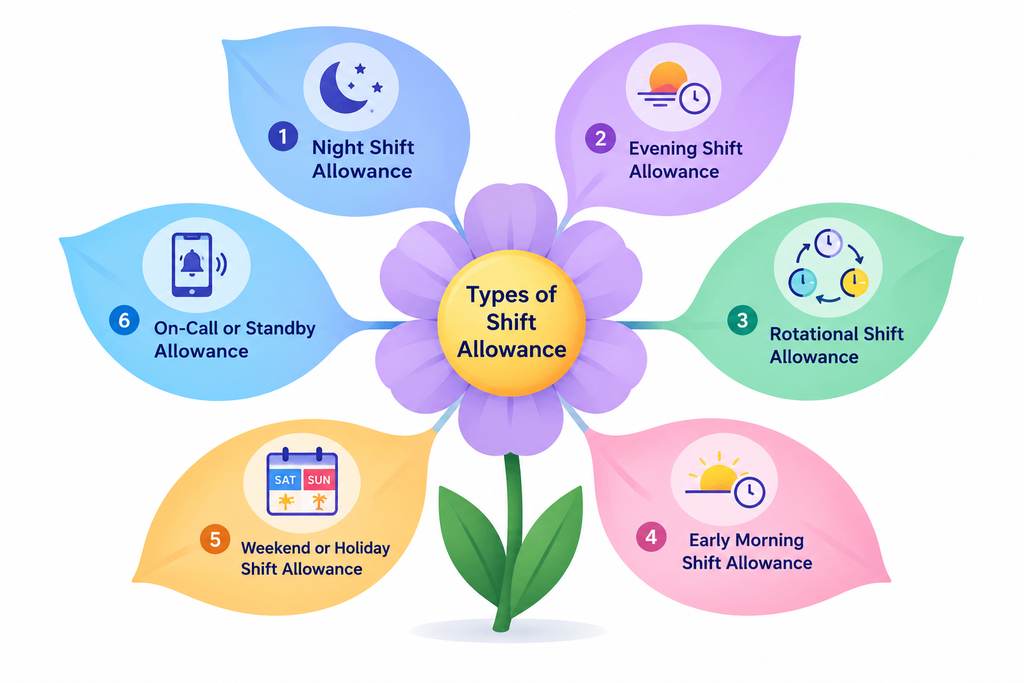
1. Night Shift Allowance
Employees who work late at night or through the early morning may receive a night shift allowance as extra pay for their working hours.
For example, an IT support employee working from 10 PM to 7 AM may receive this allowance if the company’s policy covers those hours.
The employer should clearly explain when the allowance applies, how much employees will receive, and whether they need to complete a minimum number of hours. Meals and transport may be offered as separate benefits.
2. Evening Shift Allowance
Employees who work evening hours may receive an evening shift allowance in addition to their regular salary.
For instance, an employee working from 2 PM to 11 PM may qualify for extra pay under the company’s shift policy.
Some employers offer different allowance rates for evening and night shifts, depending on their operational needs. However, the rates and eligibility conditions vary from one organisation to another.
3. Rotational Shift Allowance
When employees regularly switch between morning, evening, and night shifts, their employer may offer a rotational shift allowance.
For example, a manufacturing employee might work the morning shift one week, the evening shift the next, and the night shift the following week.
If the allowance depends on the shifts worked, the amount may change each month based on the employee’s roster.
4. Early Morning Shift Allowance
Some employees start work long before the usual working day begins. To compensate for these early starts, employers may offer an early morning shift allowance.
For example, employees in transportation, manufacturing, or hospitality may begin their shifts at 4 AM or 5 AM.
Whether they receive extra pay depends on the company’s policy and any applicable legal requirements.
5. Weekend or Holiday Shift Allowance
Working on a weekend or holiday can mean giving up personal time, so some employers offer additional pay to employees scheduled on these days.
For example, a customer support employee working on a Sunday may receive a weekend shift allowance under company policy.
However, this allowance should not be confused with statutory overtime pay or other payments required under applicable holiday rules. HR teams must check these entitlements separately.
6. On-Call or Standby Allowance
Sometimes, employees need to remain available even when they are not scheduled to work. Employers may provide an on-call or standby allowance to compensate them for this availability.
For example, an IT administrator may receive a standby payment for being available to resolve server issues or system outages overnight.
This payment is different from a regular shift allowance because it covers availability rather than scheduled working hours. The company should clearly explain how standby payments work and how actual work performed during an on-call period will be compensated.
How Does Shift Allowance Work?
Shift allowance depends on the company’s policy and the shifts an employee actually works. From setting eligibility rules to processing payments, each step helps HR calculate the allowance correctly and include it in the employee’s salary.
1. Set the Eligibility Rules
First, the company defines which shifts qualify for extra pay, such as evening, night, or rotating shifts. HR may also specify eligible departments, working hours, and minimum hours employees must complete before they qualify for the allowance.
2. Decide How the Allowance Is Calculated
Once eligibility is clear, the employer decides how to calculate the payment. This could be a fixed amount per shift, an hourly rate, a percentage of salary, or a fixed monthly amount. The chosen method determines how the allowance will be calculated later.
3. Track Attendance and Verify Shifts
With the rules in place, HR checks attendance records against the employee’s shift roster. This helps confirm which shifts were completed and whether absences, shift swaps, or schedule changes affect the employee’s eligibility.
4. Calculate and Process the Payment
After verifying attendance, the payroll team applies the approved rate to the eligible shifts or hours. The calculated amount is then added to the relevant payroll cycle and shown in the employee’s salary breakdown.
Example of Shift Allowance Calculation
For example, suppose an employee is scheduled for 20 night shifts in a month but completes only 18 qualifying shifts. If the company pays ₹250 per eligible shift, the calculation would be:
18 × ₹250 = ₹4,500
The employee receives ₹4,500, assuming the policy pays only for completed qualifying shifts. If the company offers a fixed monthly allowance, different rules may apply.
Accurate attendance management and roster records help HR verify eligibility, calculate payments correctly, and reduce payroll errors.
How to Calculate Shift Allowance?
The amount an employee receives as shift allowance depends on how the employer structures the payment. Some companies pay for every eligible shift, while others calculate it by the hour, use a percentage of salary, or offer a fixed monthly amount. Here are four common ways to calculate it.
1. Calculate Allowance Per Shift
Some employers pay a fixed amount for every eligible shift an employee completes. The monthly allowance depends on the number of qualifying shifts worked.
Formula:
Shift allowance = Allowance per shift × Eligible shifts completed
Example:
Suppose an employee receives ₹300 for each eligible shift and completes 22 shifts in a month.
₹300 × 22 = ₹6,600 per month
This method is straightforward because payroll can calculate the payment using the employee’s roster and attendance records.
2. Calculate Allowance Per Hour
An employer may also pay shift allowance for each eligible hour worked during designated periods, such as late evenings or overnight hours.
Formula:
Shift allowance = Rate per eligible hour × Eligible hours worked
Example:
If an employee receives ₹40 per eligible hour and completes 80 qualifying hours, the calculation is:
₹40 × 80 = ₹3,200
The company policy should clarify how breaks, partial hours, and shifts extending past midnight are counted.
3. Calculate Allowance as a Percentage of Salary
Some organisations calculate shift allowance as a percentage of a specified salary component, such as basic salary. The percentage and salary component used depend on the employer’s policy.
Formula:
Shift allowance = Eligible salary component × Applicable percentage
Example:
If the monthly basic salary is ₹40,000 and the allowance is set at 10% of basic salary:
₹40,000 × 10% = ₹4,000 per month
This is an example of a company-defined payment method, not a legally prescribed formula.
4. Calculate a Fixed Monthly Allowance
Instead of calculating payment for individual shifts or hours, an employer may offer a fixed monthly amount to employees assigned to a particular shift.
For example, an employee assigned to a night shift may receive ₹5,000 per month under the company’s policy. The policy should clarify whether this amount changes when the employee takes leave, moves to another shift, or no longer meets the eligibility conditions.
Shift Allowance Calculation Methods at a Glance
| Method | Calculation basis | Example |
| Per shift | Number of eligible shifts | ₹300 × 22 = ₹6,600 |
| Per hour | Eligible hours worked | ₹40 × 80 = ₹3,200 |
| Percentage-based | Specified salary component | ₹40,000 × 10% = ₹4,000 |
| Fixed monthly | Amount defined by company policy | ₹5,000 per month |
These examples illustrate common ways employers structure shift allowance. The actual amount depends on the company’s policy and any applicable legal requirements; the figures above are not statutory rates.
What Are the Labour Law Rules for Shift Allowance in India?
Shift allowance should be considered separately from the legal requirements governing wages, working hours, overtime, and night work.
The Government of India announced that the four Labour Codes became effective on 21 November 2025. Employers should review the wages, industrial relations, social security, and workplace safety requirements before establishing a policy.
Is Shift Allowance Mandatory Under Labour Law?
There is no universal shift allowance rate that every employer must pay across India simply because an employee works an evening or night shift.
Whether an employee is entitled to the allowance depends on applicable employment terms, company policy, agreements or settlements, and any relevant statutory or state-specific requirements.
Employers should review these areas:
- Wage requirements: Check applicable minimum wage and wage-payment obligations.
- Working hours and overtime: Ensure compliance with applicable working-hour limits, rest periods, and overtime provisions.
- Night-work conditions: Review relevant safeguards, consent requirements, transport provisions, and other conditions applicable to the establishment.
- Employment agreements: Confirm whether the appointment letter, contract, or established policy provides an entitlement.
- Industry and state rules: Check the provisions applicable to the specific establishment and employee category.
What Do Indian Labour Codes Say About Night Shifts?
The Occupational Safety, Health and Working Conditions Code, 2020 includes provisions concerning the employment of women in different shifts.
Section 43 addresses the employment of women before 6 AM and beyond 7 PM, subject to their consent and prescribed conditions relating to safety, holidays, working hours, and other safeguards.
Employers must verify the current rules and notifications applicable to their establishment. These provisions concern conditions for night work; they do not prescribe one universal rupee amount for night shift allowance.
What Is the Difference Between Shift Allowance and Overtime Pay?
Shift allowance and overtime pay serve different purposes. Shift allowance is extra pay for working a designated shift, while overtime pay compensates employees for qualifying additional working hours.
The rules for each depend on company policy and applicable labour laws.
| Basis | Shift Allowance | Overtime Pay |
| Purpose | Compensates employees for working specific shifts, such as evening or night shifts. | Compensates employees for working beyond applicable working-hour limits. |
| Eligibility | Depends on company policy or an applicable entitlement. | Depends on the relevant legal provisions and employee eligibility. |
| Calculation | May be based on a fixed amount, eligible hours, or shifts worked. | Calculated using the applicable statutory wage basis and overtime rate. |
| Payment | May be included in regular monthly payroll. | Paid when qualifying overtime conditions are met. |
| Can both apply? | Yes, an employee may qualify for both payments. | Overtime may be payable separately even when shift allowance is already provided. |
For example, an employee working a scheduled night shift may receive a night shift allowance under company policy. If the employee also works additional hours that qualify for overtime, they may be entitled to overtime pay separately.
HR teams should assess both payments independently rather than assuming that shift allowance automatically covers overtime obligations.
What Should a Night Shift Allowance Policy Include?
A clear night shift allowance policy helps employees understand when they qualify for extra pay, how the amount is calculated, and when they will receive it. It also gives HR and payroll teams a consistent way to manage shift-related payments.
Here are the key points to cover when drafting the policy.
1. Who Is Eligible for the Allowance?
Start by defining which employees qualify for night shift allowance. Specify the eligible roles, departments, locations, and employment categories.
If remote employees, temporary staff, or contract workers are covered, mention that clearly to avoid confusion.
2. Which Shift Timings Qualify?
Clearly state the start and end times that count as a night shift. For example, the policy might cover shifts beginning at 10 PM and ending at 6 AM.
Also explain how partial shifts, overlapping schedules, and shifts extending past midnight will be treated.
3. How Much Will Employees Receive?
Explain the payment rate and how the allowance is calculated. For example, a company might pay ₹300 for each eligible night shift and ₹150 for each eligible evening shift.
These are illustrative amounts, not standard or legally prescribed rates.
4. How Will Attendance Be Verified?
The policy should explain how attendance affects eligibility, including how missed punches, approved shift swaps, leave, early departures, and schedule changes are handled.
This helps HR determine which shifts qualify for payment.
5. When Will the Allowance Be Paid?
Specify whether the allowance will be paid with the monthly salary or in another payroll cycle.
Explain how it will appear on the payslip and how employees can report incorrect or missing payments.
6. What Safety Requirements Apply?
Night shift arrangements should also address applicable working-hour limits, rest periods, transportation, and workplace safety requirements.
Paying an allowance does not remove the employer’s responsibility to meet relevant legal obligations.
7. When Should the Policy Be Reviewed?
Review the policy whenever shift schedules, employee arrangements, work locations, or applicable legal requirements change because regular reviews help to keep the rules clear and consistent with current operations.
Is Shift Allowance Part of CTC?
Yes, shift allowance can be part of an employee’s cost to company (CTC), but it depends on how the employer structures the salary package. A fixed pay included in the agreed compensation may form part of fixed CTC, while an allowance that changes with the number of eligible shifts may be treated as variable earnings.
Fixed vs Variable Shift Allowance
| Scenario | Possible treatment |
| Fixed monthly allowance included in the offer | May form part of fixed CTC |
| Allowance based on eligible shifts worked | May be treated as variable or conditional earnings |
| Allowance paid separately under company policy | Depends on whether it is included in the agreed CTC |
| Employee moves to a daytime role | Shift-dependent payments may stop if eligibility ends |
Example: How Shift Allowance Affects Annual CTC
Suppose an employee has an annual CTC of ₹6,00,000 and receives ₹4,000 per month for qualifying shifts.
If the allowance is paid in addition to the stated CTC and the employee qualifies for all 12 months, the extra payment would be:
₹4,000 × 12 = ₹48,000 annually.
The total annual compensation would then be ₹6,48,000, before other applicable adjustments.
However, if the ₹4,000 monthly allowance is already included in the ₹6,00,000 CTC, it should not be added again.
When comparing job offers, check the salary breakup carefully. A higher CTC does not necessarily mean higher fixed pay or take-home salary, especially when part of the package depends on working eligible shifts.
| Remember: Being included in CTC does not necessarily mean the allowance is paid in full every month or received as take-home salary. Tax deductions and other applicable payroll deductions may affect the final amount. |
Is Shift Allowance Taxable in India?
Shift allowance is generally taxable as salary unless a specific tax exemption applies. Ordinary shift allowance does not receive a general exemption simply because it compensates an employee for working at night.
The Income Tax Department explains that salary allowances are generally taxable unless an applicable provision provides an exemption.
Is Shift Allowance Taxable Under the New Tax Regime?
Yes, ordinary shift allowance is generally taxable under both the old and new tax regimes because there is no general exemption specifically for shift allowance.
The final tax liability depends on the employee’s overall taxable income, the applicable financial year’s provisions, the chosen tax regime where permitted, and any eligible deductions or exemptions.
Taxability does not mean that the allowance is charged at a separate fixed rate. It generally forms part of salary income when the employee’s overall tax liability is calculated.
How Does Shift Allowance Affect TDS?
Employers generally consider taxable shift allowance when estimating salary income and deducting tax at source (TDS).
An employee who receives additional shift allowance may have higher taxable salary for that period. The actual TDS calculation depends on the employer’s annual tax estimate and the employee’s complete salary details.
Employees can review their payslips and Form 16 to understand how the allowance was reported. The final tax liability depends on the applicable tax provisions and the employee’s overall income.
How Does Shift Allowance Affect Other Payroll Contributions?
Tax treatment and statutory contribution treatment are separate matters. The fact that an allowance is taxable does not automatically establish whether it must be included in every statutory calculation.
Provident Fund (PF) and ESI
The treatment of shift allowance for provident fund and Employees’ State Insurance contributions depends on the applicable statutory definitions, the nature of the payment, employee coverage, and current rules.
Employers should not assume that shift allowance is always excluded or always included. They should assess the actual compensation structure under the applicable provisions.
Professional Tax and Gratuity
Professional tax depends on the relevant state law. Gratuity and other statutory benefits may use a different wage or remuneration basis from income tax.
HR teams should review each calculation independently rather than apply a single classification to every payroll component.
| Practical recommendation: Maintain a documented salary-component mapping and have it reviewed against the current applicable legal provisions. This helps reduce errors when compensation structures or statutory rules change. |
How Can HR Teams Manage Shift Allowance Efficiently?
Managing shift allowance becomes more challenging when employees work different shifts, change schedules, or work across multiple locations. HR teams need accurate attendance records and clear payment rules to ensure employees receive the correct amount each month.
An integrated HRMS can simplify this process by connecting shift schedules, attendance data, and payroll calculations in one system.
1. Keep Shift Rosters Updated
Start by maintaining an accurate record of employee shifts, work locations, and approved schedule changes. When a manager approves a shift swap or changes an employee’s roster, the updated information should be reflected in the system.
2. Match Attendance With Scheduled Shifts
Once the roster is updated, compare it with actual attendance records. This helps HR identify missed punches, incomplete shifts, and differences between scheduled and completed working hours before calculating the allowance.
3. Set Clear Allowance Rules
Define the eligible shifts, qualifying hours, payment rates, and rules for partial shifts. Applying these conditions consistently helps HR calculate allowances fairly and reduces confusion among employees and managers.
4. Link Attendance Records to Payroll
When attendance and payroll systems are integrated, verified shift data can be used to calculate eligible earnings. This reduces repeated data entry and makes it easier for payroll teams to reconcile shift allowance with other salary components.
5. Check Payments Before Processing Payroll
Before finalising salaries, review unusual allowance amounts, duplicate entries, and mismatches between attendance records and payroll calculations. Resolving these issues early helps prevent incorrect payments and avoidable payroll corrections.
6. Maintain Records for Future Reference
Keep shift rosters, attendance records, approval details, applicable policy versions, and allowance calculations accessible for review. These records help HR answer employee queries and investigate payment discrepancies when they arise.
With the right processes and HRMS support, organisations can reduce manual work, improve payroll accuracy, and manage shift allowance more consistently.
Conclusion
Shift allowance helps employers compensate eligible employees for working designated shifts outside conventional business hours. However, payment rates, eligibility, and calculation methods vary according to company policy and applicable employment terms.
Employees should understand whether their allowance is fixed or variable, how it affects CTC and take-home salary, and how it is treated for income tax. Employers should maintain transparent policies, verify attendance before payroll processing, and distinguish shift incentives from statutory overtime and other legal entitlements.
By connecting accurate attendance records with payroll processing, HR teams can make shift allowance calculations easier to verify, reduce manual errors, and give employees a clearer understanding of their earnings.
Looking to simplify shift-based payroll?
Explore how integrated attendance management and payroll software can help HR teams track employee shifts, verify attendance, and process salary components more consistently.