How AI Is Transforming HR and Payroll Management in the BFSI Sector


-
AuthorRaghvendra Bhardwaj
-
 Last Updated
October 28, 2026
-
 Reading Time
19 Mins
TL;DR
HR and Payroll Software for BFSI can help banks, NBFCs, and insurance companies simplify HR tasks, improve payroll accuracy, support statutory compliance, and make better workforce decisions. AI-powered features can further streamline routine processes, flag potential errors, and provide useful workforce insights when supported by accurate data and proper human oversight.
- AI can streamline recruitment, onboarding, employee queries, and workforce analytics.
- AI-assisted payroll checks can flag unusual salary entries, duplicate records, and missing information for review.
- AI can help identify discrepancies in PF, ESI, TDS, and professional tax workflows, but organizations must verify applicable rules and requirements.
- Access controls, audit trails, and clear data-handling policies are essential when using AI with sensitive employee information.
- HR and payroll software should be evaluated based on integration, compliance support, security, reporting, and verified AI capabilities.
- Organizations should start with a specific business problem, test AI through a controlled pilot, and measure results before expanding its use.
A single payroll error can lead to employee complaints, time-consuming corrections, and additional compliance checks. For banks, NBFCs, and insurance companies managing employees across multiple branches, keeping HR records and payroll data accurate can be a significant challenge.
Traditional processes often require HR teams to coordinate recruitment, onboarding, attendance, leave, incentives, and salary calculations across different systems. As the workforce grows, manual checks and disconnected records can slow down operations and increase the risk of errors.
This is where AI is changing the way financial institutions manage their workforce. By helping teams identify unusual payroll entries, automate routine HR tasks, respond to employee queries, and analyze workforce data, AI can make HR operations more efficient. When combined with integrated HR and Payroll Software for BFSI, it can also help teams manage employee information and payroll workflows more effectively.
This guide explains how AI is transforming HR and payroll management in BFSI, the benefits and challenges to consider, and how organizations can choose the right software for their needs.
Why Is HR and Payroll Management Complex in the BFSI Sector?
HR and payroll management in the banking, financial services, and insurance (BFSI) sector involves more than processing salaries. Organizations must manage employee data across locations, handle different pay structures, maintain accurate records, and follow applicable statutory requirements.
Several factors make these responsibilities more challenging:
1. Complex salary structures
Employees may receive fixed salaries, performance incentives, commissions, bonuses, and reimbursements under different policies. Each component must be calculated and recorded correctly.
2. Distributed employee data
Employee records, attendance, leave, and salary information may sit across separate systems. Keeping this information consistent becomes difficult as the workforce grows.
3. Changing compliance requirements
Employers must apply relevant requirements for provident fund (PF), employee state insurance (ESI), tax deducted at source (TDS), and professional tax, depending on eligibility and applicable rules.
4. Payroll accuracy and audit requirements
Incorrect entries, missing approvals, or mismatched attendance records can lead to salary discrepancies, employee complaints, and additional reconciliation work.
5. Sensitive employee information
HR and payroll systems handle bank details, tax records, salary information, and personal data. Organizations need appropriate access controls and safeguards to protect this information.
These challenges make integrated HR and Payroll Software for BFSI valuable. Connecting employee records, attendance, leave, and payroll can reduce duplicate data entry and improve visibility. AI can add another layer by flagging unusual entries or identifying patterns that need investigation.
However, AI alone cannot guarantee accurate payroll or statutory compliance. Results still depend on reliable employee data, correctly configured payroll rules, and appropriate human review.
How Is AI Transforming HR Management in Banking and Financial Services?
AI is helping banks, NBFCs, and insurance companies automate repetitive HR tasks, respond to employee queries, and make better-informed workforce decisions. Its applications range from candidate screening and onboarding to workforce planning and employee support.
According to 2026 research, 39% of surveyed organizations were using AI in HR, with talent acquisition among the most common applications. Although this finding is not specific to India’s BFSI sector, it indicates how AI is being applied to HR operations. Source: SHRM
1. AI-Powered Recruitment and Candidate Screening
Recruitment teams in BFSI organizations may handle large numbers of applications for roles in banking operations, customer service, finance, risk management, and technology. But AI tools can help to organize applications, extract relevant skills, and compare candidate profiles for different job requirements.
This helps recruiters prioritize applications for further review and spend less time on repetitive screening. However, AI-generated rankings should not replace human judgment as recruiters need to check for inaccurate matches, potential bias, and candidates whose relevant experience may not be captured by automated screening.
AI can also help recruiters organize applications and identify relevant candidate skills more efficiently. For practical insights, explore our guide on how AI can improve candidate screening efficiency.
2. Automated Employee Onboarding and Documentation
New employees often need to submit documents, complete forms, review company policies, and receive access to internal systems. Automated onboarding workflows can assign tasks, send reminders, track pending documents, and notify the Core HR teams.
AI can support this process by identifying missing information, summarizing approved policies, or helping new hires find answers to routine questions.
To explore how AI can simplify document collection, automate follow-ups, and improve the new-hire experience, read our guide to AI employee onboarding automation and its benefits.
3. AI-Assisted Employee Self-Service
Employees frequently contact HR about their leave balances, payroll dates, payslips, benefits, and company policies. An AI can respond to routine questions using approved internal information, reducing repetitive requests to HR teams.
For example, an employee could ask how to access a payslip or where to find the leave policy. Questions involving salary disputes, confidential information, or unusual employment situations should be directed to an authorized HR or payroll professional rather than answered automatically.
4. Workforce Analytics and Planning
BFSI organizations need to align staffing with business demand, branch operations, customer service requirements, and employees’ skills. AI-assisted analytics can help identify workforce patterns, highlight skill gaps, and support estimates of future staffing needs.
HR teams can use these insights to plan recruitment, training, and resource allocation more effectively. However, predictions about performance, attrition, or employee suitability should be reviewed carefully and should not be treated as definitive judgments about individuals.
Overall, AI can make HR operations more responsive and data-informed. The strongest results come when organizations combine suitable AI tools with reliable employee records, clear policies, and human oversight.
| BFSI operational challenge | Possible AI application | Expected value |
| Large volumes of job applications | Resume organization and skill matching | Helps recruiters prioritize applications |
| Repeated employee questions | AI-assisted HR self-service | Reduces routine HR queries |
| Missing payroll inputs | Exception identification | Helps teams review incomplete records |
| Unusual incentives or reimbursements | Payroll anomaly detection | Directs attention to entries needing investigation |
| Workforce planning across branches | Workforce analytics | Supports staffing and training decisions |
| Payroll discrepancies during audits | Exception summaries and record retrieval | Helps authorized teams investigate issues |
Note: These are potential applications, not guaranteed results. Actual capabilities depend on the software, available data, configuration, and organizational controls.
How Is AI Improving Payroll Management in BFSI?
BFSI payroll involves processing salaries, incentives, commissions, reimbursements, deductions, and attendance-based payments. When employee data comes from different systems, checking errors and matching records can take significant time.
1. Automated Payroll Data Validation
Payroll depends on accurate employee records, attendance, leave, salary details, and approved changes. Missing information or incorrect entries can lead to salary errors.
Payroll software checks data against set rules, while AI can flag unusual entries for review. For example, it may identify a mismatch between attendance management records and payroll inputs before salaries are processed.
2. AI-Based Payroll Anomaly Detection
AI can identify unusual payroll entries, such as duplicate payment records, unexpected salary changes, unusual overtime amounts, or irregular reimbursement claims.
These alerts help payroll teams identify transactions that need checking. However, an unusual entry does not always mean an error or fraud. The payroll team must investigate the issue and decide whether any correction is needed.
3. Reviewing Incentives, Overtime, and Reimbursements
BFSI employees may receive performance incentives, commissions, travel reimbursements, and other variable payments based on their roles and company policies.
The payroll system calculates these amounts using configured formulas and approval rules. AI can flag unusual values, missing approvals, or differences from previous records. Payroll teams should verify these alerts with company policies and supporting documents before making changes.
4. Payroll Reconciliation and Reporting
After payroll calculations, teams review salary totals, deductions, payment records, and differences between payroll and financial reports. AI tools can help summarize exceptions, identify repeated discrepancies, and organize information for investigation.
However, Payroll reports and audit trails also help authorized teams track changes and approvals. These tools support reconciliation but do not replace final checks, payment approvals, or financial controls.
Example: How AI Can Help a Bank Review Payroll Exceptions
Consider a bank with employees working across branches and regional offices. Before payroll is finalized, the HR and payroll teams need to verify attendance, approved leave, incentives, reimbursements, and salary changes.
An integrated payroll system can calculate salaries using configured rules and approved employee records. AI-assisted checks may then flag cases such as:
- An incentive amount that differs significantly from the employee’s usual payment pattern.
- A mismatch between attendance records and payable days.
- A reimbursement entry that appears duplicated.
- A salary change that lacks the expected approval record.
The payroll team can investigate these alerts, check supporting documents, and correct confirmed errors before approving payments. This approach helps prioritize unusual entries without treating every alert as an actual mistake or automatically changing employee salaries.
How Does Traditional Payroll Automation Differ From AI-Assisted Payroll?
| Payroll task | Traditional payroll automation | AI-assisted capability |
| Salary calculations | Applies configured salary rules and formulas | Flags unusual calculated amounts for review |
| Attendance validation | Checks records against defined conditions | Identifies potential inconsistencies or unexpected patterns |
| Incentive processing | Calculates payments using approved formulas | Highlights unusual incentive amounts |
| Payroll validation | Checks predefined rules and required fields | May identify additional anomalies in the data |
| Payroll reporting | Generates standard reports | Can summarize exceptions and support investigations |
The distinction is important because traditional automation handles predictable, rule-based tasks, while AI can help identify patterns that predefined checks may not capture. Both depend on accurate data, appropriate controls, and human review before payroll is approved.
| Key Insights: 27% of surveyed organizations reported using AI in talent acquisition in 2026. |
How Can AI Help BFSI Organizations Manage Statutory Compliance?
BFSI organizations must manage payroll deductions, employee records, reports, and statutory requirements under applicable Indian laws. AI can help flag missing information, identify discrepancies, and make payroll records easier to review.
However, compliance still depends on using the correct rules and completing required checks and filings.
1. Supporting PF, ESI, TDS, and Professional Tax Workflows
Payroll software calculates applicable deductions using configured rules and employee details. Depending on eligibility, these may include provident fund (PF), employee state insurance (ESI), tax deducted at source (TDS), and professional tax.
AI can identify missing details, unexpected deductions, or entries that need checking. Payroll teams must verify calculations against current rules and ensure that required payments, returns, and filings are completed correctly.
2. Identifying Payroll Discrepancies and Missing Information
Missing employee details, incorrect salary inputs, or differences between attendance and payroll records can create compliance issues.
AI tools can help identify these problems before payroll is finalized. For example, they may flag a deduction that differs from configured rules or highlight employee records with missing information.
These alerts help teams focus on potential issues, but they do not automatically confirm a compliance violation, so an authorized team member must investigate each exception and take the necessary action.
3. Maintaining Audit Trails and Compliance Records
BFSI organizations need accurate records of payroll calculations, changes, approvals, and reports for internal reviews and audits.
Integrated HR and payroll systems can store these records and maintain approval histories. Where available, AI can help retrieve information, summarize exceptions, and organize records for review.
Organizations should check that their systems provide appropriate access controls, audit logs, record retention, and evidence of approvals.
4. Why Human Review Remains Essential
AI cannot guarantee statutory compliance. Outdated rules, incomplete employee data, incorrect system settings, and inaccurate AI outputs can all cause errors.
BFSI organizations should:
- Review payroll exceptions before approving salaries.
- Keep statutory rules and payroll settings updated.
- Limit access to sensitive employee and tax information.
- Maintain records of calculations, approvals, payments, and filings.
- Monitor regulatory changes and verify requirements with qualified professionals.
AI can help teams monitor compliance workflows, but accurate HR and payroll software, current rules, and human review remain essential.
What Are the Benefits of AI-Powered HR and Payroll Software for BFSI?
AI-powered HR and payroll software can help banks, NBFCs, and insurance companies reduce manual work, identify errors, and understand workforce data. The benefits depend on data quality, system integration, and the features available in the software. Let’s explore some of the benefits below:
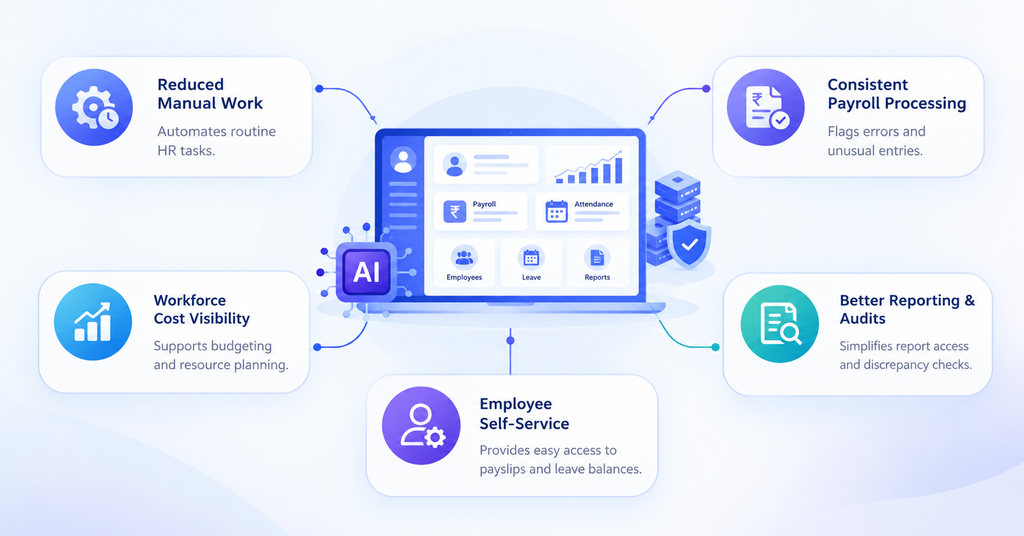
1. Reduced Manual Work for HR Teams
Automated workflows can manage routine tasks such as onboarding reminders, employee queries, and payroll data collection. AI can help to summarize requests, find missing information, and direct issues to the right team.
This gives HR professionals more time to focus on employee engagement support and workforce planning.
2. More Consistent Payroll Processing
Connected employee records and configured payroll rules can reduce duplicate entries and calculation errors.
AI-supported checks can flag unusual salary amounts, missing details, or unexpected deductions for review, and Payroll teams must check these alerts before approving payments.
3. Better Visibility Into Workforce Costs
Workforce analytics can help HR and finance teams review salary costs, incentives, overtime, staffing levels, and other expenses.
This information helps in budgeting and resource planning across branches and departments, which is more useful when the data is complete, consistent, and interpreted correctly.
4. Improved Employee Self-Service
Employee self-service tools help staff access payslips, leave balances, and company policies without contacting HR for every request.
However, AI tools can help answer routine questions, while sensitive or complex issues can be directed to authorized HR or payroll professionals.
5. Better Reporting and Audit Preparation
Centralized HR and payroll records make it easier to access reports, check approval histories, and investigate discrepancies. However, AI can help summarize exceptions and find relevant information, so organizations must verify records and complete required checks and filings.
The value of AI-powered HR and payroll software for BFSI comes from combining reliable automation, connected employee data, useful analytics, and clear controls. Additionally, organizations should measure actual results against their existing processes instead of assuming that AI will automatically improve every task.
| Key Insights: 87% of HR professionals using AI reported improved efficiency in 2026. |
How Can BFSI Organizations Implement AI in HR and Payroll?
BFSI organizations should introduce AI into HR and payroll through a phased approach. Starting with a specific operational problem, preparing reliable data, and measuring results can help teams manage implementation risks and identify where AI adds genuine value.
Let’s understand how BFSI organizations can implement AI into their HR and Payroll operations:
1. Identify Repetitive Tasks and Business Needs
Start by identifying tasks that require considerable manual effort, such as payroll data validation, attendance reconciliation, employee queries, onboarding follow-ups, and report preparation.
Prioritize tasks based on their frequency, error rates, and business impact. Once you identify a process that needs improvement, determine what employee information and system access are required to address it.
2. Prepare and Integrate Employee Data
After selecting the task, review the data needed to support it, so check employee records, salary structures, attendance, leave, and payroll inputs for missing details, duplicate entries, or outdated information.
Correct these issues and ensure HR, attendance, and payroll systems can exchange data reliably. Once the information is accurate and connected, you can begin automating routine tasks without carrying existing data problems into the new workflow.
3. Automate Standard Workflows First
With reliable data in place, automate predictable tasks such as employee data updates, approved leave transfers, payroll calculations using configured rules, and routine notifications.
Once these workflows operate consistently, introduce AI where it can address a specific need, such as flagging unusual payroll entries or helping employees find approved HR policies. Test the selected capability on a small scale before using it more widely.
4. Run a Pilot With Clear Controls
Choose one AI use case and test it with a defined team or workflow. For example, a payroll team could trial AI-assisted anomaly detection while keeping existing approval procedures in place.
Set clear rules for data access, alert reviews, error reporting, and human approvals. During the pilot, compare the results with the existing process to understand whether AI improves the task and what needs adjustment before expansion.
5. Measure Results and Expand Gradually
Next, use the pilot results to assess payroll correction rates, processing time, unresolved exceptions, employee query resolution time, and manual effort, then compare these measures with the baseline and account for implementation and ongoing costs.
If the results show clear benefits and the necessary controls are effective, then you can expand AI to other suitable workflows.
This gradual approach helps BFSI organizations adopt AI based on reliable data, practical needs, and measurable improvements while maintaining control over HR and payroll operations.
What Should You Look for in HR and Payroll Software for BFSI?
Choosing the right HR and payroll software for BFSI involves more than checking its AI features. Banks, NBFCs, and insurance companies need accurate payroll processing, connected employee records, strong security, and reports that support their business and compliance needs.
Therefore, organizations should evaluate the following features before selecting a solution.
1. Integrated HR, Attendance, Leave, and Payroll
First, choose software that connects employee records, attendance, leave, salary structures, and payroll processing. This integration helps reduce duplicate data entry and identify differences between employee records and payroll inputs.
In addition, check whether the system supports your workforce structure, approval processes, and existing business applications. These integrations also help you assess whether the software can meet your compliance and reporting needs.
2. Indian Statutory Compliance Support
Along with integrated workflows, the software should support applicable payroll requirements, including PF, ESI, TDS, and professional tax, based on employee eligibility and current rules.
To evaluate this capability, ask vendors how they configure and update statutory calculations, which reports they provide, and how they support reconciliation and filing workflows. Also, confirm which tasks your payroll team must handle and whether the system meets your organization’s requirements.
3. Data Security and Audit Trails
Beyond compliance, data security is another important factor. HR and payroll systems handle sensitive employee information, so check their access controls, authentication, data protection, backups, audit logs, and vendor security practices.
If the software includes AI features, ask how they process employee data, what information they can access, whether inputs are retained, and how outputs and system changes are monitored. These checks help you determine whether the software meets your security needs or not.
4. AI Capabilities, Analytics, and Exception Reporting
Once security requirements are clear, evaluate the AI features based on your actual business needs rather than choosing software simply because it includes AI.
Depending on the product, useful features may include flagging unusual payroll entries, identifying missing information, answering routine HR questions, and summarizing workforce reports.
To verify these capabilities, ask vendors to demonstrate them and explain how users check errors, review exceptions, and control automated actions.
5. Integration, Scalability, and Support
Finally, for multi-location organizations, it is equally important to confirm that the system can handle different employee groups, salary structures, approval levels, and operational needs as the business grows.
Before making a final decision, compare vendors against your requirements, request demonstrations, and test important workflows.
Organizations evaluating integrated HR and payroll workflows can also explore Savvy HRMS payroll software and its statutory compliance capabilities. Assess the available features against your organization’s needs and verify any specific AI functionality directly with the vendor.
Conclusion
AI is creating new opportunities for banks, NBFCs, and insurance companies to improve HR operations, support payroll checks, respond to employee queries, and analyze workforce data. However, its value depends on reliable employee records, connected systems, appropriate security controls, and human oversight.
When evaluating HR and Payroll Software for BFSI, organizations should first identify their operational challenges, strengthen core HR and payroll processes, and choose AI capabilities that solve specific problems. They should then measure outcomes such as processing time, payroll corrections, unresolved exceptions, and employee query resolution.
The goal is not to automate every HR decision but to make routine work more efficient while keeping payroll decisions, employee data, and compliance processes accurate and accountable.

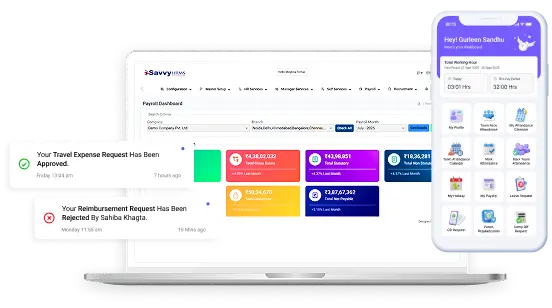


Looking for Better HR and Payroll Software for BFSI?
Simplify payroll, attendance, employee records, and statutory compliance workflows with Savvy HRMS.
Frequently Asked Questions
1. What Is AI in Banking HR?
AI in banking HR refers to using artificial intelligence to support tasks such as candidate screening, employee onboarding, HR query resolution, and workforce analytics. It can help HR teams process information faster, identify patterns, and support workforce planning while retaining human oversight.
2. How Does AI Improve Payroll Accuracy in BFSI?
AI can help flag unusual salary entries, duplicate payment records, missing information, and unexpected deductions. Payroll teams investigate these alerts and verify the underlying data before approving payments. Accurate calculations still depend on reliable employee records and correctly configured payroll rules.
3. Can AI Automate Statutory Payroll Compliance in India?
AI can support compliance workflows by identifying missing information, highlighting payroll discrepancies, and organizing records for review. However, organizations must apply current statutory rules, verify calculations, meet applicable deadlines, and complete required payments and filings.
4. What Is the Difference Between HR Automation and AI?
HR automation follows predefined rules to perform tasks such as sending reminders, transferring approved leave records, or processing configured payroll calculations. AI can help interpret queries, summarize information, and identify patterns or unusual entries. Both require accurate data and appropriate controls.
5. What Features Should BFSI Payroll Software Include?
BFSI payroll software should support configurable salary structures, employee records, attendance, leave, applicable statutory deductions, payroll reports, security controls, audit trails, and necessary integrations. AI-assisted anomaly detection and analytics may be useful when they address specific operational needs.
6. How Can Banks Protect Employee Data When Using AI?
Banks should use approved AI tools, restrict access to authorized users, apply appropriate encryption and authentication, and review vendor data-handling practices. Clear retention policies, audit logs, employee-data safeguards, and human review can further reduce the risk of unauthorized access or inaccurate outputs.