How HR Teams Should Manage E-Way Bill Processes for Multi-Location Transport Operations


-
AuthorHRMS
-
 Last Updated
October 22, 2026
-
 Reading Time
15 Mins
TL;DR
- An e-way bill is an electronic document required for certain goods movements under India’s GST rules.
- An e-way bill is generally required for specified goods movements when the consignment value exceeds ₹50,000, subject to applicable rules, exceptions, and special provisions.
- The e-way bill process involves checking requirements, preparing documents, entering the necessary details, adding transport information, and generating the e-way bill where required.
- A standard process helps multi-location businesses coordinate shipment details, reduce avoidable documentation errors, and maintain consistent records across branches.
- HR teams support the process through employee training, clear responsibilities, shift coverage, and proper handovers, while finance, GST, and logistics teams handle their respective compliance and transport duties.
An e-way bill is an electronic document required for certain goods movements under GST rules in India. For businesses managing multiple factories, warehouses, branches, and distribution centres, handling e-way bills correctly requires accurate documentation and coordination between teams.
The system operates at a national scale. According to the Press Information Bureau, the GST system had cumulatively processed 833.82 crore e-way bills as of 30 September 2026. At that volume, small errors in shipment details can repeat across locations. They can delay dispatch, create rework for warehouse teams and cause mismatches between goods sent and received.
A well-defined e-way bill system helps businesses manage required documentation and coordinate eligible goods movements. While finance, GST, and logistics teams handle compliance and transport activities, HR supports the process through employee training, clear responsibilities, shift planning, and proper handovers.
This guide explains everything about the e-way bill, how the system works in India, and how teams can coordinate e-way bill generation across multiple locations.
What Is an E-Way Bill?
An e-way bill is an electronic document generated on the GST e-way bill portal to record the movement of goods. It is required under Section 68 of the CGST Act, 2017 and Rule 138 of the CGST Rules, 2017, and it links the goods in transit to the invoice or other document that supports the movement.
It stores the details of the sender and recipient, the supporting document, the goods and the transport arrangement. Businesses use it for sales, stock transfers between branches, job work and other movements covered by GST rules.
When Is an E-Way Bill Required?
An e-way bill is generally required when goods worth more than ₹50,000 are moved from one place to another in situations covered by GST rules. This can include moving goods to a customer, transferring goods between business locations, or receiving goods from an unregistered supplier.
However, the ₹50,000 limit is not the only factor to consider. Some types of movement have different requirements or exemptions, and state-specific rules may also apply.
For example, if a company sends goods worth ₹80,000 from its warehouse to a customer, it should check whether an e-way bill is required before dispatch. The applicable rules and any exemptions must be verified for that movement.
Businesses should check the latest requirements under the official CBIC e-way bill rules before transporting goods.
What Information Does an E-Way Bill Contain?
The information an E-Way Bill contains generally relates to the following areas:
- Consignor and consignee: Details of the parties involved in the movement, including applicable GSTINs.
- Invoice or delivery challan: Supporting document information relevant to the transaction.
- Goods details: Information such as the description, quantity, value, and applicable HSN details.
- Transport information: Details relating to the transporter, vehicle, or transport document, as applicable.
- Movement details: Relevant dispatch, destination, and distance information.
The e-way bill form has two parts. Part A covers the transaction and goods, and Part B covers transport details such as the vehicle number.
Why Is an E-Way Bill Important for Businesses?
An e-way bill helps businesses document the movement of goods and provide the required details during transit checks. It helps connect transport information with the relevant invoice or other supporting document, making it easier to verify a shipment when needed.
For businesses operating across multiple branches, this is especially important. For example, when a warehouse sends goods to another branch or a customer, accurate details help the billing, warehouse, and logistics teams coordinate the dispatch and track the shipment.
Missing or incorrect information can lead to delays, extra checks, and difficulties reconciling goods sent and received.
HR teams support this process by ensuring employees understand their responsibilities and follow approved procedures.
Through training, clear role assignments, and proper shift handovers, HR can help reduce avoidable errors and keep dispatch operations running smoothly. Finance, GST, and logistics teams remain responsible for their respective compliance and transport tasks.
How Does the E-Way Bill System Work in India?
The e-way bill system helps businesses document the movement of goods from one location to another. In India, businesses can use the official e-way bill portal to generate e-way bills, enter transport details, and complete other permitted activities.
For companies operating across multiple branches, the process generally follows these steps.
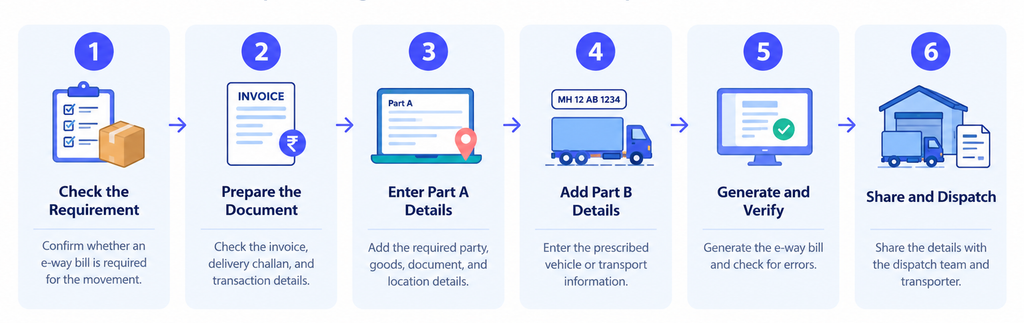
Step 1: Check Whether an E-Way Bill Is Required
Before dispatching goods, the responsible team should check the type of transaction, consignment value, distance or movement conditions where relevant, and applicable GST rules. This helps determine whether an e-way bill is required.
Step 2: Prepare the Invoice or Relevant Document
In this step, the billing or accounts team prepares the applicable tax invoice, bill of supply, delivery challan, or other relevant document. The document details should be checked before they are entered into the e-way bill system.
Step 3: Enter the Details in the E-Way Bill Portal
Now, the authorized person enters the required information on the official portal. This may include the supplier and recipient details, document number and date, goods value, HSN code, and dispatch and delivery locations, depending on the transaction.
These details are commonly recorded under Part A of the e-way bill form.
Step 4: Add the Transportation Details
The responsible person enters the required transport information, such as the vehicle number or transporter details, according to the mode of transport and applicable requirements. These details are commonly associated with Part B.
The person responsible for this step should coordinate with the transporter or dispatch team to ensure the information is accurate.
Step 5: Generate and Verify the E-Way Bill
After the required information is entered, the authorized user generates the e-way bill, and the team should check the generated document and confirm that its details match the relevant business and transport records.
If any information is incorrect, employees should follow the prescribed correction or cancellation procedure rather than assuming the generated e-way bill can be edited.
Step 6: Share the Details and Coordinate the Dispatch
Finally, the e-way bill number and relevant documents should be made available to the people responsible for dispatch and transportation. The team should also monitor validity and update transport details through the permitted process if circumstances change.
For businesses with multiple branches, a common checklist helps ensure that every location follows the same steps.
What Are Part A and Part B of an E-Way Bill?
The e-way bill form is commonly explained through two parts.
Part A contains transaction and goods-related information. Depending on the transaction, this can include details of the parties, document number and date, goods value, HSN code, and relevant locations.
Part B contains transportation details, such as the vehicle number or other prescribed transport information, depending on the mode of transportation and applicable provisions.
The information must be entered by the responsible person or authorized user. The process should be completed according to the applicable requirements before the goods move.
What Is the Difference Between an E-Way Bill and an E-Invoice?
An e-invoice and an e-way bill serve different purposes under GST. An e-invoice relates to reporting specified invoice details to the Invoice Registration Portal (IRP), while an e-way bill documents the movement of goods when required under applicable rules.
Businesses should check which requirements apply to each transaction.
| Basis | E-Invoice | E-Way Bill |
| Main purpose | Reports specified invoice details through the IRP and obtains an Invoice Reference Number (IRN). | Documents the movement of goods. |
| Focus | Invoice reporting and authentication under the e-invoicing system. | Transportation and movement of goods. |
| When required | For taxpayers and transactions covered by the applicable e-invoicing rules. | For goods movements covered by the applicable e-way bill rules and conditions. |
| Key information | Invoice details submitted to the IRP. | Consignment, document, location, and required transport details. |
| Main users | Relevant invoicing, accounts, and GST teams. | Finance, GST, warehouse, dispatch, and transport teams. |
How Long Is an E-Way Bill Valid?
An e-way bill is generally valid for one day for every 200 km (or part thereof) for regular cargo and one day for every 20 km (or part thereof) for over-dimensional cargo. Validity is calculated based on the distance the goods must travel.
| Type of cargo | Distance | Validity |
| Regular cargo | Up to 200 km | 1 day |
| Regular cargo | Every additional 200 km or part thereof | 1 additional day |
| Over-dimensional cargo | Up to 20 km | 1 day |
| Over-dimensional cargo | Every additional 20 km or part thereof | 1 additional day |
Example: A regular cargo consignment travelling 350 km is valid for 2 days. The first 200 km counts as 1 day, and the remaining 150 km counts as part of the next 200 km, adding 1 day.
Can the validity be extended?
Yes. If goods cannot reach their destination on time due to circumstances such as a vehicle breakdown, the validity may be extended by an authorized person within eight hours before or after expiry, subject to applicable rules and portal procedures.
Why Do Multi-Branch Businesses Need a Standard E-Way Bill Process?
When a business works across multiple offices, factories, and warehouses, managing e-way bills becomes more complex. Each location may handle billing, documentation, and dispatch differently.
A standard process helps businesses reduce errors, coordinate teams, and maintain consistent shipment records.
4 Challenges Multi-Branch Businesses Face With E-Way Bills
1. Different GST Registrations
Branches operating across states may have separate GSTINs. When goods move between locations, teams must verify the applicable GST treatment and e-way bill requirements.
Because incorrect GSTINs or mismatched invoice details can create documentation and accounting discrepancies.
What helps: Set clear rules for selecting GSTINs and documenting inter-branch movements.
2. Billing and Dispatch From Different Locations
An invoice may be issued by a Delhi office while goods are dispatched from a Gurugram warehouse.
If billing and dispatch teams do not coordinate, the documents may contain incorrect addresses or inconsistent transaction details.
What helps: Verify billing, dispatch-from, recipient, and delivery details before dispatch.
3. Different Dispatch Procedures Across Branches
One branch may follow a detailed checklist, while another may rely on manual records.
This can lead to duplicate documents, missing e-way bill references, incomplete vehicle details, and delayed delivery confirmations.
What helps: Use a shared dispatch checklist and assign responsibility for preparing, checking, and generating e-way bills.
4. Limited Visibility Across Locations
When branches maintain separate spreadsheets, head office teams may struggle to track dispatched, delayed, delivered, or cancelled consignments.
What helps: Maintain centralized shipment records so authorized teams can monitor status, identify missing details, and follow up promptly.
Example: How a Standard E-Way Bill Process Helps Across Branches
Let‘s understand with an example.
Imagine a company has its head office in Delhi and a warehouse in Gurugram. The Delhi team prepares the invoice, while the Gurugram team handles the physical dispatch.
Before the goods leave the warehouse, the teams need to confirm that the invoice, GSTINs, dispatch-from details, and transport information are correct and that an e-way bill is generated where required. If these checks are handled differently at each branch, missing details or incorrect information could delay dispatch.
A standard process assigns clear responsibilities where the billing team verifies invoice details, the authorized finance or GST team checks applicable requirements, and the warehouse and logistics teams confirm dispatch and vehicle details. A shared checklist and centralized shipment records help everyone follow the same steps.
Who Is Responsible for Each Step of the E-Way Bill Process?
Managing e-way bills across multiple branches requires coordination between several teams. When employees know who prepares documents, verifies details, coordinates transport, and handles errors, businesses can reduce confusion and avoid missed steps.
| Department | Main responsibility |
| Finance and GST | Check applicable GST requirements, verify transaction details, and oversee compliance procedures. |
| Logistics and dispatch | Coordinate shipment schedules, transporters, vehicle details, and dispatch-related updates. |
| Warehouse | Verify goods, quantities, loading readiness, and supporting documents. |
| Branch manager | Coordinate local teams, monitor pending activities, and escalate operational issues. |
| Core HR | Arrange employee training, clarify job responsibilities, and support shift coverage and handovers. |
| IT | Maintain authorized system access, support integrations, and resolve technical issues. |
| Transporter | Provide required transport information and complete assigned transportation activities. |
” Strong HR operations help teams maintain clear responsibilities, consistent procedures, and reliable handovers across locations, even during workforce changes.”
—HR Operations Expert
How Can HR Teams Support E-Way Bill Generation and Transport Coordination?
HR teams may not generate e-way bills or manage GST compliance directly, but they can help employees follow approved procedures across branches.
By supporting training, role clarity, staffing, and communication, HR helps reduce workforce-related delays in transport operations.
1. Define Responsibilities Across Branches
HR can work with Payroll, logistics, and warehouse managers to clarify who handles each task at every location by:
- Identifying employees responsible for preparing and checking shipment information.
- Assigning trained backup employees for critical tasks.
- Explaining reporting lines and escalation procedures when issues arise.
Clear responsibilities help employees know whom to contact and reduce delays caused by confusion or staff unavailability.
2. Train Employees on Approved Procedures
To make training consistent across branches, businesses can use a Learning Management System to organize employee learning activities and track training completion, where these capabilities are available. Finance and GST specialists should still provide guidance on e-way bill requirements.
Training can cover:
- Checking shipment information against approved documents.
- Following internal verification and recordkeeping procedures.
- Identifying errors that require attention.
- Escalating GST-related questions to the appropriate team.
Finance or GST personnel should guide tax-specific requirements, while HR coordinates training and tracks completion.
3. Plan Shifts and Backup Staffing
For businesses operating warehouses and factories across multiple shifts, Attendance Management Software can help HR teams track attendance and manage workforce availability, making it easier to plan coverage for critical operational roles.
HR can:
- Coordinate staffing around dispatch schedules.
- Arrange leave coverage for employees handling critical tasks.
- Ensure trained personnel are available across shifts.
- Establish contacts for issues that arise outside normal working hours.
This helps businesses maintain dispatch continuity without relying on a single employee.
4. Standardise Shift Handovers
When a shift ends before a shipment issue is resolved, important details can be missed. HR can help departments introduce a common handover format across locations.
The handover should include:
- Pending dispatches and missing information.
- Unresolved document discrepancies.
- Transporter updates and follow-up requirements.
- The next action and the employee responsible.
A consistent handover process helps incoming employees continue pending work without unnecessary delays.
By supporting trained employees, clear responsibilities, and reliable shift handovers, HR helps multi-location businesses coordinate transport activities more effectively while leaving e-way bill compliance responsibilities with the appropriate teams.
What Does an E-Way Bill Workflow Look Like for a Multi-Location Company?
Consider a hypothetical manufacturing business with a factory in Pune, a central warehouse in Maharashtra, and a distribution centre in Chennai.
The business needs a consistent process so that employees at each location know what to do and when to involve other departments.
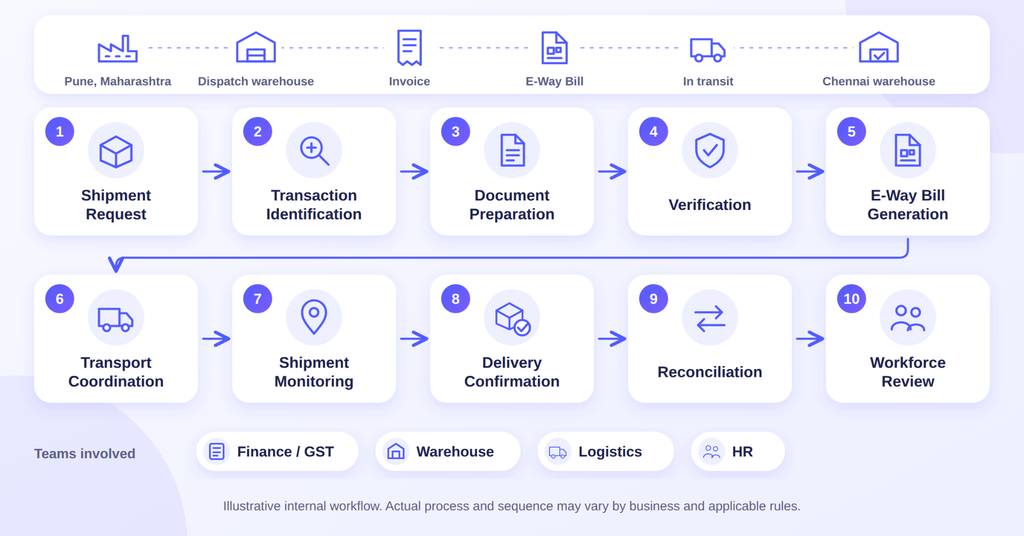
| Stage | Activity | Responsible team |
| 1. Shipment request | The factory or warehouse initiates a goods movement. | Warehouse or dispatch |
| 2. Transaction identification | The nature of the movement and applicable documentation requirements are determined. | Finance/GST with the relevant business team |
| 3. Document preparation | The appropriate invoice or delivery challan and supporting information are prepared. | Authorized business team |
| 4. Verification | Relevant transaction, goods, party, and location details are checked. | Designated finance/GST and operational staff |
| 5. E-way bill generation | The responsible party generates the required e-way bill. | Authorized person under applicable rules |
| 6. Transport coordination | Transporter and vehicle information is confirmed and updated as required. | Logistics and transporter |
| 7. Shipment monitoring | Delays, breakdowns, and other exceptions are reported and addressed. | Logistics and transporter |
| 8. Delivery confirmation | The receiving team confirms goods received and reports discrepancies. | Receiving warehouse |
| 9. Reconciliation | Dispatch, receiving, inventory, and relevant documentation records are compared. | Warehouse and finance |
| 10. Workforce review | Managers review staffing gaps, training needs, and handover issues. | HR with department heads |
This is a practical internal workflow, not a universal legal sequence. The exact requirements depend on the type of movement, transport arrangement, and applicable rules.
Example: A shipment moving from Maharashtra to Tamil Nadu
Suppose a factory in Pune sends finished goods to a distribution centre in Chennai.
The dispatch team prepares the shipment information and coordinates with finance to complete the required checks. The responsible person generates the e-way bill, and the logistics team coordinates the transportation.
During the journey, the vehicle faces a mechanical problem. The transporter informs the logistics team, which takes the appropriate action and coordinates any required transport-detail updates with the authorized person.
At the same time, the receiving location needs an updated delivery estimate. If the incident occurs during a shift change, the outgoing logistics employee must communicate the status and pending actions to the incoming employee.
During the whole process, HR supports this process by ensuring that shift coverage, backup responsibilities, and handover procedures are defined. The finance and logistics teams remain responsible for the relevant compliance and transportation decisions.
Conclusion
Managing e-way bills across multiple locations requires coordination between finance, GST, logistics, warehouse, transport, and other operational teams. Businesses need accurate information, clear responsibility assignments, and documented procedures to manage eligible goods movements effectively.
HR supports this process by helping ensure that employees understand their roles, receive relevant training, and have the staffing and backup coverage needed to carry out their responsibilities. Shift planning, standardized handovers, and regular reviews can help identify workforce-related gaps before they repeatedly disrupt operations.
For Indian businesses operating across multiple factories, warehouses, and branches, the practical starting point is to map the existing workflow, assign responsibility for every critical task, review employee training and staffing gaps, and verify compliance procedures against current GST requirements.