

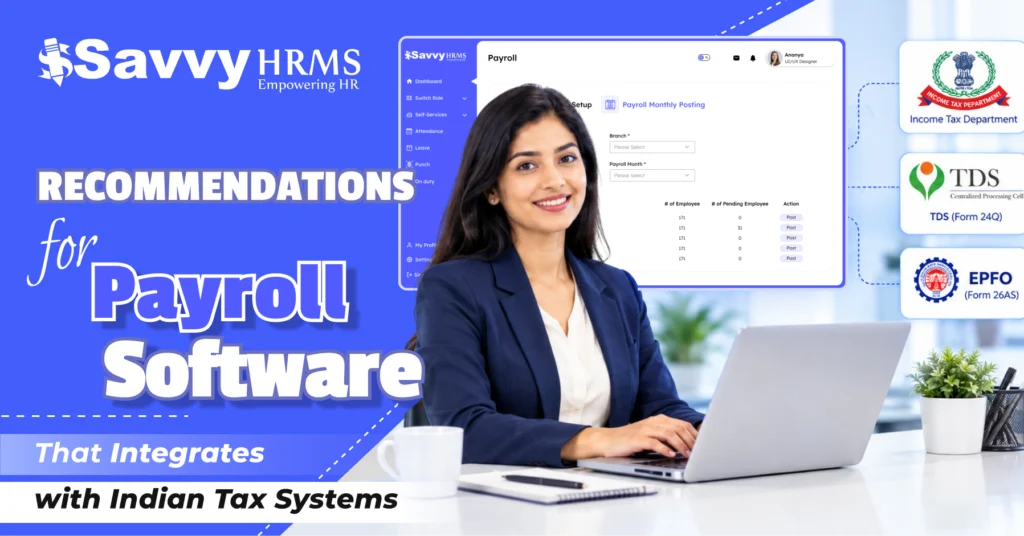
Recommendations for payroll software that integrates with Indian tax systems


-
AuthorRuchika Rajput
-
 Last Updated
September 30, 2026
Last Updated
September 30, 2026
-
 Reading Time
17 Mins
Reading Time
17 Mins
TL;DR
- Payroll software can automate salary processing, TDS, statutory deductions, and compliance workflows.
- Look for support for TDS, tax declarations, tax regimes, Form 16, EPF, ESI, and Professional Tax.
- HR and payroll integrations can connect attendance, leave, salary, reimbursements, and employee data.
- Multi-state businesses should check for state-specific tax and payroll configurations.
- Key features to evaluate include reporting, reconciliation, employee self-service, security, audit trails, and scalability.
- Regular tax-rule updates and accurate employee data are essential for reliable payroll processing.
- Businesses should test real payroll scenarios and request a product demonstration before choosing a solution.
- Savvy HRMS can provide an integrated environment for managing HR, attendance, payroll, performance, recruitment, and onboarding.
Imagine your HR and finance team is preparing monthly payroll for hundreds of employees. They need to calculate salaries, deduct TDS, account for EPF and ESI, manage Professional Tax, process reimbursements, check employee tax declarations, generate payslips, and maintain compliance records. Managing all these tasks manually can quickly become complicated.
For Indian businesses, payroll is no longer just about calculating gross salary and net pay. Payroll teams must manage income tax calculations, statutory deductions, employee declarations, salary structures, compliance reports, and year-end tax documentation. This makes reliable payroll software integrations with Indian tax systems an important part of modern payroll management.
The right payroll software can connect employee information, attendance, salary, tax calculations, statutory deductions, and reporting within a single system. In this blog, we explore what businesses should look for when choosing payroll software that integrates with Indian tax systems and how such software can simplify payroll and compliance.
What Is Payroll Software With Indian Tax Integration?
Payroll software with Indian tax integration is a digital solution that automates salary processing while supporting India-specific tax and statutory requirements. It helps businesses calculate salaries, TDS, deductions, reimbursements, and statutory contributions while maintaining employee payroll records in one centralized system.
Unlike basic payroll tools, integrated payroll software connects employee data, salary structures, attendance, leave, bonuses, tax declarations, and deductions. This allows payroll teams to process salaries more efficiently while reducing repetitive calculations and manual spreadsheet work.
For Indian businesses, payroll software integrations with Indian tax systems can also simplify tax-related workflows such as TDS calculation, tax-regime management, Form 16 preparation, EPF, ESI, Professional Tax, and compliance reporting. By bringing these processes together, businesses can improve payroll accuracy, save administrative time, and provide employees with easier access to payslips and tax information.
Why Indian Tax Integration Matters in Payroll Processing
Indian payroll involves more than calculating monthly salaries. Businesses must manage TDS, tax declarations, applicable tax regimes, EPF, ESI, Professional Tax, and other payroll-related requirements. Payroll software integrations with Indian tax systems help connect these calculations with employee salary data, reducing repetitive manual work and improving payroll consistency.
Tax integration is particularly useful for businesses with a growing workforce, multiple salary structures, or employees across different locations. By automating recurring calculations and maintaining centralized payroll records, organizations can simplify compliance processes while giving employees greater visibility into their salary and tax deductions.
Key benefits include:
- Accurate TDS calculations: Reduces manual tax-calculation errors.
- Simplified compliance: Helps manage applicable statutory payroll requirements.
- Less manual work: Reduces dependence on spreadsheets and repetitive data entry.
- Faster payroll processing: Automates recurring salary and deduction calculations.
- Better employee visibility: Provides easy access to payslips and tax information.
- Easier tax management: Helps manage declarations, deductions, and applicable tax-regime information.
Key Tax and Compliance Requirements Payroll Software Should Handle
The exact payroll requirements of an organization depend on its employee strength, salary structure, locations, establishment type, and applicable statutory provisions. However, businesses should assess several important capabilities when selecting payroll software for India.
1. TDS Calculation
The software should support automated salary TDS calculations based on employee income, applicable tax rules, salary components, declarations, and relevant tax-regime information.
2. Tax Declaration Management
Employees should have a convenient way to submit applicable investment declarations and supporting information. HR teams should be able to review and approve these declarations before they are considered in payroll calculations.
3. Tax Regime Management
Payroll software should support applicable income-tax regime calculations and allow payroll teams to maintain employee-level tax information.
4. Form 16 Support
The software should maintain accurate salary and TDS information throughout the year and support the generation of relevant year-end salary tax documentation.
5. TDS Reporting
Payroll teams should be able to generate and maintain the reports and information required for salary-TDS compliance.
6. EPF Processing
Where applicable, payroll software should calculate employee and employer provident fund contributions and maintain relevant payroll records.
7. ESI Processing
Where ESI applies, the system should support applicable employee and employer contribution calculations and relevant reporting.
8. Professional Tax
Businesses operating in states where Professional Tax applies should check whether the payroll software supports appropriate state-specific configurations.
9. Payroll Records
The system should provide salary registers, payslips, deduction reports, payroll summaries, and other records required by HR and finance teams.
10. Audit Trails
A reliable payroll platform should maintain records of important changes to employee information, salary structures, tax information, and payroll data.
A strong payroll system should bring these processes together rather than forcing HR teams to manage separate spreadsheets and disconnected applications.
What Features Should You Look for in Payroll Software for India?
Choosing payroll software involves more than checking whether a platform can calculate monthly salaries. Businesses should evaluate its tax, compliance, integration, automation, reporting, security, and employee-service capabilities.
1. Automated TDS Calculation
Payroll software should automatically calculate TDS based on employee salary, taxable components, applicable deductions, declarations, and relevant tax rules, reducing manual calculations and improving payroll accuracy.
2. Tax Declaration Management
The system should allow employees to submit tax declarations digitally while enabling HR teams to review, approve, and incorporate relevant information into payroll calculations without depending on separate spreadsheets.
3. EPF, ESI, and Professional Tax
Choose payroll software that supports applicable EPF, ESI, and Professional Tax calculations. State-specific configurations can help businesses manage statutory deductions accurately across different employee locations.
4. Salary Structure Management
A flexible payroll system should support different salary structures, allowances, bonuses, reimbursements, incentives, deductions, and variable-pay components, ensuring accurate calculations for employees with various compensation arrangements.
5. Employee Self-Service
Employee self-service allows employees to access payslips, tax information, salary details, declarations, and payroll documents independently, reducing routine queries and administrative workload for HR teams.
6. Payroll Reporting and Reconciliation
Payroll software should provide detailed salary, tax, deduction, statutory, and reconciliation reports, helping HR and finance teams review payroll calculations, identify discrepancies, and maintain accurate financial records.
7. HR and Accounting Integrations
Look for software that integrates payroll with attendance, leave, employee management, HR, and accounting systems. Connected workflows reduce duplicate data entry and create a smoother payroll processing experience.
How Payroll Software Integrates With Indian Tax Systems
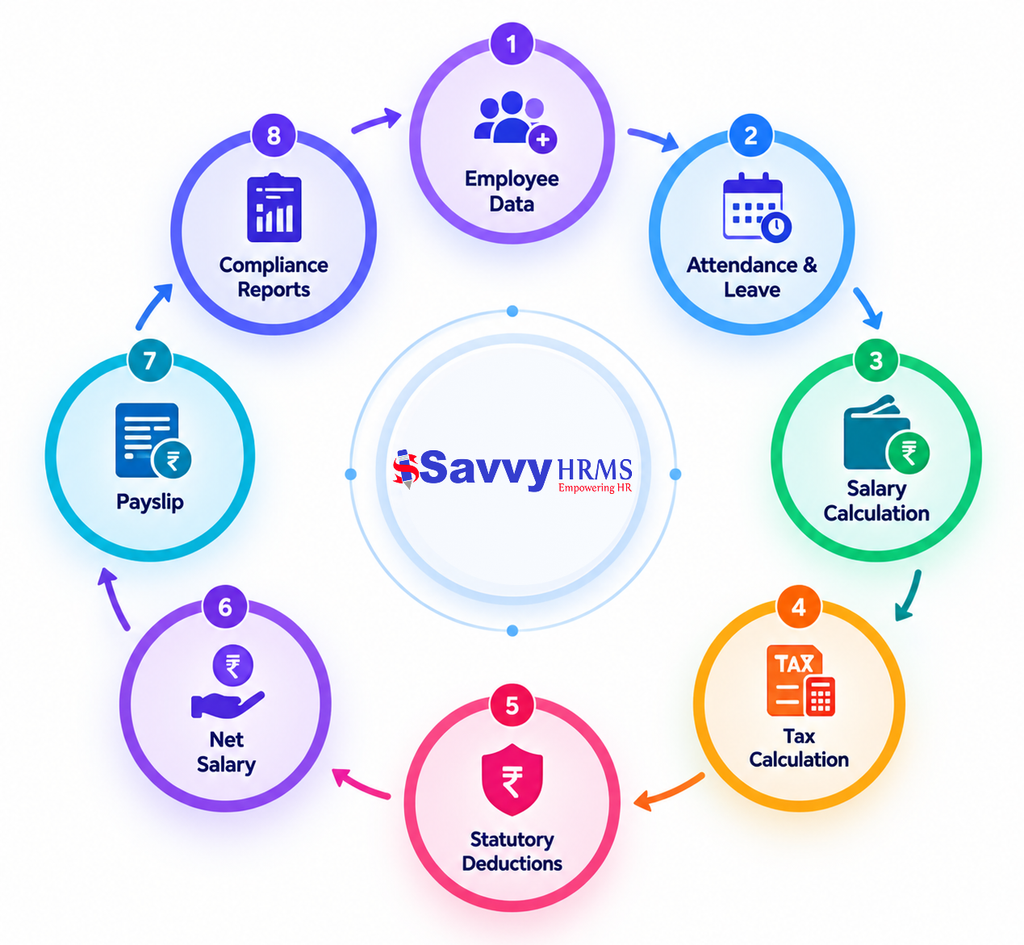
Payroll software generally acts as a central system connecting employee information, salary processing, tax calculations, statutory deductions, and payroll reporting.
The process generally starts with employee master data. This can include employee identification details, salary structure, PAN information, joining date, location, bank information, and applicable statutory details.
The system can then incorporate attendance, leave, overtime, bonuses, reimbursements, incentives, and other payroll inputs. These inputs are used to calculate gross earnings and applicable deductions.
Taxable salary is then calculated according to the configured payroll and tax rules. Where applicable, employee declarations, deductions, exemptions, and tax-regime information are incorporated into the calculation.
The system then calculates applicable TDS and statutory deductions before arriving at the employee’s net salary.
Once payroll is processed, the system can generate payslips, salary registers, payroll summaries, tax reports, statutory reports, and other relevant documentation.
This creates a connected payroll workflow:
The major advantage of this approach is that payroll information does not need to be repeatedly transferred between spreadsheets and separate systems.
Best Payroll Software for Indian Tax Compliance
When businesses search for the best payroll software for Indian tax compliance, there is no single feature that determines whether a solution is suitable. Businesses should evaluate software based on workforce size, payroll complexity, locations, statutory requirements, integrations, implementation needs, and budget.
A payroll platform should ideally provide the following capabilities:
| Capability | What to Check |
| TDS Calculation | Automated salary-TDS calculations |
| Tax Regime | Support for applicable tax-regime calculations |
| Tax Declarations | Digital employee declaration workflows |
| Form 16 | Support for year-end tax documentation |
| EPF | Applicable contribution calculations |
| ESI | Applicable contribution calculations |
| Professional Tax | State-specific configuration |
| Payroll Reports | Salary, deduction and compliance reports |
| Employee Self-Service | Payslips and tax documents |
| Integrations | HR, attendance, leave and finance integrations |
| Audit Trail | Tracking of important payroll changes |
| Security | Access control and employee-data protection |
| Statutory Updates | Timely updates to applicable payroll rules |
| Scalability | Support for workforce and business growth |
Businesses should also consider how easily the software integrates with their existing HR processes.
For example, Savvy HRMS provides an integrated HRMS environment with 20+ powerful HR modules, helping businesses manage functions such as employee management, attendance, payroll, performance management, recruitment, and onboarding.
When comparing payroll solutions, businesses should request a product demonstration and test realistic payroll scenarios rather than depending only on feature lists.
How Payroll Software Handles TDS Calculation and Form 16
TDS calculation is one of the most important functions to evaluate when selecting payroll software in India.
The process begins with employee salary information. The payroll system considers applicable salary components and other taxable earnings to determine the employee’s projected taxable income.
Depending on the employee’s information and applicable tax rules, the system can incorporate relevant declarations, deductions, exemptions, and tax-regime information.
The payroll engine then calculates the applicable tax liability and distributes the required TDS across salary payments according to the applicable payroll process.
A properly configured system should maintain these calculations throughout the year. This is important because employee salary, bonuses, declarations, reimbursements, and other taxable components can change during the financial year.
At the end of the year, the accumulated salary and TDS information can be used for relevant tax documentation, including Form 16.
Form 16 provides employees with important information about their salary income and TDS. Maintaining accurate payroll records throughout the year makes year-end documentation easier and reduces the need for manual reconstruction.
Businesses should therefore check whether their payroll platform supports:
- Automated TDS calculation
- Employee tax declarations
- Tax-regime selection
- Salary projections
- Taxable salary calculations
- Year-end reconciliation
- Form 16 support
- TDS-related reports
- Employee access to tax information
Payroll Software Integration With EPF, ESI, and Professional Tax
| Statutory Component | What Payroll Software Should Handle | Key Benefit |
| EPF (Employees’ Provident Fund) | Calculate applicable employee and employer contributions and reflect them accurately in payroll records. | Reduces manual contribution calculations and supports consistent payroll processing. |
| ESI (Employees’ State Insurance) | Calculate applicable employee and employer contributions based on employee eligibility and configured payroll information. | Simplifies recurring ESI calculations and payroll deductions. |
| Professional Tax (PT) | Apply relevant state-specific Professional Tax rules and calculate deductions based on employee location and applicability. | Helps manage varying state-level payroll requirements. |
| Statutory Reports | Generate contribution and deduction reports for HR and finance teams. | Makes payroll review and reconciliation easier. |
| Employee Payslips | Clearly display applicable EPF, ESI, and Professional Tax deductions on payslips. | Gives employees better visibility into salary deductions. |
| Payroll Integration | Automatically incorporate statutory deductions into monthly salary calculations. | Reduces duplicate data entry and manual payroll work. |
How Payroll Software Simplifies Income Tax Regime Calculations
Income-tax calculations can become complicated when employees have different salary structures, declarations, deductions, exemptions, and tax preferences.
Payroll software can simplify this process by maintaining employee-level tax information and using it during salary calculations.
The system can maintain information such as:
- Annual salary
- Monthly salary
- Taxable allowances
- Bonuses
- Variable pay
- Eligible deductions
- Employee declarations
- Previous employment information where applicable
- Tax-regime information
- Other relevant payroll inputs
Instead of maintaining separate spreadsheets for every employee, payroll teams can manage this information within the payroll platform.
This is particularly useful for organizations with large employee populations. A company with 50 employees may be able to manage some payroll calculations manually, but the same process becomes significantly more difficult when the workforce reaches several hundred or thousands of employees.
Automated tax calculations also make payroll processing more repeatable. When the underlying employee information is accurate, and the software’s tax rules are properly maintained, payroll teams can reduce repetitive calculations.
However, businesses should always verify that their payroll software has been updated for the relevant financial or tax year and applicable regulatory changes.
Payroll Software for Multi-State Tax and Payroll Compliance
Multi-state payroll software helps businesses manage employees across different states by supporting location-specific Professional Tax, payroll configurations, holidays, and reporting. It centralizes payroll processes while allowing HR teams to manage state, branch, and entity-wise requirements efficiently.
Before selecting software, businesses should ask:
- Can employees be assigned to different states?
- Does the system support state-specific Professional Tax?
- Can payroll reports be generated location-wise?
- Can multiple legal entities be managed?
- Can separate payroll policies be configured?
- Can statutory reports be generated by location?
- Can employee transfers between locations be managed?
These questions become particularly important for companies experiencing rapid workforce expansion.
How to Choose the Right Payroll Software for Your Business
The right payroll software should fit the organization’s current requirements while also supporting future growth.
Begin by identifying your payroll requirements. Consider the number of employees, number of locations, salary structures, payroll frequency, applicable statutory requirements, and existing HR and accounting systems.
Next, assess the software’s tax capabilities.
Ask whether it supports:
- TDS calculation
- Tax declarations
- Tax-regime management
- Form 16
- TDS reports
- EPF
- ESI
- Professional Tax
- Multi-state payroll
- Payroll reconciliation
You should also evaluate the software’s HR integrations. Attendance, leave, employee management, recruitment, onboarding, performance management, and payroll can work more efficiently when they are connected.
For example, attendance information can automatically influence salary calculations, while employee information captured during onboarding can flow into payroll.
Businesses should also assess implementation and support. A payroll system requires accurate configuration of salary structures, employee information, statutory settings, tax rules, and workflows.
A product demonstration should therefore be part of the selection process.
Ask the vendor to demonstrate a complete payroll cycle using sample employees with different salary structures, tax declarations, locations, deductions, and statutory applicability.
Payroll Software Integration: What Should You Check Before Buying?
Before purchasing payroll software, businesses should verify how the advertised integrations work in practice.
1. Tax Rule Updates
Ask how the vendor handles changes in income-tax provisions, TDS rules, tax regimes, forms, and other applicable requirements.
2. TDS Calculation
Understand how the software calculates taxable income and TDS and how it handles changes in salary and employee declarations.
3. Statutory Compliance
Verify support for applicable EPF, ESI, Professional Tax, and other statutory payroll requirements.
4. HR Integration
Check whether employee data, attendance, leave, overtime, bonuses, and other payroll inputs can flow automatically into payroll.
5. Accounting Integration
If your finance team uses accounting software, determine whether payroll data can be transferred automatically.
6. Reporting
Request examples of payroll registers, tax reports, statutory reports, reconciliation reports, and employee-level reports.
7. Security
Payroll data contains sensitive information. Evaluate role-based permissions, authentication, access controls, audit trails, backups, and data-protection practices.
8. Scalability
The platform should be able to support additional employees, locations, departments, and entities without creating unnecessary administrative complexity.
9. Customer Support
Ask about implementation support, payroll assistance, statutory updates, issue resolution, and customer-service processes.
10. Data Migration
If you are moving from spreadsheets or another payroll system, understand how historical employee and payroll data will be migrated.
What are the Benefits of Using Payroll Software With Tax Integrations
Using payroll software with integrated tax and compliance capabilities can provide several benefits to HR, finance teams, employees, and business leaders.
1. Reduced Manual Work
Automation reduces repetitive salary calculations and data entry, allowing payroll teams to spend less time maintaining spreadsheets and more time reviewing payroll accuracy.
2. Improved Payroll Accuracy
Connected employee, attendance, salary, and tax data helps reduce inconsistencies caused by repeated manual entries and supports more reliable payroll calculations.
3. Faster Payroll Processing
Automated salary, tax, and statutory calculations can speed up monthly payroll processing, particularly for businesses managing a large or growing workforce.
4. Easier Tax and Compliance Management
TDS calculations, tax declarations, statutory deductions, and payroll reports can be managed through one centralized system, simplifying routine compliance activities.
5. Better Employee Experience
Employees can conveniently access payslips, salary details, tax information, and other payroll documents through self-service features without depending on HR for every request.
Common Challenges in Managing Payroll and Indian Tax Compliance
Even with payroll software, businesses can face payroll and compliance challenges if the underlying processes and data are not managed properly.
1. Outdated Tax Rules
Payroll software needs regular updates when tax and statutory requirements change. Businesses should understand how vendors manage these updates.
2. Incorrect Employee Data
Incorrect PAN information, salary components, employee locations, joining dates, declarations, or statutory details can affect payroll calculations.
3. Complex Salary Structures
Employees may have different combinations of basic salary, allowances, incentives, bonuses, reimbursements, and deductions.
4. Multi-State Requirements
Businesses operating across different states may need location-specific payroll and statutory configurations.
5. Integration Problems
If HR, attendance, leave, payroll, and accounting systems are not properly integrated, employees may still need to enter the same information multiple times.
6. Poor Implementation
Even a capable payroll platform may create problems if salary structures, statutory settings, employee records, and workflows are configured incorrectly.
7. Employee Declaration Delays
Late or incomplete tax declarations can affect payroll calculations and create additional work for HR teams.
8. Payroll Reconciliation Issues
Payroll should be reconciled regularly with bank payments, deductions, statutory records, and accounting data.
The key to successful payroll automation is therefore not simply purchasing software. Businesses need accurate employee data, clearly defined payroll processes, regular reconciliation, appropriate system configuration, and timely statutory updates.
Conclusion
For Indian businesses, payroll software has developed beyond basic salary calculation. Modern payroll platforms can connect employee information, salary processing, tax calculations, statutory deductions, compliance reporting, and employee self-service within a single system.
Effective payroll software integrations with Indian tax systems can reduce repetitive manual work, simplify TDS calculations, support statutory payroll processes, and improve visibility across HR and finance teams.
When evaluating payroll software, businesses should consider TDS calculation, tax-regime management, Form 16, EPF, ESI, Professional Tax, multi-state payroll, employee declarations, reporting, integrations, security, scalability, and statutory updates.
The most suitable solution will depend on the organization’s workforce size, locations, payroll complexity, compliance requirements, existing technology, and future growth plans.
A detailed product demonstration and real-world payroll test can help businesses understand whether a platform genuinely meets their requirements before implementation.

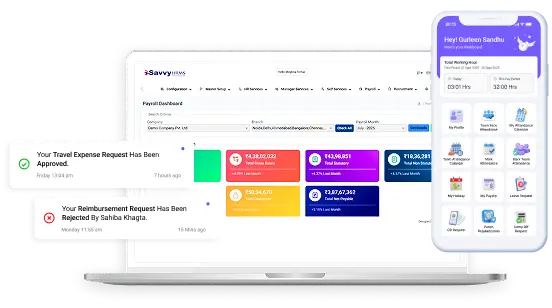









Ready to simplify payroll, tax calculations, and compliance?
Explore Savvy HRMS and streamline your complete HR and payroll operations with an integrated HRMS platform.
Frequently Asked Questions (FAQs)
1. What is payroll software with Indian tax integration?
Payroll software with Indian tax integration combines salary processing with India-specific tax and statutory payroll requirements. It can automate salary calculations, TDS, employee tax declarations, tax-regime calculations, statutory deductions, payslips, reports, and year-end tax documentation while reducing repetitive manual payroll work.
2. Does payroll software calculate TDS in India?
Yes, payroll software can calculate salary TDS using employee salary information, taxable components, applicable deductions or exemptions, employee declarations, and relevant tax-regime information. Businesses should verify that the software’s tax engine is regularly updated according to the applicable tax year and statutory requirements.
3. Can payroll software generate Form 16?
Many payroll platforms support Form 16 generation by maintaining employee salary, deductions, exemptions, and TDS information throughout the year. Accurate payroll records make year-end tax documentation easier and reduce the need for HR teams to manually reconstruct employee salary and TDS information.
4. Can payroll software manage EPF, ESI, and Professional Tax?
Yes, payroll software can support applicable EPF, ESI, and Professional Tax calculations and reporting. However, functionality varies between platforms. Businesses should verify state-specific Professional Tax support, statutory configurations, contribution calculations, reports, and compliance workflows before selecting a payroll solution.
5. What should businesses check before choosing payroll software in India?
Businesses should evaluate TDS calculation, tax-regime support, employee declarations, Form 16, EPF, ESI, Professional Tax, multi-state payroll, statutory updates, HR and accounting integrations, reporting, security, audit trails, implementation support, customer service, and scalability before selecting payroll software for Indian operations.