

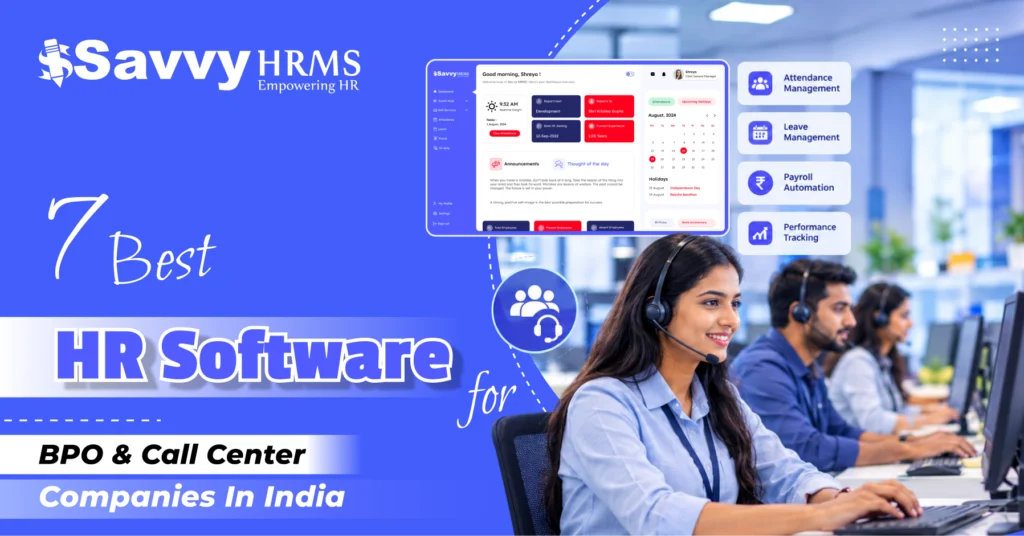
7 Best HR Software for BPO & Call Center Companies in India


-
AuthorChandra Shekhar Verma
-
 Last Updated
September 29, 2026
Last Updated
September 29, 2026
-
 Reading Time
22 Mins
Reading Time
22 Mins
TL;DR
- BPOs need HR software to manage shifts, attendance, payroll, recruitment, and performance efficiently.
- The right HRMS helps automate repetitive HR tasks and reduce manual work.
- Key features include shift scheduling, payroll automation, employee self-service, recruitment, and analytics.
- The blog compares 7 HR software options: Savvy HRMS, Darwinbox, Keka, greytHR, Zoho People, ZingHR, and BambooHR.
- Businesses should evaluate scalability, integrations, compliance, workforce size, and implementation before choosing an HRMS.
- An integrated HRMS can help BPOs centralize workforce data and simplify HR operations.
Is your organization struggling to manage employee attendance, shifts, payroll, recruitment, and performance across your BPO or call center company? Managing a large, shift-based workforce can become complicated when HR teams depend on spreadsheets and disconnected systems. HR software can bring these processes together in one centralized platform.
BPO and call center companies often deal with multiple shifts, night shifts, high-volume recruitment, employee attendance, overtime, payroll, performance tracking, and frequent employee movement. This makes choosing the best HR software for BPO and call center companies an important part of building efficient HR operations.
The right HR software can help automate repetitive processes, enhance workforce visibility, simplify payroll, support employee self-service, and provide HR teams with practical workforce data. In this blog, we compare 7 HR software solutions based on their features, workforce capabilities, scalability, integrations, and best fit for BPO and call center companies in India.
Why Do BPO & Call Center Companies Need HR Software?
BPO and call center companies manage large, shift-based workforces across multiple teams and locations. HR teams have to handle attendance, shift schedules, payroll, recruitment, onboarding, performance, leave, and employee records separately. HR software helps centralize and automate these processes.
Key reasons BPO and call center companies need HR software:
- Manage Shift-Based Employees: Easily create, assign, and manage rotational, night, and multiple shifts.
- Automate Attendance Tracking: Monitor employee attendance, working hours, late marks, overtime, and attendance exceptions.
- Simplify Payroll Processing: Connect attendance, leave, salary, overtime, and deductions for smoother payroll management.
- Simplify High-Volume Recruitment: Handle candidates, hiring workflows, documentation, and onboarding from one platform.
- Improve Employee Self-Service: Allow employees to access payslips, attendance, leave balances, documents, and HR requests.
- Track Employee Performance: Set goals, monitor KPIs, conduct appraisals, and maintain performance records.
- Maintain Employee Data: Keep employee profiles, documents, job information, and lifecycle records organized centrally.
- Support HR Compliance: Maintain relevant employee, payroll, attendance, and statutory information more systematically.
- Monitor Workforce Analytics: Track headcount, absenteeism, overtime, attrition, and other important HR metrics.
- Scale HR Operations: Manage growing employee populations without depending heavily on manual spreadsheets and paperwork.
How Do We Rank This HR Software for BPO and Call Center Companies?
The comparison considers how well each platform’s capabilities align with the specific requirements of BPO and call center operations. Instead of looking only at the number of features, the evaluation focuses on workforce management, payroll, attendance, scalability, employee experience, and India-specific HR requirements.
| Criteria | What We Evaluate | Importance for BPOs & Call Centers |
| Shift Management | Multiple, rotational, overnight, and changing shifts | Very High |
| Attendance Management | Employee attendance, regularization, and tracking | Very High |
| Payroll | Salary processing and attendance-linked payroll | Very High |
| Employee Management | Centralized employee records and lifecycle | High |
| Recruitment | Candidate management and high-volume hiring | High |
| Onboarding | Digital employee onboarding and documentation | High |
| Performance Management | Goals, reviews, KPIs and appraisals | High |
| Compliance | Statutory and payroll compliance support | Very High |
| Employee Self-Service | Employee access to HR information and requests | High |
| Reporting & Analytics | Workforce reports and HR dashboards | High |
| Integrations | Biometric, ERP, payroll, and other integrations | High |
| Scalability | Ability to support workforce growth | Very High |
| BPO Workforce Fit | Suitability for high-volume, shift-based operations | Very High |
These criteria are particularly relevant because BPO and call center operations depend heavily on accurate attendance, scheduling, payroll, and employee data. The final choice should still be based on each organization’s workforce size, processes, technology environment, and implementation requirements.
7 Best HR Software for BPO & Call Center Companies in India
The following platforms represent a comparison of commonly considered HR software solutions for businesses in India. The order is an editorial shortlist based on relevance to the requirements discussed in this blog rather than an independent performance score.
| Rank | HR Software | Best For | Overall Fit |
| 1 | Savvy HRMS | Indian businesses looking for comprehensive HR and payroll management | Comprehensive |
| 2 | Darwinbox | Mid-sized and large enterprises | Enterprise HCM |
| 3 | Keka | Growing businesses managing attendance, payroll, and employee experience | Strong |
| 4 | greytHR | Payroll, attendance and workforce administration | Strong |
| 5 | Zoho People | Businesses seeking HR management within the Zoho ecosystem | Integrated HR |
| 6 | ZingHR | Large and distributed workforces | Workforce-focused |
| 7 | BambooHR | Core HR and employee experience | Core HR |
1. Savvy HRMS
Overview
Savvy HRMS is an integrated HR platform designed to manage different stages of the employee lifecycle. Its capabilities cover employee management, recruitment, onboarding, attendance, leave, payroll, statutory compliance, performance management, learning, travel and expense, and other HR processes.
For BPOs and call centers, this broad functionality can help bring employee management, attendance, payroll, recruitment, performance, and workforce administration into an integrated HR environment. Savvy HRMS offers 20+ HR modules, allowing businesses to manage multiple HR activities through a connected platform.
Key Features
- Centralized employee management maintains employee records, documents, and organizational information.
- Attendance management helps track employee working hours and attendance information.
- Payroll management supports salary processing and payroll-related HR workflows.
- Recruitment tools help manage candidates, hiring processes, and employee onboarding.
- Performance management supports goals, reviews, appraisals, and employee performance tracking.
- Statutory compliance capabilities support India-focused payroll and compliance administration.
- Mobile functionality allows employees to access selected HR services remotely.
- Travel and expense management includes workforce administration beyond traditional HR processes.
- Employee lifecycle tools support processes from onboarding through employee separation.
Who Should Choose Savvy HRMS?
Savvy HRMS can suit BPOs and call centers looking for an integrated HR platform covering recruitment, employee management, attendance, leave, payroll, compliance, performance, and employee lifecycle processes. It can be particularly useful for Indian organizations managing growing, distributed, or shift-based workforces.
Who Might Not Need Savvy HRMS?
Very small teams with straightforward employee administration and limited automation requirements may not need a comprehensive HRMS. Organizations already using extensive enterprise HR infrastructure may also prefer expanding their existing technology ecosystem instead of implementing another broad HR platform.
Best For
Savvy HRMS is best for Indian BPO and call center companies looking for comprehensive HR software covering payroll, attendance, recruitment, compliance, performance, employee management, and other workforce processes through one integrated HR platform.
2. Darwinbox
Overview
Darwinbox is a cloud-based HCM platform designed for mid-sized and large organizations. It supports core HR, payroll, recruitment, attendance, performance, employee engagement, and workforce management, making it suitable for BPOs and call centers managing complex employee structures and multiple operational teams.
Key Features
- Core HR centralizes employee information and workforce records.
- Workforce management supports structured management of employee operations.
- Payroll capabilities support India-focused salary processing and statutory deductions.
- Recruitment tools support candidate acquisition and hiring workflows.
- Onboarding capabilities help structure new employee joining processes.
- Employee engagement features support broader workforce experience initiatives.
Who Should Choose Darwinbox?
Darwinbox can suit larger BPO and call center organizations requiring enterprise-level HCM capabilities across HR, payroll, workforce management, recruitment, employee engagement, and talent processes. It can be relevant for organizations managing complex structures, multiple locations, and large employee populations.
Who Might Not Need Darwinbox?
Smaller BPOs with relatively simple HR operations may not require an enterprise-oriented HCM environment. Companies primarily looking for straightforward attendance, payroll, employee management, and leave automation may prefer a platform with a narrower implementation scope.
Best For
Darwinbox is best for larger BPOs, call center groups, and enterprises looking for a broad HCM platform that brings workforce management, payroll, recruitment, talent, and employee experience processes together.
3. Keka
Overview
Keka is an HR and payroll platform focused on simplifying employee management, payroll, attendance, leave, recruitment, and performance processes. Its employee-centric interface makes it useful for BPOs and call centers looking to automate routine HR operations while improving employee self-service.
Key Features
- Shift management supports employees working different schedules and shifts.
- Attendance tracking helps monitor employee working time and attendance.
- Payroll automation connects workforce information with salary processing.
- Leave management supports configurable leave policies and employee requests.
- Mobile capabilities allow employees to perform selected HR activities remotely.
- Employee self-service reduces repetitive HR requests and administrative workload.
Who Should Choose Keka?
Keka can suit growing BPOs and call centers looking for modern HR software that combines attendance, shift management, payroll, leave, employee management, and employee experience. It can be relevant for organizations that want employees and managers to complete routine HR activities digitally.
Who Might Not Need Keka?
Organizations requiring highly specialized enterprise workforce configurations or complex outdated system integrations should carefully assess implementation requirements. Very small businesses with only basic employee administration and payroll needs may also require fewer capabilities than a broader HR platform provides.
Best For
Keka is best for growing BPO and call center organizations looking for integrated attendance, shift management, payroll, leave management, employee self-service, and modern HR administration.
4. greytHR
Overview
greytHR is an HR and payroll software platform offering tools for employee information, attendance, leave, payroll, onboarding, and employee self-service. It can support BPO and call center organizations that need structured HR processes, payroll automation, and centralized employee records.
Key Features
- Shift configuration supports different employee working patterns.
- Shift rosters help managers organize employee schedules.
- Attendance policies allow organizations to define workforce attendance rules.
- Employee attendance records provide visibility into working information.
- Shift changes can follow structured employee and manager workflows.
- Payroll capabilities connect employee information with salary processing.
Who Should Choose greytHR?
greytHR can suit BPOs and call centers where attendance, payroll, shift management, and employee administration are major priorities. Organizations looking for structured workforce administration with practical attendance and payroll capabilities can consider it for everyday HR operations.
Who Might Not Need greytHR?
Organizations looking for a highly specialized enterprise HCM platform covering extensive global talent, workforce, and employee-experience requirements may need to evaluate broader alternatives. Very small teams with minimal HR administration may also need fewer capabilities.
Best For
greytHR is best for BPOs and call centers that prioritize payroll, attendance, shift scheduling, employee records, leave management, and practical workforce administration.
5. Zoho People
Overview
Zoho People is a cloud-based HR management platform that helps businesses manage employee information, attendance, leave, performance, onboarding, and workflows. Its integration capabilities make it useful for BPOs and call centers already using other business applications within the Zoho ecosystem.
Key Features
- Shift mapping and rotation support structured employee scheduling.
- Attendance management captures employee working-time information.
- Employees can submit selected shift-related requests digitally.
- Managers can monitor team schedules and shift information.
- Leave management supports employee leave requests and approvals.
- Zoho ecosystem connectivity can connect HR with other business applications.
Who Should Choose Zoho People?
Zoho People can suit BPOs and call centers looking for flexible HR management with attendance, shifts, leave, performance, and employee self-service capabilities. Organizations already using other Zoho applications may also find ecosystem connectivity relevant when evaluating their HR technology.
Who Might Not Need Zoho People?
Organizations requiring highly specialized BPO workforce functionality should validate shift, payroll, attendance, and integration requirements before implementation. Businesses that do not use the broader Zoho ecosystem may also place less value on its ecosystem connectivity.
Best For
Zoho People is best for BPO and call center companies looking for flexible HR management with attendance, shift capabilities, employee self-service, and potential integration with the broader Zoho business ecosystem.
6. ZingHR
Overview
ZingHR is a cloud-based HRMS designed to manage employee lifecycle processes, including recruitment, onboarding, attendance, payroll, performance, and employee engagement. Its broad HR capabilities can help BPOs and call centers simplify workforce administration across teams, locations, and operational functions.
Key Features
- Workforce management supports varied and distributed employee populations.
- Shift rostering helps managers organize employee schedules.
- Geo-based attendance supports location-related attendance management.
- Payroll capabilities connect workforce information with salary processing.
- Recruitment tools support candidate acquisition and hiring workflows.
- Performance tools support employee goals, reviews, and performance processes.
Who Should Choose ZingHR?
ZingHR can suit larger BPO and call center organizations managing distributed employees, multiple locations, or complex workforce structures. Companies looking for workforce management, attendance, payroll, recruitment, and performance capabilities within a broader HCM platform can evaluate its suitability.
Who Might Not Need ZingHR?
Smaller BPOs with straightforward employee structures may not require the broader workforce capabilities of an enterprise-oriented platform. Businesses primarily looking for basic payroll and attendance automation may prefer a more focused HR solution.
Best For
ZingHR is best for larger BPOs and call center organizations managing distributed employees, multiple locations, shift rosters, attendance, payroll, recruitment, and broader workforce operations.
7. BambooHR
Overview
BambooHR is a cloud-based HR software platform focused on employee records, hiring, onboarding, performance management, time tracking, and employee experience. It is particularly suited to organizations looking for simplified HR administration and centralized employee information rather than highly complex payroll operations.
Key Features
- Centralized employee records organize workforce information.
- Employee self-service provides access to important HR information.
- Performance management supports structured employee review processes.
- Recruitment capabilities support candidate and hiring workflows.
- Reporting provides workforce information for HR decision-making.
- Integrations connect HR data with selected business applications.
Who Should Choose BambooHR?
BambooHR can suit organizations prioritizing core HR, employee records, employee experience, recruitment, and performance workflows. Indian companies should assess its payroll, attendance, statutory compliance, and shift-management suitability carefully before selecting it for BPO or call center operations.
Who Might Not Need BambooHR?
Indian BPOs primarily looking for an India-focused payroll, complex shift management, attendance automation, and statutory compliance capabilities may need to compare other HR platforms closely. Organizations requiring extensive local payroll functionality should validate those requirements before implementation.
Best For
BambooHR is best for organizations prioritizing core HR, employee experience, employee records, recruitment, and people-management workflows, particularly where international operations or broader HR ecosystem requirements are important.
| HR Software | Best For | Biggest Advantage | Potential Integration | Ideal Employee Size |
| Savvy HRMS | Indian BPOs and large businesses | Broad HR, payroll and workforce modules | Biometric, payroll and business systems | Small to large |
| Darwinbox | Enterprises and large BPO groups | Broad enterprise HCM | Enterprise business systems | Mid to large |
| Keka | Growing BPOs and service companies | Attendance, shifts and employee experience | Attendance devices and business tools | Small to mid-large |
| greytHR | Payroll and attendance-focused organizations | Practical workforce administration | Attendance and payroll systems | Small to large |
| Zoho People | Zoho ecosystem users | Ecosystem connectivity | Zoho applications and third-party tools | Small to large |
| ZingHR | Distributed and large workforces | Workforce management | Payroll, attendance and enterprise systems | Mid to large |
| BambooHR | Core HR and employee experience | Modern employee management | HR and business applications | Small to mid-large |
Employee-size categories are indicative and should be validated with the respective provider according to workforce requirements, implementation model, and pricing.
What Are the Key Features to Look for in HR Software for BPOs & Call Centers?
When selecting HR software for BPO and call center companies, organizations should focus on the features that directly support their workforce structure. A platform with various features may not necessarily be suitable if it cannot efficiently handle shifts, attendance, payroll, and employee management.
1. Shift and Roster Management
BPO employees may work morning, evening, night, rotational, or split shifts. HR software should allow organizations to create schedules, assign employees, manage changes, and maintain visibility into workforce availability.
2. Attendance Management
Attendance records directly affect payroll, overtime, leave, and workforce reporting. The HRMS should provide reliable attendance tracking and support relevant methods such as biometric, mobile, web, or location-based attendance.
3. Payroll Automation
The software should connect employee information, attendance, leave, salary structures, deductions, and other relevant inputs to payroll processing. This can reduce manual calculations and duplicate data entry.
4. Recruitment and Onboarding
BPOs often recruit employees at high volume. Recruitment workflows, candidate management, offer processes, document collection, and digital onboarding can help HR teams manage hiring more efficiently.
5. Employee Self-Service
Employees should be able to view payslips, attendance, leave balances, HR documents, and submit requests without depending on HR for every routine transaction.
6. Performance Management
Call center employees may be assessed against role-specific KPIs and targets. Performance management features should support goals, reviews, feedback, appraisals, and performance documentation.
7. Reporting and Analytics
HR teams should be able to monitor headcount, attendance, absenteeism, overtime, payroll, employee movement, and attrition through reports and dashboards.
8. Integrations
The HRMS should integrate with relevant biometric devices, payroll systems, ERP platforms, recruitment tools, access-control systems, or other business applications where required.
9. Mobile Accessibility
Mobile HR functionality can be useful for employees and managers working different shifts or locations. It allows them to access HR services without depending entirely on desktop systems.
How HR Software Helps Manage Shift-Based BPO Workforces
BPOs and call centers often operate across rotational, night, weekend, and overlapping shifts. HR software helps organizations plan workforce schedules, track attendance, manage working hours, and coordinate employees efficiently while reducing manual scheduling errors.
- Shift Scheduling: Create and assign rotational, fixed, night, and weekend shifts easily.
- Automated Attendance: Track employee attendance, working hours, late marks, and absences correctly.
- Shift Swapping: Allow employees to request and manage shift changes through defined workflows.
- Overtime Tracking: Record additional working hours and connect them with payroll calculations.
- Real-Time Workforce Visibility: Monitor employee availability, attendance, and shift coverage from one dashboard.
- Leave Management: Manage employee leave requests without disrupting shift schedules.
- Night Shift Management: Maintain accurate records for employees working during night and extended shifts.
- Payroll Integration: Connect shifts, attendance, overtime, and leave data for smoother payroll processing.
- Reduce Scheduling Conflicts: Reduce overlapping assignments, understaffing, and manual scheduling mistakes.
- Improve Workforce Productivity: Help managers allocate employees efficiently according to operational requirements.
How HR Software Simplifies Payroll for BPO & Call Center Employees
Payroll management in BPOs and call centers is not always straightforward. With employees working different shifts, overtime hours, weekly offs, incentives, leave, and varying salary structures, HR teams have to manage a lot of payroll inputs every month. Doing everything manually can make the process time-consuming and error-prone.
So, how does HR software help? It brings attendance, shift schedules, leave, overtime, employee information, and payroll data together in one centralized system. This allows HR teams to process salaries using updated information without constantly switching between spreadsheets and separate records.
- Connects Attendance with Payroll: Employee attendance and working hours can flow directly into payroll calculations, reducing repetitive data entry.
- Handles Different Shifts: BPO employees may work day, night, rotational, or weekend shifts. HR software helps maintain accurate shift and working-hour records.
- Tracks Overtime: Approved overtime can be recorded systematically and considered during payroll processing, making additional working hours easier to manage.
- Manages Leave and Absences: Approved leave, unpaid leave, and attendance records can be connected with payroll to support more accurate salary calculations.
- Supports Incentives and Earnings: BPO employees may receive incentives or additional earnings based on organizational policies. HR software helps HR teams manage these payroll components systematically.
What about payslips? Employees can access their payslips through an employee self-service portal, allowing them to check salary details, deductions, earnings, and other payroll information without depending on HR for every request.
- Reduces Manual Errors: Automated calculations and centralized employee data can help reduce mistakes caused by repetitive manual payroll work.
- Makes Payroll More Transparent: HR teams and employees can access relevant payroll information more easily, improving visibility and reducing unnecessary queries.
For BPO and call center companies, where employee numbers and shift patterns can change frequently, payroll automation can make monthly salary processing more organized, consistent, and easier to manage.
What Are the HR Compliance Requirements for BPO & Call Center Companies in India?
BPO and call center companies need to manage employment, wage, payroll, social security, working-time, leave, and workplace requirements according to the applicable legal framework and their specific business circumstances.
India’s four Labour Codes are the Code on Wages, 2019; Industrial Relations Code, 2020; Code on Social Security, 2020; and Occupational Safety, Health and Working Conditions Code, 2020. The four Codes were brought into effect on November 21, 2025, and the Central Rules were subsequently notified in 2026.
Because labour is a Concurrent List subject, organizations should also consider applicable state-level rules and requirements. This is particularly important for BPOs operating across multiple states.
Depending on the organization and applicable requirements, HR teams may need to manage areas such as:
- Wage and salary administration
- Social security contributions
- Employee appointment and employment records
- Working hours and overtime
- Attendance and leave records
- Workplace safety requirements
- Payroll deductions
- Statutory reporting
- Employee registers and records
- State-specific employment requirements
An HRMS can help organize employee and payroll information, maintain records, automate selected workflows, and generate reports. However, software should not be treated as a substitute for professional legal or compliance advice.
How to Choose the Right HR Software for Your BPO or Call Center
Start by understanding your workforce structure. Identify the number of employees, locations, shifts, departments, employee categories, and frequency of shift changes.
Next, identify your most important HR processes. If your biggest challenge is attendance and payroll, prioritize those capabilities. If recruitment volume is high, recruitment and onboarding should receive greater attention.
Then evaluate integrations. Check whether the HR software can work with your existing biometric devices, payroll systems, ERP, recruitment tools, access-control systems, or other business applications.
You should also evaluate employee self-service and mobile capabilities. Employees working different shifts may benefit from being able to access attendance, leave, payslips, and other HR services without visiting the HR department.
Finally, evaluate implementation, support, security, scalability, and total cost. The right HRMS should be able to support current operations while accommodating future workforce growth.
HR Software Selection Checklist
- Does the software support multiple shifts?
- Can it handle rotational and overnight schedules?
- Can attendance connect with payroll?
- Does it support biometric or mobile attendance?
- Can employees access HR information through self-service?
- Does it support high-volume recruitment?
- Can it manage employee onboarding?
- Does it provide performance management?
- Does it provide HR analytics and reports?
- Can it integrate with existing systems?
- Does it support applicable Indian payroll requirements?
- Can it scale as the workforce grows?
- What implementation and support services are included?
- Does the overall cost match the organization’s requirements?
What Are the Benefits of Using HR Software in BPO & Call Center Operations?
The biggest benefit of HR software is that it brings multiple workforce processes into a centralized digital environment. Instead of maintaining employee information, attendance, leave, payroll, recruitment, and performance separately, HR teams can manage connected processes through one system.
1. Reduced Manual HR Work
HR software takes care of repetitive HR activities such as data entry, approvals, calculations, and employee requests. This allows HR teams to spend less time on administrative work and more time supporting employees.
2. Better Attendance Visibility
With centralized attendance data, HR teams can easily monitor working hours, absences, late marks, overtime, and attendance exceptions. This gives managers clearer visibility into workforce availability and helps address attendance-related issues quickly.
3. Simplified Shift Management
Managing different shifts becomes easier when schedules and employee availability are maintained in one system. HR software helps managers assign shifts, handle changes, and maintain organized workforce schedules across different teams and locations.
4. Faster Payroll Processing
Payroll becomes more manageable when employee information, attendance, leave, overtime, and salary details are connected. HR teams can reduce repetitive calculations and data collection, helping them complete monthly payroll processing more efficiently.
5. Improved Employee Experience
Employees do not always want to contact HR for every small request. Self-service tools allow them to access payslips, attendance, leave balances, documents, and other important HR information whenever needed.
6. More Efficient Recruitment
BPOs often hire employees in large numbers to meet changing workforce requirements. Digital recruitment and onboarding workflows help HR teams organize candidates, track hiring progress, collect documents, and move new employees through onboarding smoothly.
7. Better Performance Tracking
Performance management becomes easier when goals, reviews, KPIs, and employee performance records are maintained centrally. Managers can track progress regularly, provide feedback, and conduct structured performance reviews without depending on scattered records.
8. Centralized Workforce Data
Instead of managing employee information across spreadsheets, emails, and physical files, HR software brings everything into one centralized platform. This makes employee data easier to access, update, organize, and manage across the organization.
9. Better HR Reporting
HR dashboards provide useful visibility into important workforce information such as headcount, attendance, attrition, payroll, leave, and overtime. These reports help HR teams understand workforce trends and support more informed day-to-day decisions.
10. Improved Scalability
As BPO operations grow, managing more employees manually can become increasingly difficult. A centralized HRMS helps teams handle larger workforces, automate routine processes, and maintain organized HR operations without increasing administrative workload at the same pace.
Conclusion
Choosing HR software for BPO and call center companies requires more than comparing the number of features available on different platforms. Businesses should evaluate how effectively each solution addresses shift management, attendance, payroll, recruitment, employee self-service, performance, compliance, reporting, integrations, and workforce scalability.
The 7 platforms discussed in this guide- Savvy HRMS, Darwinbox, Keka, greytHR, Zoho People, ZingHR, and BambooHR- offer different approaches to HR management. The right choice depends on the organization’s employee size, operational complexity, technology environment, budget, and specific HR priorities.
For Indian BPOs and call centers, a strong HR technology strategy should connect employee management, shift scheduling, attendance, payroll, recruitment, performance, compliance, and employee self-service. Businesses should conduct a detailed product demonstration and validate important requirements before making a final implementation decision.

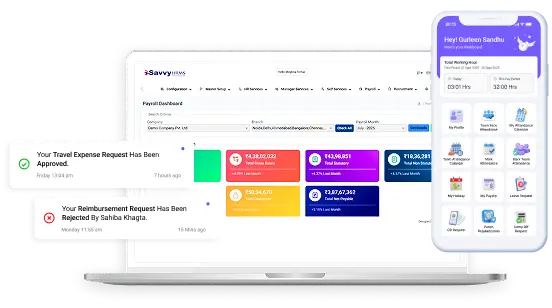









Looking for an integrated HR solution for your BPO or call center?
Explore Savvy HRMS to manage 20+ HR processes, including attendance, payroll, recruitment, performance, compliance, and employee management from one platform.
Frequently Asked Questions (FAQs)
1. What are the top 5 HR software options?
The top HR software options for BPO and call center companies in India include Savvy HRMS, Darwinbox, Keka, greytHR, and Zoho People. The right choice depends on workforce size, shift management, payroll requirements, integrations, and HR processes.
2. Which software is used in BPO?
BPO companies commonly use HR software such as Savvy HRMS, Darwinbox, Keka, greytHR, Zoho People, ZingHR, and BambooHR to manage employee records, attendance, shifts, payroll, recruitment, performance, and employee self-service.
3. What features should BPOs look for in HR software?
BPOs should look for shift scheduling, attendance tracking, payroll automation, overtime management, leave management, recruitment, onboarding, performance tracking, employee self-service, workforce reporting, and compliance-related capabilities.
4. How does HR software help BPO and call center companies?
HR software helps BPOs automate repetitive HR tasks, manage shift-based employees, simplify payroll, improve attendance visibility, simplify recruitment and onboarding, centralize workforce data, and provide employees with convenient self-service options.
5. Is HR software suitable for large BPO workforces?
Yes. HR software can help large BPOs manage employee records, multiple shifts, attendance, leave, payroll, recruitment, and performance from a centralized platform. It can also support growing workforces by reducing manual administrative processes.