


Retirement Age in India: Sector-Wise Rules, Private Sector Policies and HR Responsibilities


-
AuthorSatyam Chauhan
-
 Last Updated
November 24, 2026
-
 Reading Time
19 Mins
Summary
- There is no single retirement age in India for everyone. It varies by employment sector and applicable service rules.
- Central government employees generally retire at 60 years, subject to certain exceptions.
- Many private-sector companies follow 58 or 60 years as the retirement age, depending on employment terms and applicable rules.
- State government employees, PSU staff, bank employees, teachers and defence personnel may follow different retirement ages.
- Superannuation refers to completing regular service upon reaching the prescribed retirement age.
- Eligible employees may receive EPF, EPS pension, gratuity, leave encashment and other company-specific retirement benefits.
- HR teams must verify retirement dates, inform employees in advance, calculate eligible benefits, coordinate payroll and complete exit formalities.
At what age do employees retire in India? The answer isn’t the same for everyone. While central government employees generally retire at 60 years, many private companies follow 58 or 60 years. The retirement age can also vary across state government departments, PSUs, banks, educational institutions and defence services.
Knowing the retirement age in India is important for more than just planning the end of a career. Employees need to understand when they can retire and what benefits they may receive. HR teams, on the other hand, must calculate retirement dates, inform employees in advance, process eligible benefits and complete exit formalities.
In this guide, we’ll explore retirement age rules across different sectors, explain private-sector retirement policies and walk through the key steps involved in managing employee retirement.
What Is Retirement Age in India?
The retirement age in India refers to the age at which an employee is expected to leave regular employment under the applicable service rules, employment agreement or organizational retirement policy.
It marks the end of an employee’s active service with an organization. However, the applicable age differs across government departments, public-sector enterprises and private companies.
For example, central government employees generally retire at 60 years, whereas private-sector employees may retire at 58 or 60 years, depending on the terms governing their employment.
Is There a Fixed Retirement Age in India?
No, India does not have one universal retirement age for all employees. Different employment categories follow different retirement rules.
The retirement age generally depends on:
- Employment sector: Government departments, PSUs, banks and private organizations may follow different retirement rules.
- Service regulations: Government employees follow the applicable service rules, while private employees are governed by relevant employment conditions and laws.
- Employment agreements: Appointment letters, employment contracts and applicable standing orders may specify the retirement age.
- Organizational policies: Private companies may establish retirement policies based on their business requirements, subject to applicable legal provisions.
- Industry-specific requirements: Certain professions, such as defence services and specialized medical services, have different retirement conditions.
Therefore, employees should check their appointment letters, service records and applicable retirement policies instead of assuming that everyone retires at 58 or 60 years.
What Is the Retirement Age in India by Sector?
The retirement age in India differs across sectors. Government employees, private-sector employees, bank employees and professionals such as teachers and judges follow different retirement rules.
Here is a quick overview of the commonly applicable retirement ages across different sectors:
1. Retirement Age for Central Government Employees
The general retirement age for central government employees in India is 60 years, as prescribed under Fundamental Rule 56.
Employees generally retire on the last day of the month in which they turn 60. However, if an employee’s date of birth falls on the first day of a month, they generally retire on the last day of the preceding month.
For example:
- An employee born on 15 March 1966 generally retires on 31 March 2026.
- An employee born on 1 March 1966 generally retires on 28 February 2026.
Certain categories, such as specified medical specialists, may have a higher retirement age of 62 or 65 years under applicable service rules.
2. Retirement Age for State Government Employees
The retirement age for state government employees varies from one state to another. Each state government sets retirement rules through its service regulations and official notifications.
The retirement age may also differ between departments. For example, government administrative employees, healthcare professionals and university teachers may follow different retirement conditions.
Employees should check their respective state government’s service rules to confirm their applicable retirement age.
3. Retirement Age for Private-Sector Employees
There is no single retirement age for private-sector employees applicable to all private-sector employees in India. Many private companies follow 58 or 60 years as their retirement age, depending on their employment terms and company policies.
The applicable retirement age may be mentioned in the employee’s appointment letter, employment agreement or company service rules.
For covered industrial establishments, the Industrial Relations Code, 2020, and applicable standing orders also play an important role.
Under the Model Standing Orders, 2026, the retirement or superannuation age for covered workers is generally the age agreed upon in writing or specified in a binding settlement or award. If no age is agreed upon, the default retirement age is 58 years.
However, this does not mean that every private-sector employee in India must retire at 58. The applicable provisions depend on the establishment, employee category and employment conditions.
4. Retirement Age for Public-Sector Undertakings (PSUs)
Public-sector undertakings (PSUs) follow retirement rules based on government directions, service regulations and organizational policies.
Many central public-sector enterprises follow a retirement age of 58 or 60 years. However, the applicable age may differ between organizations and employee categories.
Employees should refer to their organization’s service rules to confirm their retirement age.
5. Retirement Age for Bank Employees
The general retirement age for many bank employees in India is 60 years.
Public-sector bank employees follow retirement provisions specified under their applicable service regulations and industry-level settlements.
However, employees should check their bank’s service rules to understand the exact retirement conditions applicable to their position.
6. Retirement Age for Defence Personnel
Defence personnel do not have one common retirement age. Their retirement depends on their rank, branch of service and applicable service regulations.
Commissioned officers, junior commissioned officers and other ranks may have different retirement ages and service limits.
Other factors, such as length of service and medical fitness, may also affect their retirement.
7. Retirement Age for Teachers and University Professors
The retirement age for teachers and university professors depends on the type of educational institution and the applicable service regulations.
In many centrally governed higher education institutions, the retirement age for university teachers is 65 years. However, state universities and other educational institutions may follow different retirement ages, commonly ranging from 60 to 65 years.
Teachers should check their institution’s service rules to confirm the applicable retirement age.
8. Retirement Age for Judges
The retirement age for judges in India is determined by the Constitution of India.
- High Court judges: 62 years.
- Supreme Court judges: 65 years.
These retirement ages are specified under Articles 217(1) and 124(2) of the Constitution, respectively.
What Is the Retirement Age in India for Private-Sector Employees?
The retirement age in India for private-sector employees depends on the company’s rules, employment terms and applicable labour laws.
Unlike central government employees, private-sector employees do not have one fixed retirement age. Many private companies set the retirement age at 58 or 60 years. However, it may differ from one organization to another.
Let’s look at how private companies decide the retirement age and whether employees can continue working after reaching it.
Is There a Fixed Retirement Age for Private Employees in India?
The retirement age for private employees is generally determined by their appointment letter, employment agreement, company service rules and applicable labour laws. Many private companies follow 58 or 60 years as the standard retirement age.
No, there is no single retirement age for all private-sector employees in India.
A company’s retirement age may be mentioned in the following documents:
- Appointment letter or employment agreement.
- Certified or applicable standing orders.
- Company service rules or retirement policy.
- Settlements or awards that apply to the employer and employees.
- Other applicable employment rules.
For certain industrial establishments, the Industrial Relations Code, 2020, and applicable standing orders also cover retirement-related conditions.
Therefore, employees and HR teams should check the relevant documents and rules to know the retirement age that applies to them.
How Do Private Companies Decide the Retirement Age?
Private companies consider their business needs, employment terms and applicable labour laws when deciding the retirement age.
Some common factors include:
1. Applicable labour laws
Companies must follow the labour laws and standing orders that apply to their establishment and employees.
2. Employment agreements
The retirement age may be mentioned in an employee’s appointment letter or employment agreement. Employees can refer to these documents to check their retirement conditions.
3. Company retirement policy
A company may set the same retirement age for all employees or have different rules for certain roles, wherever legally allowed.
4. Industry requirements
Retirement practices may vary across industries depending on the type of work, business needs and applicable rules.
5. Employee category
Retirement rules may differ for managerial employees and workers covered by standing orders. The applicable conditions depend on the employee’s role and employment terms.
Can a Private Company Extend an Employee’s Retirement Age?
Yes, a private company may allow an employee to continue working beyond the normal retirement age, depending on its policies and applicable laws.
This may happen when an employee has specialized skills or experience that the company still needs.
Some companies may offer:
- Contractual employment: Hiring the employee for a specific period after retirement.
- Fixed-term employment: Offering employment for a defined period.
- Consultancy: Hiring the retired employee as a consultant.
- Re-employment: Bringing the employee back for a specific role or project.
However, an extension is not automatic. It requires the employer’s approval and must follow the applicable employment terms and rules.
Can Employees Continue Working After Reaching Retirement Age?
Yes, employees may continue working after reaching the company’s retirement age if the employer agrees to a suitable arrangement.
For example, a company may retain an experienced technical employee for a few months to train new employees, share work-related knowledge or complete an important project.
In such cases, the company should clearly mention the duration of the engagement, job responsibilities, payment terms and applicable benefits in the agreement. This helps avoid confusion for both the employer and the employee.
What Is the Difference Between Retirement, Superannuation and Early Retirement?
Retirement, superannuation and early retirement are related employment concepts, but they do not always have the same meaning.
Understanding these differences helps employees and HR professionals to identify the applicable employment conditions and retirement benefits.
| Term | Meaning | When it applies |
| Retirement | Leaving regular employment under applicable retirement conditions | Upon reaching the prescribed retirement age or under other applicable retirement provisions |
| Superannuation | Completion of service upon reaching the prescribed age | When an employee reaches the applicable superannuation age |
| Early retirement | Leaving employment before the normal retirement age under an applicable arrangement | Subject to employer policy, service rules and relevant conditions |
| Voluntary retirement | An employee-initiated departure under applicable service provisions | When the employee satisfies the prescribed eligibility and approval conditions |
The important distinction is that superannuation is generally linked to a prescribed retirement age, whereas early or voluntary retirement may take place before that age under specific conditions.
How Is an Employee’s Retirement Date Calculated?
An employee’s retirement date is calculated using their date of birth and the retirement age prescribed under the applicable employment rules.
However, the calculation method may differ between government departments and private organizations.
For HR teams, accurate retirement-date calculation is important because it helps with employee communication, workforce planning, payroll management coordination and benefit processing.
What Information Is Required to Calculate Retirement Date?
HR should verify the following information before calculating an employee’s retirement date:
- Date of birth: The employee’s officially recorded date of birth.
- Applicable retirement age: The retirement age specified under the relevant service rules or employment conditions.
- Employment category: Whether the employee is governed by government service rules, standing orders or company policies.
- Retirement-date convention: Whether retirement takes place on the birthday, the last day of the month or another date prescribed by the applicable rules.
- Any applicable extension: Whether the employee has received an approved extension or re-employment arrangement.
The date of birth recorded in the employee’s official service records should be verified before processing retirement.
How Does HR Calculate an Employee’s Last Working Day?
The last working day depends on the retirement-date provisions applicable to the employee.
For central government employees, Fundamental Rule 56 generally provides for retirement on the afternoon of the last day of the month in which the employee reaches 60 years.
For private-sector employees, the date must be determined according to the applicable employment terms and retirement policy.
Example 1: Employee retiring at 60 years
Suppose an employee’s date of birth is 15 June 1966 and the applicable retirement age is 60 years.
Under a policy that provides for retirement at the end of the month in which the employee reaches 60, the retirement date would be 30 June 2026.
Example 2: Employee born on the first day of a month
Suppose a central government employee’s date of birth is 1 June 1966.
Under Fundamental Rule 56, the employee would generally retire on 31 May 2026, the last day of the preceding month.
What Retirement Benefits Are Employees Eligible for in India?
Employees in India may receive different retirement benefits depending on their employment terms, years of service, salary and applicable laws.
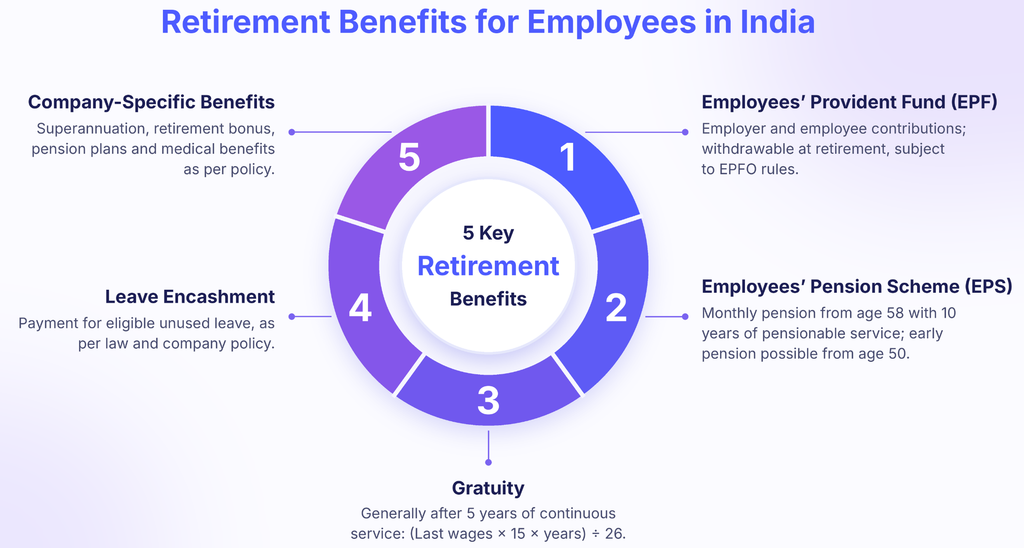
Some benefits, such as EPF and gratuity, are governed by statutory provisions while others such as retirement bonuses or post-retirement medical benefits, depend on company policies.
Here are the main retirement benefits employees may be eligible for.
1. Employees’ Provident Fund (EPF)
The Employees’ Provident Fund (EPF) is a retirement savings scheme that helps employees build a savings fund during their working years.
Both the employer and employee contribute to the employee’s EPF account as per the applicable rules.
When an employee retires, they can withdraw their accumulated EPF balance, subject to EPFO rules.
Before applying for withdrawal, employees should check that their UAN, service details, contribution records and KYC information are up to date. This can help prevent delays in processing their claims.
2. Employees’ Pension Scheme (EPS)
The Employees’ Pension Scheme (EPS), 1995, provides monthly pension benefits to eligible EPF members after retirement.
Generally, an employee becomes eligible for a monthly pension at 58 years of age, provided they have completed at least 10 years of eligible pensionable service.
An eligible member may also choose to take an early pension from the age of 50, subject to applicable conditions. The pension amount is reduced for early withdrawal.
It is important to remember that the EPS pension age and an employee’s retirement age are not necessarily the same.
For example, an employee may retire from a private company at 60 but become eligible for an EPS pension at 58 if they meet the required service conditions.
3. Gratuity
Gratuity is a payment made by an employer to an eligible employee when their employment ends under qualifying conditions.
Generally, employees become eligible for gratuity after completing five years of continuous service. However, this five-year requirement does not apply in cases of death or disablement. Different eligibility provisions also apply to fixed-term employees.
For employees covered by the applicable 15-days-wages method, gratuity is calculated using the following formula:
Gratuity = (Last drawn monthly wages × 15 × Completed years of service) ÷ 26
Example:
Suppose an employee has:
- Last drawn monthly wages: ₹40,000
- Completed years of service: 20
The estimated gratuity amount would be:
(₹40,000 × 15 × 20) ÷ 26 = ₹4,61,538 approximately
The actual amount depends on the applicable definition of wages, service period and statutory rules.
4. Leave Encashment
Leave encashment is the payment an employee receives for eligible unused leave at the time of retirement or separation from the organization.
The rules for leave encashment depend on the employee’s category, applicable employment laws and company policy.
Before processing the payment, HR should check:
- The employee’s remaining leave balance.
- Which types of leave can be encashed.
- The applicable calculation method.
- Any limits under the law or company policy.
- Required approvals and payment details.
Keeping employee leave records updated throughout their service makes it easier for HR to calculate the correct amount at retirement.
5. Other Company-Specific Retirement Benefits
Apart from statutory benefits, some companies offer additional benefits to employees when they retire. These depend on the organization’s policies and the employee’s compensation terms.
Such benefits may include:
- Superannuation fund benefits.
- Retirement bonuses.
- Company-sponsored pension plans.
- Post-retirement medical benefits.
- Group insurance continuation, where permitted.
- Other benefits mentioned in the employment agreement.
Employees should check their appointment letters and company policies to understand which additional retirement benefits they are eligible to receive.
What Are the Responsibilities of HR When an Employee Retires?
HR plays an important role in ensuring that employee retirement is completed accurately, transparently and on time.
The process begins before the employee reaches retirement age and continues until the organization completes the applicable exit formalities and updates its records.
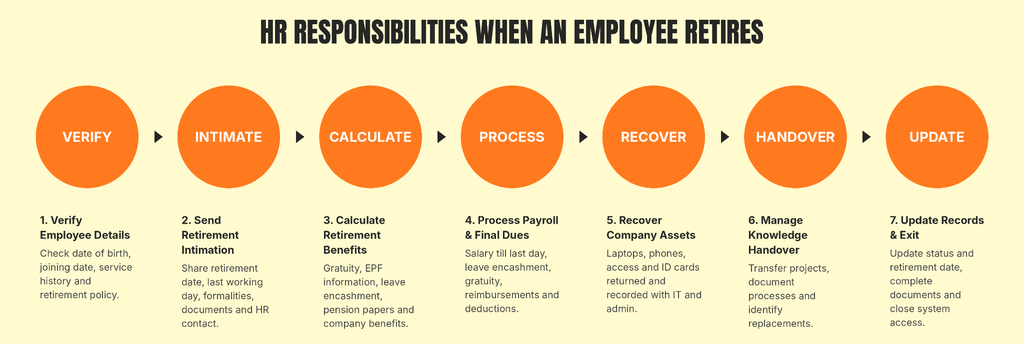
Here are the major responsibilities HR teams should manage.
1. Verify Employee Details and Retirement Eligibility
The first responsibility of HR is to verify the employee’s date of birth, joining date, service history and applicable retirement conditions.
HR should check the employee’s official records, appointment letter and relevant retirement policy. This helps avoid incorrect retirement-date calculations and disagreements regarding the employee’s last working day.
2. Send Retirement Intimation to the Employee
HR should communicate the upcoming retirement to the employee within the timeframe prescribed by the organization’s policy or applicable rules.
The communication should generally include:
- Expected retirement date.
- Last working day.
- Applicable retirement formalities.
- Required documents.
- Details of applicable benefits.
- Contact information for HR or payroll support.
Early communication gives employees sufficient time to arrange their documents and complete the required formalities.
3. Calculate Applicable Retirement Benefits
HR and payroll teams should coordinate to identify the benefits payable to the retiring employee.
These may include eligible gratuity, EPF-related information, leave encashment, pension documentation and other company-specific benefits.
Each benefit should be calculated according to its applicable statutory provisions or organizational policy.
4. Process Payroll and Final Employee Dues
HR should coordinate with the payroll department to calculate the employee’s remaining salary and other applicable payments.
This may include:
- Salary payable up to the last working day.
- Eligible leave encashment.
- Gratuity.
- Approved reimbursements.
- Other contractual or policy-based payments.
- Applicable deductions.
Maintaining accurate attendance, leave and salary records throughout employment helps reduce errors during the final payment process.
5. Complete Company Asset Recovery
Employees may have company-owned assets such as laptops, mobile phones, access cards, identity cards and other equipment.
HR should coordinate with the IT and administration departments to ensure that these assets are returned and properly recorded.
A formal asset clearance process also helps the organization to maintain accurate asset records.
6. Manage Knowledge Transfer and Handover
Employee retirement may result in the loss of valuable organizational knowledge and work experience.
HR should coordinate with the reporting manager to plan the employee’s handover.
This may include:
- Transferring ongoing project responsibilities.
- Documenting important processes.
- Identifying replacement employees.
- Sharing important operational information.
- Completing pending work assignments.
A structured handover helps to maintain business continuity after the employee leaves.
7. Update Employee Records and Complete Exit Formalities
Once the employee’s retirement is completed, HR should update the employee’s records in the HR system.
This includes updating employment status, recording the retirement date, completing applicable documentation and coordinating access closure with IT.
HR should also ensure that the employee receives relevant service or relieving documentation, where applicable.
What Documents Are Required During Employee Retirement?
The documents required during employee retirement depend on the employee’s employment category, benefits and applicable organizational procedures.
However, HR teams generally need to maintain the following records.
| Document | Purpose |
| Employee service records | Verify employment history and service duration |
| Date-of-birth proof | Confirm the employee’s retirement eligibility |
| Retirement intimation letter | Officially communicate the retirement date |
| EPF and UAN details | Support provident fund-related processes |
| EPS-related records | Verify pensionable service and eligibility |
| Gratuity calculation statement | Document the applicable gratuity amount |
| Leave balance statement | Verify eligible unused leave |
| Asset clearance records | Confirm the return of company property |
| Final payment statement | Record salary and other applicable dues |
| Service or relieving certificate | Document the employee’s service, where applicable |
Maintaining these documents in an organized manner helps HR teams to complete retirement formalities efficiently and respond to future employee queries.
Conclusion
Overall, Retirement is an important milestone, and knowing the applicable retirement age in India helps both employees and employers prepare for it. While central government employees generally retire at 60 years, private companies may follow 58 or 60 years. Other sectors have their own retirement rules based on service conditions and applicable regulations.
For employees, understanding these rules helps with career planning and knowing which retirement benefits they may be eligible for. For HR teams, the work goes beyond tracking an employee’s retirement date. They also need to manage benefit calculations, payroll coordination, documentation and asset clearance.
A well-planned retirement process makes the transition smoother for everyone. With organized HR processes and the right HRMS support, companies can manage employee records, leave balances, payroll activities and retirement formalities without unnecessary confusion.









Want to Simplify Employee Retirement Management with Savvy HRMS?
Frequently Asked Questions
1. What is the normal retirement age in India?
There is no single normal retirement age applicable to every employee in India. Central government employees generally retire at 60 years, while private-sector organizations commonly follow 58 or 60 years, depending on their applicable employment conditions and policies.
2. Is the retirement age 58 or 60 in India?
Both 58 and 60 years are followed in different employment categories. Central government employees generally retire at 60, while private organizations may follow 58 or 60 years. The applicable retirement age depends on the relevant service rules and employment conditions.
3. What is the retirement age in India for private-sector employees?
The retirement age for private-sector employees is not universally fixed. Many companies follow 58 or 60 years through their employment policies and service rules. For covered industrial establishments, the applicable standing-order provisions must also be considered.
4. Is there a fixed retirement age for private companies?
No, there is no one retirement age applicable to every private company. The applicable age depends on employment agreements, organizational policies, standing orders and relevant labour laws. Covered establishments must also consider the Model Standing Orders and applicable binding service conditions.
5. Can a company extend an employee’s retirement age?
A company may permit an employee to continue working beyond the prescribed retirement age through a legally permissible extension or re-employment arrangement. However, the arrangement must comply with applicable employment conditions, service rules and organizational policies.
6. What is the retirement age for central government employees?
The general retirement age for central government employees is 60 years under Fundamental Rule 56. Certain employee categories, including specified medical specialists, may have different retirement ages under applicable service provisions.