




Payroll in India is entering a new phase. The new Labour Codes bring important changes to how businesses need to look at wages, salary structures, statutory contributions, gratuity, overtime, and payroll compliance. For employers, payroll is no longer just about calculating monthly salaries correctly; it is also about building a more structured and compliant process.
But what exactly will change? Will the new Labour Codes affect basic salary, PF, ESI, gratuity, CTC, or employee take-home salary? These are some of the biggest questions HR and payroll teams are asking as they prepare their organizations for the new framework.
The good news is that businesses can prepare for these changes systematically. By reviewing salary structures, understanding the new wage definition, checking statutory calculations, and adopting reliable payroll software, employers can make payroll management more accurate, transparent, and easier to manage.
Understanding the New Labour Codes in India
India’s labour-law framework has been consolidated into four major Labour Codes:
- Code on Wages, 2019
- Industrial Relations Code, 2020
- Code on Social Security, 2020
- Occupational Safety, Health and Working Conditions Code, 2020
Together, these Labour Codes aim to simplify India’s labour-law framework while creating a more consistent approach to wages, social security, industrial relations and working conditions.
For HR and payroll teams, the Code on Wages and Code on Social Security are particularly important. These Codes have a direct connection with salary calculation, wage components, statutory contributions, gratuity and other payroll-related processes.
One of the most important changes is the common definition of “wages” used across the Labour Codes. This definition determines which components of an employee’s remuneration are considered wages for different statutory purposes.
This is where payroll teams need to pay close attention.
An employee’s salary may contain basic pay, dearness allowance, HRA, conveyance allowance, special allowance, incentives, overtime and other components. Under the new framework, the treatment of these components needs to be reviewed carefully.
The Labour Codes therefore have an impact beyond legal compliance. They can influence the entire payroll cycle, including:
- Salary structure
- Wage calculation
- PF and ESI
- Gratuity
- Overtime
- CTC
- Take-home salary
- Salary slips
- Statutory reporting
- Payroll records
- Employee communication
For employers, understanding these changes early can make the transition much smoother.
Why Are the New Labour Codes Important for Payroll?
Payroll is where employment policies and labour laws eventually become actual numbers.
An employee may have a fixed CTC, basic salary, HRA, special allowance, bonus, overtime, and statutory deductions. The payroll process brings all these components together and calculates the employee’s gross salary, deductions, and final take-home pay.
When the rules governing wages change, the logic behind these calculations may also need to change.
This is why the Labour Codes are particularly important for payroll management. A salary structure that was designed under the previous framework may need to be reviewed to determine whether it continues to produce the intended statutory outcomes.
For example, businesses that use a relatively low basic salary combined with a large number of allowances may need to examine how the new definition of wages affects their calculations.
The impact can extend to:
- Employee salary structures
- Statutory contributions
- Gratuity calculations
- Payroll costs
- Salary slips
- Compliance reports
- Payroll software configuration
Another important point is that payroll compliance cannot be handled separately from HR operations.
Attendance, leave, overtime, employee information, salary structures, and payroll are all connected. If one area contains incorrect information, it can affect the final payroll calculation.
For this reason, the Labour Codes also create an opportunity for organizations to improve their overall HR and payroll management process.
The 50% Wage Rule and Its Impact on Salary Structure
The 50% wage rule is one of the most discussed aspects of the new Labour Codes.
However, there is an important distinction that employers should understand.
The rule does not simply mean that every employee’s basic salary must automatically be 50% of CTC.
Under the wage definition, basic pay, dearness allowance and retaining allowance are included. Certain other components are excluded, but where the specified excluded components exceed 50% of total remuneration, the excess amount is added back to wages for the relevant statutory calculations.
In simple terms, employers need to look at the overall salary structure and determine whether the excluded components cross the prescribed threshold.
A simple example
Suppose an employee receives total monthly remuneration of ₹60,000.
If the components that are considered for the 50% calculation exceed ₹30,000, the excess may need to be added back to wages for applicable statutory purposes, subject to the relevant provisions.
So, if the applicable components amount to ₹35,000, the excess ₹5,000 may form part of the wage calculation.
This does not necessarily mean the employee’s CTC increases by ₹5,000.
Instead, it can increase the wage base used for certain statutory calculations.
This distinction is extremely important for HR and payroll teams.
Does this mean basic salary must always be 50%?
Not necessarily.
Employers should avoid using a blanket formula such as:
Basic Salary = 50% of CTC
The actual calculation depends on the definition of wages and the treatment of individual salary components under the applicable provisions.
Therefore, businesses should conduct a salary structure audit before making changes.
Why does the 50% rule matter?
The wage calculation can influence areas such as:
- PF-related calculations
- Gratuity
- Statutory contributions
- Payroll costing
- Salary restructuring
- Employee compensation planning
It can also create differences between employees depending on how their salary components are structured.
This makes automated and component-based payroll calculation increasingly important.
How Will the New Definition of Wages Affect Payroll Calculations?
The new definition of wages is at the heart of many payroll changes.
Broadly, wages include basic pay, dearness allowance and retaining allowance, while certain components are excluded subject to the provisions of the Code. However, when the specified excluded components exceed the prescribed 50% threshold of remuneration, the excess is added back to wages.
This means payroll teams cannot simply calculate statutory wages by looking at the basic salary alone.
They need to understand the complete salary breakup.
For example, payroll may need to consider:
- Basic pay
- Dearness allowance
- Retaining allowance
- HRA
- Conveyance-related components
- Overtime
- Commission
- Allowances
- Employer contributions
- Other applicable payments
Each component needs to be mapped correctly according to the applicable legal provisions.
This is especially important for businesses that have complex salary structures or multiple employee categories.
What does this mean for payroll software?
Payroll software should be able to distinguish between different salary components and apply the appropriate calculation rules.
A good payroll system should allow HR teams to:
- Configure salary components
- Define wage-related rules
- Automate statutory calculations
- Maintain employee salary history
- Generate accurate salary slips
- Handle payroll revisions
- Maintain compliance records
This reduces the risk of manually applying the wrong formula across hundreds or thousands of employees.
How Will the New Labour Codes Impact PF, ESI and Gratuity?
PF, ESI and gratuity are among the most important areas for payroll teams to review.
The Code on Social Security brings several social-security provisions under a consolidated framework. However, employers should not assume that PF, ESI and gratuity will all be calculated in exactly the same way.
Each benefit has its own eligibility, contribution and calculation provisions.
1. PF
The revised wage definition can affect the wage base relevant to PF calculations, depending on the employee’s circumstances and applicable PF provisions.
For employers, this means the existing PF configuration in payroll software should be reviewed rather than assuming that the old salary-component mapping will automatically remain appropriate.
2. ESI
ESI has its own eligibility and contribution requirements.
Payroll teams should therefore evaluate ESI separately and ensure that employee eligibility, wage calculations and contribution rates are configured according to the applicable requirements.
3. Gratuity
Gratuity is particularly important because it is linked to wages.
Under the new framework, gratuity calculations need to be considered alongside the revised definition of wages and the applicable provisions for employee categories.
This can be especially relevant for businesses with a large workforce, fixed-term employees, or employees whose salary structures contain significant allowances.
Why should HR teams review these calculations?
A change in wage structure can have a ripple effect.
Salary Components → Wage Calculation → Statutory Contribution → Payroll Cost → Employee Salary Slip
If the first step is configured incorrectly, subsequent calculations may also be affected.
That is why employers should review their complete payroll configuration instead of updating only one component.
How Will the Labour Codes Affect Employee CTC and Take-Home Salary?
One of the first questions employees may ask is:
“Will the Labour Codes reduce my take-home salary?”
There is no universal answer.
The impact depends on the employee’s salary structure, statutory deductions, employer contribution structure, and the way the organization implements the changes.
For employees with allowance-heavy salary structures, an increase in the wage base may affect certain statutory contributions. This could influence the relationship between gross salary, deductions and take-home salary.
However, employers should not assume that every employee will automatically experience a reduction in take-home pay.
The actual impact should be calculated employee by employee.
HR teams should consider:
- Current basic salary
- Applicable allowances
- Wage calculation
- PF
- ESI
- Gratuity
- Employer contributions
- Employee deductions
- CTC structure
- Take-home salary
CTC vs take-home salary
| Particulars | CTC | Take-Home Salary |
| Meaning | Total cost to employer | Amount received by employee |
| Includes | Salary + employer benefits/contributions | Gross salary after deductions |
| PF & Gratuity | Employer contributions may be included | Applicable deductions are subtracted |
| Tax/Deductions | Not deducted from stated CTC | Tax and other deductions reduce pay |
| Received by Employee | No | Yes |
| Simple Formula | Total employment cost | Gross Salary, Deductions |
How Will Overtime Rules Change Payroll Processing?
Overtime is another important payroll consideration.
The Labour Code framework includes overtime-related provisions, and overtime payments also need to be considered in the relevant wage calculations.
For payroll teams, this means overtime cannot simply be treated as an isolated additional payment.
The payroll process should correctly connect:
Attendance → Working Hours → Overtime → Approval → Payroll Calculation → Salary Slip
This is particularly important for organizations with:
- Shift workers
- Factory employees
- Field employees
- Operational teams
- Hourly workers
- Employees working beyond standard hours
Manual overtime calculations can create errors, especially when the workforce is large.
A payroll system can make this process easier by integrating attendance and overtime records directly into payroll.
For example, once approved overtime hours are recorded, the payroll software can use the configured rules to calculate the applicable overtime amount and include it in the employee’s salary.
This also creates a clearer audit trail for HR and payroll teams.
Key Payroll Challenges During Labour Code Implementation
Implementing Labour Code changes can create several practical challenges for HR and payroll teams.
1. Complex Salary Structures
Different employees have different salary components, allowances, incentives, and benefits, making it challenging for payroll teams to apply consistent Labour Code calculations accurately.
2. Manual Calculations
Spreadsheets and manual calculations can increase payroll errors, especially when HR teams need to apply multiple wage, deduction and statutory rules simultaneously.
3. Incorrect Salary-Component Mapping
Incorrectly classifying salary components can affect wage calculations, statutory contributions and employee deductions, potentially creating compliance issues and requiring payroll corrections later.
4. Legacy Payroll Systems
Older payroll software may lack the flexibility required to configure updated wage definitions, statutory calculations, and changing Labour Code compliance requirements accurately.
5. Employee Communication
Changes to salary structures may raise employee questions about basic pay, deductions, CTC and take-home salary, requiring clear and transparent communication from HR.
6. Payroll Testing
Organizations need to test multiple employee scenarios, including overtime, leave, increments and new joiners, before implementing revised payroll calculations across the workforce.
7. Compliance Monitoring
Labour Code compliance requires continuous monitoring of applicable rules, notifications and statutory requirements to ensure payroll processes remain accurate and compliant over time.
8. Data Consistency
HR, attendance, leave, and payroll data must remain synchronized because inaccurate or outdated employee information can directly affect salary calculations and compliance.
For growing organizations, these challenges become even more important as increasing employee numbers make accurate, automated, and scalable payroll management is important.
This is where integrated HR software can provide considerable value.
How Payroll Software Can Simplify Labour Code Compliance
The biggest advantage of payroll software is not just speed. It is the ability to create a consistent and controlled payroll process.
With the right payroll software, businesses can manage several connected HR processes from one platform.
1. Salary Management
HR teams can define salary components, maintain employee salary structures, manage revisions, and ensure accurate compensation records across different employee categories and payroll cycles.
2. Automated Payroll
Payroll software automates gross salary, deductions and net salary calculations based on configured rules, helping HR teams reduce manual work and minimize payroll errors.
3. Statutory Compliance
The system can support statutory calculations and reports, helping businesses manage applicable deductions, contributions and compliance requirements more efficiently and consistently.
4. Attendance and Overtime
Attendance data can flow directly into payroll, reducing manual data entry while helping businesses accurately calculate working hours, overtime and related salary components.
5. Leave Management
Approved leave records can integrate with payroll calculations, helping HR teams manage leave deductions, balances and applicable leave encashment accurately during salary processing.
6. Salary Slips
Employees can access clear salary slips showing earnings, deductions, contributions and net pay, improving transparency and making salary information easier to understand.
7. Employee Records
HR teams can maintain centralized employee information, salary details and payroll history, making employee data easier to access, update and manage across HR processes.
8. Reporting
Payroll reports help HR teams monitor salary costs, deductions, contributions and other payroll information, supporting better analysis, decision-making and compliance management.
For Labour Code readiness, businesses should look for payroll software that provides configurable salary and wage components rather than depending on rigid formulas.
The goal is not simply to automate today’s payroll. It is to create a payroll system that can adapt as rules and business requirements change.
Preparing Your Payroll System for the New Labour Codes
Preparing for the Labour Codes should be treated as a structured project rather than a last-minute payroll change.
Step 1: Audit Existing Salary Structures
Review each employee’s salary breakup, including basic salary, allowances, incentives, overtime, and other components, to understand the potential impact of revised wage calculations.
Step 2: Map Salary Components
- Identify all salary components.
- Classify included and excluded components.
- Review their treatment under the applicable wage definition.
- Document the mapping for payroll configuration.
Step 3: Analyze the 50% Rule
Calculate whether relevant excluded components exceed the applicable 50% threshold and determine how any excess could affect the wage base.
Step 4: Review Statutory Calculations
Assess the potential impact on PF, ESI, gratuity and other applicable statutory components to identify changes in employer contributions, employee deductions and payroll costs.
Step 5: Review CTC
- Compare existing and potential revised CTC.
- Calculate possible changes in employer contributions.
- Review the impact on employee take-home salary.
- Identify employees requiring salary restructuring.
Step 6: Test Employee Scenarios
Test different payroll situations to ensure the revised calculations work accurately across various employee categories.
- New joiners
- Employees receiving increments
- Employees working overtime
- Employees taking leave
- Employees receiving bonuses
- Employees exiting the organization
- Fixed-term employees
Step 7: Review Leave and Leave Encashment
Ensure leave balances, deductions, and leave encashment are correctly captured in payroll, with appropriate rules configured for different employee categories and applicable situations.
Step 8: Update Payroll Software
- Configure revised salary components.
- Update wage-related rules.
- Review statutory settings.
- Update payroll calculation formulas.
- Test salary-slip generation.
Step 9: Run Parallel Calculations
Run existing and revised payroll calculations together during testing to identify discrepancies, validate statutory deductions, and resolve issues before implementation.
Step 10: Communicate With Employees
Explain changes to salary structures, deductions, CTC and take-home salary clearly so employees understand how Labour Code-related payroll changes may affect their compensation.
A structured approach gives HR teams greater confidence and reduces the risk of unexpected payroll issues.
New Labour Codes Payroll Compliance Checklist for Employers
Use the following checklist as a starting point for Labour Code payroll preparation:
- Understand the four Labour Codes and their applicable provisions.
- Review current employee salary structures.
- Identify all salary and wage components.
- Review the definition of wages.
- Assess the 50% wage rule.
- Review PF calculations and applicability.
- Review ESI calculations and applicability.
- Reassess gratuity calculations.
- Review overtime calculations.
- Review employee CTC.
- Assess potential changes to employer payroll costs.
- Review employee take-home salary.
- Verify salary slips.
- Review leave management processes.
- Review leave encashment treatment.
- Verify employee master data.
- Update payroll software configurations.
- Test different payroll scenarios.
- Review statutory reports and records.
- Train HR and payroll teams.
- Communicate relevant changes to employees.
- Maintain payroll documentation.
- Monitor Labour Code updates and applicable rules.
A checklist like this helps employers move from simply understanding the Labour Codes to actually preparing their payroll operations for them.
Conclusion
The new Labour Codes can significantly influence payroll operations in India. The impact goes beyond changing one salary component. Employers need to look at the complete payroll ecosystem, including wages, the 50% rule, salary structure, PF, ESI, gratuity, overtime, leave, leave encashment, CTC, statutory compliance and employee communication.
The best approach is to prepare rather than react. Businesses should audit their existing payroll structure, understand how the new wage definition applies, test different employee scenarios and ensure their HR and payroll systems are flexible enough to accommodate changing compliance requirements.
Make Your Payroll Ready for the New Labour Codes
Managing payroll manually can become increasingly difficult when salary structures, statutory rules and employee data are changing. Savvy HRMS brings HR and payroll processes together to help businesses manage employee information, salary, attendance, leave, payroll and related HR operations through a connected platform.

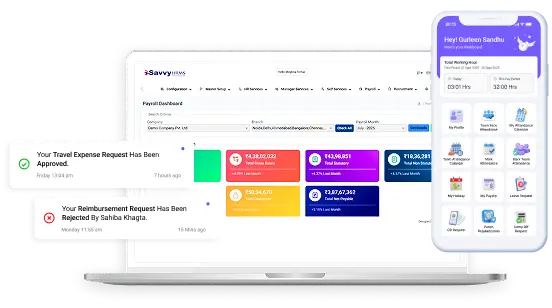









Ready to simplify payroll management and build a more efficient HR process?
Explore Savvy HRMS and take your payroll operations toward a smarter, more automated future.
Frequently Asked Questions (FAQs)
1. What are the new Labour Codes in India?
India’s four Labour Codes consolidate several existing labour laws covering wages, social security, industrial relations, and occupational safety and working conditions.
2. What is the 50% wage rule under the Labour Codes?
The 50% rule requires certain excluded salary components exceeding 50% of total remuneration to be added back to wages for applicable statutory calculations.
3. Will the Labour Codes affect employee take-home salary?
The impact can vary depending on the employee’s salary structure, wage components, statutory deductions, employer contributions, and how the organization implements the revised payroll rules.
4. How will the Labour Codes affect PF, ESI and gratuity?
Changes to the wage calculation can affect applicable PF, ESI and gratuity calculations. Employers should review each statutory component according to its specific provisions and employee eligibility.
5. Can payroll software help businesses comply with the Labour Codes?
Yes. Payroll software can help manage salary structures, wage calculations, statutory deductions, attendance, overtime, leave, leave encashment, salary slips, and payroll reports more efficiently.