


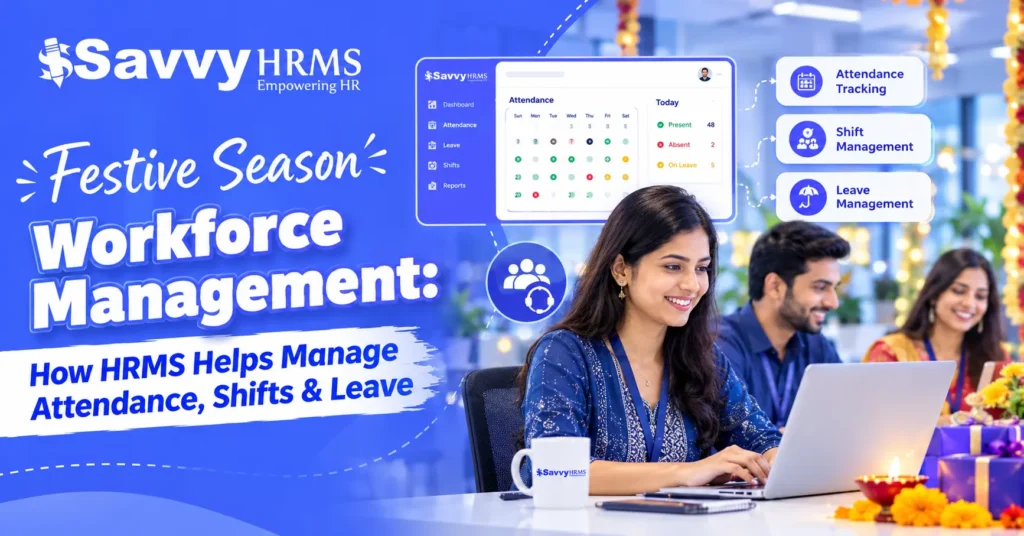

Imagine it’s the week before Diwali. Half the team wants leave, customer orders are suddenly rising, some employees need different shifts, and HR is buried under attendance corrections. Festive excitement is everywhere, but workforce management is getting complicated.
That’s exactly when a structured HRMS can make a difference. Instead of juggling spreadsheets, messages, emails, and manual attendance records, HR teams can manage attendance, shifts, leave, overtime, and approvals from one connected system.
Festive periods bring a unique workforce challenge. Employees want flexibility to celebrate with their families, while businesses often need more people available than usual. Retail, e-commerce, hospitality, logistics, manufacturing, healthcare, and customer support teams may experience especially sharp changes in staffing requirements.
The solution isn’t simply asking employees to work more. It is about planning smarter. With workforce management software and HRMS technology, HR teams can understand who is available, who is on leave, which shifts need coverage, and where staffing gaps may appear before they become operational problems.
TL;DR
- Manage employee attendance and working hours efficiently during the festive season.
- Simplify festive leave requests, approvals, and employee leave tracking.
- Plan and manage employee shifts, rosters, and workforce schedules effectively.
- Handle late arrivals, unexpected absences, missed punches, and shift swaps.
- Track overtime, extra working hours, and compensatory-off requests accurately.
- Identify potential staffing gaps before they affect daily business operations.
- Get better visibility into employee availability, attendance, leave, and shifts.
- Use HRMS reports to support smarter festive workforce planning decisions.
- Reduce manual attendance, leave tracking, and repetitive HR administration.
- Give employees easy access to attendance, leave, and other HR services.
Why Workforce Management Becomes Challenging During the Festive Season
Festive workforce management becomes challenging because employee availability changes while business demand can increase unpredictably. HR teams must coordinate attendance, leave, shift schedules, overtime, holidays, and staffing requirements without disrupting daily operations.
During a normal week, a manager may already know who is scheduled to work and who is likely to be available. During the festive season, however, that predictability can disappear. Employees may request planned leave, swap shifts, arrive late because of travel, or need changes to their regular working hours.
Manual workforce management makes this harder. HR may have to compare spreadsheets with attendance records, WhatsApp messages, emails, leave applications, and manager approvals. A small mistake can quickly turn into an uncovered shift or an incorrect attendance record.
Common festive workforce challenges
- Higher volume of leave requests
- Last-minute leave applications
- Shift swaps and roster changes
- Increased absenteeism
- Extended working hours
- Overtime management
- Temporary or seasonal staffing
- Different holiday calendars across locations
- Late arrivals caused by travel or local events
- Difficulty maintaining adequate staffing
- Increased pressure on HR and line managers
The biggest challenge is not necessarily the number of employees. It is the number of moving parts.
A modern HRMS brings those moving parts together so HR can manage them through defined workflows and centralized employee data.
How Festive Season Impacts Employee Attendance and Leave Planning
Festive seasons can significantly change attendance patterns because employees often combine public holidays, weekly offs, earned leave, casual leave, and planned vacations. HR therefore needs accurate leave visibility before finalizing workforce schedules.
For example, an employee may request three days of leave around a festival holiday and effectively remain unavailable for five or six consecutive days. If several employees from the same team make similar requests, a department can quickly become understaffed.
This is where leave planning becomes closely connected with workforce management.
HR teams should ideally look beyond individual leave requests and consider the impact on departments, shifts, locations, and critical business functions.
What HR should monitor
| Workforce factor | What HR should check |
| Leave requests | Number and duration of employees requesting leave |
| Attendance | Daily presence and absence patterns |
| Shift coverage | Employees available for each shift |
| Weekly offs | Whether planned offs create staffing gaps |
| Holidays | Location-specific and company holidays |
| Overtime | Employees working beyond scheduled hours |
| Absenteeism | Unexpected employee absence |
| Critical roles | Whether essential positions remain covered |
A centralized HRMS can make this information easier to access because attendance and leave information can be connected instead of maintained separately.
This gives HR managers a more complete picture before approving leave or changing rosters.
How HRMS Helps Manage Festive Season Attendance
An HRMS simplifies festive season attendance by bringing check-ins, working hours, shifts, leave, regularization, overtime, and approvals into one platform. HR managers get better visibility into attendance, while employees can conveniently check records and raise corrections through self-service tools when needed.
How an HRMS can simplify festive attendance
1. Centralized attendance records
HR can view employee attendance without collecting information from multiple spreadsheets or departments.
2. Mobile attendance
Employees can use supported mobile attendance capabilities when they are working away from traditional office setups.
3. Attendance regularization
If an employee misses a punch or records an incorrect attendance entry, the request can follow a defined approval workflow.
4. Policy-based attendance
Organizations can configure rules for late coming, early going, breaks, shifts, and other attendance scenarios.
5. Real-time visibility
Managers can identify attendance issues earlier rather than discovering them after the festive period.
The result is a more organized attendance management process during one of the busiest workforce periods of the year.
Managing Employee Shifts During Peak Festive Demand
Managing employee shifts during peak festive demand requires HR teams to match employee availability with business requirements while considering shift timings, skills, weekly offs, holidays, and workload.
This becomes particularly important for businesses where customer demand increases during festivals. Retail stores may extend operating hours, logistics companies may handle additional deliveries, and hospitality businesses may experience higher customer volumes.
Creating a festive shift roster manually can become difficult when employees are constantly requesting changes.
A structured shift management process
HR can begin by identifying:
- Which departments need additional staffing?
- Which shifts have the highest workload?
- Which employees are available?
- Which employees have approved leave?
- Which employees have the required skills?
- Which employees are eligible for overtime?
- Which shifts require backup employees?
An HRMS can help connect roster planning with employee attendance and leave information.
For example, if an employee is already approved for leave on a particular date, the scheduling process can account for that absence rather than assigning the employee to a shift that cannot be covered.
Savvy HRMS specifically lists multiple shift creation and roster capabilities, including roster combinations and configurable attendance policies.
Festive shift planning tip
Don’t build the roster only around employee availability. Build it around business-critical coverage.
Identify the minimum number of employees required for each shift first, then distribute available employees accordingly.
This approach makes workforce planning more practical and reduces last-minute scheduling pressure.
Simplifying Leave Requests and Approvals with HRMS
An HRMS simplifies festive leave management by allowing employees to submit requests digitally while managers can review availability, apply company policies, and approve or reject requests through a defined workflow.
This is particularly useful when HR receives dozens or hundreds of leave applications around the same festival.
Without a centralized system, employees may send requests through email or messaging applications, while managers maintain separate records. That can create confusion about which requests have actually been approved.
With leave management software, employees can submit leave requests through an employee self-service portal or mobile application, while HR and managers retain visibility into leave balances and approval status.
A general digital leave workflow
Employee submits leave → Manager reviews → Policy/availability checked → Approval or rejection → Leave balance updated → Attendance records synchronized
Savvy HRMS supports multiple leave masters, eligibility rules, accrual processes, carry-forward policies, comp-off policies, leave calendars, approval notifications, and MIS reports.
This can be particularly useful during festivals because HR can establish leave policies before the season begins rather than handling every request as a separate exception.
Why this matters
Employees get clarity.
Managers get visibility.
HR gets centralized records.
And the business gets a clearer picture of workforce availability.
Handling Shift Swaps, Late Arrivals and Absences Efficiently
Festive workforce management also involves exceptions such as shift swaps, late arrivals, missed punches, unexpected absences, and early departures. HRMS workflows can help route these exceptions to the right manager for review.
Consider a simple example. An employee scheduled for a morning shift cannot reach the workplace because of unexpected travel disruption. Another employee agrees to cover the shift. Without a structured process, HR may only discover the change later.
With an HRMS, the relevant request can be documented and routed through the appropriate approval process.
Common attendance exceptions
- Missed punch
- Late arrival
- Early departure
- Shift swap
- Unplanned absence
- Overtime request
- Comp-off request
- Attendance regularization
This creates an audit trail rather than depending on informal conversations.
Savvy HRMS offers workflows for overtime and comp-off approval, late-coming and early-going approvals, punch regularization, and configurable approval levels.
The important point is that automation does not mean every exception is automatically approved. Instead, HRMS can help ensure that exceptions follow the organization’s defined workflow.
That distinction matters for maintaining both flexibility and workforce discipline.
Balancing Employee Leave and Business Staffing Requirements
The goal of festive leave management is not simply to approve or reject requests. It is to balance employee flexibility with the staffing levels required to keep business operations running.
Employees naturally want time with their families during festivals. At the same time, some departments may experience their busiest period of the year.
A practical approach is to establish leave planning rules before the festive season.
HR can create a festive workforce plan around:
- Minimum staffing requirements
- Critical departments
- High-demand dates
- Employee skill requirements
- Leave rotation
- Backup employees
- Shift coverage
- Overtime availability
- Temporary workforce requirements
For example, instead of approving leave strictly on a first-come, first-served basis, organizations can define minimum staffing requirements for critical teams and then review requests against those requirements.
This can make the process more transparent.
A simple festive staffing formula
Required workforce = Minimum operational staffing + Expected demand buffer − Available planned resources
The exact calculation will differ by organization, industry, location, and season.
The key is to make staffing decisions using current workforce data rather than assumptions.
An HRMS helps by bringing employee availability, attendance, leave, and shift information into a centralized environment.
How HRMS Helps Track Overtime and Extra Working Hours
HRMS software can help track overtime by comparing scheduled working hours with actual attendance and recording overtime or compensatory-off requests according to configured policies.
Festive demand can sometimes require employees to work longer hours. If those additional hours are tracked manually, HR may struggle to maintain accurate records across departments and shifts.
A connected attendance and workforce management system can make this process more structured.
Overtime management may include:
- Planned overtime
- Actual overtime
- Overtime approval
- Comp-off eligibility
- Overtime records
- Employee-wise reports
- Department-wise analysis
- Payroll integration
Savvy HRMS lists overtime planning versus actual hours, overstay-to-overtime functionality, and overtime-related reporting within its attendance capabilities.
This is especially useful when festive operations extend beyond normal working schedules.
However, overtime should always be managed according to applicable employment policies, contracts, and labor requirements. HRMS can support the process, but organizations still need to configure and apply the rules relevant to their workforce.
Real-Time Workforce Visibility for HR Managers
Real-time workforce visibility means HR managers can quickly understand who is present, absent, on leave, scheduled, working overtime, or assigned to a particular shift.
During the festive season, this visibility becomes valuable because workforce conditions can change throughout the day.
Imagine a manager discovering at 10 a.m. that three employees assigned to an evening shift have unexpectedly requested leave. If that information is visible early, the manager has more time to arrange coverage.
Without timely information, the same issue may only become obvious when the shift begins.
What HR managers can monitor
Attendance: Who has checked in and who is absent?
Leave: Which employees are unavailable?
Shifts: Who is assigned to each shift?
Overtime: Which employees are working beyond planned hours?
Exceptions: Which attendance or approval requests require action?
Workforce trends: Are particular departments experiencing repeated absenteeism?
Savvy HRMS describes real-time tracking and reporting capabilities across attendance, leave, payroll, and workforce operations.
For festive workforce management, the practical advantage is simple: HR spends less time collecting information and more time acting on it.
Key Benefits of Using HRMS for Festive Workforce Management
The key benefits of HRMS for festive workforce management include centralized attendance tracking, faster leave processing, better shift visibility, structured approvals, overtime tracking, workforce reporting, and reduced dependence on manual HR processes.
But the value goes beyond automation.
1. Better Workforce Visibility
An HRMS gives HR teams and managers a centralized view of attendance, leave, shifts, and employee availability, making it easier to identify staffing gaps and take timely workforce management decisions during busy festive periods.
2. Faster Leave Processing
Digital leave workflows allow employees to submit requests online while managers can review and approve them quickly. This reduces dependency on emails, messages, spreadsheets, and manual follow-ups during the festive season.
3. Easier Shift Planning
With centralized roster and shift information, HR teams can plan employee schedules more efficiently. They can identify available employees, manage shift requirements, and address potential staffing gaps before they affect daily operations.
4. Fewer Manual Errors
Automated attendance, leave, and working-hour calculations can reduce repetitive data entry and common manual mistakes. Centralized employee records also make it easier for HR teams to maintain accurate workforce information.
5. Better Employee Experience
Employee self-service allows staff to check attendance, apply for leave, view schedules, and submit requests without depending on HR for every task. This creates a more convenient and transparent employee experience.
6. Improved Overtime Tracking
An HRMS can record additional working hours and route overtime requests through defined approval workflows. This helps HR maintain organized overtime records while giving managers better visibility into extra hours worked.
7. Stronger Reporting
HRMS reports help HR teams analyze attendance, leave, overtime, absenteeism, and shift patterns during the festive season. These insights can support better workforce planning and help organizations prepare for future peak periods.
8. Better Payroll Coordination
When attendance, leave, overtime, and payroll systems are connected, HR can maintain more consistent employee records. This reduces manual data transfer and helps ensure payroll calculations are based on updated workforce information.
What to Look for in an HRMS for Festive Season Workforce Management
When choosing an HRMS for festive workforce management, businesses should look for attendance, shift scheduling, leave management, overtime tracking, employee self-service, mobile accessibility, reporting, approval workflows, and payroll integration.
A festive season can expose weaknesses in an HR system that may remain unnoticed during routine operations.
So, instead of selecting HR software based only on the number of modules, HR teams should evaluate how those modules work together.
Essential HRMS features to consider
1. Attendance Management
Look for check-in/check-out, attendance policies, missed-punch handling, regularization, and attendance reports.
2. Shift and Roster Management
The system should support multiple shifts, roster planning, weekly offs, and holiday calendars where required.
3. Leave Management
Check whether the software supports different leave types, leave balances, eligibility rules, approvals, carry-forward, and leave reporting.
4. Overtime Management
Look for overtime planning, actual-hour tracking, approvals, and payroll integration.
5. Employee Self-Service
Employees should be able to access relevant HR services and submit requests without depending entirely on HR.
6. Mobile Access
Mobile functionality can be useful for employees and managers who need to access attendance, leave, approvals, and related information away from a desktop.
7. Reports and Analytics
The HRMS should provide reports that help HR understand attendance, leave, overtime, and workforce trends.
8. Approval Workflows
Configurable approval levels can help organizations handle exceptions consistently.
Savvy HRMS lists capabilities across these areas, including multiple shifts, rosters, attendance policies, leave policies, overtime, approval workflows, mobile attendance, and MIS reports.
How to Prepare Your Workforce Before the Festive Season
Preparing for festive workforce management should begin before the first major holiday. HR teams should review staffing requirements, finalize holiday calendars, communicate leave policies, prepare shift rosters, identify backup employees, and configure HRMS workflows.
Waiting until employees start submitting last-minute requests can create unnecessary pressure.
A better approach is to create a festive workforce management checklist several weeks in advance.
Festive workforce management checklist
Step 1: Review Last Year’s Data
Analyze previous festive-season attendance, absenteeism, overtime, leave patterns, and staffing gaps to understand what worked and where workforce management faced challenges.
Step 2: Forecast Workforce Demand
Identify departments, locations, and roles likely to experience increased demand so you can plan adequate staffing before the festive rush begins.
Step 3: Finalize Holiday Calendars
Publish holiday calendars and weekly-off schedules in advance, ensuring employees and managers clearly understand working and non-working days.
Step 4: Communicate Leave Policies
Clearly communicate leave deadlines, approval procedures, staffing requirements, and applicable restrictions so employees understand the process before submitting festive leave requests.
Step 5: Collect Planned Leave
Encourage employees to submit festive leave requests early, giving managers enough time to review applications and arrange alternative workforce coverage.
Step 6: Prepare Shift Rosters
Create shift schedules based on expected workload, employee availability, skills, and approved leave to maintain sufficient staffing throughout the festive period.
Step 7: Identify Backups
Identify employees who can cover critical roles during unexpected absences, ensuring important operations continue smoothly despite last-minute workforce changes.
Step 8: Configure HRMS Policies
Review and update attendance, leave, overtime, approval workflows, holiday calendars, and shift policies in your HRMS before festive operations begin.
Step 9: Monitor Workforce Data
Track attendance, leave, shifts, absenteeism, and overtime throughout the festive season to identify workforce gaps and address issues promptly.
Step 10: Review the Results
Analyze festive-season workforce reports after the period ends to identify trends, challenges, and improvements for planning future peak-season workforce requirements.
This preparation can turn festive workforce management from a reactive HR activity into a structured workforce planning process.
Festive Season Workforce Management: A Simple Example
Consider a retail company with 300 employees across three locations. During Diwali, customer footfall increases, store operating hours are extended, and employees begin requesting leave.
The HR team now needs to answer several questions:
- Who is available?
- Who has requested leave?
- Which stores are understaffed?
- Which employees can work additional hours?
- Who is assigned to each shift?
- Which attendance exceptions need approval?
- How much overtime has been recorded?
If this information sits across spreadsheets, emails, and messages, answering these questions can take considerable time.
With an integrated HRMS, HR can bring attendance, leave, shift, overtime, and employee information into one workflow.
The objective isn’t to remove human decision-making. Instead, the HRMS gives managers better information so they can make workforce decisions faster and with greater visibility.
This is where technology becomes particularly useful during high-pressure periods.
How HRMS Supports Employee Self-Service During Festivals
Employee self-service can reduce HR workload by allowing employees to handle routine requests themselves. During the festive season, this can be particularly useful because HR teams are already dealing with increased workforce planning requirements.
Depending on the HRMS, employees may be able to:
- Apply for leave
- View leave balances
- Check attendance
- Mark attendance
- Submit attendance corrections
- View shift information
- Request overtime or comp-off
- Receive notifications
- Access HR information
Savvy HRMS lists employee self-service and mobile capabilities, including attendance marking, leave-related functionality, holiday calendars, notifications, and request/approval workflows.
The benefit is straightforward: employees get more control over routine HR tasks while HR teams can focus on workforce planning, exceptions, and business-critical requirements.
Conclusion
Festive workforce management becomes easier when HR teams can see attendance, leave, shifts, overtime, and employee availability in one connected system. An HRMS can replace scattered processes with structured workflows, real-time visibility, and centralized workforce data.
The festive season will always bring changing employee availability and business demand. What HR can control is the preparation behind it. With clear policies, workforce planning, and the right HRMS, teams can respond faster while keeping employees and operations aligned.

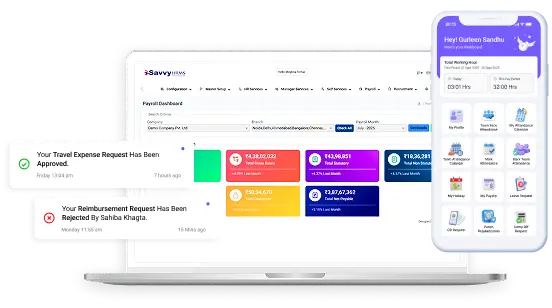









Ready to simplify festive workforce management?
Explore Savvy HRMS to manage attendance, shifts, leave, overtime, employee self-service, and workforce reporting from an integrated HRMS platform.
Frequently Asked Questions (FAQs)
1. What is festive season workforce management?
Festive season workforce management involves planning employee attendance, shifts, leave, overtime, and staffing requirements during periods when employee availability and business demand may change. It helps organizations maintain adequate workforce coverage while supporting employee flexibility.
2. How does HRMS help with festive season workforce management?
An HRMS can help businesses manage:
• Employee attendance
• Shift schedules and rosters
• Leave requests and approvals
• Overtime and extra working hours
• Employee availability
• Workforce reports
3. How can HRMS simplify festive season leave management?
HRMS allows employees to submit leave requests digitally while managers can review availability and approve requests through defined workflows. HR teams can also monitor leave balances, planned absences, and staffing requirements from a centralized platform.
4. Can HRMS help manage employee shifts during festivals?
Yes, an HRMS can support festive shift management by helping HR teams:
• Create and assign shifts
• Manage employee rosters
• Track shift attendance
• Handle shift changes
• Identify staffing gaps
• Monitor working hours
5. Why is workforce planning important during the festive season?
Effective workforce planning helps businesses balance employee leave with operational requirements. It allows HR teams to anticipate staffing gaps, prepare backup resources, manage peak workloads, and maintain smoother operations while employees take time off during festivals.