

Which Statutory Registers Are Mandatory for Employers in India? Complete 2026 Compliance Guide



-
AuthorSalilendra Kumar
-
 Last Updated
October 06, 2026
Last Updated
October 06, 2026
-
 Reading Time
15 Mins
Reading Time
15 Mins
TL;DR
- Statutory registers are official records employers may be required to maintain under applicable labour and employment laws.
- There is no single register list for every employer; requirements vary by establishment type, industry, employee strength, and applicable Central or State laws.
- Common records cover employee details, attendance, wages, overtime, deductions, leave, and workplace safety.
- Under the consolidated Labour Code framework, the Government’s compliance approach aims to simplify employer record-keeping, including reducing 84 registers to 8.
- Factories, contractors, construction businesses, and other regulated establishments may have additional record-keeping requirements.
- Employers should regularly update, verify, preserve, and audit statutory records to maintain a clear compliance trail.
- Digital HRMS platforms can help organise employee data, attendance, payroll, statutory records, and compliance workflows in one place.
Statutory registers that are mandatory for employers in India help businesses keep track of important employee, attendance, wage, working-hour, and compliance information. These records create a clear compliance trail and help HR teams demonstrate that employment-related requirements are being followed.
But there is one important catch: not every employer in India needs to maintain exactly the same statutory registers. The requirements can vary depending on the establishment type, number of employees, industry, location, and applicable Central or State labour laws.
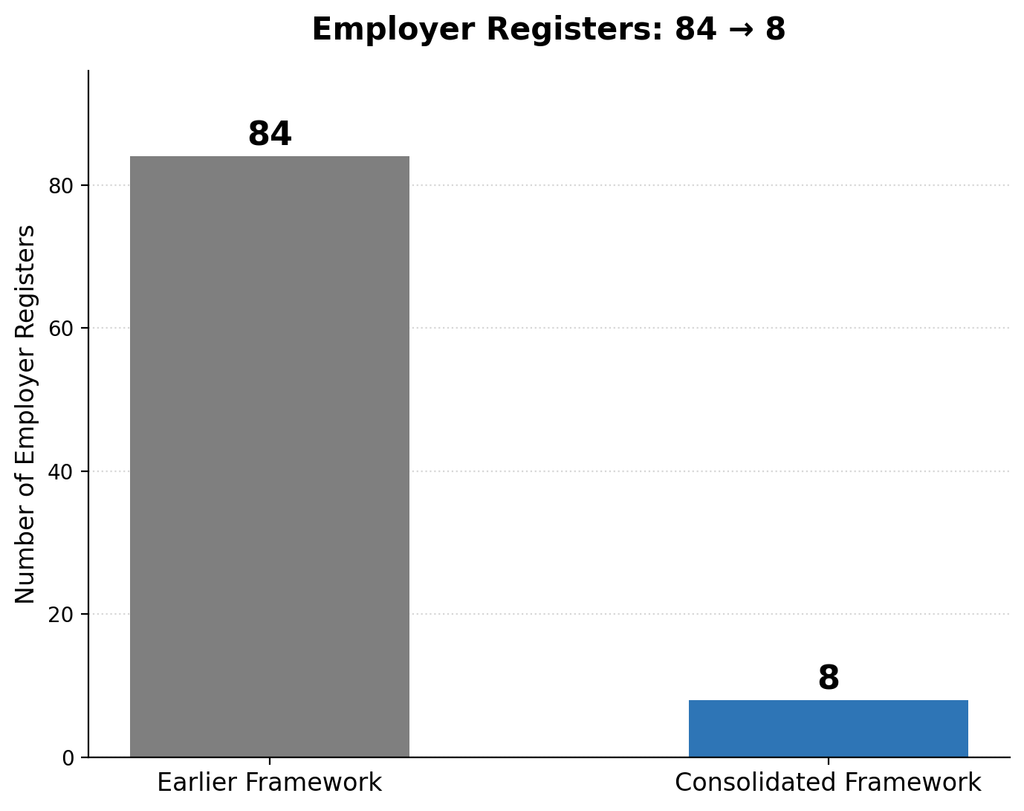
In 2026, statutory register compliance is also changing with the implementation of the Labour Codes. The Government’s compliance framework aims to simplify and consolidate labour records, including reducing the number of employer registers from 84 to 8 under the consolidated framework.
So, let’s break down which statutory registers employers need to maintain in India, what information they contain, who they apply to, and how businesses can stay compliant in 2026.
What Are Statutory Registers and Why Are They Important for Employers?
Statutory registers are official employment and compliance records that employers are required to maintain under applicable labour laws and rules. Depending on the business, these records can contain information about employees, attendance, working hours, wages, overtime, deductions, leave, accidents, and other employment-related matters.
In simple terms, a statutory register is a documented compliance trail. It helps answer important questions such as:
- Who is employed in the organization?
- How many days did employees work?
- How many hours did they work?
- What wages were paid?
- Was overtime performed?
- What deductions were made?
- Were applicable statutory requirements followed?
- Were workplace accidents or dangerous occurrences recorded?
Why are statutory registers important?
Statutory registers help employers:
- Maintain organized employment records.
- Demonstrate labour-law compliance.
- Support inspections and audits.
- Track employee attendance and working hours.
- Maintain wage and payroll records.
- Document overtime and deductions.
- Prepare statutory reports and returns.
- Reduce the risk of missing important compliance information.
For HR teams, maintaining these records is not simply an administrative task. Accurate statutory registers can connect everyday HR activities such as attendance and payroll with broader labour compliance.
Which Statutory Registers Are Mandatory for Employers in India?
There is no single statutory register checklist that applies identically to every employer in India. The exact requirements depend on the applicable Labour Code, rules, State or UT requirements, establishment type, workforce, and industry.
However, the consolidated Labour Code framework has significantly simplified the earlier compliance structure.
According to the Ministry of Labour and Employment’s 2026 compliance material, the number of employer registers has been rationalized from 84 to 8 under the consolidated framework.
Statutory registers and records employers should understand
| Register / Record | What it generally records | Main purpose |
| Employee Register | Employee and employment particulars | Workforce records |
| Attendance-cum-Muster Roll | Attendance and working information | Attendance compliance |
| Wage Register | Wages and payment information | Wage compliance |
| Overtime Records | Overtime worked and payment | Working-hour compliance |
| Deduction Records | Permitted wage deductions | Payroll compliance |
| Accident / Safety Records | Workplace accidents and specified occurrences | Safety compliance |
| Other Prescribed Records | Establishment-specific information | Law-specific compliance |
| Statutory Returns / Supporting Records | Information required for reporting | Regulatory compliance |
The 2026 Central rules specifically provide for records including the Register of Employees, Register of Attendance-cum-Muster Roll, and Register of Wages, Overtime and Deductions, along with wage slips.
Important: This is a high-level overview rather than a universal legal checklist. Employers should identify the exact statutory registers applicable to their establishment based on the relevant law and rules.
What Are the Different Types of Statutory Registers in India?
Statutory registers can be grouped into different categories depending on the information they capture.
1. Employee Registers
Employee registers record necessary information about the workforce and employment relationship. They help employers maintain accurate employee records and demonstrate compliance with applicable labour requirements.
General information includes:
- Employee name
- Date of joining
- Employment details
- Employee category
- Designation or job information
- Other prescribed particulars
2. Attendance and Muster-Roll Records
Attendance and muster-roll records help employers track employee presence, working days, and, where applicable, working hours.
These records may capture:
- Daily attendance
- Working days
- Hours worked
- Employee identification details
- Absence or attendance status
3. Wage Registers
Wage registers provide a record of employee earnings and payments, helping HR teams maintain transparency and support payroll-related compliance.
Common details include:
- Basic wages
- Allowances
- Gross wages
- Deductions
- Net wages
- Payment details
4. Overtime Registers
Overtime records are maintained where employees work beyond prescribed working hours and applicable laws require such information to be recorded.
Records may include:
- Overtime hours
- Date of overtime
- Employee details
- Overtime wages
- Total overtime payment
5. Deduction Records
Deduction records document amounts deducted from employee wages and help employers maintain a clear record of payroll adjustments made under applicable requirements.
Examples can include:
- Statutory deductions
- Advances
- Fines, where legally permitted
- Other authorized deductions
6. Leave Records
Leave records help employers monitor employee leave balances, leave taken and related payments, depending on the requirements applicable to the establishment.
They may cover:
- Leave entitlement
- Leave taken
- Leave balance
- Leave wages
- Dates of absence
7. Accident and Safety Records
For certain establishments, accident and safety records provide documented evidence of workplace incidents, dangerous occurrences, and other occupational safety information required under applicable laws.
Such records may include:
- Workplace accidents
- Dangerous occurrences
- Injury details
- Safety-related incidents
- Preventive or corrective actions
8. Industry-Specific Records
Factories, contractors, construction businesses and other regulated establishments may need additional statutory registers based on their industry, workforce structure and applicable labour laws.
Examples may include records relating to:
- Contract workers
- Factory operations
- Construction workers
- Hazardous processes
- Specific industry compliance requirements
Which Statutory Registers Are Required Under Indian Labour Laws?
The exact statutory registers required depend on the labour law or Labour Code applicable to the employer.
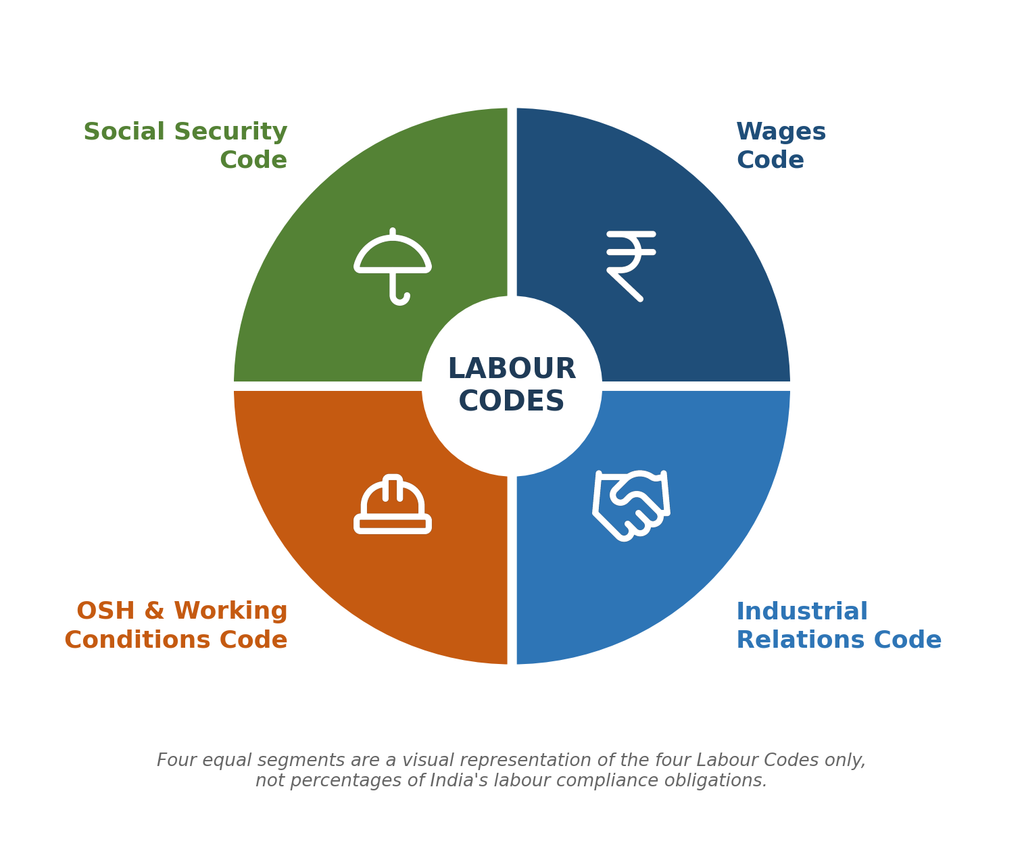
India’s labour-law framework has been consolidated into four major Labour Codes:
- Code on Wages, 2019
- Industrial Relations Code, 2020
- Code on Social Security, 2020
- Occupational Safety, Health and Working Conditions Code, 2020
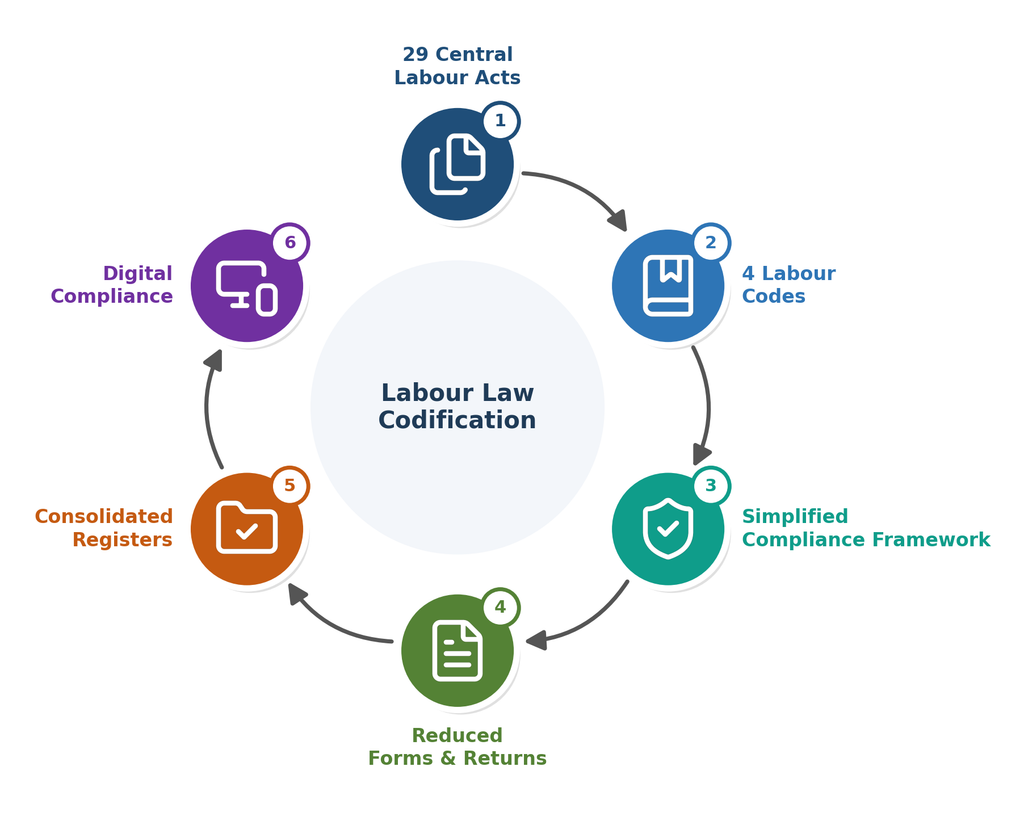
These four Codes consolidate 29 Central labour laws.
Labour Code-wise compliance overview
| Labour Code | Primary compliance area | Examples of records |
| Code on Wages | Wages, deductions and overtime | Wage and deduction information |
| Industrial Relations Code | Industrial relations and employment matters | Prescribed employment records |
| Code on Social Security | Social-security-related obligations | Prescribed employee/social-security records |
| OSH & Working Conditions Code | Safety, health and working conditions | Employee, attendance and safety records |
The Labour Code framework is intended to reduce duplication and make compliance easier to manage.
According to the Ministry’s 2026 compliance material:
| Compliance Area | Earlier Framework | Consolidated Framework |
| Central Labour Acts | 29 | 4 Codes |
| Rules | 1,436 | 351 draft rules |
| Returns | 31 | 1 electronic return |
| Forms | 181 | 73 |
| Employer Registers | 84 | 8 |
Key statistic
The reported reduction from 84 employer registers to 8 represents a reduction of approximately 90.5% in the number of registers under the consolidated framework.
Note: This does not mean that every employer can simply maintain eight identical registers regardless of circumstances. Applicability continues to depend on the relevant law, rules and establishment.
Which Statutory Registers Apply to Factories, Shops and Establishments?
This is one area where employers should avoid using a one-size-fits-all statutory register checklist.
1. Statutory registers for factories
Factories can have additional requirements relating to:
- Employees
- Working hours
- Attendance
- Overtime
- Wages
- Health
- Safety
- Workplace accidents
- Dangerous occurrences
- Other occupational safety requirements
2. Statutory registers for shops and commercial establishments
Shops and commercial establishments can be subject to the applicable State Shops and Establishments legislation.
Depending on the State, records may cover:
- Employee details
- Attendance
- Working hours
- Weekly holidays
- Leave
- Wages
- Overtime
- Employment conditions
3. Statutory registers for offices
An office or service business can have a different compliance profile from a factory because the applicable State law, establishment category and employee profile may differ.
4. Statutory registers for contractors
Businesses engaging contract labour may have additional record-keeping obligations depending on the applicable law and circumstances.
Key takeaway
Before preparing a statutory register checklist, an employer should first identify:
Business Type → Establishment Type → State → Workforce → Applicable Law → Required Registers
Which Statutory Registers Are Mandatory for Small and Medium-Sized Businesses?
Being a small or medium-sized business does not automatically remove statutory record-keeping obligations.
The actual requirements can depend on:
- Number of employees
- Nature of business
- State or UT
- Establishment type
- Industry
- Employee categories
- Contract labour
- Applicable Labour Codes
- Applicable State rules
For SMEs, the better approach is to create an applicability matrix rather than maintaining every possible statutory register.
SME statutory compliance matrix
| Business Factor | What HR Should Check |
| Location | Which State/UT rules apply? |
| Establishment Type | Factory, shop, office, or other establishment? |
| Workforce Size | Are any thresholds applicable? |
| Employee Category | Employees, contract workers, fixed-term workers, etc.? |
| Industry | Are sector-specific requirements applicable? |
| Labour Codes | Which provisions apply? |
| Records | Which registers and records are prescribed? |
This approach prevents both under-compliance and unnecessary paperwork.
What Information Must Be Included in Statutory Registers?
The information required depends on the particular register and the applicable law.
However, statutory records can include:
- Employee identification details
- Employment category
- Date of joining
- Attendance
- Days worked
- Hours worked
- Wages
- Overtime
- Leave
- Leave wages
- Deductions
- Workplace accidents
- Dangerous occurrences
- Contractor-related information, where applicable
Example: Employee and payroll data flow
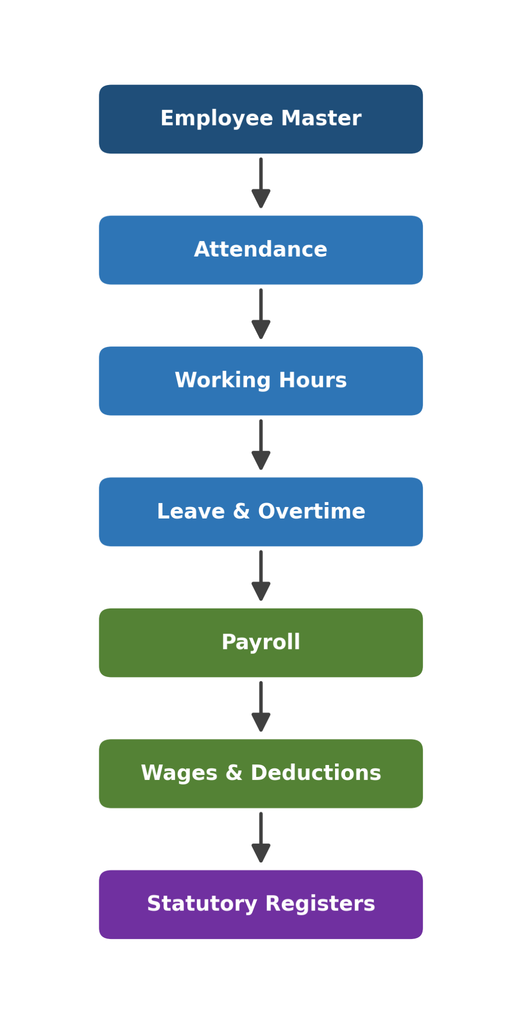
The key is consistency. If employee data, attendance, and payroll records contain conflicting information, compliance teams may have difficulty validating the records.
How Often Should Statutory Registers Be Updated?
There is no single update frequency for every statutory register.
A practical compliance framework looks like this:
| Record | General Update Frequency |
| Attendance | Daily / as work occurs |
| Working Hours | Daily / as prescribed |
| Overtime | Whenever overtime occurs |
| Wages | Each payroll cycle |
| Deductions | Each applicable payroll cycle |
| Leave | Whenever leave is recorded |
| Employee Register | Whenever employee information changes |
| Accident Records | Whenever a reportable event occurs |
The exact requirement should always be determined by the applicable law or rule.
The important principle for HR teams is simple:
A statutory register should not be treated as a document that is updated only before an inspection.
It should remain complete and up to date as part of the normal HR compliance process.
How Long Should Employers Preserve Statutory Registers and Records?
The retention period varies depending on the particular register and applicable law.
Under the Central OSH & Working Conditions Rules, some records are generally required to be preserved for five years after the date of the last report or entry, unless another period is prescribed.
Therefore, employers should not assume that every statutory register has exactly the same retention period.
Recommended statutory record-retention system
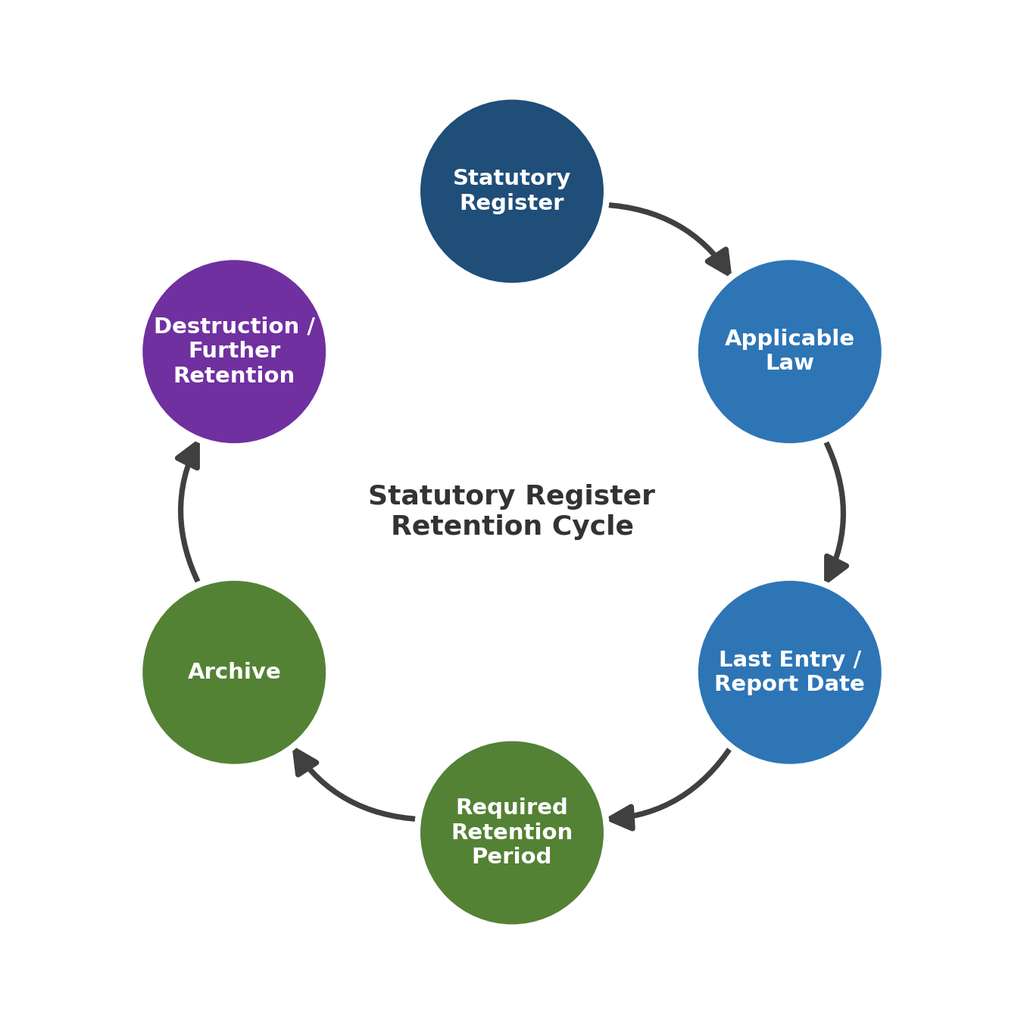
For HR teams, a simple retention tracker can contain:
| Register | Applicable Law | Last Entry | Retention Period | Archive Date |
| Employee Register | Applicable law | Date | As prescribed | Date |
| Attendance | Applicable law | Date | As prescribed | Date |
| Wage Register | Applicable law | Date | As prescribed | Date |
| Accident Record | Applicable law | Date | As prescribed | Date |
Can Employers Maintain Statutory Registers Digitally?
Yes, digital statutory register management is increasingly important under India’s evolving labour-compliance framework.
The Labour Code framework promotes digital records and simplified digital compliance processes. The applicable rules also provide for digital maintenance or production of records in relevant circumstances.
This is particularly useful for businesses with:
- Multiple locations
- Large workforces
- Distributed employees
- Multiple payroll cycles
- State-specific compliance requirements
Digital statutory register workflow

Why digital statutory registers are useful
A digital system can help HR teams:
- Reduce duplicate data entry
- Improve data consistency
- Generate reports faster
- Maintain historical records
- Search records quickly
- Create audit trails
- Manage multiple locations
- Connect attendance and payroll data
However, technology does not replace legal applicability checks. The HRMS should be configured according to the rules applicable to the organization.
What Are the Penalties for Not Maintaining Statutory Registers?
Failure to maintain required statutory registers can expose employers to penalties and other enforcement consequences under the applicable legislation.
The exact consequence depends on:
- Applicable law
- Nature of violation
- Whether records were missing or inaccurate
- Whether the violation was corrected
- Whether the violation was repeated
- Applicable Central or State rules
The Labour Code framework also includes mechanisms such as improvement notices and compounding of certain offences.
Common statutory register mistakes
1. Maintaining incomplete records
Missing employee, attendance, or wage information can make an otherwise maintained register unreliable.
2. Updating registers irregularly
Backdating or bulk updating records can create inconsistencies.
3. Using the same register structure everywhere
A requirement applicable to one establishment or State may not necessarily apply to another.
4. Ignoring State-level requirements
Multi-State employers need to consider State-specific rules.
5. Keeping disconnected HR data
When attendance, payroll, and employee records are maintained separately, issues are more likely.
How Do Statutory Register Requirements Differ Across Indian States?
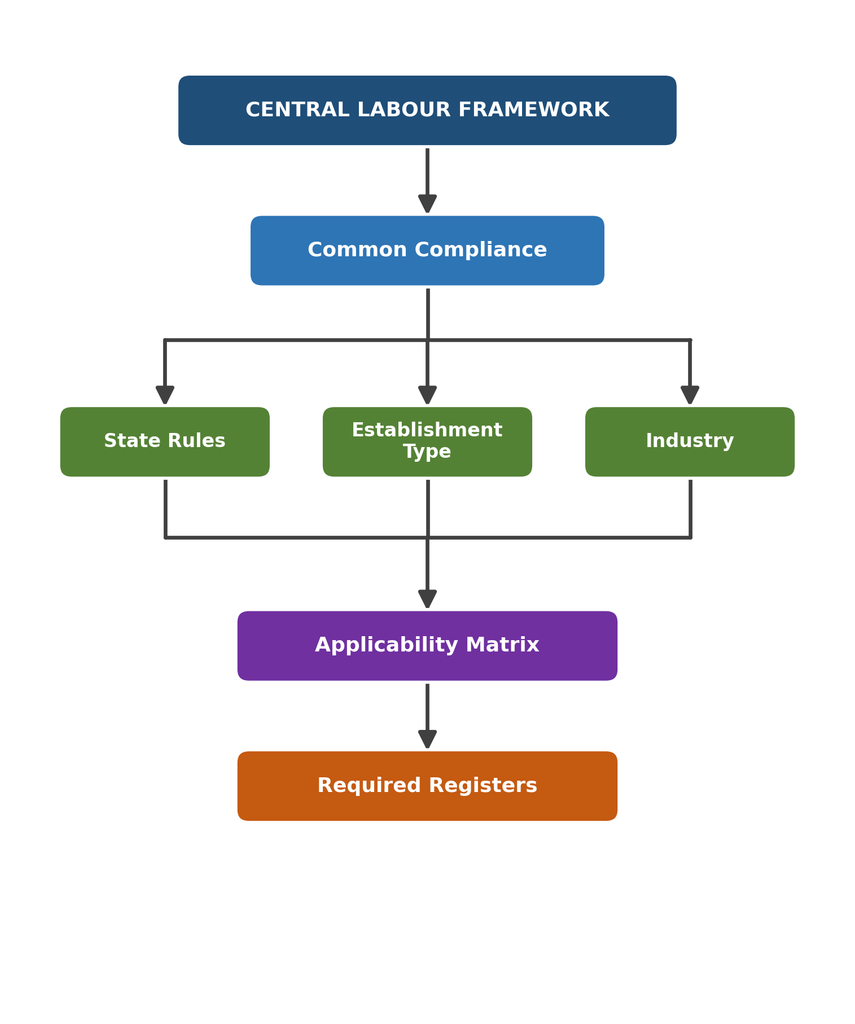
India’s labour-compliance framework includes both Central and State-level requirements.
This means businesses operating across multiple States should not assume that one statutory register configuration automatically works everywhere.
For example, an organization operating in:
- Haryana
- Maharashtra
- Karnataka
- Uttar Pradesh
may need a common core compliance structure combined with State-specific requirements.
Multi-State statutory compliance model
What should multi-State employers track?
| Compliance Factor | Why It Matters |
| State/UT | State-specific requirements |
| Establishment Type | Determines applicable provisions |
| Employee Count | Certain thresholds may matter |
| Industry | Sector-specific requirements |
| Workforce Category | Different worker categories may have different requirements |
| Applicable Rules | Determines register fields and maintenance requirements |
This makes a location-based compliance configuration particularly useful for organizations with multiple branches.
What Changes Have the Labour Codes Brought to Statutory Registers?
The most important change is consolidation and rationalisation.
The Government’s 2026 compliance material highlights significant simplification:
| Area | Earlier | Consolidated Framework |
| Central Labour Acts | 29 | 4 Labour Codes |
| Rules | 1,436 | 351 draft rules |
| Returns | 31 | 1 electronic return |
| Forms | 181 | 73 |
| Registers | 84 | 8 |
What does this mean for HR teams?
The objective is to reduce repetitive compliance and move towards a more simplified system.
Instead of managing various disconnected records, employers can move towards a structure where:
Employee Data → Attendance → Payroll → Statutory Records → Returns
are connected more efficiently.
Labour Code consolidation flow
Four Labour Codes
A simple four-part visual can be used here:
How Can HRMS Software Help Employers Manage Statutory Registers?
Managing statutory registers manually becomes increasingly difficult when an organization has multiple employees, branches, payroll cycles, or locations.
An HRMS can connect the underlying data required for several compliance processes.
HRMS statutory compliance workflow

HRMS capabilities that support statutory compliance
| HRMS Feature | How It Helps |
| Employee Master | Centralizes employee information |
| Attendance Management | Tracks attendance and working information |
| Leave Management | Maintains leave records |
| Overtime Tracking | Captures overtime information |
| Payroll | Connects wages and deductions |
| Multi-Location Management | Supports location-specific configurations |
| Compliance Reports | Simplifies reporting |
| Digital Records | Reduces paper-based administration |
| Audit Trail | Improves traceability |
| Automated Workflows | Reduces repetitive manual work |
Why this matters
The real advantage is not simply generating a statutory register.
The bigger benefit is creating a connected compliance ecosystem where the data used for attendance, leave and payroll can also support statutory records.
Statutory Registers Compliance Checklist for Employers in 2026
Before considering statutory register compliance complete, HR teams can use this checklist:
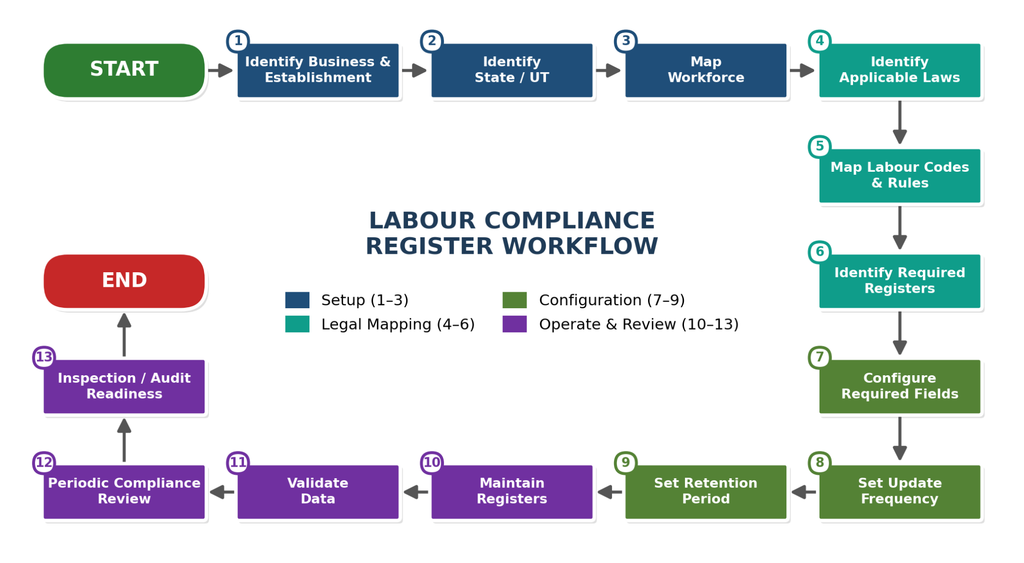
Business and applicability
- Identify the business type.
- Identify the establishment type.
- Identify the State/UT.
- Identify applicable Central laws.
- Identify applicable State laws.
- Identify applicable Labour Codes.
- Review employee categories.
- Check workforce thresholds where applicable.
Register management
- Identify mandatory statutory registers.
- Identify prescribed fields.
- Set update frequency.
- Define record-retention periods.
- Determine whether digital maintenance is permitted or required.
- Maintain complete employee information.
- Maintain accurate attendance records.
- Reconcile attendance with payroll.
- Track overtime.
- Record applicable deductions.
- Maintain leave information.
- Maintain accident/safety records where applicable.
Audit readiness
- Conduct periodic compliance reviews.
- Maintain historical records.
- Keep records accessible for inspection where required.
- Maintain an audit trail.
- Review State-specific compliance.
- Update configurations when laws or rules change.
2026 statutory compliance flowchart
Conclusion
Statutory registers are an important part of an employer’s labour-compliance framework. While the Labour Codes aim to simplify and consolidate compliance, businesses still need to identify the requirements applicable to their establishment, workforce, industry and State.
For HR teams, the practical approach is straightforward: identify the right statutory registers, maintain accurate information, update records on time, preserve them for the required period, and regularly review compliance. Digital HRMS solutions can further connect employee, attendance, leave, and payroll data to make this process more organized.

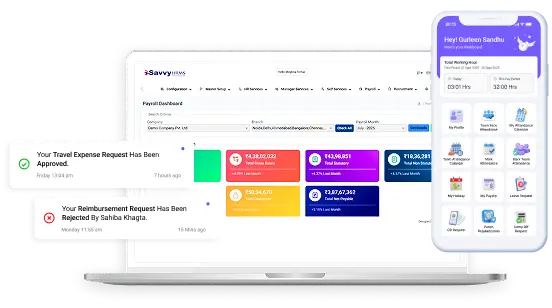









Looking to simplify statutory registers, payroll, attendance and HR compliance in one platform?
Explore Savvy HRMS and make statutory compliance management smarter, more organised, and easier for your HR team.
Frequently Asked Questions (FAQs)
1. What is the format of statutory registers?
There is no single format applicable to every statutory register in India. The required format, fields, and method of maintenance depend on the applicable labour law, rules, establishment type, and State requirements.
2. What are the names of the statutory registers under the Companies Act, 2013?
The Companies Act, 2013 requires companies to maintain various statutory registers and records depending on their structure and activities. These can include registers relating to members, directors and key managerial personnel, charges, loans and investments, contracts and arrangements, and other prescribed matters.
3. What are statutory records?
Statutory records are documents and registers that an organization is required to maintain under applicable laws and regulations. They provide evidence of compliance and may cover employee details, wages, attendance, leave, working hours, safety, company affairs, or other prescribed information.
4. What are the statutory registers required under the Factories Act?
Factories may be required to maintain records relating to areas such as attendance, wages, working hours, overtime, leave, accidents, health and safety, and employment details, depending on the applicable legal requirements. The exact requirements can vary based on the factory’s operations and applicable rules.
5. Are statutory registers mandatory for every employer in India?
Not every employer is required to maintain the same set of statutory registers. Requirements depend on factors such as the type of establishment, number and category of employees, industry, location, and the Central or State laws applicable to the organization.