

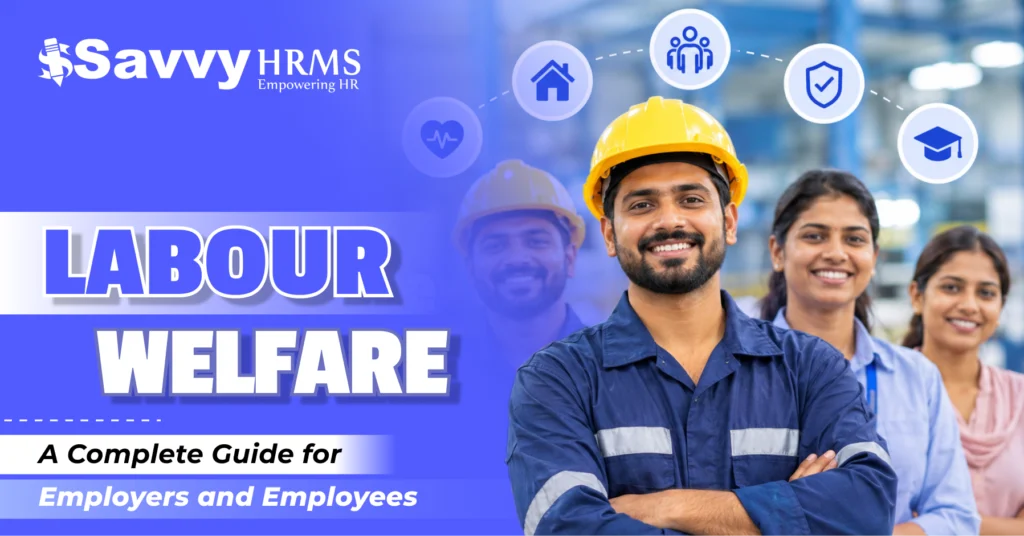
Labour Welfare: A Complete Guide for Employers and Employees


-
AuthorS.K. Gupta
-
 Last Updated
October 01, 2026
Last Updated
October 01, 2026
-
 Reading Time
17 Mins
Reading Time
17 Mins
TL;DR
- Labour welfare protects employees’ health, safety, financial security, and well-being.
- It includes statutory, voluntary, and mutual welfare measures.
- Good welfare can improve productivity, morale, retention, and workplace relations.
- India’s four Labour Codes define key requirements around wages, social security, safety, and industrial relations.
- Employers must ensure safe working conditions, statutory benefits, basic amenities, and proper records.
- Schemes such as e-Shram, PM-JAY, EPFO, ESIC, and PM-SYM support worker welfare.
- An HRMS can automate PF, ESI, LWF, and other compliance processes, reducing manual errors.
Ever wondered why some workplaces feel like a second home while others feel like repetitive work? The secret often lies in how a company treats its people. That’s where labour welfare quietly steps in and changes everything.
Think of it as a promise: safe premises, fair pay, clean drinking water, health cover, and a little dignity along the way. For employers, it’s smart business. For employees, it’s peace of mind that goes beyond the salary slip.
With India’s four new Labour Codes now in force, welfare is no longer optional goodwill. This blog walks you through the meaning, laws, schemes, and practical steps, so you can build a workplace people genuinely want to stay in.
What Is Labour Welfare?
Labour welfare is the set of facilities and services that improve the physical, mental, social, and economic wellbeing of workers, beyond their wages. It covers everything from safe drinking water and canteens to medical care, housing, education, and insurance.
The International Labour Organization (ILO) describes it as services and amenities that let people work in healthy, friendly surroundings while maintaining good health and high morale. In simple terms, labour welfare answers one question: is the worker looked after as a human being, not just as a resource?
Three parties can provide welfare:
- Employers (canteens, health check-ups, bonuses)
- Government (statutory laws, insurance and pension schemes)
- Trade unions and NGOs (training, legal support, community support)
Labour welfare is different from social security. Social security is a legal entitlement such as PF, ESI, or gratuity. Welfare is the wider ecosystem of amenities and care around it.
What Is the Scope of Labour Welfare?
The scope of labour welfare is broad. It extends from the shop floor to the worker’s home and family. It is generally divided into intra-mural (inside the workplace) and extra-mural (outside the workplace) activities.
| Type | Examples |
| Intra-mural | Safe working conditions, canteens, rest rooms, drinking water, first aid, washrooms, ventilation, protective equipment |
| Extra-mural | Housing, schools, recreation, transport, medical care for families, savings and credit societies, skill training |
The scope also grows with the changing workforce. Since November 2025, the Labour Codes recognise gig workers, platform workers and inter-state migrant workers as distinct groups. The coverage of labour welfare now reaches people who were invisible to older laws.
What Are the Objectives of Labour Welfare?
The core objectives of labour welfare are to protect workers’ health, raise their standard of living, enhance morale and productivity, and build stable industrial relations.
1. Improve quality of life
Labour welfare looks beyond the paycheque to the worker’s whole life. Healthcare, decent housing, nutritious meals, and children’s education lift entire families, creating stability that shows up in attendance and focus.
2. Increase productivity
- Healthy workers take fewer sick days
- Safe conditions reduce costly accidents
- Rested, well-fed staff stay focused on the job
- Highly engaged teams show about 23% higher profitability (Gallup)
3. Reduce absenteeism and attrition
Workers rarely leave places where they feel looked after. Reliable health cover, clean facilities and family support reduce unplanned leave and resignations, saving employers the high cost of hiring, training and replacing skilled people.
4. Ensure social justice
- Equal pay and opportunity for women
- Night-shift work with consent and safety measures
- Social-security cover for gig, platform and migrant workers
- Appointment letters and minimum wage for every worker
- Safe, non-discriminatory workplaces for contract staff
5. Prevent industrial unrest
Most issues begin with unmet needs and unheard voices. Welfare measures and fair grievance channels build trust between management and labour, so small concerns are resolved early instead of becoming strikes or litigation.
6. Comply with the law
- Meet duties under the four Labour Codes
- Pay PF, ESI and state Labour Welfare Fund contributions on time
- Avoid penalties, prosecution and inspection trouble
- Keep audit-ready digital records
- Protect the company’s reputation
7. Build a positive employer brand
Today’s candidates research how companies treat their people before applying. A reputation for genuine welfare attracts skilled talent, earns referrals from happy employees, and makes your business the employer of choice in a crowded market.
What Are the Different Categories of Labour Welfare?
Labour welfare is classified into three categories based on who provides it and whether it is legally required.
| Category | Provided by | Nature | Examples |
| Statutory welfare | Employer, as required by law | Mandatory | Canteen, first aid, PF, ESI, maternity benefit, safe drinking water |
| Voluntary welfare | Employer, by choice | Optional | Free meals, transport, scholarships, wellness programmes, housing loans |
| Mutual (union) welfare | Trade unions, cooperatives, workers’ groups | Self-help | Credit societies, legal aid, training, cooperative stores |
1. Statutory Welfare
Statutory welfare refers to the labour welfare measures that employers are legally required to provide under applicable labour laws and regulations. These measures are intended to protect employees’ health, safety, working conditions, and basic well-being.
Depending on the nature of the establishment and the applicable law, statutory welfare may include safe working conditions, clean drinking water, sanitation facilities, first-aid arrangements, canteens, rest areas, washing facilities, and other prescribed workplace amenities.
2. Voluntary Welfare
Voluntary welfare includes additional welfare measures provided by employers beyond what is legally required. These initiatives are generally introduced to improve employee well-being, job satisfaction, workplace experience, and overall quality of work life.
Examples may include health insurance, employee assistance programmes, transportation facilities, educational assistance, recreational activities, counselling services, flexible work arrangements, and additional financial or family benefits.
3. Mutual (Union) Welfare
Mutual or union welfare refers to welfare activities organized collectively by employees, trade unions, or worker associations for the benefit of their members. These initiatives are generally supported through employee or union contributions and are designed to provide assistance and promote workers’ social and economic well-being.
Examples may include union welfare funds, financial assistance during emergencies, educational support for workers’ families, recreational activities, scholarships, and other member-support programmes.
Welfare can also be split into intra-mural and extra-mural activities, as explained above. Smart employers start with statutory compliance, then add voluntary benefits that match their workforce’s real needs.
What Facilities Are Covered Under Labour Welfare?
Labour welfare facilities cover health, safety, hygiene, daily facilities, financial security and family support. The exact requirements depend on the type and size of the establishment, and thresholds are being finalized in rules under the new Codes.
- Health and safety: first-aid boxes, ambulance rooms, protective gear, fire safety and, under the new OSH Code, free annual medical check-ups for workers aged 40 and above.
- Hygiene and comfort: clean toilets, drinking water, ventilation, lighting and rest shelters.
- Nutrition: canteens and subsidised meals.
- Family support: Maternity benefits (26 weeks of paid leave for the first two children) and education support.
- Financial security: provident fund, ESI, gratuity, bonus and insurance.
- Housing and transport: worker housing, transport and, in many industries, travel allowances.
- Recreation and development: sports, cultural activities and skill-building.
Why Are Labour Welfare Measures Important?
Labour welfare measures are important because they protect lives, improve productivity and keep businesses legally compliant. Workers spend most of their waking hours at work, so the conditions there shape their health, income and family life.
The figures are large. The ILO estimates that nearly 3 million people die every year from work-related accidents and diseases worldwide. In India, roughly nine in ten workers are in the informal economy, where welfare gaps are widest.
The good news is that coverage is expanding. Social security coverage in India rose from about 19% of the workforce in 2015 to more than 64% in 2025.
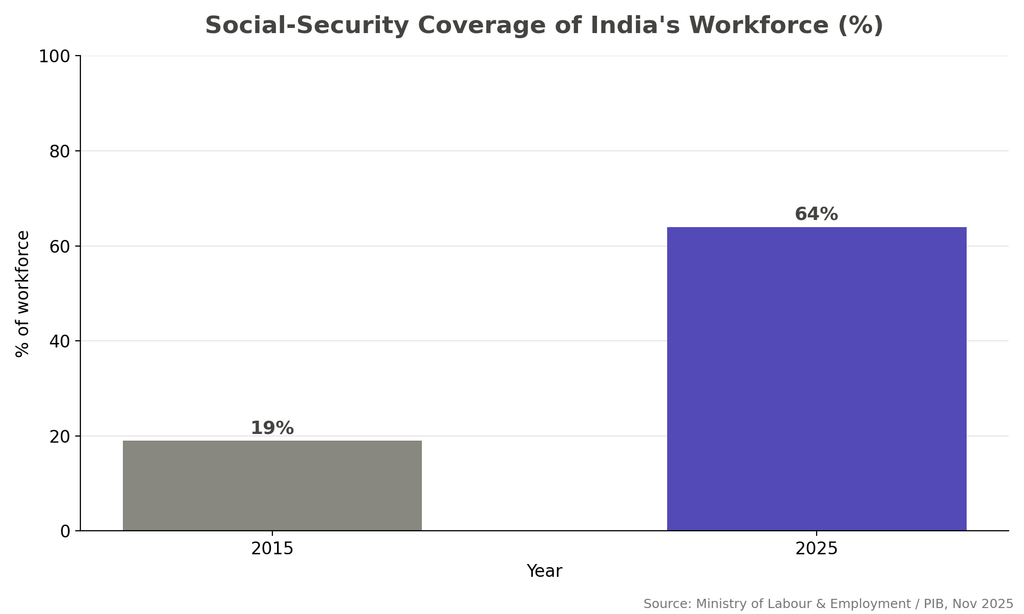
Source: Ministry of Labour and Employment / PIB, November 2025. Coverage has more than tripled in ten years, yet a large share of workers still lacks protection. That gap is the space where employers can make a real difference.
What Are the Benefits of Labour Welfare for Employees and Employers?
Labour welfare benefits both sides: employees gain health, security and dignity, while employers gain productivity, loyalty and lower costs. The proper workplace meta-analysis found that highly engaged business units show about 23% higher profitability and 81% lower absenteeism than the least engaged ones.
Benefits for employees
- Better physical and mental health: access to medical care, clean facilities, and rest breaks keep workers fit and reduce stress.
- Financial security: PF, ESI, gratuity and insurance give workers a safety net for illness, accidents and retirement.
- Safer workplaces: proper equipment and safety training mean fewer injuries and less fear on the job.
- Support for family needs: housing, education aid and other facilities ease the daily pressure on working parents.
- Maternity benefits and health check-ups: paid maternity leave and free annual check-ups for workers aged 40+ protect long-term wellbeing.
- Higher morale and job satisfaction: feeling valued makes workers more motivated, engaged and proud of their work.
- Dignity and fair treatment: equal pay, respectful conduct and equal opportunity for women, migrants and contract staff.
- Greater job stability: appointment letters and social-security cover make employment more secure and predictable.
Benefits for employers
- Higher productivity and work quality: healthy, focused and motivated employees deliver better output with fewer errors.
- Lower absenteeism and attrition: workers who feel cared for take fewer unplanned leaves and stay longer with the company.
- Fewer accidents and legal disputes: strong safety practices reduce injuries, compensation claims, and costly litigation.
- Stronger employer brand: a caring reputation helps attract skilled candidates and earns referrals from happy employees.
- Smoother industrial relations: trust and open grievance channels resolve concerns before they turn into strikes or conflict.
- Full legal compliance: meeting Labour Code duties lowers penalty risk and avoids inspection headaches.
- Reduced hiring and training costs: retaining experienced workers saves money spent on recruitment and onboarding replacements.
- A loyal, engaged workforce: committed employees go the extra mile and support long-term business growth.
Welfare spending is best seen as an investment, not an expense. Replacing a trained worker is usually costlier than keeping one healthy and motivated.
What Labour Welfare Schemes Are Available for Labourers in India?
India has a wide range of central and state welfare schemes for organized and unorganized workers. The most important are:
- e-Shram: the national database of unorganized workers. As of August 18, 2026, it had recorded 31.89 crore registrations, including roughly 11.5 lakh gig and platform workers. Registered workers get a Universal Account Number and an e-Shram card.
- Ayushman Bharat PM-JAY: health cover of up to ₹5 lakh per family per year. About 15.10 crore e-Shram workers are enrolled through the portal.
- One Nation One Ration Card (ONORC): portable food-grain entitlements for migrants, with 24.46 crore beneficiaries linked through e-Shram.
- PM Shram Yogi Maandhan (PM-SYM): an assured pension of ₹3,000 per month after age 60 for eligible unorganized workers aged 18 to 40.
- PMSBY and PMJJBY: accident cover of ₹2 lakh at ₹20 per year and life cover of ₹2 lakh at ₹436 per year. Check the current premium before enrolling.
- Atal Pension Yojana (APY): guaranteed pension of ₹1,000 to ₹5,000 per month.
- EPFO and ESIC: provident fund, pension, and medical benefits for the organized sector.
- Building and Other Construction Workers (BOCW) welfare boards: funded by a 1% cess on construction cost, with education, health, and housing assistance.
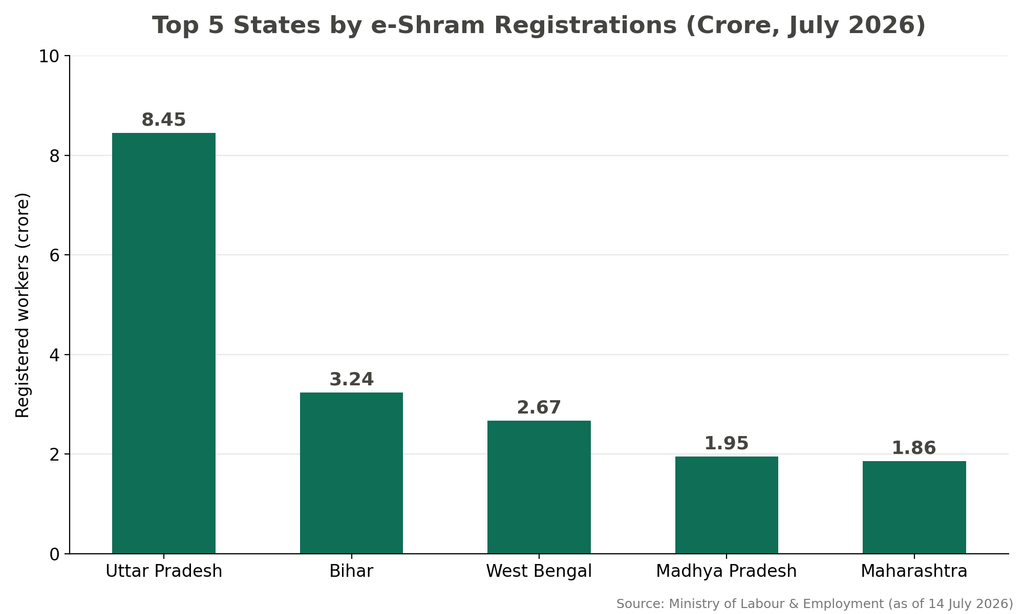
Uttar Pradesh leads e-Shram registrations with 8.45 crore workers, followed by Bihar, West Bengal, Madhya Pradesh and Maharashtra.
How to Implement Labour Welfare Measures: 6-Step Roadmap
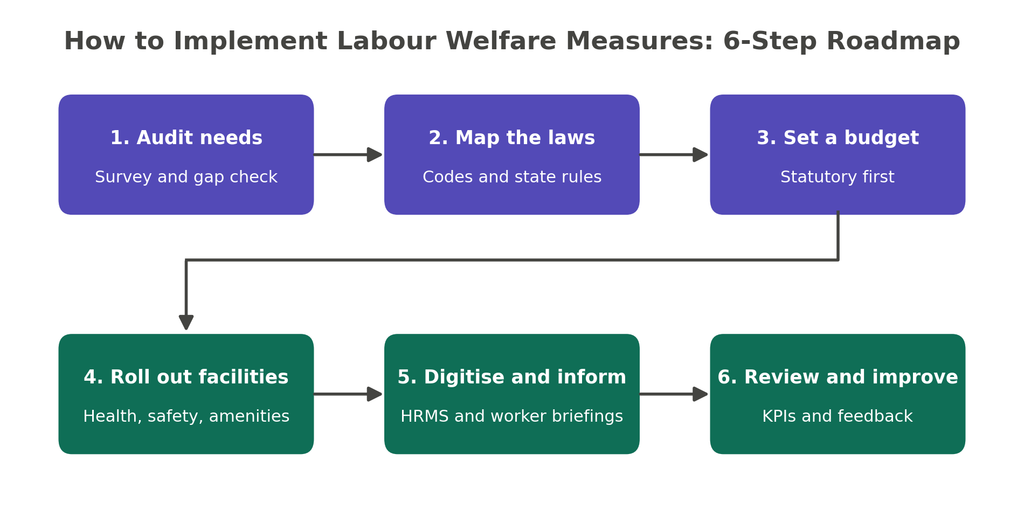
Step 1: Audit needs
Start by finding out what your workers really need, not what you assume they need. Walk the shop floor, review accident and absenteeism records, and collect honest feedback.
- Run anonymous worker surveys
- Check safety, hygiene, and amenity gaps
- Review attrition and sick-leave patterns
- Hold small group discussions, including women, migrant and contract workers
Step 2: Map the laws
List every legal obligation that applies to your business. Requirements depend on your headcount, industry and state, and the four Labour Codes, effective from 21 November 2025, now form the core framework.
- Identify duties under the Wages, Social Security, OSH and Industrial Relations Codes
- Check state Labour Welfare Fund rates and due dates
- Confirm which final rules apply in your state, as some rules are still being notified
- Assign one person to track legal updates
Step 3: Set a budget
Fund statutory obligations first, because they are non-negotiable. Then add voluntary benefits according to the needs found in your audit and what your business can sustain.
- Cover PF, ESI, LWF, bonus, and gratuity provisions
- Set aside funds for safety equipment and amenities
- Prioritise high-impact extras such as health camps or subsidised meals
- Avoid overpromising benefits you cannot sustain
Step 4: Roll out facilities
Put the plan into action, starting with what protects lives and health. Give each facility a clear owner and deadline so nothing stays on paper.
- Begin with safety, first aid, and clean drinking water
- Add toilets, rest areas, and canteens where applicable
- Arrange annual health check-ups for workers aged 40 and above
- Offer voluntary extras such as transport or scholarships
Step 5: Digitise and inform
Technology and communication make welfare reliable. An HRMS can automate PF, ESI and LWF calculations, keep records audit-ready and reduce human error. Just as important, workers must know their entitlements, since registration alone does not guarantee that benefits are claimed.
- Automate statutory deductions and filings with HRMS software
- Issue digital appointment letters and payslips
- Hold short briefings in local languages
- Help informal and contract workers register on e-Shram and link to PM-JAY, PMSBY and PM-SYM
Step 6: Review and improve
Welfare is a continuous cycle, not a one-time project. Track results every quarter and adjust the plan using real data and worker feedback.
- Monitor absenteeism, attrition, and accident rates
- Track how many workers actually use each benefit
- Collect feedback through surveys and grievance channels
- Update the plan when laws, rules, or workforce needs change
What Are the Major Labour Welfare Laws in India?
India’s labour welfare laws are now consolidated into four Labour Codes. The government made the Code on Wages 2019, the Industrial Relations Code 2020, the Code on Social Security 2020 and the Occupational Safety, Health and Working Conditions Code 2020 effective from 21 November 2025, rationalising 29 existing labour laws.
| Labour Code | Replaces (examples) | Welfare relevance |
| Code on Wages, 2019 | Minimum Wages Act, Payment of Wages Act, Payment of Bonus Act | Floor wage, timely payment, bonus, equal pay |
| Code on Social Security, 2020 | EPF Act, ESI Act, Gratuity Act, Maternity Benefit Act | PF, ESI, gratuity, maternity benefit, gig-worker cover |
| OSH & Working Conditions Code, 2020 | Factories Act, Contract Labour Act, BOCW Act | Safety, canteens, crèches, health check-ups, working hours |
| Industrial Relations Code, 2020 | Industrial Disputes Act, Trade Unions Act | Grievance redressal, unions, fixed-term employment |
Key changes that matter for labour welfare:
- Appointment letters for all workers.
- A statutory minimum wage floor for every worker.
- Free annual health check-ups for workers aged 40 and above.
- Social-security cover extended to gig and platform workers.
- Women may work night shifts with consent and safety measures.
Two compliance warnings apply. First, draft central rules under the Codes were published on 30 December 2025 for stakeholder feedback, so confirm which final rules apply in your state. Second, the state Labour Welfare Fund (LWF) Acts still require periodic employer and employee contributions in many states, and rates and due dates differ. Always check your state’s current schedule.
What Are the Responsibilities of Employers Towards Labour Welfare?
Employers must provide safe, healthy working conditions, pay fair wages on time, contribute to statutory funds, and offer the amenities the law prescribes. In practice, that means:
- Issue appointment letters and maintain accurate employee records.
- Pay at least the minimum wage and pay on schedule, including wages for leave.
- Register and contribute to EPF, ESIC and the state Labour Welfare Fund.
- Ensure workplace safety: fire safety, protective equipment, machine guarding and first aid.
- Provide basic amenities: clean drinking water, toilets, rest areas, and canteens where applicable.
- Offer maternity and family benefits as per law.
- Arrange annual health check-ups for eligible workers.
- Prevent discrimination and harassment, and set up grievance redressal.
- Keep digital, audit-ready records of attendance, wages, and contributions.
- Report and compensate for workplace accidents and occupational diseases.
Non-compliance can bring penalties, prosecution, and worker unrest. It is also one of the fastest ways to lose skilled people.
What Are the Challenges of Labour Welfare in India?
The main challenges of labour welfare in India are informality, low awareness, compliance complexity, cost pressure on small businesses, and uneven enforcement.
- Informality: most workers sit outside formal employment, so employer-led welfare never reaches them.
- The awareness gap: e-Shram has crossed 31 crore registrations, but researchers note that registration alone does not guarantee that workers can claim benefits. Early portal data also showed that over 94% of registered informal workers earned ₹10,000 or less a month, which shows how thin their financial buffer is.
- Regulatory transition: the Codes are in force, but rules and schemes are still being finalized. Payroll teams face complexity once the implementing rules arrive. Legacy state laws can apply in the meantime.
- Cost burden on MSMEs: small employers struggle with contribution costs, infrastructure and compliance staff.
- Migrant and gig portability: benefits must follow workers across states and platforms, and funding models for gig workers are still evolving.
- Enforcement gaps: inspections, grievance systems and digital infrastructure are uneven across states.
- Manual record-keeping: paper registers cause errors, missed filings and penalties.
The best response combines clear rules, simple technology and employers who treat welfare as strategy.
Conclusion
Labour welfare is far more than a compliance checklist. It is the everyday proof that a business values its people, protecting health, income and dignity while quietly building productivity, loyalty and trust that no salary alone can ever really buy.
With the new Labour Codes reshaping employer duties, now is the time to act. Start small, stay compliant, listen to your workforce, and improve steadily. Employers who invest in welfare today will attract, retain, and grow the best talent tomorrow.

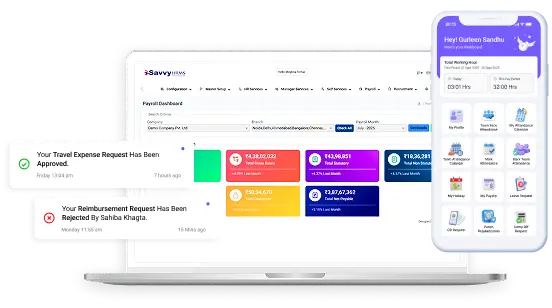









Ready to simplify labour welfare compliance?
Book a free demo with Savvy HRMS and automate PF, ESI, payroll, and worker records today.
Frequently Asked Questions (FAQs)
1. What is labour welfare?
Labour welfare refers to the services, facilities, and benefits that employers, the government, or unions provide to improve workers’ health, safety, living standards, and morale. It includes canteens, clean drinking water, crèches, medical care, housing, insurance, and education support, all aimed at making work healthier and more dignified.
2. How much LWF is deducted from salary?
LWF is a small fixed amount, not a percentage of salary, and it varies by state. Maharashtra charges ₹25 from the employee and ₹75 from the employer per half-year, Gujarat charges ₹6 and ₹12 per half-year, and Karnataka charges ₹50 and ₹100 per year.
Across states, the employee share ranges from ₹2 in Telangana and Delhi to ₹60 in Goa. It is never a monthly deduction in most states. Rates are revised from time to time, so check your state Labour Welfare Board’s latest notification before deducting.
3. Which employees are eligible for LWF?
LWF eligibility depends on the state Act. Generally, it covers employees of establishments that meet the state’s headcount threshold and type, such as factories, shops, commercial establishments, and IT companies. Managerial or supervisory staff and employees above a wage limit may be excluded in some states.
Thresholds range from 1 employee in Goa and Madhya Pradesh to 20 or more in Odisha and Punjab. Karnataka lowered its threshold from 50 to 10 employees effective January 7, 2026. Always confirm your state’s current rules.
4. Is LWF applicable in every state?
No. Only 16 states and union territories currently levy LWF, including Maharashtra, Karnataka, Tamil Nadu, Gujarat, Delhi, West Bengal, Kerala, and Telangana. Uttar Pradesh, Rajasthan, Bihar, Uttarakhand and most North-Eastern states have no LWF Act in force. Employers operating in several states must track each state’s rules separately.
5. How can an HRMS help with labour welfare and LWF compliance?
An HRMS such as Savvy HRMS can automate statutory calculations for PF, ESI, and LWF, apply the correct state-wise rates and deduction months, and keep digital records ready for inspections. This reduces manual errors, prevents over- or under-deduction, and helps HR teams avoid late-payment interest and penalties.