

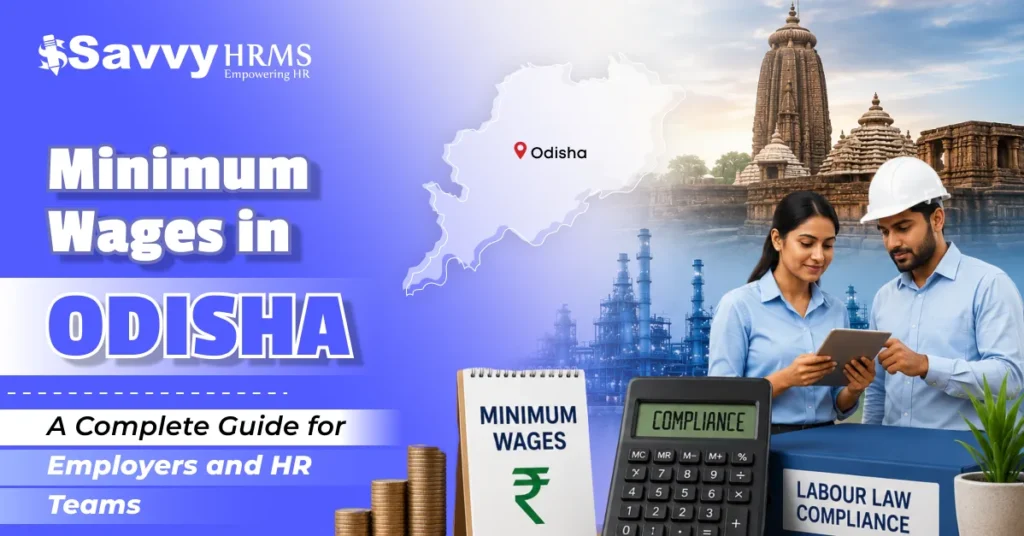
Minimum Wages in Odisha: A Complete Guide for Employers and HR Teams


-
AuthorRuchika Rajput
-
 Last Updated
June 29, 2026
Last Updated
June 29, 2026
-
 Reading Time
10 Mins
Reading Time
10 Mins
Payroll is more than numbers; it is about making sure these numbers are accurate. In the case of minimum wages in Odisha, any minor error could result in non-compliance, discontent among workers, or even penalties for the business.
Why is it so challenging? Because wage rates do not remain constant but are variable, fluctuating depending on skill level, and incorporating elements such as VDA, which most organizations ignore.
Instead of searching for information from multiple sources and dealing with complex legal confusion, this manual combines all relevant information into a single, easily understandable resource.
What Are Minimum Wages in Odisha and Why Do They Matter?
Let us begin with the basics.
Minimum wages refer to the minimum pay an employer must provide their employees for their services. Minimum wages are determined by the government based on the provisions of the Minimum Wages Act, 1948.
The minimum wages in Odisha have been revised from time to time by the state government based on factors such as:
- Inflation
- Living costs
- Industrial practices
- Economic trends
What does it mean for employers?
Since not following the minimum wage policy may result in:
- Serious penalties
- Litigation
- Reputation loss
Moreover, in addition to avoiding penalties, paying appropriate wages also leads to:
- Higher employee satisfaction
- Retention
- Productivity
What Are the Different Categories of Workers in Odisha?
While determining minimum wages in Odisha, there are various factors that are taken into consideration, but one of the most significant ones among all the rest is the type of worker.
The employees can be broadly categorized into:
1. Unskilled Workers
They execute basic functions without requiring any specialized training.
Examples include:
- Helpers
- Cleaners
- Loaders
2. Semi-skilled Workers
They possess some training or experience.
Examples include:
- Operators of machines (beginners)
- Drivers
- Assistants
3. Skilled Workers
They possess special skills.
Examples include:
- Electricians
- Technicians
- Tailors
4. Highly skilled Workers
They need to hold special qualifications or certificates for such positions.
Examples include:
- Supervisors
- Engineers
- Technicians
Minimum Wages in Odisha (Latest Structure Overview)
Below is a sample structure based on recent Odisha government wage notifications.
Note: As per the latest notification, the minimum wages in Odisha were last updated on 1st October 2025 and remain unchanged as of now.
| Category | Basic Wage (₹) | Total Per Day (₹) |
| Unskilled | 462 | 462 |
| Semi-Skilled | 512 | 512 |
| Skilled | 562 | 562 |
| Highly Skilled | 612 | 612 |
Source: https://labourdirectorate.odisha.gov.in/
Let’s Break This Table Down (In Simple Terms)
Now, don’t just look at the table; this is where the vast majority of employers go wrong. Each item here serves a distinct purpose, and knowing them well will help you avoid compliance problems.
1. Basic Wage
It is the standard wage rate fixed by the government and serves as the backbone of the employee’s remuneration system. It is the bare minimum that should be paid, apart from all the allowances.
One aspect to note about the basic wage is that, unlike other elements, this one is not revised often. Generally, it remains consistent until a significant change is made by the government. Many employers wrongly assume that paying only the basic wage is sufficient.
2. VDA (Variable Dearness Allowance)
Now comes the tricky part, and where many errors occur.
VDA is implemented to prevent the effects of inflation on employees’ incomes. As prices rise, VDA guarantees that their salaries match these costs.
Here’s the deal:
- It is fixed against the Consumer Price Index (CPI).
- It is updated from time to time (twice annually, typically).
- It fluctuates according to the economy.
- It is compulsory to incorporate it into the basic wages.
Most organizations ignore VDA revisions and continue paying outdated amounts. Accidentally, they may end up underpaying their staff, thereby violating regulations.
In other words, VDA is what makes wages relevant in today’s economy.
3. Total Wage
This is the sum of money that the law mandates you to pay your workers each day.
The formula goes like this:
| Basic Wage + VDA = Total Minimum Wage |
This is a mandatory amount that must be paid under the law; otherwise, you could face sanctions and lawsuits.
For employers, this is the important figure since it:
- Determines payroll payments.
- Dictates whether an employer is compliant.
- Impacts employee satisfaction.
Always remember that your payroll system must reflect the total wage amount, not just the basic.
Monthly Wage Calculation (Practical Example)
To elaborate further, here’s an example.
Rahul is employed as a machine operator in a small-scale manufacturing company in Odisha. Given the nature of his job, he comes under the category of semi-skilled workers.
The latest minimum wage rate for semi-skilled workers in Odisha is ₹512 per day.
Number of working days per month = 26
Calculation:
- ₹512 × 26 = ₹13,312
Thus, the minimum amount that needs to be paid to Rahul would be ₹13,312.
For instance, if Rahul is paid ₹12,500 per month (without considering any VDA updates), this can be considered an underpayment.
And if the same thing happens with other employees, too, then it becomes a serious issue of non-compliance with wage guidelines.
Thus, small changes in the wage structure do matter.
Who is covered under the minimum wages in Odisha?
It is equally important to understand who qualifies for minimum wages in Odisha as it is to know how much one pays. Every employee’s category has an equal weightage, and eligibility depends on whether their employment has been put down as scheduled employment.
Simply put, if your business falls within the sectors notified by the Odisha government, you must pay minimum wages.
Who all qualify?
Workers falling within the following sectors usually qualify:
- Manufacturing industries
- Infrastructure and construction projects
- Shopping centers and other commercial institutions
- Agricultural businesses and related activities
- Security services
- Food and beverage services (hotels, restaurants, cafes)
- Transportations and logistics companies
- Sanitation services
These sectors are officially notified by the state government as scheduled employments that mandate minimum wage rules.
Who among the types of workers qualify?
Usually, the minimum wage laws in Odisha cover:
- Regular workers
- Part-time workers
- Contractual workers
- Daily wages employees
Even if you outsource certain jobs through a contractor, your obligation as the primary employer remains the same; you have to ensure that minimum wages are adhered to.
Who does not qualify?
Some special cases (mostly managerial or technical posts) do not come under the general minimum wage brackets.
Common Payroll Mistakes (That Cost You Money)
| Mistake | What Happens? | Why It’s Risky? |
| Using Outdated Wage Rates | Employers continue paying the old minimum wages without checking the latest updates | Leads to underpayment and non-compliance with minimum wages in Odisha |
| Ignoring VDA Updates | VDA revisions are missed during payroll processing | Even small differences can result in legal violations over time |
| Wrong Employee Classification | Skilled workers are categorized as semi-skilled or unskilled | Employees are underpaid, which can trigger penalties and issues |
| Manual Payroll Calculations | Dependence on Excel or manual entries | High chances of human error and miscalculations |
| Not Maintaining Proper Records | Missing wage registers, attendance logs, or payslips | Can create serious issues during labor inspections |
| Delayed Salary Payments | Wages are not paid within the required timeline | Violates labor laws and affects employee trust |
| Unauthorized Deductions | Unapproved deductions made from salaries | Can lead to legal complaints from employees |
What Are the Compliance Requirements for Employers Under Minimum Wages in Odisha?
Understanding minimum wages in Odisha is one thing; ensuring compliance is another.
Here’s what employers must do:
1. Proper Record Keeping
Employers should have accurate records of wages, attendance, and employee classifications to help in complying with regulations and prevent disputes during inspections by the labor authorities.
2. Issue Wage Slips
Employees should be provided with a detailed wage slip for them to know about the wage structure, i.e., basic pay, VDA, and other allowances, which will help prevent misunderstandings.
3. Payment of Wages on Time
Payment of wages needs to be made in time since failure will mean violation of laws as well as compliance requirements that may result in fines and lawsuits.
4. Avoid Making Unauthorized Deductions
Deductions made by employers need to be authorized, and employees should be properly informed to prevent any future disputes that may arise out of it.
5. Display Wage Notices
A minimum wage notice should be put up at the work site to help employees know their rights regarding wages and verify whether they receive proper pay or not.
Why Manual Tracking Doesn’t Work Anymore?
Controlling minimum wages in Odisha using a manual system could appear simple until your organization’s employees start multiplying. Compliance does not remain constant since the minimum wage rates keep changing, as do VDA, with various classifications for different employees. Keeping track of all this in spreadsheets or on paper increases the chances of missing important updates.
The manual process often involves:
- Calculation mistakes while calculating salaries
- Failure to update VDA
- Mistakes in employee classifications
- Problems in keeping accurate records
Any mistake in such an approach results in underpayment, thereby affecting compliance.
Time management is another issue that occurs when the HR department uses the manual process for controlling minimum wages in Odisha. They spend countless hours analyzing information and making updates to their Excel sheets, instead of concentrating on more critical areas.
In the current dynamic corporate world, depending on manual processes will not only waste your valuable time but also make your business vulnerable to unforeseen problems.
This is one of the reasons more businesses prefer automated systems over manual ones.
How Smart HR Teams Handle Wage Compliance?
Informed HR departments are not manual. Instead, they use a process-oriented approach that ensures accurate minimum wage calculations in Odisha.
What do they pay attention to?
- Keeping up-to-date with any changes in wages and VDA updates
- Ensuring the correct classification of employees in order to prevent any underpayment
- Performing regular payroll audits to spot errors at an early stage
- Applying standard payroll processing methods
- Employing HR software for automating the whole process
Through such measures, they can minimize mistakes and increase efficiency.
This leads to smooth payroll processes and no last-minute compliance worries.
What is the role of HR Software in Wage Management?
It becomes difficult to handle the calculation of minimum wages in Odisha due to regular changes and various employee categories. In such a situation, the use of HR software becomes extremely important.
Using HR software makes the process of managing wages easy because it does not require the use of Excel sheets.
In what ways is this beneficial?
- Automated wage calculation, including basic wages and VDA
- Automatic update of compliance changes according to new government guidelines
- Reduction of manual mistakes in payroll management
- Storage of accurate information for audit purposes
- Generation of salary slip
Using HR software will help you avoid any mistakes in payroll management.
Conclusion
The handling of minimum wages in Odisha requires much more than just knowing the figures. It means implementing the figures every single month.
That’s where things get tough for most businesses.
Why deal with spreadsheets, updates, and calculations? Instead, let Savvy HRMS take care of it all.
Savvy HRMS will help you:
- Automatically compute minimum wages (and VDA)
- Keep up with government changes
- Guarantee 100% compliance
- Prevent payroll errors
- Save time on manual processing
Are you still managing wages the old-fashioned way?
Then switch to Savvy HRMS now and handle Odisha’s minimum wage rules hassle-free.
Book a Demo Today