




Discussion regarding payroll in India revolves around some terminologies, which, although they appear technical in nature, hold significant importance for both employers as well as employees, and LWF is definitely one of them. Regardless of whether you work in HR or in the area of payroll management, or are only looking at your payslip, you must have experienced a small LWF deduction, wondering what that actually stands for.
However, behind this simple LWF deduction is an elaborate policy framework established by the policy under Indian labour laws, which aims at promoting the welfare of employees through various measures.
Knowledge of LWF is important not just for adhering to labour laws, but more importantly for effective management of the workforce and efficient payroll processes.
LWF Full Form and Meaning
LWF full form is Labour Welfare Fund.
The Labour Welfare Fund is a statutory payment regulated under the Labour Welfare Fund Act, prepared by different state governments in India. Its purpose is to enhance the welfare of employees in terms of their health, education, shelter, recreation, etc.
The LWF fund is collected based on payments from:
- Employees (salary deduction)
- Employers (their contribution)
- Sometimes, the state government
Each state has its own rules, contribution rates, forms, and payment frequency, making LWF a state-specific compliance requirement in payroll management.
What is the Applicability of the Labour Welfare Fund?
The applicability of LWF varies depending on the jurisdiction in which the company operates. Not all states of India make Labour Welfare Fund contribution mandatory.
Here’s a simplified breakdown:
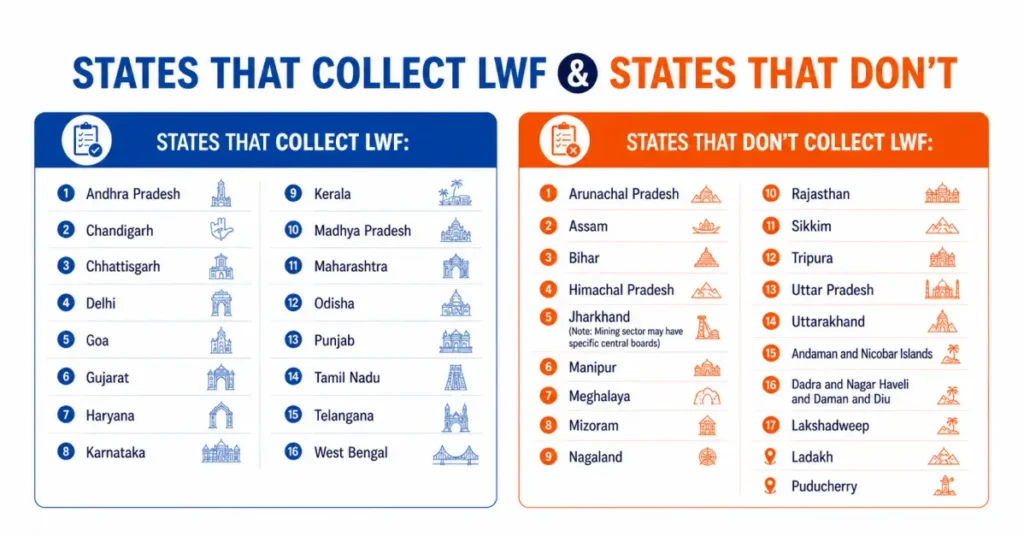
Important Note:
- In cases where the act is applicable, the rules differ greatly.
- In most cases, applicability involves employees operating in factories, shops, and commercial establishments as per the respective Shops and Establishments Act.
What Employers Must Do to Comply with LWF?
Compliance with LWF is not voluntary; it is an obligation for employers as per the law prescribed in the respective states.
Here’s what employers need to manage:
1. Registration
Employers must register under the state-specific Labour Welfare Fund Act. This may involve submitting a registration of a particular form and obtaining a unique LWF number.
2. Deduction from the Employees
A certain amount will be deducted automatically from the salaries of the employees as a payroll process.
3. Employer Contributions
Employers should contribute to the Labour Welfare Fund, which will be more than the amount contributed by the employees.
4. Time-bound Payment
Payment needs to be made at regular intervals of time decided by the authority, i.e., monthly, semiannually, or annually.
5. Return filing
Return filing for the employees’ contribution, employer contribution, and the total contribution to the fund.
6. Record Keeping
Maintain registers, employee details, and receipts for payment to facilitate audits.
7. Payroll Software Usage
Manual management of LWF payments is a confusing task. Use reliable payroll software or HRMS Software to automate the process.
How Does the LWF Scheme Work Across Different States?
The Labour Welfare Fund scheme varies in India from state to state, with each state having its own rates, frequency of payments, and compliance requirements.
Below are examples of how LWF works in key states:
1. Annual Payment Cycle
These states typically deduct the amount in December and require payment by January 15th or 31st.
| State | Employee Share | Employer Share | Payment Frequency |
| Andhra Pradesh | ₹30 | ₹70 | Annual |
| Telangana | ₹2 | ₹5 | Annual |
| Karnataka | ₹50 | ₹100 | Annual (Effective 2025) |
| Tamil Nadu | ₹20 | ₹40 | Annual |
2. Half-Yearly Payment Cycle
These states generally deduct contributions in June and December.
| State | Employee Share | Employer Share | Payment Frequency |
| Maharashtra | ₹25 | ₹75 | Half-Yearly (Jun & Dec) |
| Gujarat | ₹6 | ₹12 | Half-Yearly (Jun & Dec) |
| Madhya Pradesh | ₹10 | ₹30 | Half-Yearly (Jun & Dec) |
| West Bengal | ₹3 | ₹30 | Half-Yearly (Jun & Dec) |
| Chhattisgarh | ₹15 | ₹45 | Half-Yearly (Jun & Dec) |
| Delhi | ₹0.75 | ₹2.25 | Half-Yearly (Jun & Dec) |
| Goa | ₹60 | ₹180 | Half-Yearly (Jun & Dec) |
3. Monthly Payment Cycle
A few states follow a monthly deduction and remittance schedule.
| State | Employee Share | Employer Share | Payment Frequency |
| Haryana | 0.2% of salary (max ₹31) | 2x Employee Share (max ₹62) | Monthly |
| Punjab | ₹5 | ₹20 | Monthly |
| Kerala | ₹45 | ₹45 | Monthly (Standard) |
Step-by-Step Guide to Registering for the LWF Scheme
Getting registered under LWF is straightforward if you follow the right process:
Step 1: Visit State Portal
The first step involves going to the official Labour Welfare Fund (LWF) website portal of your state. Every state has its own unique portal from where you can collect relevant information regarding LWF policy, registration, and compliance requirements.
Step 2: Fill Registration Form
On the website, once you access the registration page, you have to complete the registration form. You will be asked various questions, including the name of the organization, the nature of the organization, the number of employees, and other financial details. It is important that your answers to these questions are accurate.
Step 3: Submit Documents
When the form has been filled, you then have to proceed to upload the relevant documents, which are:
- Business PAN Card
- Business Incorporation or Registration certificate
- Proof of address of the organization
- Details of employees
Step 4: Obtain Registration Number
The final step involves receiving your own LWF registration number once your application gets reviewed and approved. This registration number is important since it will be used for all future purposes, such as contributing funds and making returns in accordance with the requirements set out under the Labour Welfare Fund Act.
Step 5: Set Up Payroll Deduction
The last step involves incorporating LWF deductions in the payroll system. By doing so, the calculation process will be automated. Therefore, it would help eliminate any chances of making mistakes during manual processing.
Step 6: Track Compliance
Lastly, always make sure that you comply with all the requirements for paying taxes on time, submitting returns, etc. Maintaining compliance is important as failure to do so may incur legal penalties. An HRMS or payroll software would make it easy for you to maintain compliance.
How to Make LWF Payments Online?
With digital transformation, most states now allow online LWF payment, making compliance easier.
Here’s how it typically works:
1. Log in to State Portal
Log in to the official Labour Welfare Fund portal of the state through your registered user account. Ensure that you use your correct login credentials to make payments hassle-free.
2. Choose Payment Mode
Following login to your portal, choose the option of Labour Welfare Fund payment mode from the services menu on the portal dashboard. This enables you to begin and complete your LWF contribution process.
3. Fill Details
Fill in all mandatory details such as the number of employees, total payment amount, and the relevant period of LWF contribution. Correct filling of details enables accurate computation of LWF deductions.
4. Challan Generation
The next step involves the automatic generation of the challan on submission of the payment details by the portal itself. The generated challan helps complete the LWF contribution process.
5. Payment Transaction
Next, proceed with making the payment of your dues through various digital means such as net banking, UPI, or any other payment method.
6. Receipt Downloading
Finally, after successful payment, you can download the receipt from the portal page for future reference.
What are the Benefits of LWF for Employees and Employers?
Benefits for Employees
1. Access to Welfare Schemes
The employees get access to different welfare schemes that are made possible through the LWF, such as health care facilities, education programs, and housing schemes, among others.
2. Financial Support
Through the LWF, the employees receive financial support when they face emergency situations. Financial support is provided so that the employees do not struggle with any unforeseen expenditure.
3. Skill Development
With the help of the welfare fund, the employees can take part in various training schemes to develop themselves further and become productive.
4. Recreational Facilities
There are recreational programs that are facilitated through the welfare fund so that the employees can have a good work-life balance.
5. Social Security
The fund provides social security to the employees by creating a system of social security, which builds trust among the employees.
Benefits for Employers
1. Legal Compliance
The compliance of an organization with the Labour Welfare Fund Act makes sure that there are no penalties, issues of compliance, or legal issues for the organization in its functioning.
2. Employee Satisfaction
Through funding of various welfare programs through LWF, employees become satisfied as they feel valued and looked after, leading to increased efficiency and better retention rates.
3. Better Payroll Management
LWF can make payroll management of employees much smoother and more efficient with structured deductions, as there will be clarity about the salaries of employees.
4. Corporate Reputation
An organization contributes towards the welfare of its employees, reflecting positively on its image as a responsible organization in the industry.
5. Simplified Processes
Use of modern payroll or HRMS can make the process of filing and contribution of LWF easy for the organization.
Conclusion
The Labour Welfare Fund could look like a minor expense when you deduct it from your payroll, but it is far more significant than what meets the eye. It is an attempt by the government to ensure that employees are happy while helping companies adhere to labour laws.
As a company, particularly one that operates in several states, calculating and paying for the LWF manually might pose certain challenges. This is where the power of solutions such as Savvy HRMS comes in, simplifying your payroll process, handling deductions automatically, making payments on time, and keeping your business compliant.
With the proper system in place, complying with the LWF is no longer a hassle.
Looking to simplify your LWF compliance and payroll management? Try Savvy HRMS today and take control of your workforce operations effortlessly.
Book a Demo TodayFAQ
1. What are the benefits of using LWF?
LWF (Labour Welfare Fund) helps provide welfare benefits to employees, such as healthcare, education support, housing assistance, and social security programs managed by the government.
2. What does LWF mean in a salary slip?
In a salary slip, LWF stands for Labour Welfare Fund. It is a small deduction made from the employee’s salary as a contribution toward employee welfare schemes.
3. Is LWF a mandatory deduction?
Yes, LWF is mandatory in some states of India where the Labour Welfare Fund Act is applicable. Both employers and employees contribute according to state rules.
4. What is the full form of LWP?
LWP stands for Leave Without Pay. It refers to leave taken by an employee when no paid leave balance is available, resulting in a salary deduction for those days.