


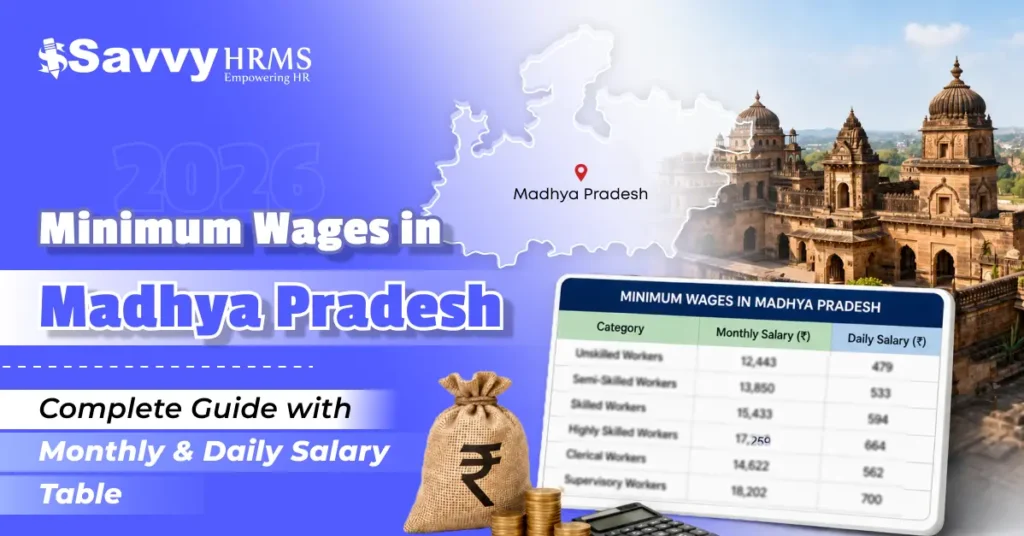

Have you ever wondered about the latest minimum wages in Madhya Pradesh? “How much is it, and what does it mean?” As a business owner, HR manager, or employee of the region, you have most likely asked yourself that question.
You are not alone.
The topic of minimum wages in Madhya Pradesh can be confusing, with constant revisions, changes to VDA, and variations in employee types. However, this blog will provide a comprehensive yet straightforward explanation to help you understand the concept.
In this blog post, we will discuss the minimum wages in Madhya Pradesh 2026, salaries, sector-wise wages, and more.
What is the minimum wage in Madhya Pradesh?
Minimum wage is the minimum amount of salary that a worker can receive for their work. It is fixed by the state government and reviewed every year, depending on inflation and the cost of living.
In the state of Madhya Pradesh, minimum wages are reviewed twice in a year, usually in the months of April and October, by adding the Variable Dearness Allowance (VDA).
The most recent minimum wages in Madhya Pradesh 2026 came into effect on:
From 1 April 2026 to 30 September 2026
These wages are applicable to 67 scheduled employments in Madhya Pradesh and are classified according to skills.
Current Minimum Wages in Madhya Pradesh (2026)
Let’s start with the basics.
The current wage structure includes:
- Basic Wage
- VDA (Variable Dearness Allowance)
- Total Monthly Wage
| Skill Category | Basic Per Day (₹) | Basic Per Month (₹) | VDA Per Day (₹) | VDA Per Month (₹) | Total Monthly (₹) |
| Unskilled | 368.27 | 9,575 | 109.62 | 2,850 | 12,425 |
| Semi-Skilled | 406.58 | 10,571 | 109.62 | 2,850 | 13,421 |
| Skilled | 472.85 | 12,294 | 109.62 | 2,850 | 15,144 |
| Highly Skilled | 535.35 | 13,919 | 109.62 | 2,850 | 16,769 |
Note: These rates are calculated using a 26-day working month
Key Highlights
- Fixed VDA ₹2,850 per month for all types of skill workers
- ₹275 increase in monthly salary compared to the last time period
- No distinction between rural/urban areas, uniform state-wide salary system
Industry-wise Minimum Wages in Madhya Pradesh
While the general schedule applies to most sectors, some industries have special wage structures.
Let’s take a closer look.
1. Printing Press Industry
| Worker Category | Basic Pay Per Day (₹) | Basic Pay Per Month (₹) | Variable DA Per Day (₹) | Variable DA Per Month (₹) | Total Wage Per Day (₹) | Total Wage Per Month (₹) |
| Mazdoor (Unskilled) | ₹368.27 | ₹9,575 | ₹109.62 | ₹2,850 | ₹477.89 | ₹12,425 |
| Grade One (Clerk/Mistry etc.) | ₹472.85 | ₹12,294 | ₹109.62 | ₹2,850 | ₹582.47 | ₹15,144 |
| Grade Two | ₹406.57 | ₹10,571 | ₹109.62 | ₹2,850 | ₹516.20 | ₹13,421 |
| Highly Skilled (Top Grade) | ₹535.35 | ₹13,919 | ₹109.62 | ₹2,850 | ₹644.97 | ₹16,769 |
| Skilled Category, Grade One | ₹532.93 | ₹13,856 | ₹109.62 | ₹2,850 | ₹642.54 | ₹16,706 |
| Skilled Category, Grade Two | ₹518.19 | ₹13,473 | ₹109.62 | ₹2,850 | ₹627.81 | ₹16,323 |
| Skilled Category, Grade Three | ₹472.85 | ₹12,294 | ₹109.62 | ₹2,850 | ₹582.47 | ₹15,144 |
| Semi Skilled Category, Grade One | ₹472.85 | ₹12,294 | ₹109.62 | ₹2,850 | ₹582.47 | ₹15,144 |
| Semi Skilled Category, Grade Two | ₹406.58 | ₹10,571 | ₹109.62 | ₹2,850 | ₹516.20 | ₹13,421 |
2. Slate & Pencil Manufacturing
| Worker Category | Basic Pay Per Day (₹) | Basic Pay Per Month (₹) | Variable DA Per Day (₹) | Variable DA Per Month(₹) | Total Wage Per Day (₹) | Total Wage Per Month (₹) |
| Mazdoor (Unskilled) | ₹368.27 | ₹9,575 | ₹109.62 | ₹2,850 | ₹477.89 | ₹12,425 |
| Peon, Pateti, Helper, Sweeper | ₹389.65 | ₹10,131 | ₹109.62 | ₹2,850 | ₹499.27 | ₹12,981 |
| Mistry, Typist, Clerk, etc. | ₹472.85 | ₹12,294 | ₹109.62 | ₹2,850 | ₹582.47 | ₹15,144 |
| Salesman, Cashier, etc. | ₹525.12 | ₹13,653 | ₹109.62 | ₹2,850 | ₹634.74 | ₹16,503 |
| Driver | ₹535.35 | ₹13,919 | ₹109.62 | ₹2,850 | ₹644.97 | ₹16,769 |
| Clerk (Senior/Skilled) | ₹555.54 | ₹14,444 | ₹109.62 | ₹2,850 | ₹665.16 | ₹17,294 |
3. Agriculture Workers
| Category | Basic Pay Per Month (₹) | VDA Per Month (₹) | Monthly Wage per Month (₹) | Minimum Wage Per Day (₹) |
| Unskilled | 7,660 | 2,352 | 10,012 | 334 |
Note: Full agricultural categories are not fully available in public data
What Are the Different Skill Categories in Minimum Wages in Madhya Pradesh?
While discussing the minimum wages in Madhya Pradesh, there are several aspects one should pay attention to and remember. However, the classification of workers is one of the most significant elements. What makes it so important? Well, your salary and wage depend on your employment classification, as well as on the one you employ.
State government classifies workers by various skills depending on the nature of work, its complexity, level of expertise, and other factors.
1. Unskilled Workers
This is the least complex category of employees.
As a rule, unskilled workers execute simple actions that don’t require any specific qualifications, professional education, or practical experience. The main feature of their job is repetitiveness.
These workers are engaged in such activities as:
- Labourer (Mazdoor)
- Sweeper
- Helper
- Loader
Though these positions might not seem complicated, their role in everyday activity cannot be miscalculated. According to the latest minimum wages in Madhya Pradesh 2026, unskilled workers have the lowest wage bracket but receive VDA increases.
2. Semi-skilled Workers
Semi-skilled workers can be found at an intermediate level between basic and highly skilled workers.
Such workers need training, familiarity with instruments, and general operational skills. Although these individuals cannot be called masters, they are capable of completing their tasks after learning about them.
Examples of semi-skilled workers include:
- Machine operators (entry-level)
- Drivers (non-commercial)
- Office assistants
- Technicians (entry-level)
This is quite a popular classification in industries such as manufacturing, logistics, and retail.
3. Skilled Workers
Now we will consider highly specialized jobs.
As the name implies, skilled workers have training certificates or substantial experience in the sphere. These specialists need to perform complex duties that require technical skills and decision-making.
Examples of skilled workers are as follows:
- Electricians
- Fitters
- Tailors
- Technicians
- Clerks and typists
As you can see, skilled workers earn more than others and get higher minimum wages in Madhya Pradesh in 2026.
4. Highly Skilled Workers
This is the highest category.
Highly skilled workers are specialists who are able to demonstrate high expertise, supervisory skills, and leadership qualities.
Examples of highly skilled workers include:
- Engineers
- Supervisors
- Senior drivers
- Senior clerical employees
- Technicians (high-level)
These specialists get the highest minimum wages in Madhya Pradesh in 2026.
How Minimum Wages in Madhya Pradesh Are Calculated?
Have you ever asked yourself the question “How is the minimum salary determined?” Then you are not alone. The method used to calculate the minimum wage in Madhya Pradesh can appear complicated at first glance. However, once we understand what components are involved, we will easily figure out how the process works.
Let’s analyze it practically.
Formula:
Here is how minimum wages are calculated in Madhya Pradesh:
| Minimum Wage = Basic Salary + Variable Dearness Allowance (VDA) |
1. Basic Salary
Basic salary is the permanent component of the minimum salary established by the state government. It changes infrequently and is relatively stable over a long period.
2. Variable Dearness Allowance (VDA)
As the name implies, the VDA is a variable part that depends on inflation rates. It is usually adjusted based on the Consumer Price Index (CPI).
- As inflation goes up, VDA increases
- If there are no significant changes in inflation, VDA is kept unchanged
For example, in the latest minimum wages in Madhya Pradesh 2026, VDA has been increased, hence increasing the minimum wages.
3. Computation of Monthly Wages
When both elements are known:
Basic Wage + VDA = Monthly Wages
For example:
If Basic Wage (Per Month) = ₹9,575
VDA (Per Month)= ₹2,850
Monthly Wages = ₹12,425
4. Computation of Daily Wages
The computation of daily wages is based on monthly wages.
In Madhya Pradesh, the computation is made considering:
- 26 working days in a month
Therefore,
Daily Wages = Monthly Wages ÷ 26
In the above example,
₹12,425 ÷ 26 ≈ ₹478 per day
5. Rounding Off
After computing the daily wages, the figure is rounded off to the nearest rupee for easy payment.
6. Sector-Specific Adjustments
Though the formula is generally the same, certain sectors might have:
- Different classification of duties
- Piece-rate system (beedi, agarbatti)
- Specific wages structure
However, in all these cases, the VDA is an important element.
Key Changes in Minimum Wages in Madhya Pradesh 2026
Here’s what changed compared to the previous cycle:
1. Rise in VDA Amount
There has been an increase in the amount of Variable Dearness Allowance, which has risen from ₹2,575 to ₹2,850, thereby increasing it by ₹275 per month.
2. Total Wage Increase
Unskilled to highly skilled workers have had a similar ₹275 increase, with a daily wage hike of about ₹10 – ₹11.
3. Unchanged Basic Pay
The amount of basic pay remains the same; only the VDA amount has seen an increase.
4. Period of Effectiveness
The new wage revision will be effective from 1 April 2026 to 30 September 2026.
5. Increase Based on CPI
The revision has been done considering the increase in the Cost of Living Index (CPI).
6. Uniform Wage Structure
Madhya Pradesh still follows a uniform wage structure throughout the state without distinguishing between urban and rural areas.
What is the Legal Importance of Minimum Wage Compliance?
Let’s face it, compliance with minimum wage requirements cannot be ignored, particularly when adhering to the latest minimum wages in Madhya Pradesh. Regardless of whether you are a small-scale or large-scale business owner, ensuring compliance not only helps you avoid getting into legal trouble but also helps establish a sustainable organization.
The obligations of an employer include the following:
1. Pay at Least the Notified Wages
Each employer is obligated to pay employees at least the notified minimum wages according to their respective skills and industries. Payment of less than the notified minimum wage amounts is considered non-compliance with labour regulations.
2. Maintain Proper Payroll Records
As an employer, you must record the following details in your payroll system:
- Attendance of employees
- Payment of salaries to workers
- Records of wages
Proper record maintenance is very important when labour inspectors conduct inspections and audits on your company.
3. Pay Arrears if Applicable
If wages have been revised, backdated, or if employees have not been paid properly in the past, you must ensure the settlement of any arrears.
What the Government Is Doing
The government is doing many things to make sure that the minimum wage policy in Madhya Pradesh 2026 is implemented:
- Issued arrears circulars to pay previous debts
- Implemented more strict inspections
- Authorized penalties against defaulters
It is clear that the government is paying attention to how companies implement the wage policy, not just stating the requirements.
Consequences of Non-Compliance
If you violate minimum wage laws, you may suffer severe consequences:
1. Legal Penalties
The company could face financial penalties or even legal charges according to the labour law if the employer violates minimum wage standards.
2. Financial Obligations
You will need to:
- Settle outstanding wages
- Provide penalties
- Calculate interest on overdue wages
This could have a major impact on your business finances.
3. Damage to Your Reputation
Non-compliance doesn’t just affect your finances, but it could also damage your reputation. Stakeholders, employees, and clients may all lose confidence in your company.
Why HR & Payroll Automation is Important?
The truth is that running payroll manually in the current business world is no more efficient than it is challenging.
In an age when compliance changes frequently, such as minimum wages in Madhya Pradesh, a slight error can be very harmful, resulting in compliance fines and dissatisfied employees.
And that’s why automation comes into play.
1. Stays Up-to-date with Compliance Laws
Compliance laws, minimum wages, VDA, and labour laws keep changing frequently. Automation will ensure that your payroll system stays up-to-date with minimum wages in Madhya Pradesh.
2. Minimises Mistakes in Payroll Calculations
There are various factors that go into calculating employee pay: basic pay, VDA, and other factors. All these calculations, manually put you at risk of making mistakes.
Here’s how automation helps:
- Ensures accurate calculations
- Determines correct wages
3. Ensures 100% Compliance
Using automatic systems, you will be able to:
- Comply with the minimum wage requirements properly
- Keep the necessary documentation
- Prepare compliance reports immediately
- This helps avoid fines and legal troubles.
4. Minimises Wasted Time and Efforts
Traditional payroll preparation may take many hours, and sometimes even several days, particularly when dealing with a large number of employees.
Automation ensures:
- Faster payroll processing
- Decrease in the administrative load
- Ability to concentrate on strategy
5. Facilitates Record Keeping
Keeping records of registers, attendance, and salary payments is obligatory.
The use of automatic software ensures:
- Digital record keeping
- Easy-to-access documents
- Effortless audit preparation
6. Enhances Employee Satisfaction
If employees get:
- Exact salaries
- Prompt payments
- Detailed explanations
… it improves trust and raises overall employee satisfaction.
How Savvy HRMS Simplifies Minimum Wage Compliance?
If you are fed up with updating wage changes manually, then you should know about Savvy HRMS. With Savvy HRMS, you can get:
- Latest Minimum Wages in Madhya Pradesh 2026
- Payroll Processing, including VDA
- Complete Compliance with 100%
- Instant Generation of Reports
- Reduce Your HR Workload by 80%
Savvy HRMS is a one-stop solution to all these problems.
Conclusion
Minimum wage information in Madhya Pradesh does not need to be confusing.
Here’s how to look at it:
- Pay depends on the skill set of the worker
- Revised every six months
- Includes VDA components
- Applicable throughout the state with some industry-specific differences
As an employer, compliance is about more than preventing penalties; it’s also about maintaining goodwill among your workers.
With software such as Savvy HRMS, complying with minimum wage legislation can be made easier.
Looking for an easy way to comply with the minimum wages in Madhya Pradesh and process payroll?
Book a Demo Today