


Resignation Letter Format: Complete Guide with Examples


-
AuthorAnkit Singh
-
 Last Updated
July 25, 2026
Last Updated
July 25, 2026
-
 Reading Time
13 Mins
Reading Time
13 Mins
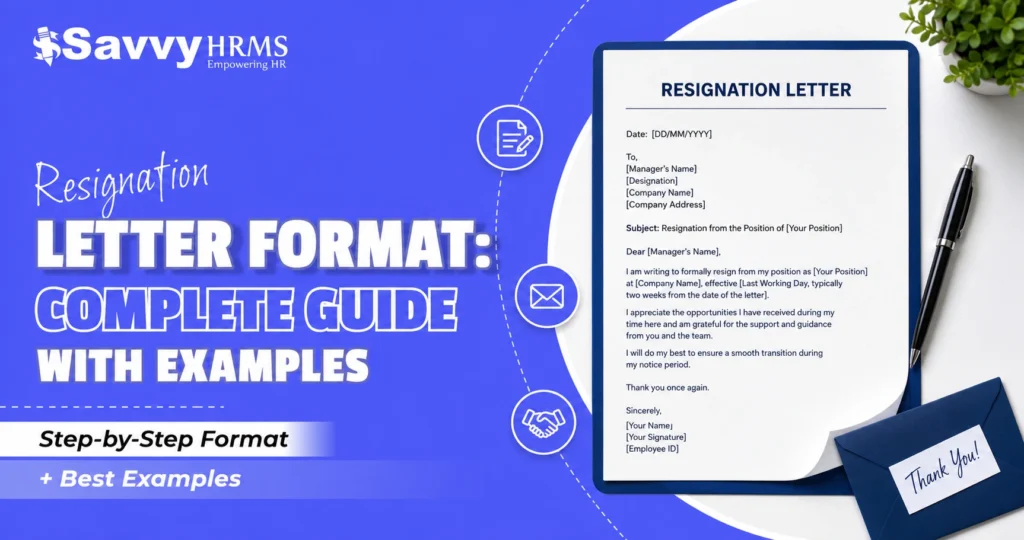
A resignation letter is a formal written notice informing your employer that you are voluntarily leaving your job, stating your last working day and starting your notice period. It should be short – typically five to ten lines – and include your resignation statement, last working day, and a brief thank-you note. This guide walks through the exact format, ready-to-use examples, and the mistakes that most often hold up an employee’s exit.
What Is a Resignation Letter?
A resignation letter is a formal document that notifies your employer of your decision to voluntarily leave your job, states your intended last working day, and officially starts your notice period. It creates a written record that protects both you and your employer during the exit process.
Even if you’ve already told your manager verbally, most companies require a written resignation letter before they process your notice period, full and final settlement, or relieving letter. Without it, HR has no formal trigger to begin the exit workflow.
Definition Box
Resignation letter refers to a written statement, submitted by an employee to an employer, that formally communicates the employee’s intent to end their employment on a specified date.
What Should a Resignation Letter Include?
A complete resignation letter should include the date, recipient details, a subject line, a clear resignation statement, your last working day, an optional brief reason, an offer to help with the transition, and a closing thank-you. Missing any of these can create confusion or delay processing.
- Date – the day you’re submitting the letter
- Recipient details – manager or HR’s name, designation
- Subject line – e.g., “Resignation – [Your Name] – [Designation]”
- Resignation statement – a direct first sentence, no build-up
- Last working day – the specific date on which employment ends, worked out from your notice period.
- Reason (optional) – keep it brief and neutral
- Transition offer – a line offering to help with handover
- Closing – thank-you and signature
Standard Resignation Letter Format
A standard resignation letter follows a set sequence: date, recipient, subject line, opening resignation statement, last working day, brief reason, handover offer, and a closing thank-you – in that exact order. Following this order avoids the most common processing delays.
- Write the date at the top.
- Address your direct manager or HR by name and designation.
- Use a clean subject line stating your resignation.
- State that you are resigning in the very first sentence – don’t lead with pleasantries.
- Mention your exact last working day, calculated from your notice period.
- Add one or two sentences on your reason, if you choose to share one.
- Offer to help with a smooth handover.
- Close with gratitude and your signature.
| Element | Purpose | Required? |
| Date | Anchors the notice period start | Yes |
| Recipient details | Ensures it’s routed correctly | Yes |
| Resignation statement | Makes intent unambiguous | Yes |
| Last working day | Triggers HR’s exit workflow | Yes |
| Reason | Context for HR/manager | Optional |
| Handover offer | Signals professionalism | Recommended |
| Thank-you closing | Preserves the relationship | Recommended |
Resignation Letter Examples for Every Situation
Different exit situations call for a slightly different resignation letter example – a probation exit reads differently from a senior-level resignation, and an immediate resignation needs extra care in how it’s worded. Below are ready-to-use resign resignation letter templates for the most common scenarios.
1. Simple Resignation Letter Example (Standard Notice Period)
Date: [DD/MM/YYYY]
To, [Manager’s Name] [Designation] [Company Name]
Subject: Resignation – [Your Name] – [Your Designation]
Dear [Manager’s Name],
I am writing to formally tender my resignation from my role as [Designation] at [Company Name]. In line with my notice period, my last working day will be [Date].
I’m grateful for the opportunities and support I received during my time here, and I’m happy to assist with a smooth handover before I leave.
Thank you for your understanding.
Sincerely, [Your Name]
2. Resignation Letter with Reason (Career Growth)
Dear [Manager’s Name],
I am resigning from my role as [Designation], effective [Last Working Day], due to a career opportunity better aligned with my long-term goals. It has been a pleasure working with the team, and I’ll ensure a smooth transition of my responsibilities before I leave.
Thank you for the guidance and support during my tenure.
Regards, [Your Name]
3. Resignation Letter for Personal Reasons
Dear [Manager’s Name],
I am writing to formally resign from my position as [Designation], effective [Last Working Day], due to personal reasons. I appreciate the support and opportunities I’ve had during my time at [Company Name] and will do everything possible to ensure a smooth handover.
Thank you for your understanding.
Sincerely, [Your Name]
4. Resignation Letter During Probation Period
Dear [Manager’s Name],
I am writing to inform you of my decision to resign from my position as [Designation], effective [Date], in accordance with the notice period applicable during probation as per my appointment letter.
I appreciate the opportunity to have been part of [Company Name] and am happy to assist with a smooth handover during my remaining time here.
Regards, [Your Name]
Note: Probation notice periods are usually shorter – commonly 7 to 15 days – so always confirm the exact figure in your appointment letter before setting the date.
5. Immediate Resignation Letter (Short or No Notice)
Dear [Manager’s Name],
I am writing to inform you of my resignation from the position of [Designation], effective immediately, due to [brief reason, e.g., an urgent personal situation]. I understand this is shorter than my contractual notice period and am willing to discuss how I can support a smooth transition within the constraints of my availability.
I appreciate your understanding in this matter.
Sincerely, [Your Name]
6. Resignation Letter Email Format
Subject: Resignation – [Your Name] – [Employee ID]
Dear [Manager’s Name],
Please accept this email as formal notification of my resignation from [Company Name], effective [Last Working Day]. I have valued my time here and will ensure all pending work is handed over smoothly before I leave.
Thank you for the opportunity to be part of the team.
Best regards, [Your Name] [Contact Number]
7. Simple One-Line Resignation Statement (for Quick Reference)
If you only need the core sentence to build a letter around, this works as the opening line for almost any resignation letter format:
“I am writing to formally resign from my position as [Designation] at [Company Name], with my last working day being [Date].”
How Short Should a Resignation Letter Be?
A resignation letter should generally stay under 100–150 words, or five to ten lines. A short, clear letter reads as more professional than a long, explanatory one.
Save detailed feedback, reasons, or complaints for the exit interview rather than the letter itself. The letter’s only job is to formally communicate your decision and your last working day – everything else is optional context.
Do You Need to Give a Reason for Resigning?
No, Indian employment norms do not require you to state a reason for resigning, and most professionals keep it brief or omit it entirely. If you do include one, keep it neutral and positive – a new opportunity, career change, or personal reasons are sufficient.
Avoid detailed criticism of the company, colleagues, or management in the letter itself, even if you have legitimate concerns – that feedback belongs in a private conversation or exit interview, not a document that becomes part of your permanent HR record.
Can You Resign by Email in India?
Yes, most Indian companies accept an emailed resignation letter as the official record, though some traditional organizations – including certain PSUs, government bodies, and banks – may still require a signed physical copy in addition to the email.
Check your appointment letter or employee handbook to confirm your company’s specific requirement before assuming email alone is sufficient.
Resignation Letter vs. Relieving Letter
A resignation letter is written by the employee to initiate their exit, while a relieving letter is issued by the employer to confirm that the exit process is complete. They serve opposite ends of the same process and are often confused.
| Aspect | Resignation Letter | Relieving Letter |
| Who writes it | Employee | Employer/HR |
| When | At the start of the exit process | After notice period completion |
| Purpose | Formally communicates intent to leave | Confirms exit and clears dues |
| Required for | Starting notice period | Joining a new employer |
For a full breakdown of what a relieving letter should contain and when it’s issued, see this guide on relieving letter meaning, format, and importance.
How Does Notice Period Affect Your Resignation Letter?
Your resignation letter’s last working day must be calculated from your notice period, as defined in your appointment letter – typically 30 days for junior roles, 60 days for mid-level roles, and up to 90 days for senior or IT roles in India. Stating an incorrect or vague date is one of the most common reasons resignations get bounced back for correction.
- Check your employment contract for the exact notice period before writing the letter.
- If you want to leave earlier than your notice period allows, request early release separately – don’t just state an earlier date and assume it’s approved.
- Some organizations let you offset notice period with unused earned leave; confirm this with HR before assuming it applies.
- Your notice period completion directly affects when your relieving letter and full & final settlement are processed.
Companies using structured separation management software can calculate this last working day automatically once the resignation is logged, reducing the back-and-forth over dates that often happens with manual, email-only resignations. If you’re unsure how to calculate your own date manually, a notice period calculator can work it out from your resignation date and contractual notice period in seconds.
How to Write a Resignation Letter Without Serving Full Notice
When you can’t serve your full notice period, state your intended last working day clearly, briefly explain the constraint, and formally request early release rather than assuming a shorter date will be accepted. Simply writing an earlier date without addressing the shortfall is the most common reason such letters get sent back for revision.
- State your resignation and desired last working day as usual.
- Add a line acknowledging your notice period obligation and requesting early release or notice buyout.
- Offer to complete a compressed but genuine handover in the time available.
- Follow up with HR directly to confirm whether early release is approved and what it means for your settlement.
Keep in mind that leaving early without approval typically results in a notice pay deduction from your full and final settlement, and your relieving letter may be delayed until that’s resolved. If your company uses separation management software, this shortfall is usually calculated automatically once your resignation is logged, so you’ll see the impact on your settlement before your last day rather than being surprised by it afterward.
Resignation Letter Checklist Before You Hit Send
Before submitting your resignation letter, confirm your exact notice period, verify your last working day calculation, check whether your company requires a physical copy in addition to email, and decide whether to include a reason. A quick pre-send check avoids most of the back-and-forth that delays processing.
- [ ] Notice period confirmed from appointment letter or HR policy
- [ ] Last working day calculated correctly (use a notice period calculator if unsure)
- [ ] Addressed to the correct manager and/or HR contact
- [ ] Subject line is clear and professional
- [ ] Reason for leaving (if included) is brief and neutral
- [ ] No criticism of colleagues, management, or company policy
- [ ] Handover offer included
- [ ] Signed copy kept for personal records, even if sent by email
Common Resignation Letter Mistakes to Avoid
The most common resignation letter mistakes are vague last working dates, overly long explanations, negative language about the company, and skipping written confirmation after a verbal resignation. Each of these can delay your exit or affect your professional record.
- Don’t leave the last working day approximate – always give an exact date.
- Don’t write more than a few sentences of explanation; save details for the exit interview.
- Don’t criticize colleagues, management, or company policy in the letter.
- Don’t rely on a verbal resignation alone – always follow up in writing, even if it’s a quick email.
- Don’t forget to address it to the correct person – sending it only to a peer or missing HR can delay processing.
Key Takeaways
- A resignation letter should be short, direct, and specific – stating your resignation, last working day, and little else.
- Always include an exact last working day, calculated correctly from your notice period.
- A reason for leaving is optional – keep it brief and neutral if you include one.
- The resignation letter is only the start of the process – it leads to your notice period, relieving letter, and full & final settlement.
- Email resignations are accepted by most Indian companies, but check your specific policy first.
If you’re calculating your exact last working day, use the notice period calculator to get the date right before you submit your letter.










Ready to turn every resignation into a smooth transition?
Start your journey with Savvy HRMS today and see how the right HRMS can simplify exit formalities from notice to final settlement.
FAQs
What is the difference between a resignation letter and a notice period?
A resignation letter is the document you submit to communicate your decision to leave; the notice period is the duration of time – defined in your contract – that you continue working after submitting it. The letter’s last working day should reflect the end of that notice period.
Is a resignation letter legally required in India?
There’s no single labour law mandating a written resignation letter for private-sector employees, but nearly every company’s HR policy requires one before it will process a formal exit, including notice period tracking and settlement.
Can I withdraw my resignation after submitting the letter?
In many companies, yes – if your resignation hasn’t been formally accepted yet and your employer agrees, you can submit a written withdrawal request. Once accepted or once your last working day has passed, withdrawal is typically not possible.
What happens if I don’t serve my full notice period?
Most companies deduct the equivalent notice pay from your final settlement, and issuing your relieving letter may be delayed until dues are cleared. Some contracts allow a mutually agreed early release if you discuss it with HR in advance.
Should I mention my next employer in the resignation letter?
It’s not necessary and generally not recommended. Keep the letter focused on your departure from the current organization rather than details about where you’re going next.
Can I send my resignation letter directly to the CEO instead of my manager?
In most organizations, resignation letters should go to your direct manager and HR, following the standard reporting structure. Sending it elsewhere first – unless your company is very small – can create confusion in processing.
Is there a difference between a resignation letter and a resignation email?
No – the content and structure are the same; only the delivery format changes. Most companies today treat a resignation email as equally official as a printed and signed letter, provided it’s sent from your registered company or personal email on record.
What if my company doesn’t respond to my resignation letter?
Follow up in writing after a few business days, referencing your original letter and requesting written acknowledgment of your last working day. A documented follow-up protects you if there’s ever a dispute about when your notice period started.