


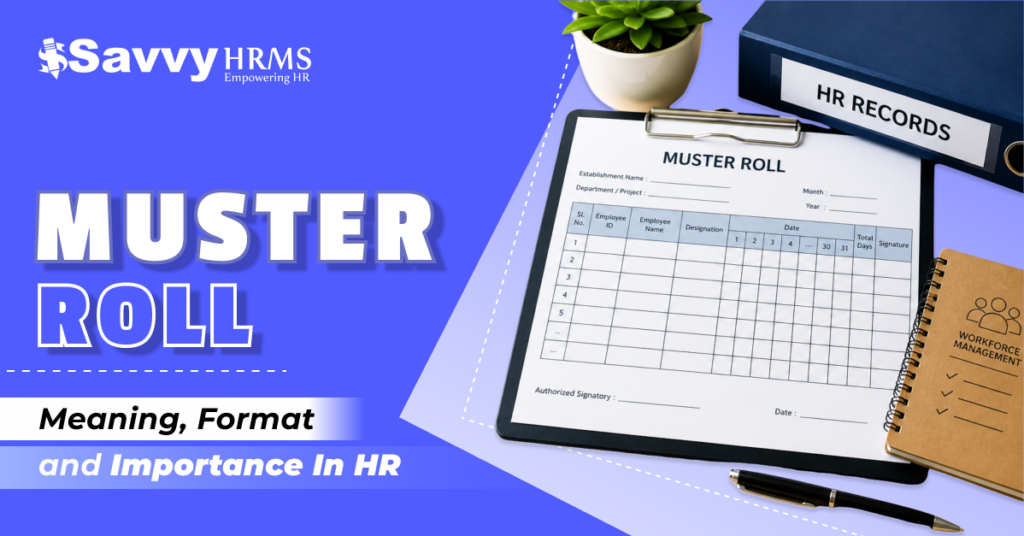
Let’s be honest; most individuals think that muster roll is a term from old military days or simply some other dry HR form filed away in filing cabinets. What these individuals don’t realize is that if you have a workforce that needs managing, whether it’s on a production line, in the construction industry, or just in the mid-size office setting, the muster roll plays an important role in HR management.
The muster roll is like the heart and soul of your employee attendance management system. With muster rolls, you have a way of tracking the time employees have come to work, the time they leave, and the amount of pay each employee should receive based on their performance. Without muster rolls, HR and payroll management will definitely become quite complicated.
This article will explain everything there is to know about muster rolls, including what they do and how businesses can benefit from them. If you are in HR management, or if you run a business and do not understand the importance of the muster roll, this guide is definitely for you.
What Is a Muster Roll?
A muster roll refers to a list that contains information regarding all the individuals employed within a particular factory or work group. It is mainly used for controlling attendance in the organization. The muster roll operates as an attendance register for the employees within the workplace.
To put it simply, it is similar to the register that you have in schools for recording your attendance, but for adult workers, and with many more strings attached to it.
The history of the muster roll dates back several centuries. The muster roll was initially developed within the military and coastal fields to keep track of every single individual present within the boat or army. The process has gradually developed over time such that the muster roll can now be seen within industrial, construction, and manufacturing environments.
Muster roll refers to a formal administrative register that is used in recording the attendance, presence, and duties performed by individuals within a particular worksite. The Muster roll differs significantly from conventional attendance registers since they act as a legally binding document linking the attendance of an individual to their pay rate.
What Are the Benefits of a Muster Roll?
You may wonder: With all the technologies that have been introduced in recent times, why does muster roll still remain relevant? The answer to this question can be provided by pointing out the following factors:
1. Reliable Monitoring Of Attendance
A muster roll enables an employer to maintain a consistent record of attendance on a daily basis. This allows an organization to achieve effective attendance monitoring and reduce the problem of absenteeism among employees.
2. Easy Payroll Calculation
Maybe the greatest advantage of a properly maintained muster roll is its usefulness in payroll calculation. By keeping a detailed record of hours worked by an individual worker, his or her overtime work, and the leave taken, any confusion about wage calculation is easily eliminated.
3. Stronger Employee Accountability
With a record maintained of the presence of employees in the company every day, employees usually tend to show up on time and be responsible for their actions. A muster roll ensures accountability without necessarily excessive employees.
4. Legal Compliance Under various labour laws in India
There are different labor laws that govern the operations of companies in India. The Factories Act and the Minimum Wages Act require all businesses to maintain a muster roll. This ensures that your company complies with labor laws, tax laws, PF policies, and other regulations.
5. Fraud Prevention
A muster roll is signed by employees using their signatures, thumb impressions, or fingerprints. Therefore, it becomes difficult for someone to create signatures and claim attendance or wages for services they did not perform.
6. Quick Dispute Resolution
In case there are any issues regarding the payment of wages or the recording of attendance, a muster roll will be the first document that you will use to provide proof to the employee.
Why Is Muster Roll Important for HR?
The HR department has a lot of work to do. The muster roll, although fine, plays an important role in almost all key HR functions. Here’s how it should be given due consideration:
1. Precision in payroll accounting
Correct attendance records are necessary for proper payroll management. With an accurate muster roll, there are no doubts about employee working hours, overtime calculation, and salaries; everything is clear to both the employee and the manager.
2. Compliance and preparation for inspections
A correctly filled-out muster roll is the first thing requested from any business undergoing inspection. This document provides evidence of compliance with the Minimum Wages Act, the Factories Act, and Contract Labour provisions concerning work hours and compensation.
3. Improved workforce planning
With an up-to-date record of the current staffing on any particular day, workforce management becomes simpler. It is much easier to schedule shifts and allocate resources when knowing the exact availability of personnel.
4. Effective analysis of work performance
Apart from just monitoring attendance, the muster roll allows HR to track work patterns such as overtime work, absenteeism, and availability ratios prior to performance evaluations.
How to Fill a Muster Roll?
Filling a muster roll doesn’t need to be complicated, but it does need to be consistent and accurate. Here’s a straightforward process:
Step 1: Set up the register
To begin with, provide essential information about the factory or office along with the duration covered by the attendance register.
Step 2: List all employees
Mention the names of all the employees together with their designations, departments, and employee IDs at the top of the register.
Step 3: Record daily attendance
Mark the attendance of all workers on every working day either as Present (P), Absent (A), or Half Day (H). You should mention the time of attendance and departure when required.
Step 4: Log hours worked
Note down the number of hours worked each day, as well as the overtime hours worked, if any.
Step 5: Note leave and holidays
Take into account any paid leave, casual leave, or LOP incidents in respect of individual employees.
Step 6: Add wage particulars
State the daily wage rate, the days worked in total, and total wages due. Get signatures and thumb impressions of both employees and their superiors to prevent any wage fraud.
Step 7: Verify and sign off
HR managers and supervisors need to authenticate the attendance register periodically.
What Are the Contents of a Muster Roll?
The muster roll format is not just limited to recording the names and dates. It should contain all the necessary information that confirms the attendance and fair compensation of workers.
Below are some of the components that make up a standard and legal muster roll:
- Employee Details: Employee’s full name, parent or spouse name, designation, and department
- Date of Joining and Working Dates: Period for which the roll is prepared
- Daily Attendance Status: Present, absent, or half day
- Arrival and Departure Times: Actual time at which the employee reports for duty and leaves
- Working Hours: Working hours in a day, including any overtime work
- Leave Details: Paid leave, casual leave, public holiday, and LOP
- Salary and Wage Details: Wage per day and total payable, if any
- Verification: Signature or thumbprint from both the employee and supervising authority
Legally, it is mandatory for all employers to prepare a muster roll containing the salary or wages details of employees. Missing out on any of the above information might not only be a poor HR practice but can also land you in legal trouble.
How to View and Manage Muster Roll Attendance?
The conventional manual system of maintaining a muster roll works; however, this is not without its problems, such as lost paperwork, inaccuracies in manual processing, and lots of time being spent cross-checking spreadsheets while doing payroll calculations.
That’s where modern HRMS (Human Resource Management Systems) step in and make life significantly easier.
By using biometric identification, digital muster rolls take care of all the issues involved by automatically recording attendance and eliminating the issue of proxy entries. In the case of remotely located projects, the use of GPS geotagging in mobile apps enables workers to only check into the location when they physically report to work.
For payroll purposes, this system automatically calculates payable days, overtime, and deductions based on the attendance records and feeds the information into the payroll system.
Some effective ways to maintain an efficient muster roll system include the following:
- Ensure that attendance is properly recorded and verified daily by supervisors
- Perform periodic audits of the register to find any discrepancies and fix them
- Update the register immediately by approving leaves and overtime periods
- Always ensure transparency about how attendance is maintained
What is the difference between a muster roll and an attendance register?
It is one of the most frequently asked questions by HR personnel, and for good reason, because at first glance, there does not appear to be much difference between the two documents.
The distinction lies in the fact that the attendance sheet is usually utilized in office settings to only indicate whether or not an employee attended work on any particular day. The muster roll, on the other hand, is much more thorough and takes into account various factors, including daily earnings, number of hours worked, overtime, vacation, and wage specifics, particularly in cases where workers are paid on a daily basis.
Here’s a quick comparison to make it clearer:
| Feature | Muster Roll | Attendance Register |
| Primary Use | Factories, construction, worksites | Office environments |
| Wage Details | Included | Not typically included |
| Legal Mandate | Required under labour laws | General practice |
| Scope | Attendance + pay + overtime + leave | Attendance only |
| Workers Covered | Daily wage, contract, factory workers | Regular salaried employees |
Think of the muster roll as the more powerful, legally backed version of your regular employee attendance register. It does everything an attendance register does, and then some.
Conclusion
The muster roll is an HR tool that gets insufficient recognition for its significance and usefulness in various processes. The attendance tracking, payroll management, and workforce management are some of the areas where the muster roll plays a significant role in ensuring efficiency.
No matter whether you run a construction site with various contractual workers or a mid-sized manufacturing unit, ensuring a strong muster roll process would help you avoid compliance penalties, payroll issues, and the hassle of managing unaccounted employee absences.
If you are using the traditional method of managing muster rolls, now is the time to switch to an advanced solution that would save you the effort and time.
Savvy HRMS makes muster roll management easy, quick, and efficient. You can automate attendance tracking, workforce monitoring, payroll management, and compliance with the help of the powerful HRMS software, which offers comprehensive muster roll management capabilities.
Take control of your workforce with effortless muster roll management, simplify attendance, stay compliant, and boost productivity today
Try Savvy HRMS todayFAQ
1. What is a muster roll?
A muster roll is a document or register used to record the attendance of employees or workers at a workplace on a daily basis. It generally includes details like:
– Employee name
– Employee ID
– Date
– Attendance status (Present/Absent/Leave)
– Signature or thumb impression
It acts as official proof that an employee was present on a specific day.
2. What is the muster roll used for?
A muster roll is used for various administrative and compliance purposes, such as:
– Tracking the attendance of employees or laborers
– Calculating wages or salaries, especially for daily wage workers
– Ensuring labor law compliance (common in construction/government projects)
– Maintaining workforce records for audits and inspections
– Monitoring workforce productivity and deployment
In many industries (like construction or manufacturing), it’s a legally required document.
3. What is a muster roll in HR?
In HR, a muster roll is part of the attendance management system used to:
– Maintain daily attendance records
– Support payroll processing
– Track leave and absenteeism
– Ensure statutory compliance with labor laws
Modern HR systems often maintain digital muster rolls instead of physical registers, integrating them with payroll and employee databases.
4. How to create a muster roll?
You can create a muster roll either manually (Excel/register) or digitally (HR software). Here’s a simple step-by-step process:
Step-by-step:
– Create a header section
– Add employee details columns
– Add attendance columns
– Include summary columns
– Add authentication fields
– Optional (for compliance)
5. How to Check Muster Roll?
Go to Attendance → Reports → Muster Roll in your HRMS portal. Select the employee, department, and month/date range, then click View or Generate to check attendance details, leaves, holidays, and working days.