

Strategic Management Meaning: A Complete Guide to Building a Successful Business Strategy


-
AuthorRuchika Rajput
-
 Last Updated
July 29, 2026
Last Updated
July 29, 2026
-
 Reading Time
10 Mins
Reading Time
10 Mins
Every successful organization has one thing in common: a clear plan for where it wants to go and how it intends to get there. Businesses that grow consistently do not rely on luck; they rely on strategic thinking, careful planning, and continuous improvement.
Understanding the strategic management meaning is essential for business leaders, managers, and HR professionals. Strategic management helps organizations identify opportunities, overcome challenges, and align employees with long-term business objectives. Whether a company wants to expand into new markets, improve productivity, or increase profitability, strategic management provides the framework to make those goals achievable.
Unlike day-to-day management, strategic management focuses on the bigger picture. It allows organizations to anticipate market changes, allocate resources efficiently, and remain competitive in a rapidly evolving business environment.
This guide explains the strategic management meaning, its importance, components, benefits, approaches, examples, and how modern HR technology can help businesses execute their strategies more effectively.
What Is Strategic Management?
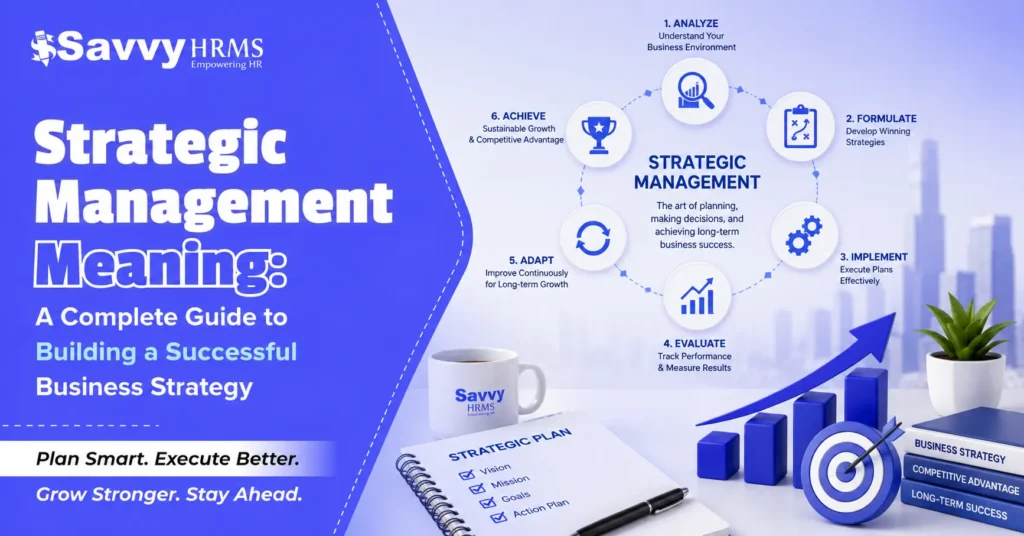
Strategic management is the process of planning, implementing, monitoring, and evaluating an organization’s long-term goals and objectives. It involves analyzing internal strengths and weaknesses while understanding external opportunities and threats.
The purpose of strategic management is to ensure that every department, employee, and business activity contributes to the company’s overall mission.
At its core, strategic management answers three fundamental questions:
- Where is the organization today?
- Where does it want to be in the future?
- How will it achieve its goals?
Organizations that adopt strategic management are often more adaptable, innovative, and better prepared for uncertainty. Rather than reacting to changes, they proactively create plans that position them for long-term success.
Strategic Management Meaning
The term strategic management meaning refers to the continuous process of developing and executing strategies that help organizations achieve sustainable growth and maintain a competitive advantage.
Strategic management combines leadership, planning, resource allocation, and performance measurement into a single framework. It ensures that businesses remain focused on their objectives while adapting to changing market conditions.
Strategic management typically involves:
- Defining a vision and mission.
- Setting short-term and long-term goals.
- Conducting market and competitor analysis.
- Developing actionable strategies.
- Implementing plans effectively.
- Measuring results and making improvements.
Businesses that understand the strategic management meaning are better equipped to make informed decisions and achieve measurable outcomes.
Why Strategic Management Matters in Business
Strategic management is important because it provides direction and helps organizations make decisions that support their long-term objectives.
1. Helps Set Clear Goals
Strategic management helps organizations establish clear and measurable goals. It ensures employees understand business priorities and work toward shared objectives, improving focus, productivity, and overall organizational performance across every department.
2. Improves Decision-Making
Strategic management provides leaders with valuable insights, market data, and performance metrics. This enables them to make informed decisions, minimize risks, and respond effectively to changing business conditions while maintaining long-term organizational success.
3. Creates a Competitive Advantage
Businesses that implement strategic management can identify opportunities before competitors. By adapting quickly to market trends and customer demands, organizations strengthen their market position and build a sustainable competitive advantage over time.
4. Encourages Long-Term Thinking
Strategic management encourages organizations to look beyond short-term achievements. It helps leaders plan for future growth, prepare for challenges, and create sustainable strategies that support business stability and long-term success.
5. Improves Organizational Alignment
Strategic management aligns teams, departments, and business functions with organizational objectives. This ensures everyone works toward common goals, improves collaboration, enhances communication, and increases efficiency throughout the organization.
Key Components of Strategic Management
Strategic management consists of several interconnected components that guide organizations from planning to execution.
1. Environmental Scanning
Environmental scanning involves analyzing internal and external factors that impact business performance.
Organizations evaluate:
- Market trends
- Customer behavior
- Competitor activities
- Economic conditions
- Technological developments
- Government regulations
Tools such as SWOT analysis and PESTLE analysis are commonly used to identify opportunities and potential risks.
2. Strategy Formulation
After gathering information, businesses develop strategies that align with their objectives.
Examples include:
- Expanding into new markets
- Launching new products
- Improving employee productivity
- Enhancing customer experience
- Reducing operational costs
Effective strategy formulation ensures that organizations have a clear roadmap for achieving success.
3. Strategy Implementation
A strategy is only valuable if it is implemented correctly. This phase involves assigning responsibilities, allocating budgets, setting timelines, and communicating expectations.
Successful implementation requires:
- Strong leadership
- Employee engagement
- Adequate resources
- Regular communication
- Continuous monitoring
Organizations that struggle with execution often fail to achieve their strategic goals despite having excellent plans.
4. Strategy Evaluation
Strategic management is an ongoing process. Businesses must continuously evaluate their performance to determine whether their strategies are delivering the desired results.
Common evaluation metrics include:
- Revenue growth
- Customer satisfaction
- Employee performance
- Productivity levels
- Market share
- Return on investment (ROI)
Regular evaluations help organizations identify areas for improvement and make timely adjustments.
Benefits of Strategic Management
Strategic management offers numerous benefits that contribute to organizational success.
1. Improved Business Performance
Strategic management improves overall business performance by providing a clear direction and measurable objectives. Organizations can monitor progress effectively, identify improvement areas, and ensure that every effort contributes to achieving long-term business goals.
2. Better Resource Allocation
Strategic management helps businesses allocate financial, human, and technological resources more efficiently. Proper resource planning minimizes waste, improves productivity, and ensures that investments are directed toward activities that generate the greatest value.
3. Increased Employee Engagement
Employees are more engaged when they understand their responsibilities and how their work supports organizational objectives. Strategic management promotes transparency, accountability, and collaboration, creating a motivated workforce committed to achieving business success.
4. Enhanced Risk Management
Strategic management enables organizations to identify potential risks before they become major challenges. Businesses can develop contingency plans, reduce uncertainties, and respond proactively to changes in the market, ensuring greater stability and resilience.
5. Greater Operational Efficiency
Organizations can streamline processes and eliminate inefficiencies through strategic management. By improving coordination between teams and optimizing workflows, businesses can increase productivity, reduce costs, and achieve better results with available resources.
6. Sustainable Growth
Strategic management focuses on long-term success rather than short-term gains. It helps organizations build sustainable growth strategies that support expansion, strengthen market presence, and ensure continued profitability in an increasingly competitive business environment.
7. Improved Innovation
Strategic management encourages organizations to embrace new ideas, technologies, and business models. By fostering a culture of innovation, businesses can develop creative solutions, improve customer experiences, and maintain a strong position within their industry.
Types and Approaches of Strategic Management
Organizations use different approaches depending on their size, industry, and business objectives.
1. Prescriptive Approach
The prescriptive approach focuses on careful planning before implementation. Organizations establish clear strategies and follow a structured process to achieve their goals.
This approach is ideal for industries with predictable environments, such as manufacturing and logistics.
2. Emergent Approach
The emergent approach allows strategies to evolve. Businesses adapt their plans based on changing market conditions and customer needs.
Startups and technology companies often prefer this approach because it provides flexibility.
3. Top-Down Approach
In a top-down approach, senior leadership develops strategies and communicates them throughout the organization.
Benefits include:
- Consistent decision-making
- Clear accountability
- Strong organizational alignment
However, it may limit employee participation in the planning process.
4. Bottom-Up Approach
The bottom-up approach encourages employees to contribute ideas and recommendations.
Advantages include:
- Increased innovation
- Higher employee engagement
- Practical insights from frontline teams
Many modern organizations combine top-down and bottom-up strategies to achieve better results.
5. Scenario Planning
Scenario planning involves preparing for multiple future possibilities.
Businesses create plans for situations such as:
- Economic downturns
- Market disruptions
- Technological changes
- Supply chain issues
- Regulatory changes
This approach improves organizational resilience and preparedness.
Real-World Examples of Strategic Management
Several organizations have demonstrated the effectiveness of strategic management.
1. IndiaMART
IndiaMART leveraged Savvy HRMS to streamline HR operations, improve attendance management, and support its growing workforce, demonstrating how strategic technology adoption drives efficiency, scalability, and long-term business success.
For more information, visit: IndiaMART
2. Haldiram Foods International Pvt. Ltd.
Haldiram implemented Savvy HRMS to centralize attendance management for over 10,000 employees, automate payroll processes, and improve workforce visibility across multiple locations, enhancing operational efficiency and employee experience.
For more information, visit: Haldiram Foods International Pvt. Ltd.
3. Kajaria Ceramics
Kajaria Ceramics used Savvy HRMS to centralize workforce management across multiple locations, streamline leave and attendance processes, and improve visibility for over 4,000 employees, supporting efficient and scalable HR operations.
For more information, visit: Kajaria Ceramics
Liberty Shoes
Liberty Shoes implemented Savvy HRMS to automate SAP-integrated payroll across 12+ locations, improving payroll accuracy, consistency, and operational efficiency for its workforce of more than 4,000 employees.
For more information, visit: Liberty Shoes
These examples illustrate how strategic management can drive business transformation and long-term success.
Role of Human Resources in Strategic Management
Human Resources plays a critical role in strategic management by ensuring that people and business objectives remain aligned.
HR responsibilities include:
- Talent acquisition
- Employee development
- Performance management
- Workforce planning
- Succession planning
- Employee engagement
Organizations cannot achieve strategic goals without a skilled and motivated workforce.
Modern HR departments are increasingly using technology to improve efficiency and support strategic initiatives.
How Savvy HRMS Supports Strategic Management
Technology has become an essential part of strategic management, particularly in workforce planning and employee management.
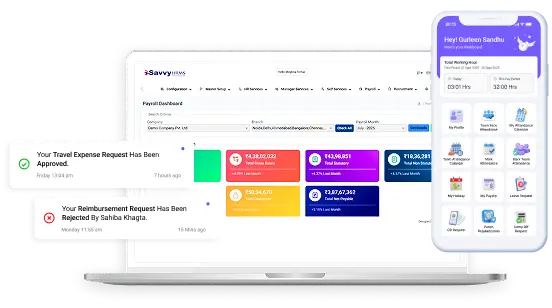
Businesses can use Savvy HRMS to streamline HR operations and improve organizational efficiency.
Savvy HRMS offers solutions that support strategic initiatives, including:
- Payroll management
- Attendance tracking
- Performance management
- Leave management
- Employee self-service
- Analytics and reporting
Organizations looking to automate payroll processes can explore Payroll Software by Savvy HRMS.
Companies focused on employee productivity and goal alignment can benefit from the Performance Management System.
Managing employee leave becomes simpler with the Leave Management System.
Businesses can also improve workforce visibility using the Attendance Management System.
By integrating HR technology into strategic planning, organizations can improve decision-making and achieve better business outcomes.
Best Practices for Implementing Strategic Management
Organizations can improve their strategic management efforts by following these best practices:
- Define measurable objectives.
- Communicate goals clearly.
- Involve employees in the planning process.
- Review strategies regularly.
- Monitor performance metrics.
- Invest in employee training.
- Embrace technology and automation.
- Stay adaptable to change.
Consistency and continuous improvement are essential for successful strategic management.
Common Challenges in Strategic Management
Despite its benefits, organizations often face challenges when implementing strategic management.
1. Lack of Clear Vision
Organizations without a clear vision often struggle to set priorities and achieve long-term goals. Employees may become confused about expectations, leading to inconsistent efforts, reduced productivity, and difficulty maintaining alignment across teams and departments.
2. Poor Communication
Poor communication can create misunderstandings and hinder strategic execution. When goals, responsibilities, and expectations are not communicated effectively, employees may feel disconnected, resulting in lower engagement and reduced organizational efficiency.
3. Resistance to Change
Employees may resist strategic initiatives when they are unfamiliar with new processes or technologies. Organizations must encourage open communication, provide adequate training, and involve employees in decision-making to ensure smoother transitions and greater acceptance.
4. Insufficient Resources
Limited budgets, outdated technology, and workforce shortages can significantly impact strategic implementation. Businesses need to allocate resources wisely and prioritize investments that support their long-term objectives and overall organizational success.
5. Weak Performance Tracking
Without proper performance tracking, organizations cannot accurately measure progress or identify areas for improvement. Regular monitoring of key performance indicators (KPIs) helps businesses evaluate strategies and make informed decisions for continuous growth.
Addressing these challenges requires strong leadership, effective communication, and a commitment to continuous improvement.
Conclusion
Understanding the strategic management meaning is essential for organizations that want to achieve long-term success. Strategic management provides a structured approach to planning, execution, and performance improvement while ensuring that every business function contributes to shared goals.
Organizations that invest in strategic management are better equipped to navigate challenges, seize opportunities, and remain competitive. By combining effective strategies with modern HR technology solutions like Savvy HRMS, businesses can improve operational efficiency, enhance employee performance, and create a strong foundation for sustainable growth.
Strategic management is not simply a business practice; it is a continuous journey that helps organizations adapt, innovate, and succeed in an ever-changing world.









Ready to turn your business strategy into measurable results?
Explore Savvy HRMS and empower your workforce with smarter HR, payroll, and performance management solutions.