

Pension Schemes in India: Types, Benefits, Eligibility and Contributions



-
AuthorAmit Kumar Jha
-
 Last Updated
November 28, 2026
-
 Reading Time
22 Mins
Summary
- Pension schemes in India help individuals to build financial security and receive income after retirement.
- The major pension schemes include Employees’ Pension Scheme (EPS), National Pension System (NPS), Unified Pension Scheme (UPS), Old Pension Scheme (OPS) and Atal Pension Yojana (APY).
- Each scheme has different eligibility criteria, contribution requirements, pension calculations and withdrawal rules.
- EPS provides pension benefits to eligible EPF members, while NPS helps individuals to build a market-linked retirement corpus.
- UPS offers an assured pension payout to eligible Central Government employees, whereas OPS follows a defined-benefit structure.
- APY provides eligible subscribers with a guaranteed monthly pension ranging from ₹1,000 to ₹5,000 after the age of 60.
- Pension schemes offer benefits such as retirement income, long-term savings, family financial protection and applicable tax benefits.
- Employers and HR teams must manage eligible employee records, pension contributions, payroll deductions and related compliance requirements.
Retirement planning is something most people think about, but understanding where to start can be confusing. With different pension options available in India, employees often have questions about which schemes they can join, how much they need to contribute and what benefits they can expect after retirement.
The Indian pension system includes several schemes for different groups, from private-sector employees and government staff to self-employed individuals and workers in the unorganised sector. Popular options include the Employees’ Pension Scheme (EPS), National Pension System (NPS), Unified Pension Scheme (UPS), Old Pension Scheme (OPS) and Atal Pension Yojana (APY).
While some schemes provide a monthly pension based on salary and service, others help individuals build a retirement corpus through regular contributions and investments. Their eligibility requirements, contribution rules and retirement benefits also differ.
In this guide, we will explore the different pension schemes in India, how they work, who can benefit from them, and what employees and employers should know about their contributions and responsibilities.
What Is a Pension Scheme?
A pension scheme is a retirement savings arrangement that helps individuals to receive financial support after they stop working. It generally involves contributions made during an individual’s working years, which are used to provide a regular pension or retirement benefits later.
Depending on the scheme, contributions may come from employees, employers, the government or individual subscribers.
For example, under the Employees’ Pension Scheme (EPS), a portion of the employer’s contribution towards the Employees’ Provident Fund (EPF) is allocated to the pension fund for eligible employees.
Under the National Pension System (NPS), subscribers accumulate retirement savings through regular contributions and market-linked investments.
Pension schemes generally follow two broad models:
1. Defined Benefit Pension Scheme
Under a defined benefit scheme, the pension amount is determined using a predefined formula. The calculation may depend on factors such as salary, years of service and retirement age.
For example, the Old Pension Scheme (OPS) provides eligible government employees with a pension linked to their last drawn basic salary and applicable dearness allowance.
2. Defined Contribution Pension Scheme
Under a defined contribution scheme, the employee, employer or both contribute a specified amount towards retirement savings. The accumulated amount is invested, and the eventual retirement benefit depends on contributions, investment performance and applicable withdrawal rules.
The National Pension System (NPS) is an example of a defined contribution scheme.
What Are the Different Types of Pension Schemes in India?
India has several pension schemes designed for different employment categories and income groups. Some are linked to employment, while others allow individuals to voluntarily save for retirement.
The major pension schemes in India include:
| Pension scheme | Primarily intended for | Key feature |
| Employees’ Pension Scheme (EPS) | Eligible EPF members | Monthly pension based on pensionable salary and service |
| National Pension System (NPS) | Government and private-sector employees, self-employed individuals and other eligible citizens | Market-linked retirement savings |
| Unified Pension Scheme (UPS) | Eligible Central Government employees covered under NPS | Assured retirement payout subject to conditions |
| Old Pension Scheme (OPS) | Government employees covered under applicable old pension rules | Defined-benefit pension |
| Atal Pension Yojana (APY) | Eligible Indian citizens, particularly workers in the unorganised sector | Guaranteed minimum monthly pension |
Let’s understand each scheme in detail.
What Is the Employees’ Pension Scheme (EPS)?
The Employees’ Pension Scheme (EPS) is a retirement benefit scheme introduced by the Employees’ Provident Fund Organisation (EPFO) in 1995. It provides monthly pension benefits to eligible employees covered under the Employees’ Provident Funds and Miscellaneous Provisions Act, 1952.
EPS is primarily designed to provide retirement income to employees working in establishments covered under the EPF framework. It also provides pension benefits in certain cases of disability and death.
Who Is Eligible for EPS?
Employees who are members of the EPF scheme and meet the applicable EPS eligibility conditions can receive pension benefits.
Some important eligibility conditions include:
- The employee must be covered under the applicable EPF and EPS provisions.
- The employee must have completed at least 10 years of eligible pensionable service to qualify for a regular monthly pension.
- The employee generally becomes eligible for a superannuation pension at the age of 58.
- Early pension may be available from the age of 50, subject to applicable conditions and reductions.
Employees who leave employment before completing 10 years of eligible pensionable service may be eligible for a PF withdrawal benefit or a scheme certificate, depending on their circumstances.
How Is the EPS Contribution Calculated?
EPS does not generally require a separate contribution directly from an employee’s salary. Instead, a portion of the employer’s contribution towards EPF is allocated to the Employees’ Pension Fund.
Under the standard EPS contribution structure:
- The employer contributes 12% of eligible wages towards EPF.
- Out of this employer contribution, 8.33% is allocated towards EPS, subject to the applicable wage ceiling.
- The Central Government contributes 1.16% of eligible wages towards EPS, subject to the prescribed wage ceiling and applicable provisions.
The standard EPS wage ceiling is ₹15,000 per month, where eligible employees who qualify under the higher-pension provisions may be subject to different contribution arrangements.
Example:
Suppose an employee’s pensionable salary is ₹15,000 per month.
The standard employer contribution towards EPS would be:
EPS contribution = ₹15,000 × 8.33%
EPS contribution = ₹1,249.50 per month (approximately).
The remaining portion of the employer’s EPF contribution is allocated towards the employee’s provident fund account.
How Is the EPS Pension Calculated?
The monthly pension under EPS is generally calculated using pensionable salary and pensionable service.
The standard formula is:
Monthly EPS Pension = (Pensionable Salary × Pensionable Service) ÷ 70
Where:
- Pensionable salary refers to the average monthly salary calculated under EPS rules, generally over the last 60 months of pensionable service.
- Pensionable service refers to the eligible service period considered under the scheme.
Example:
Suppose an employee has:
- Pensionable salary: ₹15,000
- Pensionable service: 25 years
The calculation would be:
Monthly Pension = (₹15,000 × 25) ÷ 70
Monthly Pension = ₹5,357 approximately.
The actual pension may differ depending on eligible service, pensionable salary, applicable adjustments and the employee’s individual circumstances.
What Are the Pension Benefits Under EPS?
EPS provides several benefits to eligible employees and their families.
- Monthly pension: Eligible employees receive a monthly pension after meeting the prescribed retirement and service conditions.
- Early pension: Employees may opt for an early pension from age 50, subject to applicable reductions.
- Widow or widower pension: Eligible spouses may receive pension benefits after the member’s death.
- Children’s pension: Eligible children may receive pension benefits subject to the scheme’s conditions.
- Orphan pension: Eligible children may receive benefits if both parents are deceased.
- Disability pension: Eligible members who become permanently and totally disabled during employment may qualify for pension benefits under the scheme.
For detailed information, employees can refer to the official EPFO website.
What Is the National Pension System (NPS)?
The National Pension System (NPS) is a voluntary, defined contribution-based retirement savings scheme regulated by the Pension Fund Regulatory and Development Authority (PFRDA).
It was introduced to help individuals build a retirement corpus through regular contributions invested in different financial instruments, including equity, corporate debt and government securities.
Unlike a traditional fixed pension arrangement, NPS retirement benefits depend on the accumulated contributions, investment returns and applicable exit and PF withdrawal rules.
NPS is available to eligible government employees, private-sector employees, self-employed individuals and other eligible Indian citizens through different models.
What Are the Different Types of NPS Accounts?
NPS primarily offers two account types:
Tier I Account
A Tier I account is the primary retirement account under NPS. It is designed for long-term retirement savings and comes with specific withdrawal restrictions.
Key features include:
- Designed for retirement savings.
- Contributions are invested in selected pension funds.
- Withdrawals are governed by PFRDA regulations.
- Eligible contributions may qualify for tax benefits under applicable income tax provisions.
Tier II Account
A Tier II account is a voluntary investment account available to eligible NPS Tier I subscribers.
Its main features include:
- Allows additional voluntary investments.
- Offers greater withdrawal flexibility than Tier I.
- Investment returns depend on the selected investment options.
- Tax benefits are generally not available in the same way as Tier I, except for specific eligible categories and conditions.
Who Is Eligible for NPS?
NPS is available to eligible Indian citizens through government, corporate and all-citizen subscription models.
The major categories include:
- Central Government employees covered under NPS.
- State Government employees covered under NPS.
- Private-sector employees whose employers offer the corporate NPS model.
- Self-employed individuals.
- Eligible Indian citizens subscribing through the All Citizen Model.
The applicable age limits and eligibility requirements depend on the subscription model and prevailing PFRDA rules.
How Does NPS Work?
NPS works through regular contributions made by subscribers, employers or both, depending on the applicable model.
The contributions are invested through registered pension funds as subscribers can choose from available investment options, subject to the applicable rules. Over time, the contributions and investment returns build an accumulated pension corpus.
At the time of exit, the accumulated amount can be used for permitted lump-sum withdrawals and annuity purchases, depending on the applicable regulations.
An annuity is a financial product that provides a regular income in exchange for an invested amount.
What Are the Tax Benefits of NPS?
NPS offers tax benefits under applicable provisions of the Income Tax Act, subject to the taxpayer’s chosen tax regime and prescribed conditions.
Some important provisions include:
- Section 80CCD(1): Eligible individual contributions within the applicable limits.
- Section 80CCD(1B): Additional deduction of up to ₹50,000 for eligible self-contributions, subject to applicable conditions.
- Section 80CCD(2): Deduction for eligible employer contributions, subject to prescribed limits and tax-regime conditions.
The tax treatment of NPS contributions and withdrawals depends on the applicable income tax provisions. Employees should check the current rules before including NPS in their tax planning.
What Happens to NPS Savings at Retirement?
At retirement or exit, the accumulated NPS corpus is distributed according to the applicable PFRDA exit regulations.
The subscriber may receive a permitted lump-sum amount and use the required portion of the corpus to purchase an annuity.
The withdrawal and annuity requirements can differ depending on the subscriber category, corpus value, exit reason and prevailing regulations.
NPS rules have undergone amendments, including changes effective in December 2025 and July 2026. Therefore, subscribers should refer to the latest PFRDA exit and withdrawal regulations before making withdrawal decisions.
What Is the Unified Pension Scheme (UPS)?
The Unified Pension Scheme (UPS) is a pension option introduced by the Central Government under the National Pension System framework. It became operational on 1 April 2025.
UPS is designed to provide eligible Central Government employees with an assured retirement payout based on their qualifying service and average basic pay.
Unlike the regular market-linked NPS payout, UPS provides an assured payout subject to prescribed contribution, service and withdrawal conditions.
Who Is Eligible for UPS?
UPS is available to specific categories of Central Government employees covered under NPS.
These include:
- Existing Central Government employees covered under NPS as of 1 April 2025.
- New Central Government recruits joining on or after 1 April 2025.
- Certain retired NPS subscribers who meet the prescribed eligibility conditions.
UPS is not a general pension scheme for all private-sector employees or all NPS subscribers.
Eligible employees must exercise the UPS option within the applicable timelines and follow the prescribed enrolment process.
How Does UPS Work?
UPS follows a contribution-based structure with an assured payout at retirement, subject to applicable conditions.
Under the prescribed contribution structure:
- Employee contribution: 10% of basic pay and dearness allowance.
- Government contribution: 10% of basic pay and dearness allowance.
- Additional government contribution: An estimated 8.5% towards the pool corpus.
The contributions are used to build the individual and benchmark corpus required to support the assured payout.
How Is the UPS Pension Calculated?
Under UPS, an eligible employee completing at least 25 years of qualifying service is entitled to an assured payout equal to 50% of the average basic pay received during the last 12 months before superannuation.
The formula is:
Assured Payout = 50% × Average Last 12 Months’ Basic Pay × (Qualifying Service Months ÷ 300)
For employees completing 25 years or more of qualifying service, the service factor is capped at 300 months.
Example:
Suppose a Central Government employee has:
- Average basic pay for the last 12 months: ₹60,000
- Qualifying service: 25 years
The calculation would be:
Assured monthly payout = 50% × ₹60,000
Assured monthly payout = ₹30,000.
Employees with less than 25 years but at least 10 years of qualifying service may receive a proportionate payout, subject to the scheme’s conditions.
UPS also provides a minimum guaranteed payout of ₹10,000 per month for eligible employees who complete at least 10 years of qualifying service, subject to the prescribed conditions.
What Are the Benefits of UPS?
Some important benefits of the Unified Pension Scheme include:
- Assured monthly payout based on qualifying service and average basic pay.
- Inflation-linked dearness relief.
- Family payout of 60% of the admissible payout to an eligible legally wedded spouse after the subscriber’s death.
- Minimum guaranteed payout of ₹10,000 per month, subject to eligibility.
- Applicable retirement and death gratuity benefits.
- Permitted partial withdrawals under specified conditions.
UPS is particularly relevant for eligible Central Government employees who prefer an assured retirement payout rather than relying entirely on market-linked retirement accumulation.
For detailed eligibility and payout conditions, refer to the official PFRDA UPS guidelines.
What Is the Old Pension Scheme (OPS)?
The Old Pension Scheme (OPS) is a defined benefit-based pension arrangement historically applicable to eligible government employees.
Under OPS, employees covered by the applicable pension rules receive a retirement pension calculated using their qualifying service and last drawn emoluments, as prescribed under the relevant government pension rules.
Unlike NPS, OPS does not operate as an individual market-linked retirement corpus in which the employee accumulates investments through a defined contribution account.
What Are the Main Features of OPS?
Some important features of OPS include:
- Pension is calculated using the applicable salary and service-based formula.
- Eligible employees receive a regular pension after retirement.
- Dearness relief may be provided according to government notifications.
- Eligible family members may receive family pension after the pensioner’s death.
- Retirement benefits are governed by the applicable government pension rules.
Who Is Eligible for OPS?
OPS applies to eligible government employees covered under the relevant old pension rules.
Its applicability depends on the government department, state or central service rules, recruitment date and applicable policy notifications.
Some state governments have announced or implemented changes to their pension arrangements. Therefore, employees should check the current rules applicable to their respective state or department.
OPS should not be treated as a general pension option available to private-sector employees.
5. What Is Atal Pension Yojana (APY)?
Atal Pension Yojana (APY) is a government-backed pension scheme introduced in 2015 to encourage retirement savings, particularly among workers in the unorganized sector.
The scheme provides a guaranteed minimum monthly pension after the subscriber reaches 60 years of age.
Under APY, subscribers can select a guaranteed monthly pension of:
- ₹1,000
- ₹2,000
- ₹3,000
- ₹4,000
- ₹5,000
The amount of contribution depends on the subscriber’s joining age, selected pension amount and contribution frequency.
Who Is Eligible for APY?
The main eligibility requirements include:
- The subscriber must be an Indian citizen.
- The joining age must be between 18 and 40 years.
- The subscriber must have a savings bank account or post office savings bank account.
- The subscriber must provide the required nomination details.
Individuals who are or have been income-tax payers are not eligible to join APY under the applicable eligibility restrictions introduced from October 2022.
How Does APY Work?
Under APY, subscribers make regular contributions until they reach the age of 60.
The contribution amount depends on three factors:
- Age at the time of joining.
- Selected monthly pension amount.
- Contribution frequency.
For example, a person joining at age 18 will generally need to contribute less each month than someone joining at age 35 for the same pension amount because the younger subscriber has a longer contribution period.
Contributions can be made monthly, quarterly or half-yearly through the linked savings bank or post office account.
What Are the Benefits of APY?
- Guaranteed minimum monthly pension after the age of 60.
- Five available pension amounts ranging from ₹1,000 to ₹5,000 per month.
- Government support for any shortfall in the corpus required to provide the guaranteed minimum pension, as per scheme provisions.
- Family pension benefits for the eligible spouse after the subscriber’s death.
- Nomination and account facilities for eligible subscribers.
APY is particularly useful for eligible individuals who want a predictable minimum pension and prefer a structured retirement contribution arrangement.
More details are available on the Department of Financial Services website.
What Is the Difference Between EPS, NPS, UPS, OPS and APY?
Although all five schemes provide retirement-related benefits, they differ in eligibility, contributions, pension calculations and retirement payouts.
The following table highlights their major differences.
| Parameter | EPS | NPS | UPS | OPS | APY |
| Full form | Employees’ Pension Scheme | National Pension System | Unified Pension Scheme | Old Pension Scheme | Atal Pension Yojana |
| Scheme type | Defined contribution-defined benefit | Defined contribution | Contribution-based assured payout | Defined benefit | Defined benefit |
| Target group | Eligible EPF members | Eligible citizens and employees | Eligible Central Government employees under NPS | Eligible government employees | Eligible Indian citizens aged 18–40 |
| Contribution | Employer contribution and government support | Subscriber and/or employer | Employee and government | Governed by applicable pension rules | Subscriber |
| Pension calculation | Salary and service-based formula | Based on corpus and annuity | Based on average basic pay and service | Based on applicable pension rules | Selected pension slab |
| Market-linked | No direct individual market-linked pension calculation | Yes | Corpus-based with assured payout conditions | No individual market-linked corpus | No direct individual market-linked pension calculation |
| Pension eligibility | Generally 10 years of service | Based on applicable exit rules | Minimum 10 years for specified benefits | As per applicable rules | Age 60 |
| Main regulator/authority | EPFO | PFRDA | PFRDA | Relevant government pension authorities | Government of India |
Important: These schemes are not interchangeable. Eligibility, contribution rates, payout conditions and withdrawal rights depend on the individual scheme and the applicable rules.
What Are the Benefits of Pension Schemes in India?
Pension schemes help individuals to prepare financially for retirement while reducing their dependence on employment income during old age.
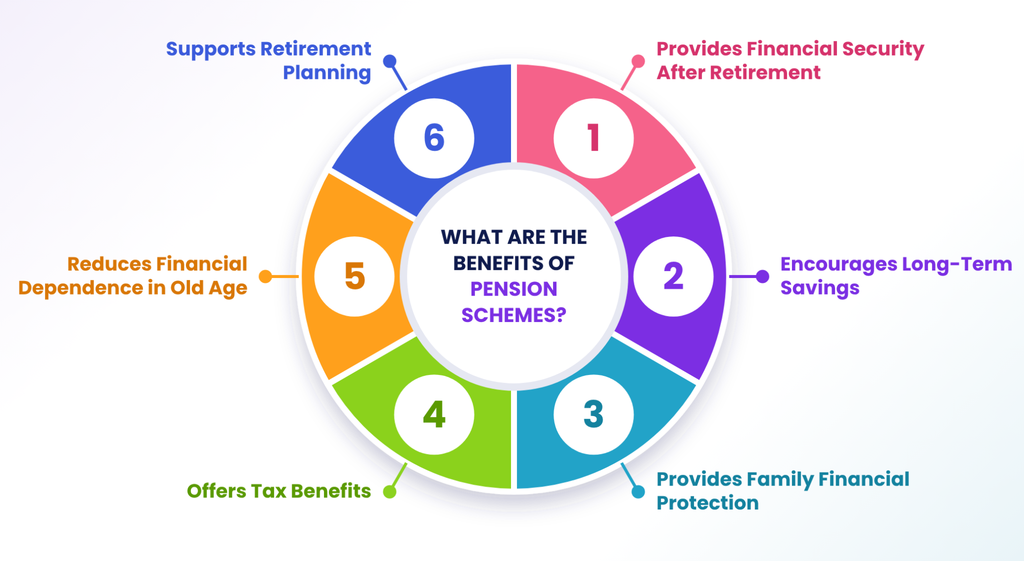
Some of their important benefits include:
1. Provides Financial Security After Retirement
One of the biggest benefits of pension schemes in India is that they help individuals to maintain a source of income after retirement.
Instead of depending entirely on personal savings or family support, eligible subscribers can receive regular pension payments or use their retirement corpus to generate income.
2. Encourages Long-Term Savings
Pension schemes encourage individuals to save regularly throughout their working years.
Small contributions made over a long period can help build a retirement corpus, depending on the contribution amount, investment performance and applicable scheme rules.
3. Provides Family Financial Protection
Several pension schemes offer benefits to eligible family members after the subscriber’s death.
For example, EPS provides widow or widower and children’s pension benefits under specified conditions. UPS also provides a family payout to an eligible spouse.
These benefits can help families maintain financial stability during difficult circumstances.
4. Offers Tax Benefits
Certain pension schemes provide tax deductions or exemptions under applicable income tax provisions.
For example, eligible NPS contributions may qualify for deductions under Section 80CCD, subject to the applicable tax regime and limits.
The exact tax benefits differ by scheme and should be checked before making investment decisions.
5. Reduces Financial Dependence in Old Age
Regular pension income can help retired individuals manage essential expenses such as housing, food, healthcare and daily living costs.
This can reduce their dependence on family members or other sources of financial support.
6. Supports Retirement Planning
Pension schemes encourage individuals to plan their finances before retirement.
By understanding contribution requirements, expected retirement benefits and withdrawal conditions, individuals can make better decisions about their long-term financial needs.
What Are the Responsibilities of Employers in Pension Management?
Employers, particularly those covered under the EPF framework or offering NPS as an employee benefit, have an important role in managing pension-related processes.
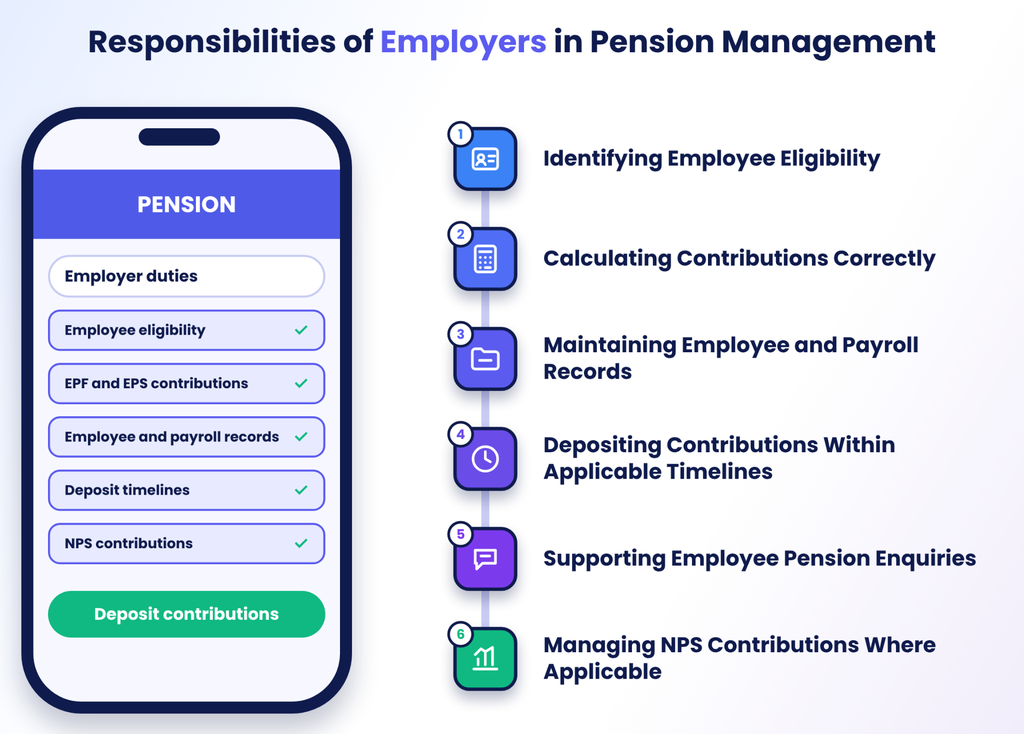
Their responsibilities include:
1. Identifying Employee Eligibility
HR and payroll teams should identify employees covered under applicable EPF and EPS provisions.
They should maintain accurate employee information, joining dates, salary details and membership records to determine the applicable statutory requirements.
2. Calculating Contributions Correctly
Employers must ensure that applicable EPF and EPS contributions are calculated using the correct wage components and prescribed contribution rates.
Incorrect wage calculations can result in contribution discrepancies and compliance issues.
3. Maintaining Employee and Payroll Records
Employers should maintain accurate records of:
- Employee basic salary and applicable wage components.
- EPF and EPS contributions.
- UAN and member information.
- Joining and exit dates.
- Pensionable service details.
- Relevant employee declarations and nominations.
These records help employees to access their retirement benefits and support accurate statutory reporting.
4. Depositing Contributions Within Applicable Timelines
Employers must deposit statutory contributions within the prescribed deadlines.
Delays or incorrect payments can result in interest, damages or other consequences under the applicable provisions.
5. Supporting Employee Pension Enquiries
Core HR teams should help employees to understand their pension-related information, including contribution records, eligibility requirements, nomination details and available withdrawal or claim procedures.
They should also direct employees to the relevant authorities for scheme-specific claims and clarifications.
6. Managing NPS Contributions Where Applicable
Employers offering Corporate NPS should manage employee enrolment, contribution deductions, employer contributions where applicable and timely remittance through the prescribed channels.
They should also communicate available investment and tax-related information without making unsupported promises about future returns.
How Can Payroll Software Help Manage Pension Contributions?
Managing pension-related processes manually can become difficult when an organization has a large workforce, multiple salary structures and different employee eligibility requirements.
Payroll software helps to simplify several activities by automating salary calculations, applicable deductions, contribution tracking and payroll reporting.
Some ways payroll software can support pension-related processes include:
- Automated contribution calculations: Helps calculate applicable EPF and EPS contributions using configured salary components and contribution rules.
- Salary and deduction management: Maintains employee-wise salary information and applicable statutory deductions during payroll processing.
- Employee record management: Stores employee information, joining dates, salary details and other relevant payroll records.
- Payroll reporting: Generates employee-wise contribution statements and payroll reports to support reconciliation.
- Compliance support: Helps HR and payroll teams to maintain consistent calculations and records for applicable statutory processes.
- Integration with HR activities: Connects employee information, attendance, leave and payroll data to reduce repetitive manual work.
For businesses managing multiple employees, an integrated HRMS and payroll solution can make routine payroll administration more organised and efficient.
However, software automation does not replace the employer’s responsibility to verify employee eligibility, follow applicable statutory notifications and ensure that contributions are deposited correctly.
Conclusion
Overall, Pension schemes in India play an important role in providing financial security after retirement. From employment-linked schemes such as EPS to market-linked retirement savings through NPS and government-backed arrangements such as UPS and APY, individuals have different options depending on their eligibility and financial requirements.
For employers, understanding these schemes is equally important because accurate employee records, contribution calculations, timely deposits and proper payroll management support pension-related compliance.
By understanding the different pension schemes and their requirements, employees can make better retirement decisions, while HR and payroll teams can manage employee benefits and statutory responsibilities more effectively.
Frequently Asked Questions
1. Which are the major pension schemes in India?
The major pension schemes in India include the Employees’ Pension Scheme (EPS), National Pension System (NPS), Unified Pension Scheme (UPS), Old Pension Scheme (OPS) and Atal Pension Yojana (APY). Each scheme has different eligibility, contribution and retirement benefit conditions.
2. Which pension scheme is available for private-sector employees?
Eligible private-sector employees working in establishments covered under the EPF framework can receive pension benefits under EPS. They may also subscribe to NPS through the Corporate Model or All Citizen Model, subject to applicable eligibility conditions.
3. What is the difference between EPF and EPS?
EPF is a provident fund scheme that helps employees accumulate retirement savings through employee and employer contributions. EPS is a pension scheme funded primarily through a portion of the employer’s EPF contribution and provides monthly pension benefits to eligible members.
4. How many years of service are required for an EPS pension?
An employee generally needs at least 10 years of eligible pensionable service to qualify for a monthly EPS pension. The employee can normally receive a superannuation pension at age 58, while early pension may be available from age 50 with applicable reductions.
5. Can a private-sector employee receive a pension after retirement?
Yes. Eligible private-sector employees may receive a monthly pension under EPS if they meet the applicable service and age conditions. They may also build additional retirement savings through NPS and other eligible pension arrangements.
6. Is NPS better than EPS?
NPS and EPS serve different purposes. EPS provides a pension based on eligible salary and service, while NPS builds a market-linked retirement corpus through contributions and investments. The suitability of each depends on employment status, eligibility, retirement goals and risk preferences.
7. Is UPS available to private-sector employees?
No. The Unified Pension Scheme is an option under NPS for eligible Central Government employees covered by the prescribed rules. It is not a general pension scheme available to private-sector employees.
8. What is the minimum pension under Atal Pension Yojana?
Atal Pension Yojana offers guaranteed minimum monthly pension options of ₹1,000, ₹2,000, ₹3,000, ₹4,000 and ₹5,000 after the subscriber reaches 60 years of age, subject to the scheme’s conditions.
9. Can an employee receive both EPF and EPS benefits?
Yes. Eligible employees can receive their accumulated EPF balance and an EPS pension separately, provided they meet the respective withdrawal and pension eligibility conditions. EPF is a provident fund benefit, whereas EPS provides pension benefits.
10. What happens to pension benefits if an employee changes jobs?
Changing jobs does not automatically cancel an employee’s accumulated retirement benefits. EPF membership and service records should be transferred or linked correctly through the applicable UAN and EPFO processes. Eligible EPS service is considered under the scheme’s rules when determining pension entitlement.